

You may be reading the Ramayana before a pilgrimage, standing beside a place associated with the epic, or trying to explain an extraordinary episode to someone who asks, “Did this happen here, or is it symbolic?” That question forces a choice the Ramayana rarely asks you to make.
A more faithful approach is to distinguish textual history, regional memory, and spiritual meaning, then examine how they work together. Once you do that, Hanuman’s command of the elements and Rishyasringa’s protected asceticism stop looking like unrelated wonders. They reveal a common architecture: disciplined power crosses a threshold, enters a landscape, and becomes service.
Key takeaways
- Sacred geography can operate simultaneously as narrative setting, regional memory, and field of practice. Keep those functions connected, but do not confuse their historical status.
- Elemental symbolism becomes useful when it explains a character’s conduct: how power is gathered, restrained, adapted, and directed toward a dharmic end.
- Tapas is not spiritual power accumulated for display. Its test is whether disciplined attention can be released for healing, social order, or protection.
- A later local tradition should be identified as later and local. That honesty protects both the textual record and the dignity of living pilgrimage traditions.
- When reading any extraordinary episode, ask three questions: What boundary is crossed? What capacity is transformed? Who finally benefits?
A sacred place holds three kinds of meaning at once
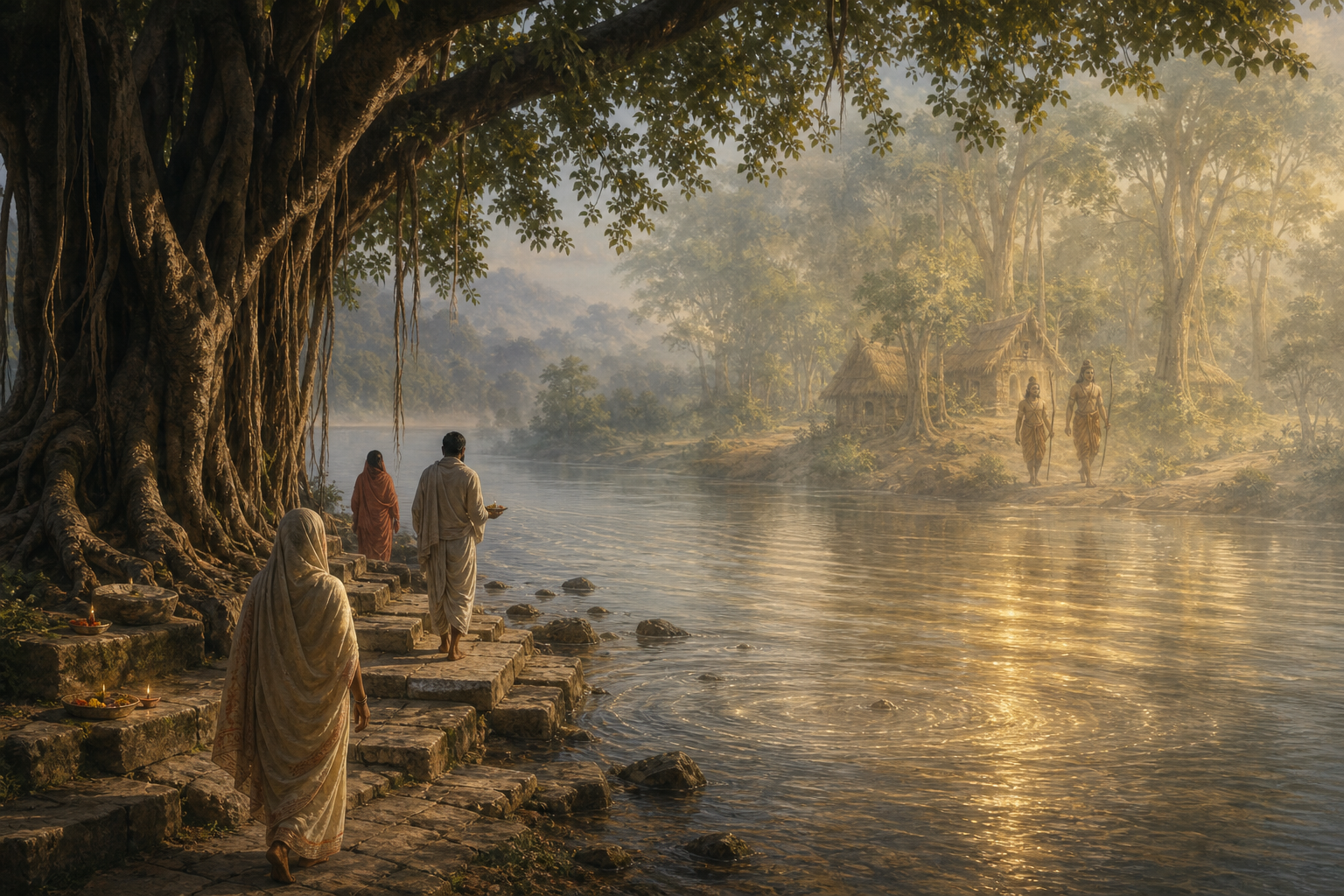
The Ramayana does not use landscape as painted scenery. Forest, ocean, sky, city, mountain, fire-ground, and lake place different demands on the people who enter them. A forest can separate an aspirant from ordinary sensory habits. Water can mark an uncertain passage. Open sky can test whether purpose survives exposure and distance. A city can turn private virtue into public responsibility.
You can read such a place in three registers:
- Narrative location: What happens there, to whom, and in which telling?
- Disciplinary function: What quality does the terrain demand – restraint, adaptability, courage, discernment, or stability?
- Sacred memory: How has a community attached the episode to a walkable landscape, pilgrimage circuit, shrine, lake, hill, or river?
These registers can support one another without becoming interchangeable. A regional association does not automatically prove that every detail belongs to the earliest textual layer. Conversely, a tradition does not become spiritually empty merely because its fullest local form appears in a later sthala-purana. Historical sequence answers one question; ritual and contemplative use answer others.
Kamban’s classical Tamil Ramayana shows why localization need not mean dilution. Its Tamil poetic world carries a pan-Indian story while making elemental imagery, devotion, and ethical action vivid within a particular language and cultural landscape. The result is not a carbon copy of another recension. It is a regional embodiment of a shared metaphysical grammar.
The opposite process appears around Kishkindha. The core Rishyasringa narrative belongs to the Bala Kanda: ascetic discipline, the drought in Anga, the sage’s arrival, his marriage to Shanta, and his role in Dasharatha’s Putrakameshti. A later regional memory places Vibhandaka’s gender-transforming lake in the Anegundi-Hampi and Tungabhadra landscape, near the wider circuit of Rishyamukha and Pampa Sarovara. The responsible reader preserves that distinction instead of either forcing every layer into one date or dismissing the local tradition as meaningless.
A useful vocabulary is core, extension, and function. Identify the core narrative. Mark the regional extension. Then ask what spiritual, ethical, or communal function the extended image performs. This keeps reverence from becoming carelessness and critical reading from becoming contempt.
Hanuman turns elemental symbolism into disciplined action

Calling Hanuman elemental does not mean assigning five decorative labels to five famous scenes. The stronger reading asks what each element enables him to do, what danger accompanies that capacity, and what discipline keeps the capacity aligned with Rama’s purpose.
The classical elemental correspondences sharpen your attention: akasha is associated with sound, vayu with touch, agni with form and sight, jala with taste, and bhoomi with smell and structure. In the Kamba Ramayanam’s elemental pattern, these are not inert substances. They are modes of perception, movement, transformation, cohesion, and stability.
| Element | Where to notice it | The discipline it reveals |
|---|---|---|
| Vayu, air | Hanuman’s lineage, movement, vigilance, and measured leap | Gather energy before acting. Speed becomes dharmic only when breath, attention, and purpose move together. |
| Jala, water | The ocean crossing and the tests associated with Surasa and Simhika | Adapt the response without abandoning the destination. Flexibility is not surrender. |
| Akasha, space | The aerial passage and Hanuman’s fidelity to Rama’s word | Create enough inner room to perceive clearly. A vow held without distortion can guide timely action. |
| Agni, fire | The burning of Lanka and the exposure of its disorder | Use intensity to reveal and transform adharma, not to indulge anger or glorify destruction. |
| Bhoomi, earth | Sita as the story’s moral ground and the herb-bearing mountain carried to restore life | Anchor strength in restraint, healing, and responsibility for consequences. |
Vayu makes the leap possible, but raw velocity is not the achievement. Hanuman expands or contracts his action according to the task. That control of scale matters. Spiritual power is not proved by remaining maximally forceful; it is proved by becoming exactly as forceful, subtle, visible, or hidden as dharma requires.
Jala supplies the clearest test of adaptability. The sea cannot be crossed by forgetting the destination, yet not every obstacle yields to one fixed response. Surasa’s test and Simhika’s shadow-snare can be read as different disturbances of attention. One asks for responsive intelligence; the other reveals how a mission can be seized through what trails behind the aspirant. The practical question is not merely, “How strong is Hanuman?” It is, “How quickly does he recognize what kind of obstacle he is facing?”
Akasha prevents purpose from contracting around the obstacle. Space is also the field of sound, so Rama’s instruction is more than remembered information. It becomes an interior orientation. This is why mantra, vow, and faithful listening belong to the symbolism of the crossing: clear action begins with a word received accurately and carried without self-serving alteration.
Agni requires the most care from a modern reader. Lanka’s burning is not a general license to make destruction sacred. Fire has a discriminating and revelatory function within the episode: hidden disorder becomes visible, and accumulated adharma encounters consequence. If an interpretation celebrates flame while ignoring purpose, restraint, and responsibility, it has detached agni from dharma.
Bhoomi brings the reading back to what must be protected. Sita, daughter of the earth, occupies the moral center of the mission. The mountain of medicines directs immense strength toward the restoration of life. Earth therefore answers the question that fire leaves open: after power has exposed disorder, what will hold, nourish, and heal?
Familiar iconography of Hanuman opening his chest to reveal Rama and Sita adds another contemplative layer. Vayu is associated with the heart center, anahata, but the image does not glorify private emotion. It locates loyalty, courage, and service inside the heart’s spaciousness. Devotion is the organizing principle that prevents elemental ability from scattering into five unrelated powers.
Try a five-minute reading exercise with any Hanuman episode. Name the dominant element. Identify the sensory or behavioral clue. State the danger of excess: speed becoming impulse, flexibility becoming drift, spaciousness becoming vagueness, fire becoming rage, or stability becoming inertia. Then identify the dharmic end that corrects the excess. This is far more useful than treating symbolism as a secret code in which every object has one permanent meaning.
Rishyasringa shows what ascetic power is for
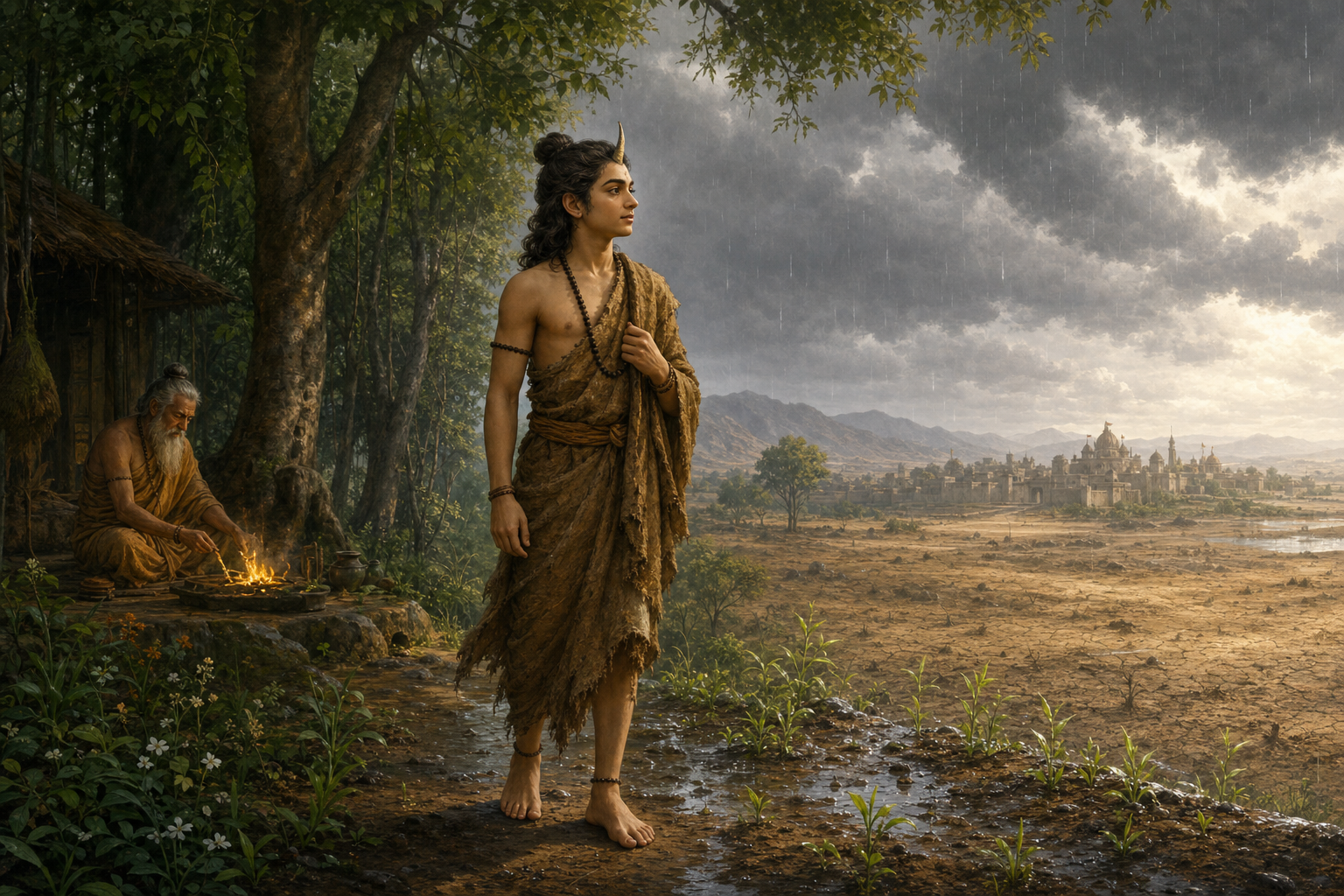
Hanuman carries disciplined power across space. Rishyasringa’s story begins by keeping power inside a boundary. His father Vibhandaka creates a controlled forest environment in which the young ascetic learns mantra, agnihotra, celibacy, and sensory restraint without the ordinary cues of courtship and urban life. The aim is concentrated tapas.
The later legend of a lake that changes the sex of anyone entering its waters intensifies the same boundary logic. Read soberly, the transformation is not an empirical claim about an ordinary body of water, nor is it best understood as punishment. It dramatizes paravartana, a reversal at the threshold. Anyone approaching the protected field encounters a destabilization of the identity and desire that motivated the approach.
This distinction matters because the episode can otherwise be reduced to a warning against women. That is too crude. The real volatility belongs to ungoverned desire and attention around a vow that has not yet completed its formation. Women are not being defined as impure. A difficult discipline is being enclosed until its energy can survive contact with a wider world.
The whole arc moves through six stages:
- Enclosure: Vibhandaka establishes a protected sensory ecology around Rishyasringa.
- Concentration: Brahmacharya, mantra, ritual, and austerity gather attention into tapas and tejas.
- Public crisis: Anga suffers drought, and private ascetic potency becomes relevant to a suffering polity.
- Threshold crossing: Rishyasringa is brought from forest seclusion into the kingdom; rain accompanies his entry in the celebrated narrative sequence.
- Integration: He marries Shanta, showing that disciplined celibacy can prepare a person for responsible household life rather than require permanent hostility to society.
- Generative service: He officiates at Dasharatha’s Putrakameshti, and the ritual sequence leads toward the births of Rama, Bharata, Lakshmana, and Shatrughna.
This progression supplies a practical test for claims about tapas. Ask whether the austerity has a boundary, a purpose, an ethical restraint, and a path back into service. Intensity without such a path can become spiritual possession: power is guarded because it is gratifying to possess, not because it is ripening for a dharmic task.
Rishyasringa’s name, “deer-horned,” reinforces his liminal character. He stands between animal-marked forest otherness and royal ritual authority, between celibate formation and marriage, and between private austerity and public fertility. The movement is not from a bad forest to a good city. Each realm supplies something the other lacks. The forest concentrates; the polity distributes. The sage guards meaning; the king organizes common life.
The same pattern helps explain why ascetic discipline resonates across Dharmic traditions without making their doctrines identical. Buddhist vinaya trains attention through brahmacharya. Jain vrata joins restraint to non-violence. Sikh discipline honors self-mastery within responsible grihastha life. The shared civilizational insight is modest but important: freedom begins by governing appetite, and restraint reaches completion when it supports compassionate responsibility.
Use three passes to read any Ramayana landscape
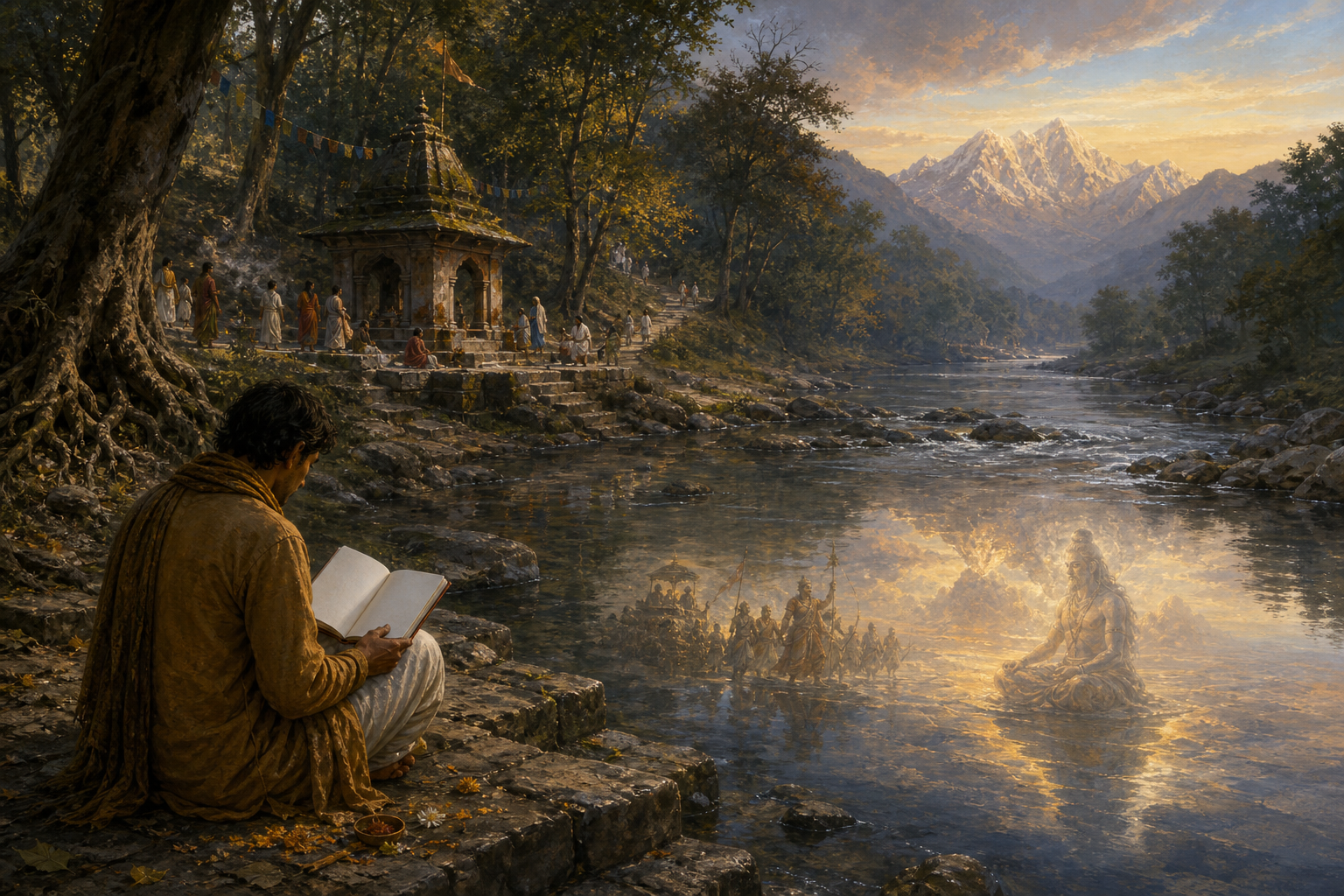
Pass one: establish the textual layer
Before interpreting a location, write one sentence about provenance. Name the recension or tradition when you know it. Distinguish the early narrative core from a later Purana, sthala-purana, oral memory, temple tradition, or modern identification. If you do not know the layer, say that plainly rather than silently upgrading a local association into a universal textual claim.
For Rishyasringa, a careful sentence would be: “The Bala Kanda carries the drought, the sage’s arrival, Shanta’s marriage, and the Putrakameshti; later Karnataka traditions add the gender-transforming lake near the Kishkindha landscape.” That sentence neither ridicules the regional memory nor mislabels it.
Use three simple labels in your notes:
- Textually anchored: the episode is present in the named textual layer.
- Regionally remembered: a community associates the episode or an expanded variant with a place.
- Interpretively proposed: a symbolic meaning helps illuminate the episode but should not be passed off as the only authorized decoding.
Pass two: observe what the terrain makes possible
Do not begin by asking what a river, mountain, forest, or flame “always symbolizes.” Begin with the action. Who enters? What changes at the boundary? Which ordinary strategy stops working? What new capacity becomes necessary?
- At water, look for crossing, yielding, cohesion, reflection, or loss of control.
- In a forest, look for withdrawal from social cues, protection of a vow, or confrontation with untrained desire.
- In open sky, look for exposure, expanded perception, distance, sound, and fidelity to an instruction.
- At fire, look for sacrifice, illumination, purification, transformation, and the danger of undisciplined intensity.
- At earth or mountain, look for moral grounding, medicine, endurance, stewardship, and the consequences that remain after dramatic action ends.
These are prompts, not a rigid dictionary. Water does not have to mean the same thing in every episode. The interpretation must explain the actual sequence better than a generic spiritual slogan would.
Pass three: follow power into service
Every claim about spiritual power should survive three further questions: Where did the power come from? What prevents its misuse? Who receives its fruit?
Hanuman’s strength comes through elemental and devotional integration; restraint keeps it obedient to Rama’s mission; Sita, the wounded army, and the restoration of dharma receive its fruit. Rishyasringa’s efficacy comes through protected austerity; vow and ritual order shape it; a drought-stricken kingdom and Dasharatha’s royal household receive its fruit.
This test exposes weak interpretations quickly. Power without restraint becomes spectacle. Restraint without service becomes hoarding. Service without attention to textual and ritual form becomes a moral slogan that could have been attached to any story. A sound interpretation needs all three.
Take this method into your next reading or pilgrimage
You do not need specialist training to read more carefully. Use this sequence with one episode or one sacred site at a time:
- Name the telling. Record whether you are reading Valmiki, Kamban, a later regional narration, or a local sacred memory.
- Locate the threshold. Mark the moment someone enters a forest, crosses water, rises into sky, passes a boundary, encounters fire, or returns to earth.
- Name the capacity being tested. Choose a precise term such as attention, adaptability, courage, sensory restraint, discernment, or steadiness.
- Find the governing restraint. Ask what prevents the capacity from becoming appetite, pride, violence, avoidance, or display.
- Identify the beneficiary. Look beyond the ascetic or hero. Note whose life, community, polity, or dharmic order is restored.
- Carry one pattern into practice. Before a demanding task, settle your attention, state the purpose, adapt the method without abandoning the aim, and decide in advance whom the completed work should serve.
For a temporary vrata or period of concentrated work, Rishyasringa’s pattern adds two useful safeguards: define the boundary before beginning, and define the return before withdrawing. Decide what you will limit, how long the limit serves its purpose, and how the resulting clarity will re-enter family, community, or seva. A boundary with no return can quietly become avoidance.
At Pampa Sarovara, Rishyamukha, the Tungabhadra, or another landscape held within Ramayana memory, resist the urge to settle every question with one label. State the tradition accurately. Observe what the terrain asks of the body and attention. Then ask what kind of person the episode calls you to become after you leave. That final movement – from sacred place back to dharmic action – is where the geography begins to do its deepest work.
References
- DharmaRenaissance Blog – Hanuman and the Five Elements in Kamba Ramayanam: Transformative Symbolism and Yogic Science
- DharmaRenaissance Blog – Rishyasringa and Vibhandaka’s Enchanted Lake: How Ascetic Power Shaped Destiny in the Ramayana
