

If you saw claims that a Guru Purnima programme in Bantwal was called “anti-national,” the first question is whether any authority actually reached that conclusion. The answer, on the information presently available, is no. No police finding, charge, or court ruling has been identified.
What has been reported is much narrower: an SDPI leader identified as Ashraf reportedly approached Bantwal Police Station, sought action against the organisers of a Hindu Janajagruti Samiti event, and characterized that event as anti-national. That is a serious allegation, but it remains an allegation. If you want to defend Guru Purnima effectively, preserve that distinction.
What is known, what is disputed, and what is still missing

The controversy has three established elements. First, Ashraf reportedly submitted a complaint seeking police action. Second, supporters of the Hindu Janajagruti Samiti rejected his characterization as unfounded and politically motivated. Third, Hindus in Bantwal and nearby areas gathered in protest, arguing that the allegation insulted a sacred observance centred on gurus, teachers, and spiritual guides.
Those facts do not establish what unlawful or hostile conduct, if any, was alleged to have occurred during the programme. The publicly described dispute does not supply the complete complaint, a case number, an official police assessment, a charge, or a judicial finding. It therefore cannot support the claim that the police themselves declared Guru Purnima anti-national.
This difference should govern the language you use. Say that a complaint was reportedly filed; do not say that the organisers were charged unless an official record confirms it. Say that Ashraf characterized the event as anti-national; do not transfer his words to the police. A police station can receive or examine a complaint without endorsing the complainant’s conclusion.
The same discipline applies to supporters of the event. Their rejection of the allegation is an important part of the dispute, but it is not a substitute for obtaining the complaint, identifying the conduct at issue, and checking the official status. Precision protects the organisers from exaggeration while protecting the public from rumours.
The “anti-national” label needs evidence, not political force
“Anti-national” is not a neutral description. It suggests hostility to the country and can make an ordinary disagreement sound like a threat to public order. Anyone applying that label to a religious gathering should therefore identify the particular speech, act, publication, or instruction that supposedly justifies it.
A useful test is to ask five direct questions:
- What exact act or statement is being challenged?
- Who was responsible for it: an organiser, a speaker, an attendee, or somebody outside the event?
- What complete, first-hand record supports the allegation?
- Does the objection concern specific conduct, or is the religious observance itself being treated as suspect?
- What have the police actually done, as distinct from what the complainant requested?
If those questions have no clear answers, the label has not carried its burden. Repetition, party affiliation, and outrage cannot fill an evidentiary gap. Nor should the controversy be decided through guilt by association. Whatever view you hold of the SDPI or the Hindu Janajagruti Samiti, the allegation must stand or fall on the conduct and evidence connected to this particular programme.
This standard is not a concession to those attacking a Hindu festival. It is the strongest defence against arbitrary stigmatization. It requires authorities to examine actual conduct instead of treating identity, affiliation, or devotional practice as proof of wrongdoing. It also prevents a careless response from turning a local dispute into indiscriminate communal hostility.
Guru Purnima must be understood before it is judged

Guru Purnima is a centuries-old Hindu observance of gratitude toward gurus and teachers. Its religious centre is the guru–shishya relationship: knowledge is received with humility, preserved through disciplined learning, and passed to the next generation. Devotees also honour saints and spiritual guides who help them distinguish dharma from adharma.
That meaning matters because a sacred festival cannot reasonably become anti-national merely through an opponent’s choice of words. Respect for teachers, gratitude for knowledge, and spiritual self-discipline are not evidence of hostility to Bharat. The person making such an accusation must point beyond the festival’s Hindu identity to some definite act.
There is an equally important boundary. Calling a programme “Guru Purnima” does not place every statement made there beyond scrutiny. If a speaker is accused of misconduct, that allegation can be examined on its merits. But scrutiny of a particular statement is not the same as condemning Guru Purnima, all participants, or Hindu religious life. Keep the festival, the particular programme, the organisers, individual speakers, and attendees analytically separate.
This is where the Bantwal response can either clarify the issue or deepen it. A disciplined defence says: identify the alleged conduct, produce the evidence, and let the police assess it impartially. An undisciplined response answers one sweeping accusation with another. The first approach protects Dharma and civic order; the second lets the original label dictate the terms of the argument.
How organisers and devotees can respond without losing the facts
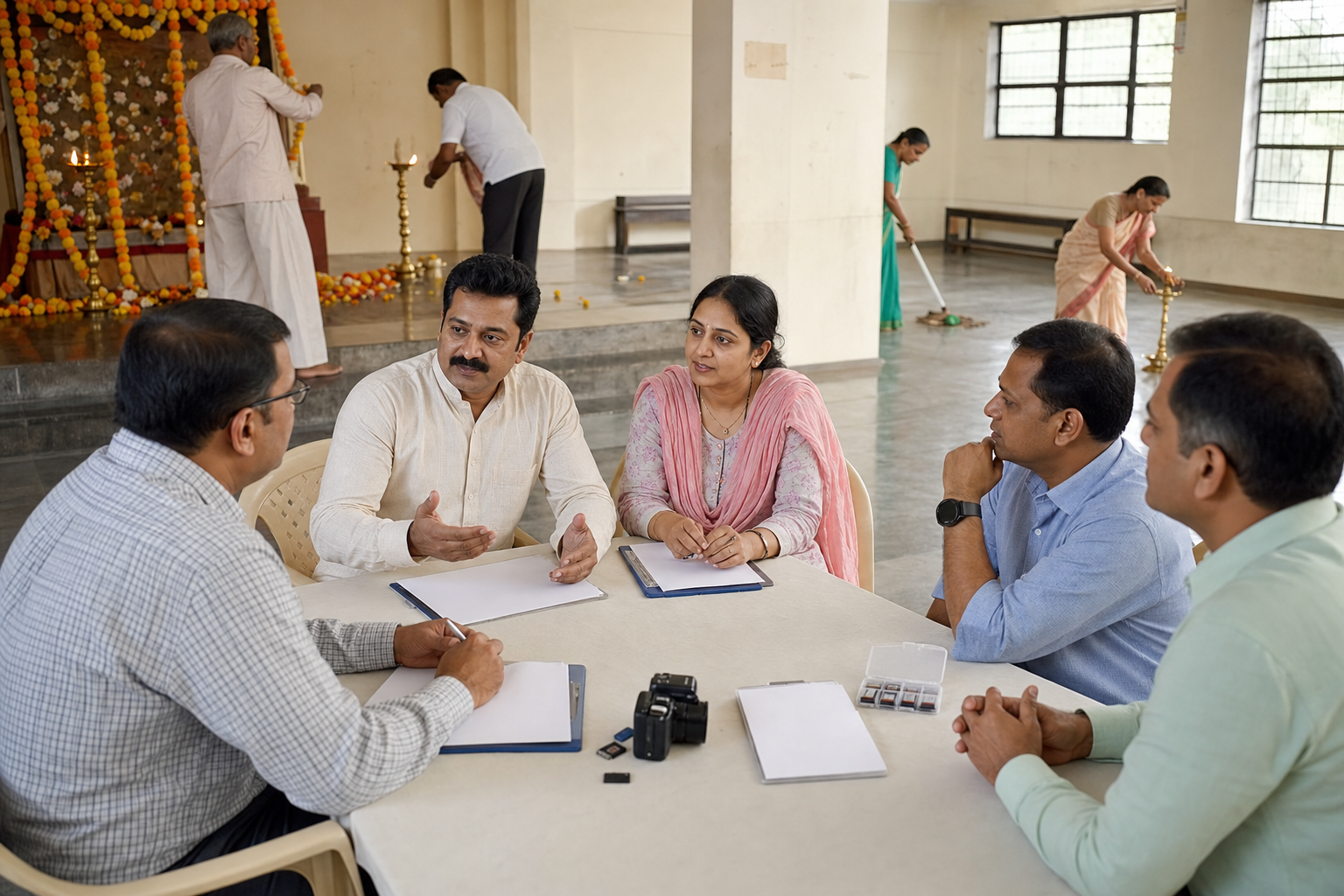
If you are an organiser, participant, or local community representative, the practical task is to build a reliable record before the controversy hardens into competing rumours.
- Preserve the original invitation, programme schedule, speaker list, speeches, notices, correspondence, photographs, and unedited recordings. Do not rely on clipped social-media videos when complete material exists.
- Obtain the exact complaint and any official acknowledgement if they are legally available. Record dates and document numbers rather than reconstructing the sequence from posts and forwarded messages.
- Ask the complainant’s side to identify the precise words or actions it considers objectionable. A request for specificity is more effective than debating a vague label.
- Use one spokesperson or one verified written statement. State the spiritual purpose of Guru Purnima, the known procedural status, and the organisers’ willingness to cooperate with an impartial examination.
- Keep demonstrations peaceful and demands concrete: objective inquiry, accurate public language, equal treatment, and correction of unsupported claims. Do not publish private information, circulate threats, or blame an entire religious community for one political actor’s allegation.
- If police issue a notice or seek statements, obtain advice from a qualified local advocate. Do not ignore official communication, guess at legal consequences, or treat social-media commentary as legal guidance.
Supporters have already called for an objective inquiry and impartial policing. That is the right institutional demand. Police should be free to examine a concrete complaint, but neither officials nor the public should prejudge a religious gathering through an inflammatory label unsupported by disclosed evidence.
The goal is not passivity. It is accountable advocacy. A dated document, a complete recording, and an accurately worded request are harder to dismiss than a hundred angry forwards. They also make it easier to correct false claims without creating new ones.
Key takeaways for readers sharing the Bantwal story
- An SDPI leader reportedly complained about the Hindu Janajagruti Samiti’s Guru Purnima programme; that complaint is not itself a police finding.
- No disclosed evidence presently establishes that Guru Purnima, as a religious observance, is anti-national.
- Any serious allegation must identify the exact conduct, the responsible person, the supporting record, and the official procedural status.
- Guru Purnima honours gurus, teachers, knowledge, humility, and the guru–shishya tradition; its Hindu identity is not evidence of wrongdoing.
- The most effective response is peaceful, evidence-led, legally careful, and directed at the allegation rather than an entire community.
If you share the story, use wording that neither weakens the Hindu response nor outruns the facts: “An SDPI leader reportedly sought police action against an HJS Guru Purnima event in Bantwal and characterized it as anti-national; supporters dispute the allegation, and the available account establishes no police finding to that effect.” Then ask for the complaint, the evidence, and the official status. That is how you defend a sacred tradition without allowing an accusation to become a fact through repetition.
References
