
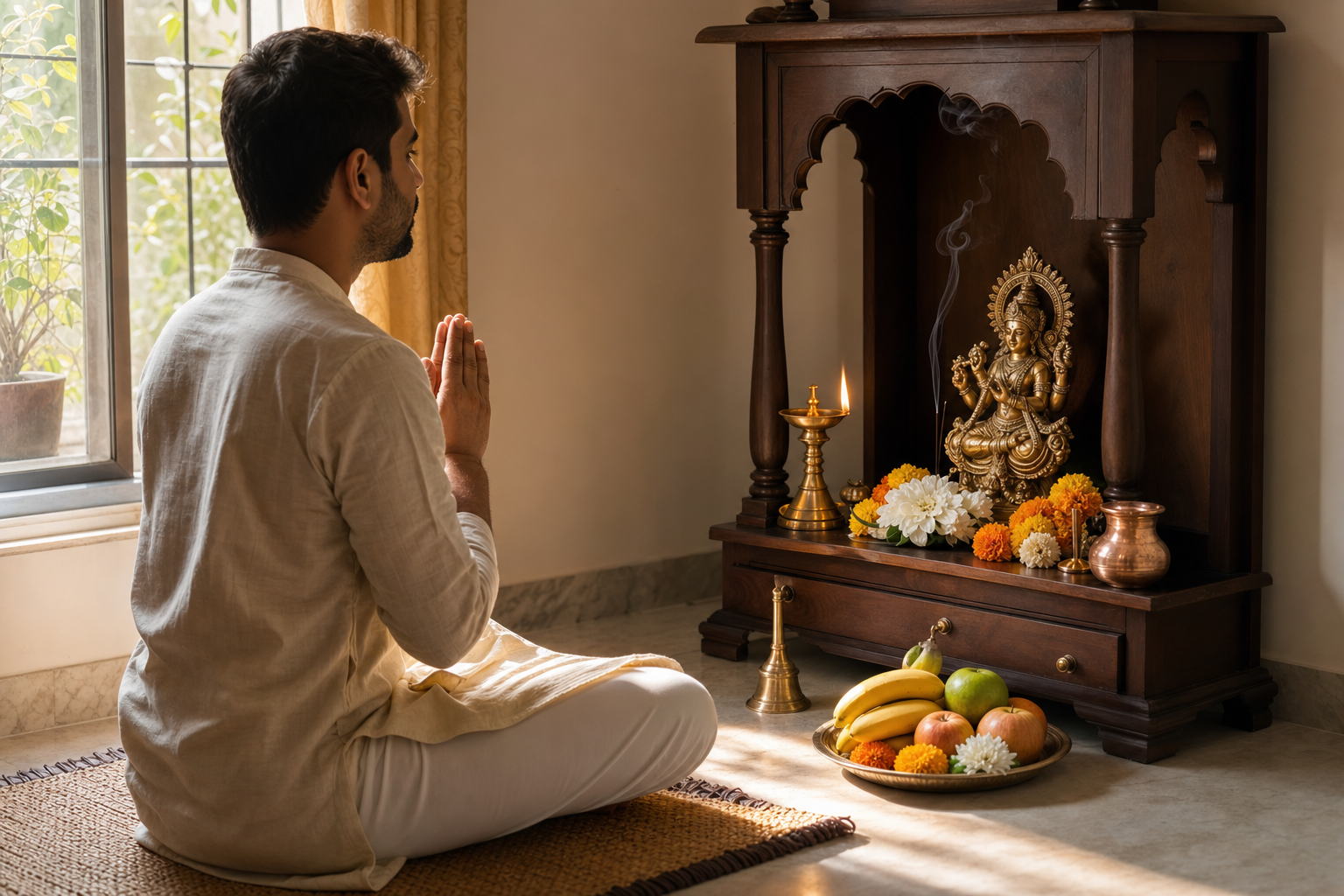
Perhaps you bow before a murti each morning yet struggle to explain why. Or perhaps puja has begun to feel mechanical, and you wonder whether a more inward spirituality would be more authentic. Both problems arise from the same assumption: that physical practice and spiritual insight belong on opposite sides of a line.
Hindu Dharma does not require you to leave the body behind before approaching the sacred. Puja trains the body, speech, senses, attention, and conduct to move in one direction. Once you see that structure, ritual stops looking like decoration around belief. It becomes one of the ways belief enters your hands, habits, relationships, and daily duties.
Your body is not waiting outside the spiritual life
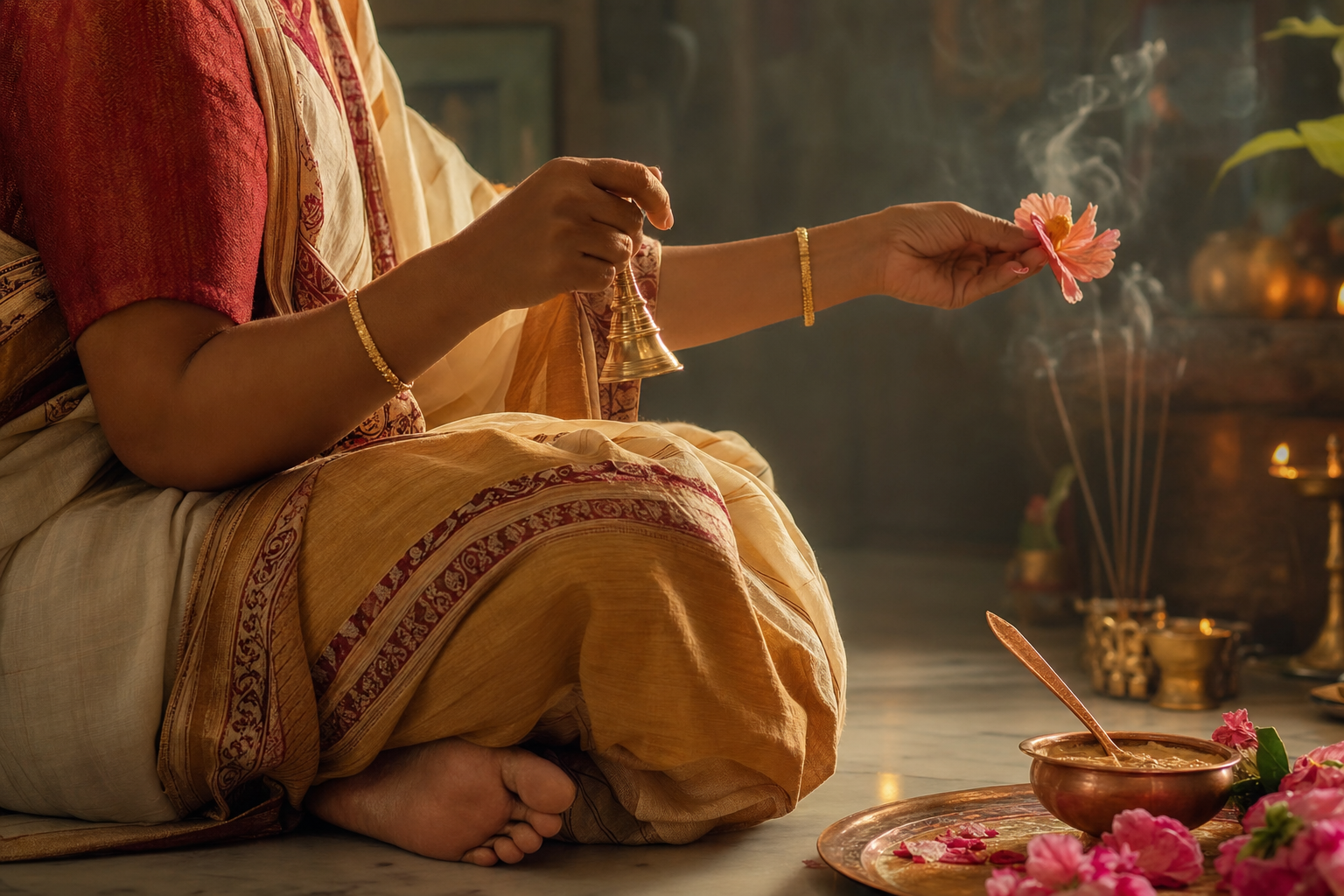
Consider what happens in even a simple puja. You clean the place and yourself. You stand or sit deliberately. Your hands join in namaskara. Your voice pronounces a divine name. Your eyes rest on a sacred form. You offer something, bow, and receive prasada. The practice engages posture, movement, sound, sight, touch, and sometimes fragrance and taste.
These acts give attention a sequence. That matters because attention rarely becomes steady merely because you command it to be steady. The body needs something definite to do. The voice needs words worth repeating. The senses need a shared centre. Ritual gathers faculties that ordinarily pull you in different directions.
This does not mean every repeated action is automatically sacred. A distracted puja can become habit without presence, just as scriptural reading can become information without understanding. Repetition is a vessel. What fills it is awareness, intention, devotion, and the quality of life that follows.
You can test your own practice through three connected questions. What is the body doing? Where is the attention resting? What disposition is the act cultivating? When you offer water, for example, the external act is simple. Its inner movement may be hospitality, gratitude, surrender, or recognition that what you possess was never entirely yours. Its ethical consequence should be greater care in the way you receive and serve others.
That is sacred embodiment: not treating the body as divine merely because it has impulses, and not treating it as an obstacle merely because it is material. The body becomes disciplined participation in dharma.
A vigraha is encountered, not merely inspected
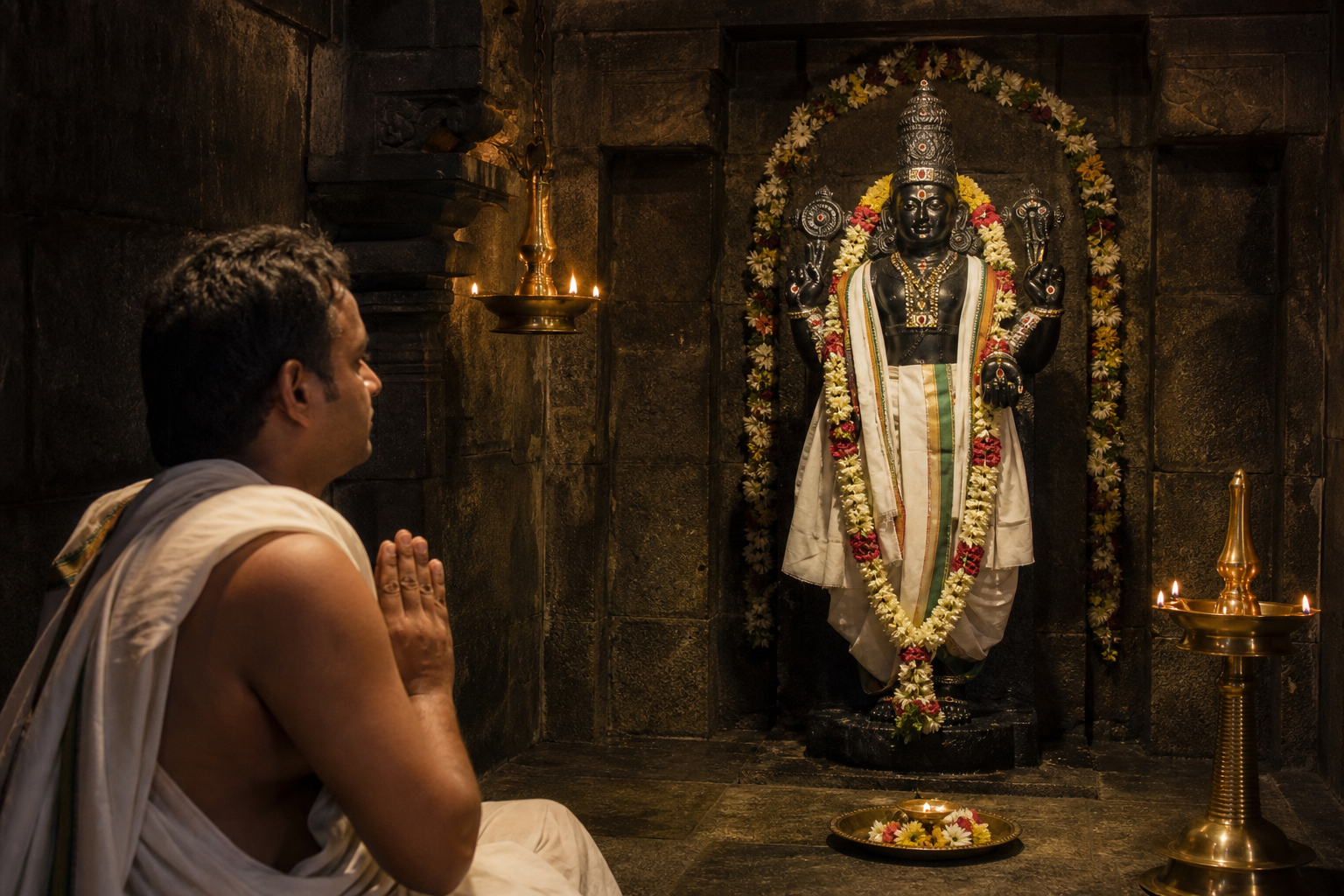
The familiar objection that a murti is only stone confuses material composition with complete identity. A stone beside a road and a stone vigraha may share a material, but they do not share form, relationship, ritual history, or sacred function. Hindu worship does not depend on pretending that matter has disappeared. It rests on the more fundamental claim that matter can bear sacred meaning and, in many traditions, divine presence.
This distinction becomes especially important in a temple. A vigraha is installed for worship through prescribed rites in which priests perform puja and recite divine names and mantras, thereby setting the sacred form apart from an ordinary object. Consecration is not cosmetic decoration added to a statue. It establishes a particular relationship among the deity, the form, the temple tradition, and the worshipping community.
Hindu traditions do not all explain that relationship in identical philosophical language. A Vaishnava, Shaiva, Shakta, Agamic, or Advaita Vedanta practitioner may place different emphasis on divine descent, presence, manifestation, symbol, consciousness, or devotional concentration. You do not need to erase those differences to defend vigraha puja. The shared point is narrower and stronger: the sacred form is not approached as an interchangeable lump of material.
If someone asks why you worship stone, a clear answer is better than either embarrassment or aggression: you are not worshipping a geological category. You are approaching Bhagavan through a form received, named, installed, and served within a living tradition. A person who rejects the possibility of sacred presence in matter may still disagree, but the disagreement is then honest. It concerns the nature of reality, not a caricature of Hindu practice.
Darshan also changes the posture of seeing. In ordinary inspection, you stand outside an object and evaluate it. In darshan, you come to behold the deity and to place yourself before the deity’s gaze. The encounter asks something of you. Remove footwear where required, respect rules about touching and photography, do not interrupt temple service for a better view, and receive the moment as worship rather than visual consumption.
A sacred form may bring peace, reassurance, courage, or renewed devotion; devotees often experience vigraha worship in precisely this personal way. Yet emotional relief is a fruit of the relationship, not its definition. If you reduce the murti to a tool for changing your mood, you have replaced worship with self-management. If you reduce it to a machine for obtaining favours, you have replaced relationship with transaction.
Fire altar, sacred story, and inner inquiry belong together
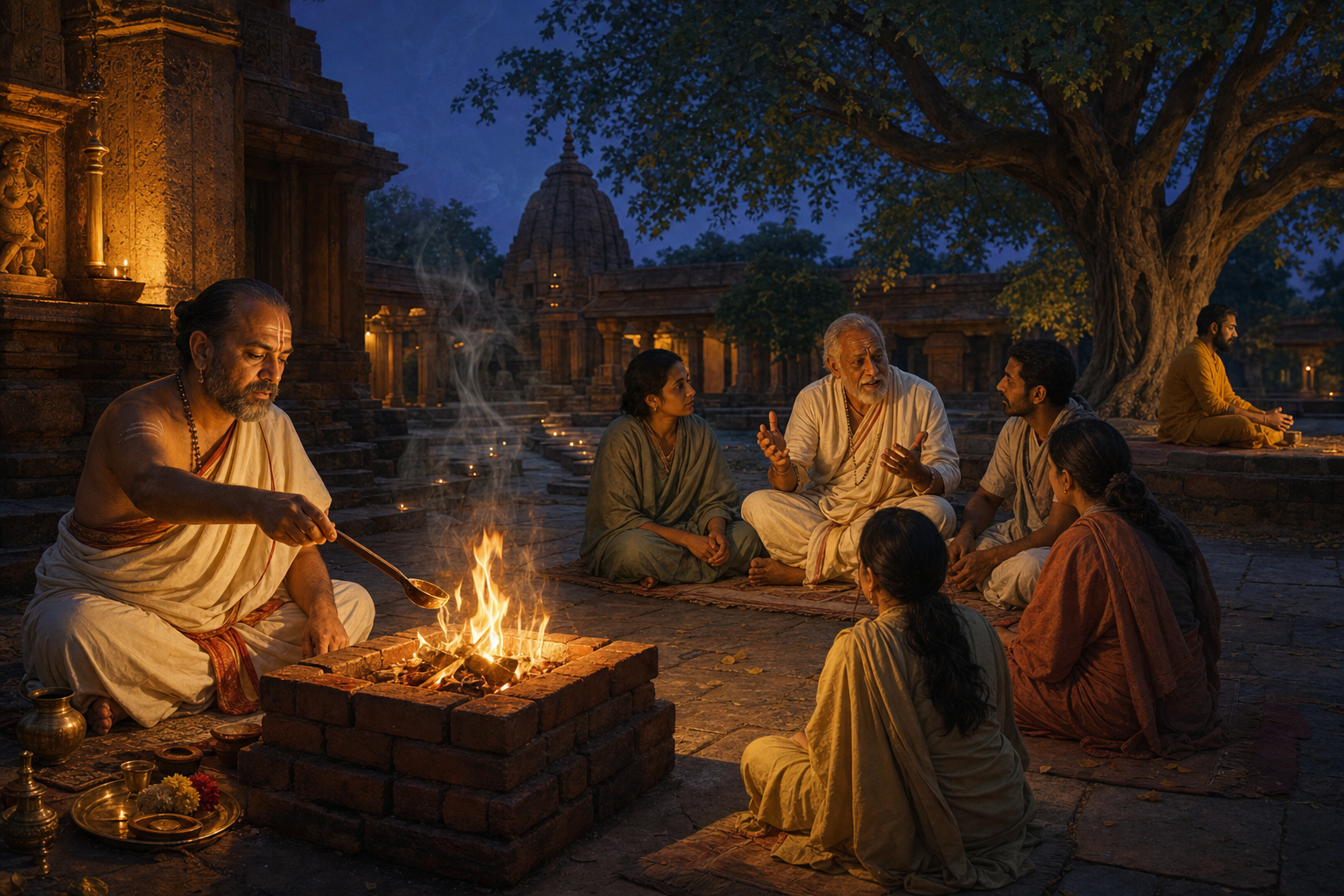
Hindu practice is sometimes forced into a misleading historical ladder: first primitive ritual, then imaginative mythology, and finally sophisticated philosophy. That model cannot explain why Vedic yajna, sacred narrative, and Upanishadic reflection could flourish together as mutually sustaining forms.
Yajna gives sacred intention an action. Something is prepared, offered, transformed through Agni, and relinquished. Sacred story gives the action memory, character, consequence, and a world of meaning. Upanishadic inquiry presses beneath both: Who is the doer? What is truly being offered? What is the self that seeks lasting fulfilment? These modes need not deliver one uniform doctrine to belong to the same civilisational conversation.
This threefold structure gives you a practical way to repair an unbalanced spiritual life. If puja feels mechanical, do not immediately discard it. Learn or revisit the katha associated with the deity, festival, vrata, or offering so that the gesture regains its narrative meaning. If reading has become abstract, place a simple act of reverence beside it: light a lamp safely, offer a flower, or begin with namaskara. If devotion is intense but unexamined, ask what desire the practice is feeding and what idea of the self lies beneath it.
Ritual keeps reflection from floating above daily life. Reflection keeps ritual from collapsing into anxious rule-following. Story keeps both connected to recognisable choices, loyalties, failures, sacrifices, and transformations. You do not have to choose among action, devotion, and knowledge before you begin. In much of Hindu Dharma, their disciplined conversation is the path.
Build a home practice that can survive an ordinary day
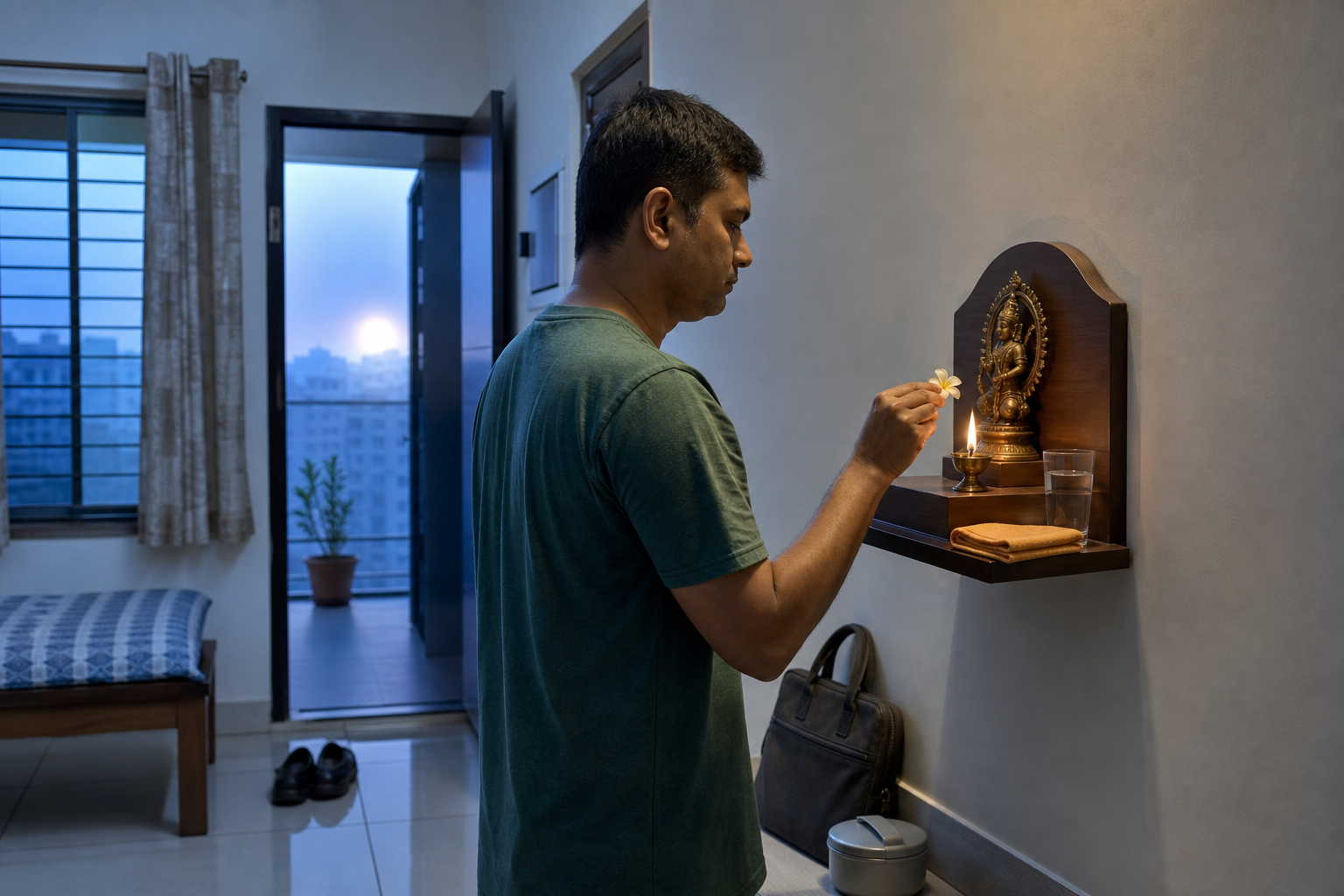
A durable home puja should be small enough to perform attentively and rooted enough that you know why you are performing it. Complexity is not depth. A long procedure copied from several unrelated traditions can create confusion, while a few actions received from your family, temple, guru, or sampradaya can carry a coherent theology.
A simple sequence for embodied worship
- Mark the boundary. Use a clean, designated place. Wash your hands and prepare yourself according to your household tradition. Silence the device that is most likely to divide your attention.
- Approach a known form. Begin with your family deity, ishta devata, or a form already established in your devotional life. Constantly changing deities in search of a stronger feeling makes relationship difficult to cultivate.
- Prepare only suitable offerings. Water, flowers, a lamp, incense, or food may be appropriate, depending on the deity and tradition. Follow the rules you have received. Never leave a flame unattended, and omit fire or smoke where the setting makes them unsafe.
- Begin with remembrance and namaskara. Use the mantra, stotra, or divine name taught in your tradition. Some mantras belong to initiated disciplines; do not assemble private or bija mantras from fragments encountered online.
- Offer without rushing. Make each movement separately enough to know what you are doing. The point is not to display ritual competence but to bring body, speech, and attention into the offering.
- Remain for darshan. After speaking and moving, leave room for stillness. Look without analysing the artistic object or demanding a particular emotion.
- Carry the worship into conduct. Bow, receive or distribute prasada as appropriate, and name one duty that should bear the mark of the puja: truthful speech, ahimsa in a tense encounter, gratitude, generosity, or the repair of a neglected obligation.
A household image and a temple vigraha do not automatically have the same ritual status. Do not imitate a temple installation or elaborate priestly rite merely from written instructions. If you want to establish a formal practice at home, ask a trusted priest or teacher from the relevant tradition what is appropriate for that deity, image, and household.
Correct the failure mode you actually have
If your practice is inconsistent because it is too elaborate, reduce the number of actions before reducing your attentiveness. If it feels lifeless, recover the meaning of one gesture rather than adding more objects. If you become preoccupied with whether a harmless mistake has offended the deity, return to a competent teacher instead of feeding fear with more improvised rules. If every puja is dominated by requests, include worship in which you ask for nothing.
Do not use emotional intensity as the sole measure of success. Some days devotion is vivid; on others, abhyasa means showing up with steadiness. A better audit happens after worship. Is your speech less careless? Are you more honest about duty? Can you give without immediately calculating return? Do you remember the sacred presence when dealing with a person who cannot benefit you? Ritual has begun to form you when reverence survives beyond the altar.
Key takeaways
- Sacred embodiment means that posture, movement, voice, sight, touch, and attention can participate in spiritual discipline.
- A consecrated vigraha is not interchangeable with an ordinary object, even when both share the same physical material.
- Hindu schools may explain divine presence differently without reducing vigraha puja to the worship of inert matter.
- Yajna, sacred story, and Upanishadic inquiry are complementary modes of action, meaning, and reflection, not stages that must cancel one another.
- A short practice rooted in a family or sampradaya tradition is usually more coherent than an elaborate mixture assembled without guidance.
- The strongest test of ritual is not spectacle or intense feeling but the attention and dharmic conduct it carries into the rest of your day.
At your next puja, change only one thing: perform one familiar gesture slowly enough to name its meaning, pause for darshan, and choose one duty through which the offering will continue. Sacred embodiment becomes intelligible when reverence does not end with the lamp, but enters the way you inhabit the day.
References
- Hindu Blog — Why Vedic Yajnas, Stories, and Upanishads Flourished Together – From Fire Altar to Forest Thought
- Hindu Post — Vigraha Puja in Hindu Dharma
