
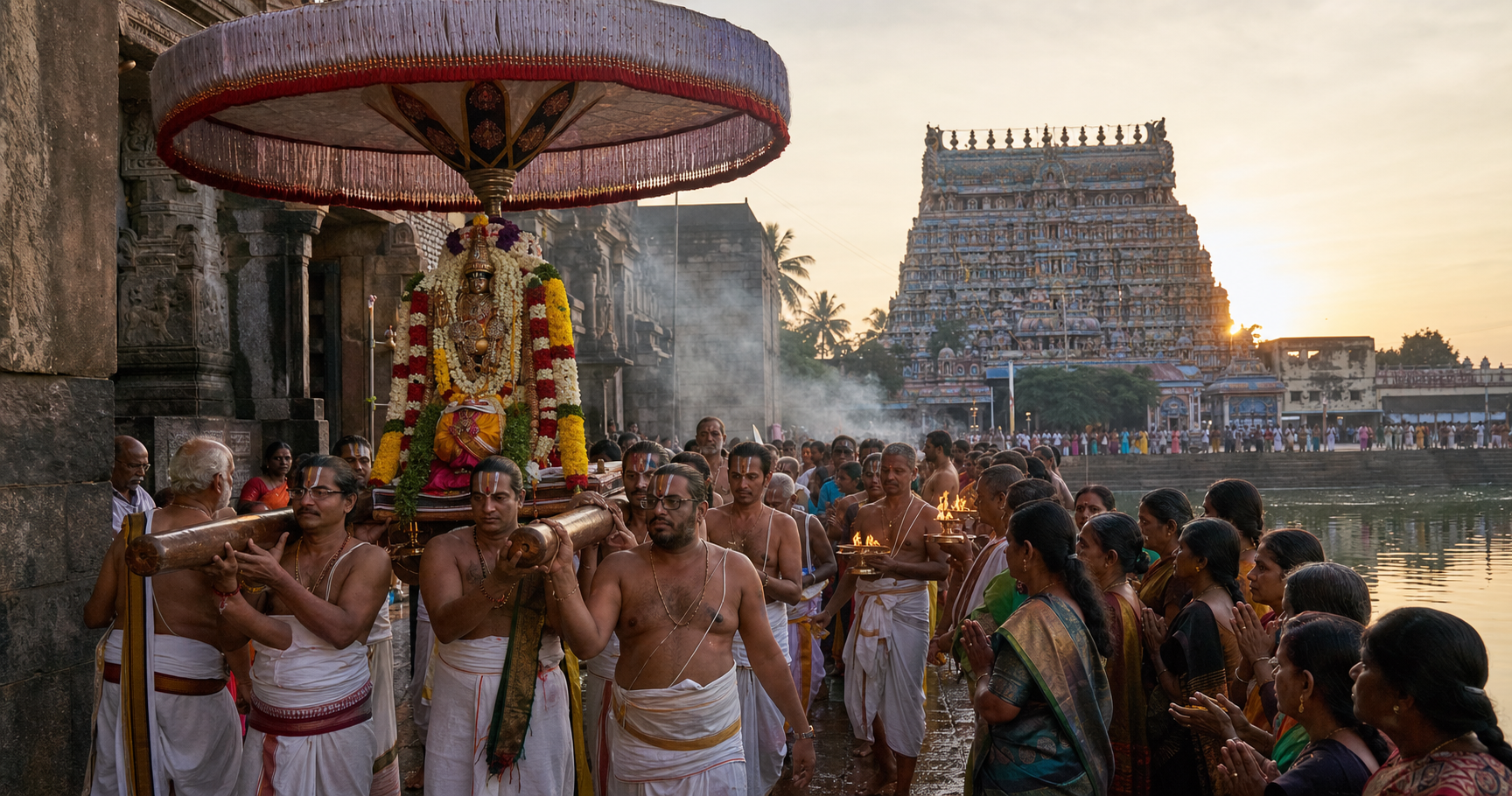
If you are going to Kumbakonam for Masi Magam, the decisive question is not simply when to enter the temple. You need to know which rite anchors the day, what Chakrapani’s presence adds to it, and how to participate without allowing a sacred pilgrimage to become a hurried round of queues and photographs.
Begin with the theerthavari, the ceremonial immersion of the festival deity. Build your travel, darshan, sankalpa, ancestral remembrance, and service around that moment. The 2026 observance fell on 2 March 2026; future dates and exact ritual hours must be confirmed afresh because Masi Magam follows a lunar and nakshatra conjunction rather than a fixed Gregorian date.
Confirm the festival date and theerthavari time separately
Masi Magam occurs in the Tamil month of Masi, generally spanning February and March, when Purnima coincides with Magha Nakshatra. More technically, the relevant lunar transit is through the Magha sector at 0 degrees to 13 degrees 20 minutes of Simha, or Leo. That astronomical basis explains why the date moves from year to year and why a generic calendar entry may not tell you the precise time of the temple’s main observance.
Local panchanga conventions, astronomical thresholds, and temple custom shape the working schedule. The festival date, temple opening, abhishekam, procession departure, and theerthavari are therefore related pieces of information, but they are not interchangeable. A calendar can help you select your travel day; only the temple’s local announcement can tell you when and where to assemble.
Before committing to a train, hotel checkout, or onward journey, verify four details at the temple noticeboard or with its priests and functionaries:
- The date being followed by Chakrapani Temple for that year’s Masi Magam observance.
- The announced departure time of the utsava-murti, the festival icon carried in procession.
- The water-body and route selected for the theerthavari.
- The day’s timings for abhishekam, public darshan, and evening deepa-aradhana.
This distinction prevents a common planning error. You can arrive on the correct date and still miss the central rite by assuming that it will occur at sunrise, at noon, or at the same hour as a previous year. Theerthavari is often placed in the forenoon or around midday, depending on the muhurta, but that pattern is not a guaranteed timetable.
Magha is traditionally associated with the Pitrs, the ancestral lineages. That gives the day a familial and ethical dimension beyond festival attendance. If ancestral remembrance is central to your visit, decide before you enter the crowd how you will express it: through prayer, anna-dana, support for a community kitchen, a temple offering, or another appropriate act of service. The intention becomes clearer when it is chosen deliberately rather than improvised at the water’s edge.
See the festival through Chakrapani’s Sudarshana form
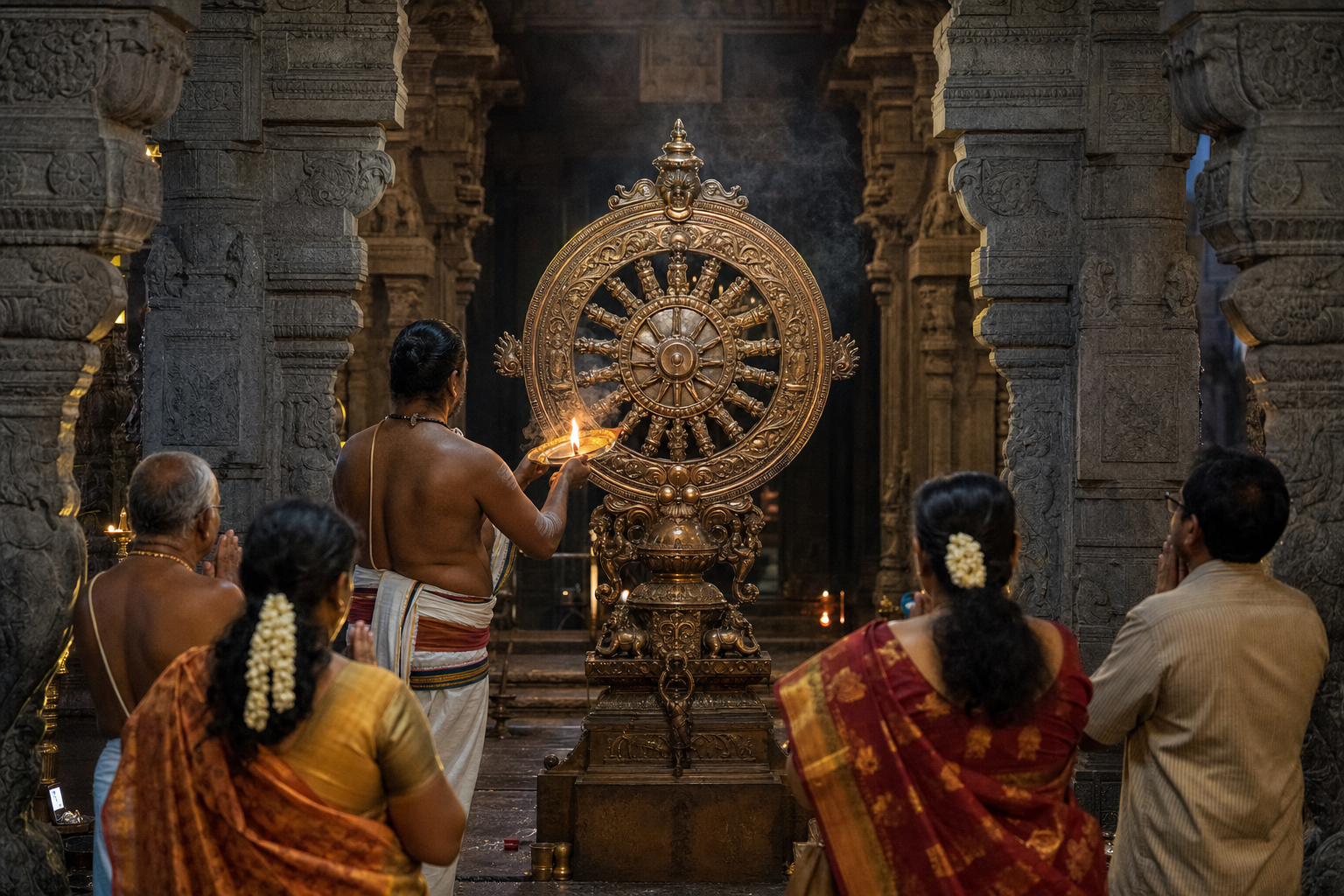
Chakrapani Temple is a Vaishnava shrine where Vishnu is worshipped in a form identified with the Sudarshana Chakra, the divine discus. Sudarshana is not merely a weapon in this setting. It signifies lucid discernment, protection, and the power by which dharma and cosmic order are restored.
That symbolism changes how you can approach Masi Magam. Water supplies the language of purification and renewal; the Chakra supplies the language of clarity and protection. Together, they invite a more exact sankalpa than a vague wish for blessings. You might identify one confusion that requires honest discernment, one duty that needs steadiness, or one harmful inherited pattern that should not be passed to the next generation. The point is not to negotiate mechanically with the deity. It is to bring your conduct into the same moral frame expressed by the ritual.
Kumbakonam’s sacred geography deepens this meaning. Temple lore connects the town with pralaya, the dissolution of an earlier order; a kumbha carrying the seeds of creation preserves the possibility of renewal. Within that landscape of shrines, tanks, and processional streets, the movement of Chakrapani toward consecrated water enacts preservation and reordering in visible form.
Notice the movement, not only the destination. The utsava-murti leaves the more enclosed temple setting, passes through the shared space of the town, and reaches the ritual water-body in the company of priests, trained bearers, musicians, Vedic scholars, functionaries, volunteers, and devotees. The rite thereby joins temple theology to public life. Protection is invoked for a community, not treated as a private possession.
The temple’s Dravidian architecture supports that movement. Its gopuram, pillared mandapas, sculptural program, and circumambulatory spaces are not simply a background for the festival. They organize how bodies, images, music, and recitation travel. Nagaswaram and percussion help make the route intelligible even when the crowd limits your view. If you cannot stand near the front, listen for the procession and follow volunteer directions instead of forcing a line of sight.
Masi Magam is annual. It should not be confused with Kumbakonam’s Maha Maham, the far larger observance associated with the Mahamaham Tank once in twelve years. An ordinary Masi Magam year remains spiritually complete in its own right: its scale is more focused, while theerthavari, worship, sacred recitation, and community participation retain their full place.
Let theerthavari organize your day of worship
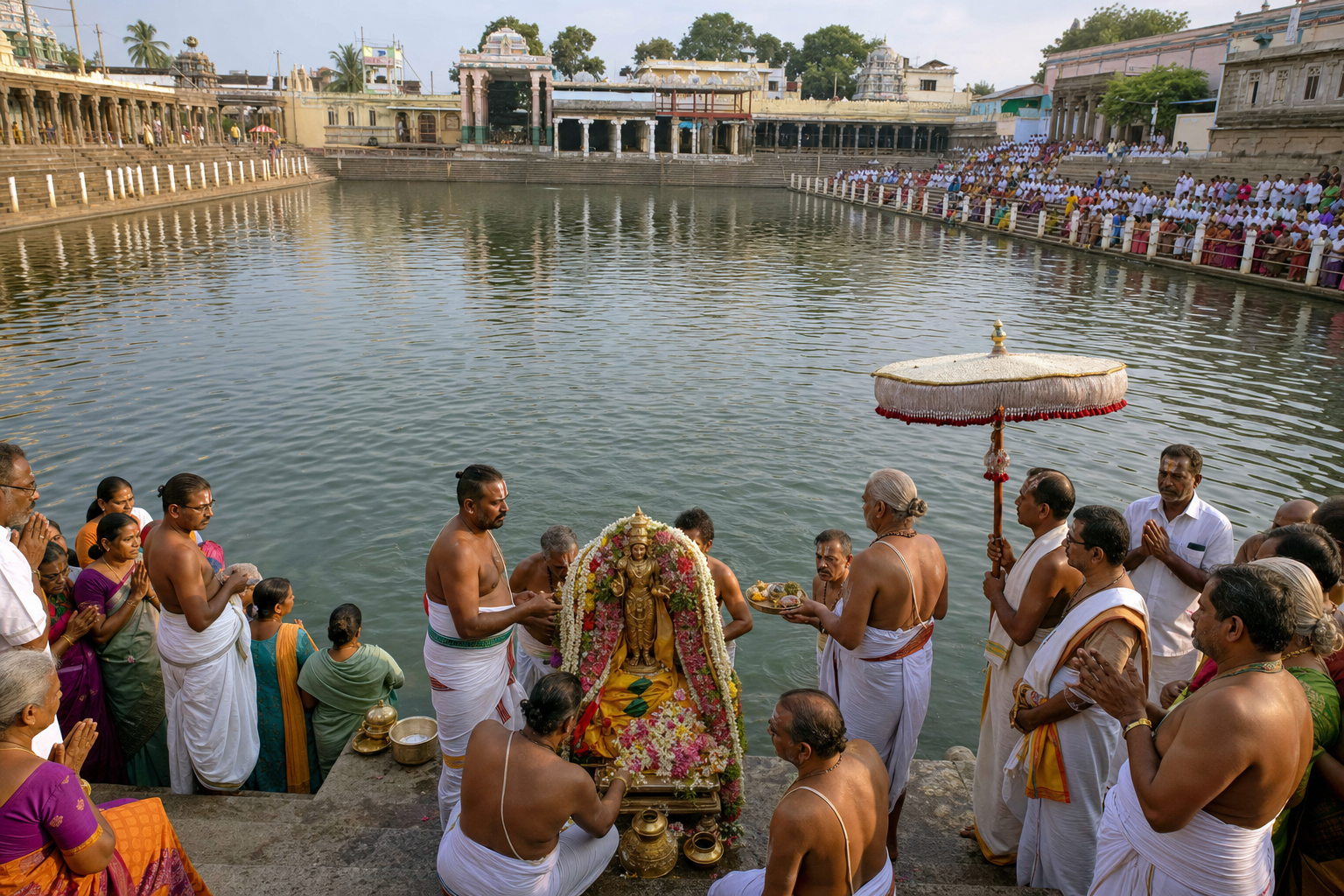
Theerthavari is the focal rite: archakas conduct mantra-guided ablutions as the utsava-murti is brought to consecrated water. The personal act for a devotee is first to witness, pray, and hold the sankalpa with attention. Do not reduce the festival to the idea of taking your own bath. The central immersion is that of the festival deity, performed within a disciplined temple sequence.
A typical day may unfold through the following stages. Use this as a map of meaning, not as a substitute for the year’s local announcement.
| Stage | What you may encounter | How to participate well |
|---|---|---|
| Pre-dawn opening and recitation | The temple awakens through worship, chant, and preparation. | Arrive quietly, settle your mind, and confirm the procession timing before joining a queue. |
| Abhishekam | Sacred water and panchamrita may be offered while texts such as the Purusha Sukta and Vishnu Sahasranama are recited. | Attend to the graded act of offering instead of treating it as a spectacle; avoid obstructing priests or other devotees for a photograph. |
| Alankaram | The deity is adorned for darshan and the public rites that follow. | Allow the iconography to guide your attention toward Chakrapani’s qualities of discernment, protection, and order. |
| Procession and theerthavari | The utsava-murti travels with bearers, priests, reciters, musicians, volunteers, and devotees before the ceremonial immersion. | Follow the designated route, keep steps and access lanes clear, and avoid pressing toward the water when officials are controlling movement. |
| Evening deepa-aradhana | Lamp worship brings the festival day back into the temple’s devotional rhythm. | If your travel allows, return for a quieter close rather than leaving immediately after the main procession. |
Abhishekam may include panchamrita, traditionally combining milk, curd, ghee, honey, and sugar, followed by sacred water and, on some occasions, herbal preparations. The materials matter, but their sequence matters more: varied offerings are gathered into a single act of consecration. Similarly, Purusha Sukta and Vishnu Sahasranama recitation situate the visible rite inside a larger discipline of mantra and remembrance.
Sudarshana Homa is performed in many Vaishnava settings during the Masi period to invoke protection, clarity, and collective welfare. Do not assume that it is automatically part of every public Masi Magam schedule. If participating in the homa matters to you, ask whether it is being conducted, when it begins, and whether sponsorship or prior registration is required.
At the theerthavari, choose attention over proximity. A place a little farther back can be spiritually and practically better than a struggle at the water’s edge. Listen to the Vedic recitation, conch, nagaswaram, and percussion; observe the change in the crowd as the deity reaches the water; and keep your prayer concise enough that you can remain aware of instructions around you. Sacred intensity does not cancel the duty to protect elders, children, bearers, and fellow devotees from avoidable pressure.
Make pilgrimage, seva, and stewardship one practice
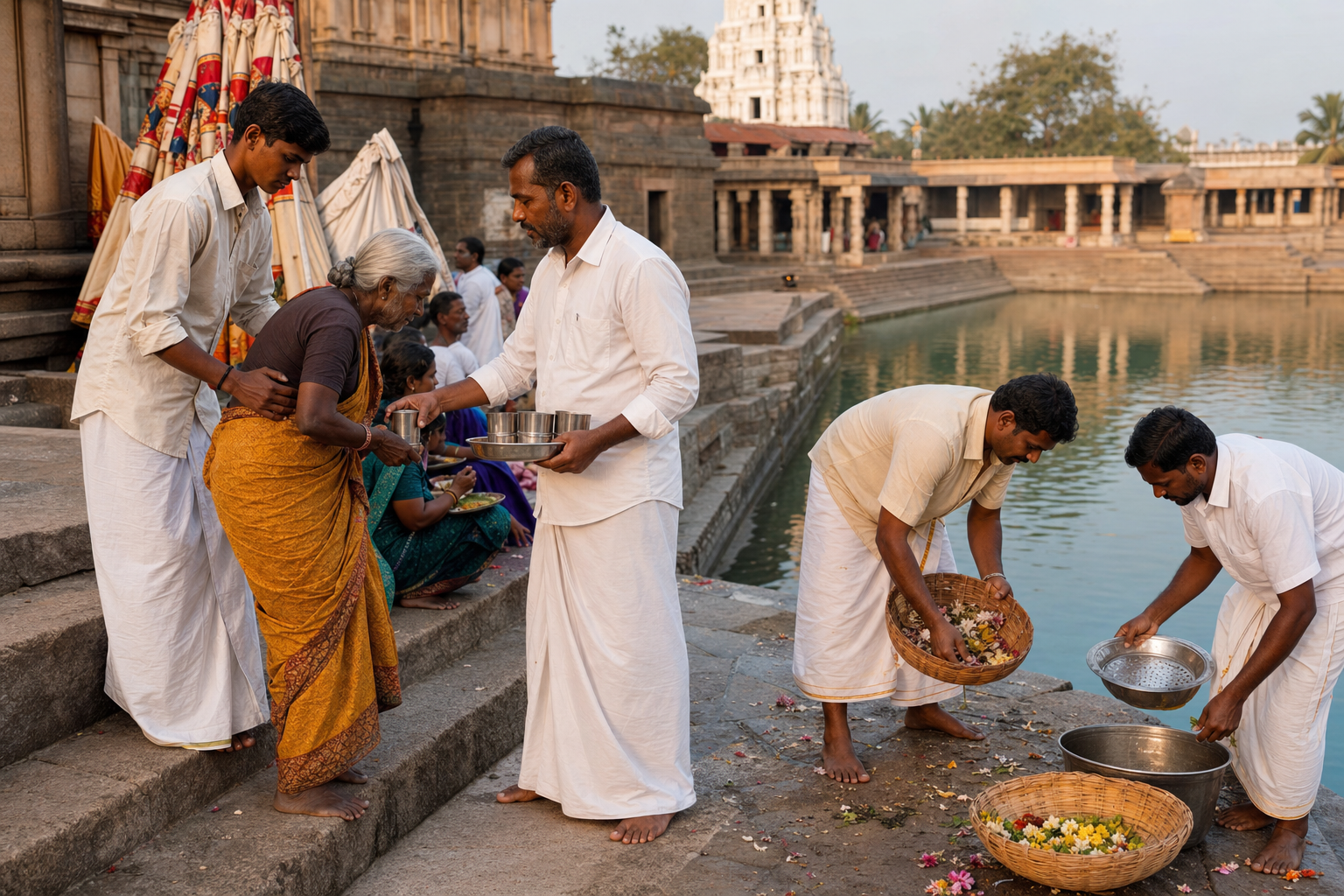
A purposeful visit begins before you reach Kumbakonam. Decide which parts of the day you can realistically attend, especially if you are travelling with children, elders, or someone with limited mobility. A half-day centred on the main rites, followed by quiet reflection, can be more coherent than attempting to cover every shrine and ritual in the town.
Kumbakonam Railway Station, identified by the code KMU, connects the town with Chennai and Tiruchirappalli. Road services include TNSTC and private buses. Tiruchirappalli International Airport is the nearest major airport at approximately 90 to 100 kilometres, while Chennai International Airport is a secondary option. Festival traffic may bring diversions around temple streets and major tanks, so do not schedule an onward train or flight as though movement through the centre of town will be ordinary.
Accommodation fills more quickly during festival periods. Booking early is useful, but location matters as much as price: a room that lets you approach the temple without repeatedly crossing diverted traffic can save time and energy. On the morning itself, leave a buffer for footwear deposit, security or queue arrangements, route changes, and the slow movement that accompanies processions.
<!– wp:list {