
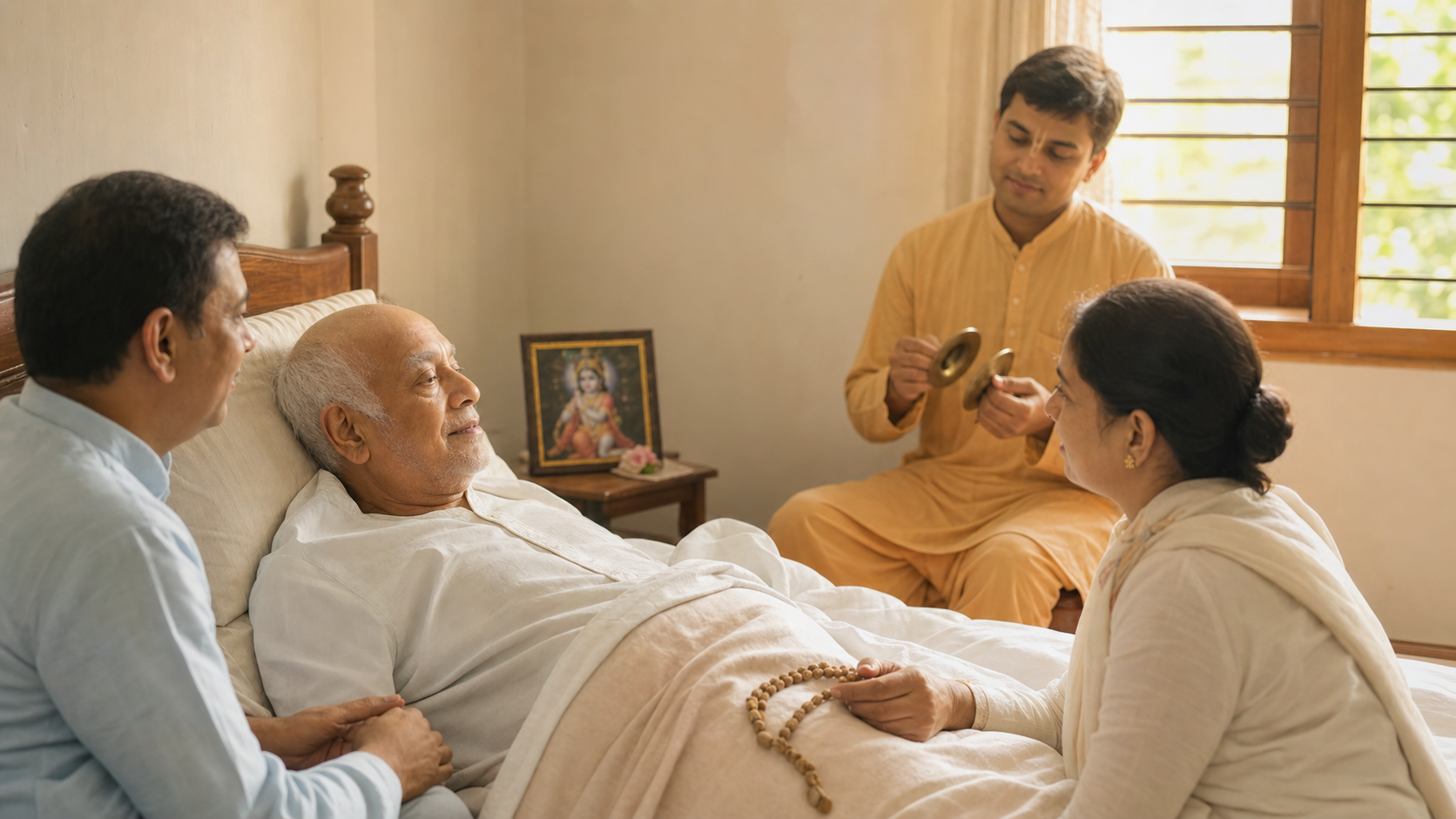
When a Vaishnava you love is nearing death, you may know that the Holy Name belongs at the bedside but still be unsure what to arrange. How loud should the kirtan be? Who should lead it? Should scripture be read? What happens if the person cannot chant? These choices are easier when you make them before the final hours.
Ranjit das’s departure offers a clear pattern: keep Krishna at the centre, keep the dying person’s needs ahead of ceremony, and let family and devotees carry the practice together. An auspicious atmosphere is not produced by doing the greatest number of religious things. It grows from familiar sacred sound, attentive service, and trust in divine grace.
Ranjit das’s final hours reveal the order of priorities
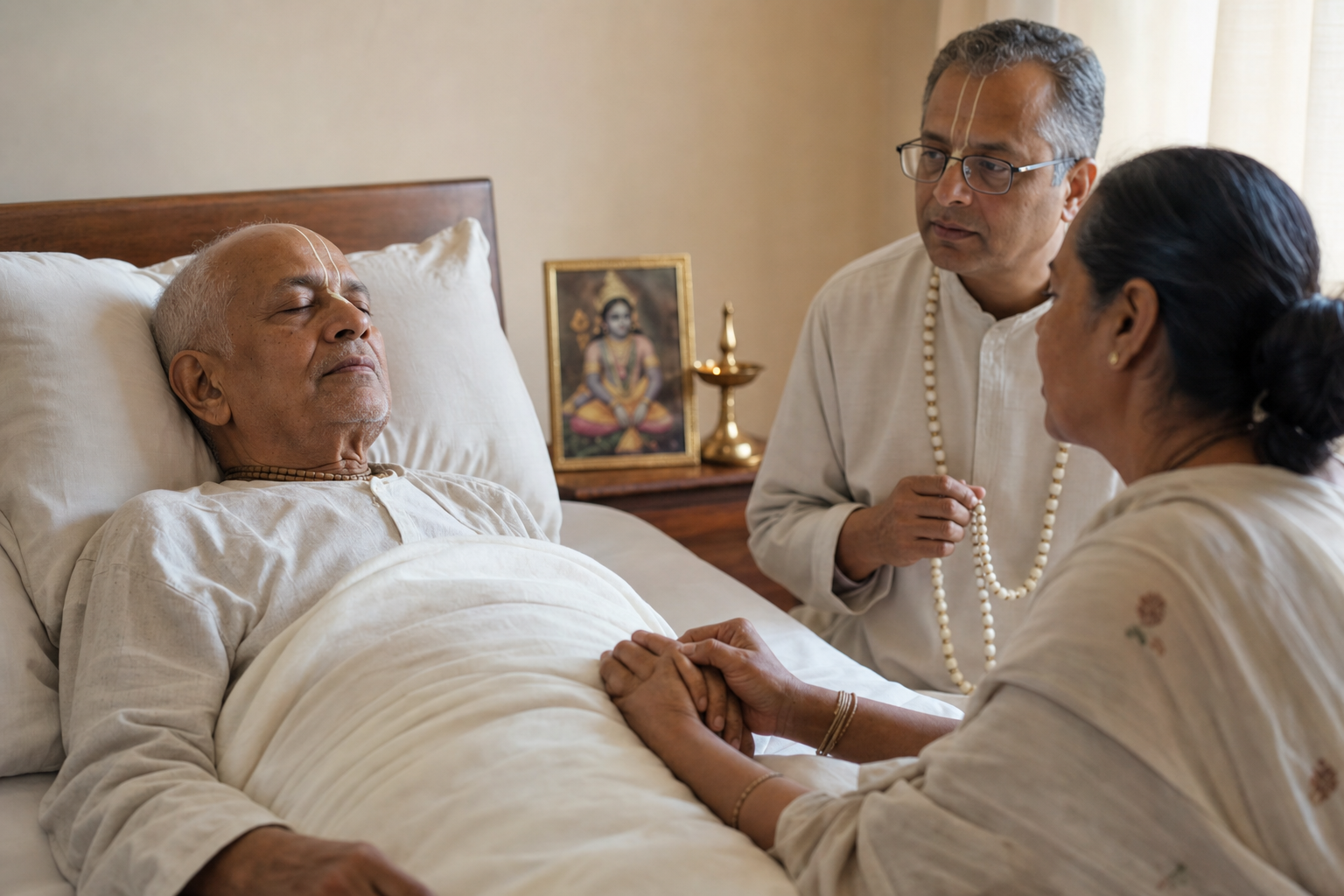
Ranjit das, ACBSP, departed on February 25 at 6:45 p.m. ET in Alachua, Florida. Soft kirtan surrounded him. His wife, Gopisvari devi dasi, and daughter, Prema, helped create the devotional setting, while well-wishers accompanied the family.
The letters ACBSP customarily identify an initiated disciple of Srila A. C. Bhaktivedanta Swami Prabhupada. They locate Ranjit prabhu within a guru-sisya parampara, or teacher-disciple lineage. Such an identity points not merely to an initiation in the past but to a continuing responsibility: practice bhakti, serve others, preserve the teachings received from the guru, and help the next generation approach Krishna.
The practical lesson lies in the arrangement around him. The kirtan was soft rather than performative. Close family participated rather than being displaced by a crowd. Devotees offered their presence rather than trying to control an unknowable spiritual moment. Sacred sound, relationship, and service worked together.
Key takeaways
- Ask about end-of-life spiritual wishes while the person can still express them.
- Treat kirtan as service to the dying person, not as a musical programme for visitors.
- Use familiar practices: the Holy Name, brief readings, tulasi when desired, and the company of trusted devotees.
- Let spiritual care accompany medical comfort care; never obstruct treatment or pressure the person to appear more conscious.
- After the departure, preserve privacy, verify memories before sharing them, and continue the person’s legacy through seva.
An auspicious passing is about remembrance, not performance
In Gaudiya Vaishnava thought, the final passage is approached through anta-kala smarana, remembrance of Bhagavan at the end of life. The emphasis is on where consciousness is being invited to rest. Nama-smarana, remembrance of the Holy Name; seva, devotional service; and satsanga, holy association, prepare that orientation throughout life.
This is why end-of-life practice cannot be reduced to a last-minute formula. A person’s daily japa, kirtan, scriptural hearing, service, and relationships form the devotional language that will feel most natural at the bedside. When you plan care, begin with that person’s actual sadhana. Do not impose a practice merely because another devotee found it meaningful.
Calling a departure auspicious does not mean that grief is a spiritual failure. It does not provide outsiders with a certificate of the soul’s destination. Nor does it require the dying person to speak, sing, or display composure. If speech is no longer possible, the surrounding community can carry the chanting without turning the person’s physical capacity into a test of devotion.
Vaishnavas understand the Holy Name as intrinsically sacred and non-different from the Divine, not merely as a method for improving mood. At the same time, familiar chanting can give family members a shared focus when ordinary conversation has become difficult. Both dimensions matter: kirtan is an offering to Krishna and a disciplined way of remaining present with one another.
The word auspicious therefore describes a devotional orientation, not a denial of death. Sorrow, surrender, gratitude, and hope may all occupy the same room. You do not need to suppress one to prove another.
Prepare a one-page Vaishnava bedside plan before the crisis

The final hours are the wrong time to discover that relatives disagree about chanting, visitors, scripture, or sacred items. If the person can communicate, ask one direct question: Would you prefer the Holy Name, a reading, quiet, or a mixture of these, and whom would you like beside you?
Record the answer on one page. It does not need to become a complicated ritual manual. Include the choices that relatives, devotees, and the care team will otherwise have to guess:
- Sacred sound: Note the preferred Holy Name, mantra, kirtan melody, or japa practice, as well as the desired volume.
- Readings: Choose one or two short selections from Bhagavad-gita or Srimad-Bhagavatam rather than leaving someone to search for a passage during a crisis.
- Sacred elements: Record whether tulasi or other familiar sanctifying elements are wanted and where they should be placed.
- People: List the close family members and devotees to contact. State whether the person wants a small room, a wider gathering, or periods without visitors.
- Coordination: Name one person who can communicate the plan, manage calls, and prevent competing instructions at the bedside.
- Privacy: Decide what may be photographed, recorded, or shared publicly. Silence should be the default where permission is unclear.
- Clinical boundaries: Make clear that chanting and sacred items must not obstruct examinations, equipment, prescribed symptom relief, or other necessary care.
Spiritual care and medical care have different responsibilities. Kirtan is not a substitute for professional pain or symptom management. Do not reduce or delay prescribed relief in an attempt to keep someone visibly alert; decisions about medicines belong to the person, those authorised to make care decisions, and qualified clinicians.
The presence of tulasi may be meaningful without placing anything in the person’s mouth. Do not offer leaves, water, food, or any other substance unless the person wants it and the clinical team has confirmed that swallowing is safe. A devotional intention does not justify creating a choking risk.
Specific rites differ among families, lineages, and locations. Ask the person’s family and trusted spiritual guides about those rites instead of presenting one community’s custom as the universal Vaishnava rule. The bedside plan should preserve the person’s relationship with Krishna, not settle every ritual question in advance.
At the bedside, let kirtan serve the dying person
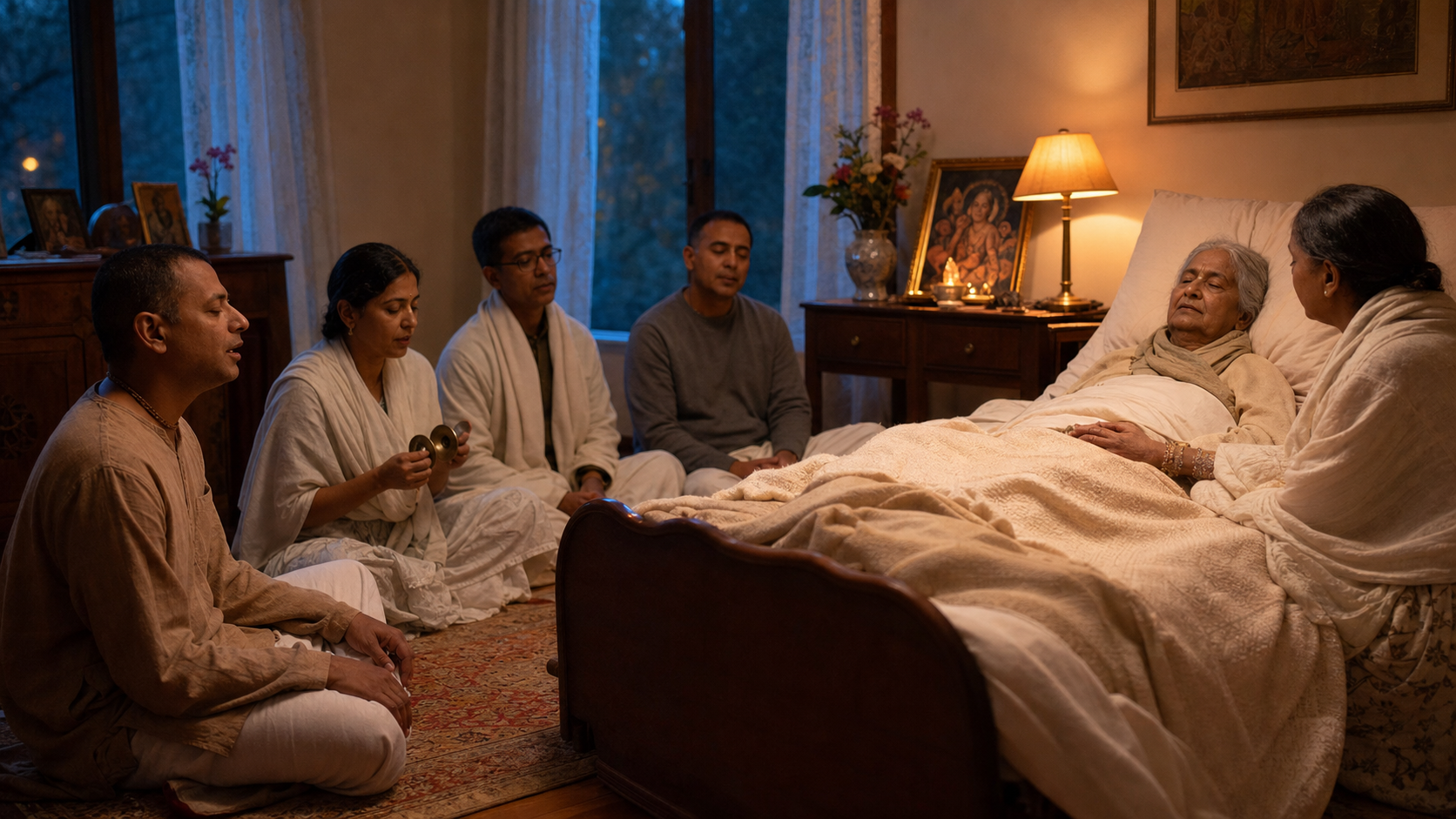
Good end-of-life kirtan is attentive. Begin softly. Use a familiar tune. Let one person lead so that the room does not become a contest between tempos, melodies, and instructions. Other devotees can respond gently or chant on beads if a call-and-response format feels too forceful.
Keep watching the person rather than the chanters. If the sound appears agitating, lower the volume, simplify the melody, reduce the number of voices, or allow quiet. If clinicians need access, make space immediately. The devotional purpose is not defeated when chanting pauses for care.
Scriptural reading should follow the same principle. A short, clearly spoken passage from Bhagavad-gita or Srimad-Bhagavatam can direct attention toward Krishna. A long discourse, theological debate, or improvised sermon can burden a room that needs simplicity. Read the chosen passage, leave space for silence, and return to the Holy Name if that is the person’s preference.
Family members do not need specialist roles to participate. One may sit close, another chant, another read, and another handle practical communication. Someone who cannot sing can still hold a hand, maintain quiet, or protect the room from unnecessary interruption. In bhakti, such unobtrusive care is also seva.
A few boundaries preserve that atmosphere:
- Do not force the dying person to repeat a mantra or respond to questions.
- Do not interpret every movement, breath, expression, or period of silence as a public spiritual sign.
- Do not crowd out the spouse, children, or other close relatives in the name of devotional urgency.
- Do not record intimate moments unless the person or family has clearly permitted it.
- Do not tell grieving relatives that tears show insufficient faith.
The language used around the bed matters as much as the arrangement. A useful question is, “Would you like chanting, a reading, or some quiet now?” It gives the person or family a real choice. Statements such as “You must chant” or “You should not cry” turn accompaniment into judgement at the moment judgement is least needed.
After the departure, protect grief, privacy, and legacy

A Vaishnava community’s responsibility does not end when the kirtan stops at the bedside. Remembrance can continue through a kirtan gathering, readings from Bhagavad-gita or Srimad-Bhagavatam, and seva offered in the devotee’s name. These acts direct grief into continuity: the departed devotee’s association continues to move other hearts toward Krishna.
Begin by asking the family what it wants made public. Share established facts without filling gaps with dramatic claims. If friends offer memories, identify them as personal recollections and seek permission before publishing intimate details. A spiritually meaningful death does not become community property.
For Ranjit prabhu, the known setting already carries its own meaning: his wife and daughter were present, devotees offered the Holy Name, and a mature Vaishnava community in Alachua supported the final passage. There is no need to embellish that scene. Its force comes from faithful practice made available when it mattered.
In a family containing several Dharmic traditions, common ground can help without erasing difference. Sikh relatives may recognise the centrality of simran and kirtan. Buddhist relatives may understand the value of chanting, mindful presence, and sangha. Jain relatives may approach the hour through equanimity, ahimsa, and ethical reflection. Let each person contribute in a way consistent with the dying person’s wishes; shared values do not make distinct rites interchangeable.
If someone you love is seriously ill, write the bedside plan while conversation is still possible. Choose the sacred sound, select the brief readings, name the coordinator, record the desired sacred elements, and state what must remain private. Give the plan to close family, trusted devotees, and the care team. Then, when the final hour comes, no one will need to invent an atmosphere. They will only need to sustain it with steadiness, service, and the Holy Name.
References
