

You may have prayed before a murti, repeated a Divine Name, meditated at dawn, or served in a sacred setting and still wondered whether anything fundamental is changing. Perhaps you felt peace for a moment. Perhaps you felt nothing. Either way, the real question remains: was that spiritual vision, a passing state, or the mind interpreting its own movement?
If liberation is your aim, asking for a dramatic sign is less useful than learning how perception becomes trustworthy. Dharmic practice begins there. You refine the person who sees, establish a disciplined way of seeing, and judge every experience by the freedom and character that follow it.
Key takeaways
- Darshan is more than an unusual visual event. It is perception clarified by ethical discipline, steady attention, sound reasoning, sacred instruction, and grace.
- Preparation cannot command the Divine, but it can make you receptive. Effort establishes fitness; grace completes what effort cannot manufacture.
- Ethics are part of spiritual epistemology. Dishonesty, resentment, vanity, and uncontrolled appetite distort the person who is trying to know reality.
- Hindu, Buddhist, Jain, and Sikh paths share practical commitments to purification and disciplined awareness without teaching identical metaphysics or identical forms of liberation.
- The safest test of spiritual progress is not intensity during practice but the reduction of compulsive behavior, possessiveness, confusion, and harm afterward.
Reliable spiritual vision begins with a fit instrument
The demand to see God immediately treats the Absolute as though it were an ordinary object placed in front of ordinary eyesight. Dharmic thought starts from a different premise: the instrument of knowledge must be suited to what it seeks to know. Your eyes can register color and form. They cannot, by themselves, determine the ultimate nature of the seer, disclose the meaning of existence, or establish that a private experience is liberation.
Classical Hindu epistemology gives you a practical way to separate experience from interpretation. Pratyaksha is direct perception. Anumana is inference. Shabda is trustworthy testimony received through shastra and realized teachers. These means of knowing can support one another, but they should not be confused.
- If light appears in meditation, the appearance of light is what you perceived directly. The conclusion that the light proves liberation is an interpretation, not part of the bare perception.
- If a period of mantra practice is followed by less anger, you can reasonably infer that the discipline is affecting your reactions. You still should not infer final realization from one improvement.
- If a guru or scripture supplies a spiritual meaning for an experience, you have received testimony. You must understand that testimony in its proper tradition, test your interpretation through reason, and examine whether your conduct agrees with it.
This is why the Bhagavad Gita 4.34 directs the seeker toward tattva-darshinah, those who have seen truth, through humility, sincere inquiry, and service. Inquiry is not excluded by reverence. It is disciplined by reverence so that questioning becomes a search for truth rather than a contest for status. A qualified teacher helps you distinguish a genuine opening from imagination, emotional intoxication, or premature certainty.
Arjuna’s experience in the Bhagavad Gita makes another boundary clear. He does not force the universal form into view through ordinary perception. He receives divya cakshu, a capacity of vision granted by grace. Preparation matters, but Godhead remains autonomous. Sadhana is not a transaction in which a prescribed quantity of effort obliges Bhagavan to appear.
This relationship between qualification and grace protects you from two opposite mistakes. The first is spiritual entitlement: believing that technique gives you control over revelation. The second is spiritual laziness: claiming that grace makes preparation unnecessary. A farmer cannot command rain, yet still prepares the field. In the same way, you cultivate attention, truthfulness, restraint, devotion, and surrender without pretending to control the fruit.
Even within Hindu traditions, spiritual vision does not have only one valid description. Bhagavata Purana 1.2.11 presents Brahman, Paramatma, and Bhagavan as realizations of nondual Absolute Truth: the unconditioned absolute, the indwelling presence, and the personal Divine. A seeker’s practice and theological lineage may emphasize one of these horizons. Respecting that plurality does not require you to pretend that every claim means precisely the same thing.
The distinction becomes even more important across the wider dharmic family. The Buddhist Dhamma eye discloses impermanence, non-self, suffering, and the path beyond suffering; it is not merely another name for beholding Bhagavan. Jain samyak darshana is right vision joined with right knowledge and right conduct, ultimately directed toward freedom from karmic obscuration and kevala-jnana. Sikh discipline cultivates remembrance of Waheguru or Akal Purakh through Naam Simran, kirtan, alignment with hukam, and seva. These paths share the conviction that distorted consciousness must be disciplined, but their doctrinal accounts of the ultimate are not interchangeable.
Train ethics, attention, understanding, and surrender together
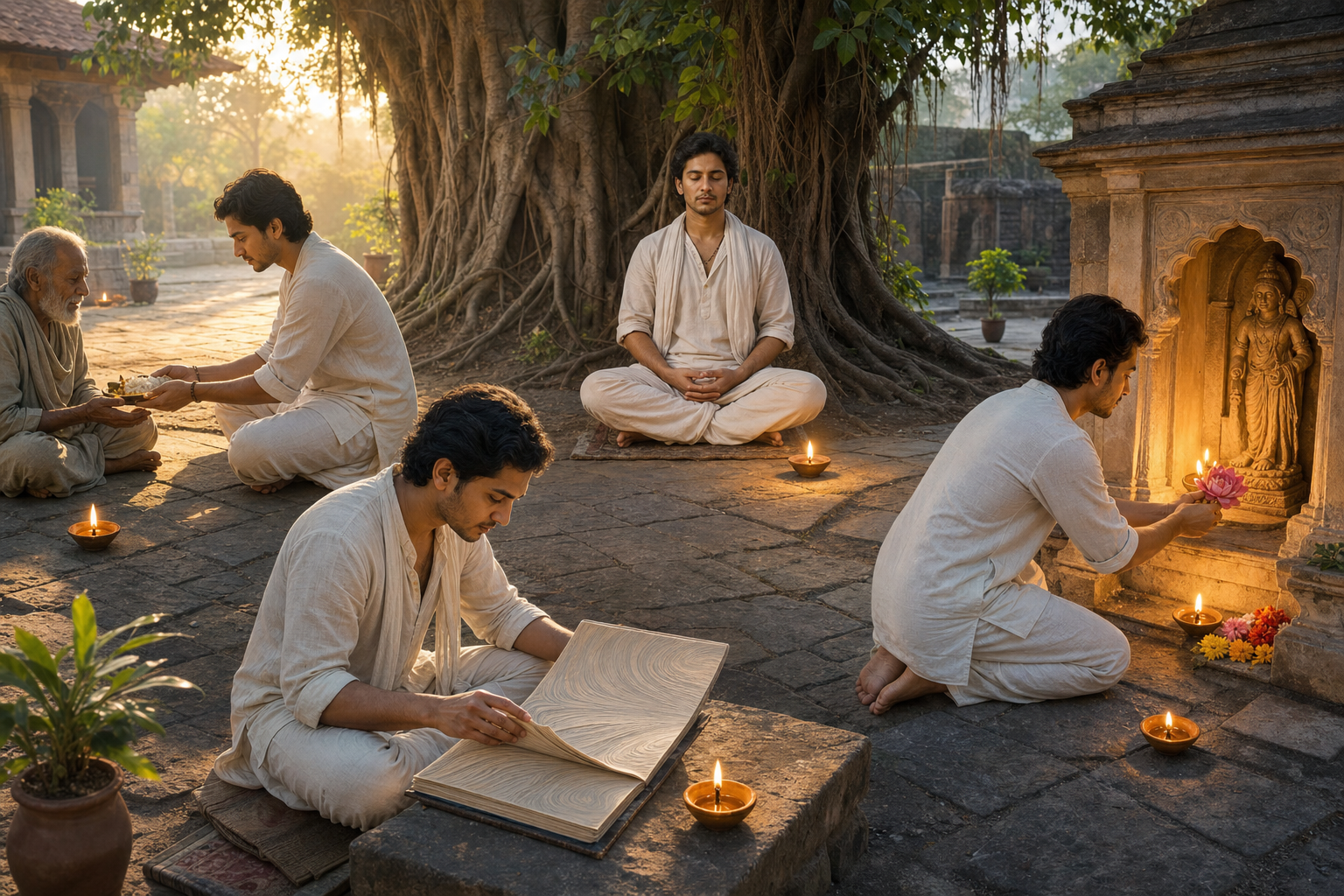
A fragmented practice produces fragmented results. Meditation without ethical restraint can make concentration sharper while leaving vanity untouched. Study without contemplation can turn sacred vocabulary into intellectual decoration. Service without remembrance can become another source of identity. Devotion without discernment can mistake emotional intensity for Divine confirmation.
You do not need to give every discipline equal emphasis every day. You do need to prevent your preferred discipline from becoming an excuse to neglect the others.
Let ethics remove the noise you keep creating
Yama and niyama in Yoga, sila in Buddhism, vows and right conduct in Jainism, and the Sikh union of Simran with seva all make conduct part of the path of knowing. This is not moral decoration placed around an otherwise private mystical practice. Every lie forces the mind to maintain a false version of events. Every cherished resentment repeatedly directs attention toward injury. Every act of exploitation trains you to perceive another being as an instrument of your appetite.
Begin with the ethical distortion that recurs in your actual life. It may be harsh speech, concealed dishonesty, uncontrolled consumption, envy, or the habit of claiming credit. At the end of the day, record the trigger, your response, its effect on another person, and the repair still required. Do not write a general judgment such as I was not spiritual today. Name the behavior precisely enough that you can interrupt it next time.
Ahimsa gives this review a clear direction. Ask not only whether you avoided obvious violence, but whether your speech, consumption, ambition, and indifference increased avoidable harm. Spiritual perception becomes unreliable when the seeker continually excuses conduct that the practice is meant to purify.
Stabilize attention instead of chasing unusual states
Yoga Sutra 1.2 defines yoga through the settling of citta-vrittis, the movements of the mind. Its eight limbs place samadhi at the end of an integrated discipline that includes ethical restraints, observances, posture, breath regulation, withdrawal of the senses, concentration, and meditation. This order matters. It prevents you from treating a concentrated state as though it were disconnected from the way you live.
Choose a primary contemplative anchor from your tradition: a mantra, the Divine Name, the breath, a form of the Divine, or a suitable object of inquiry. When attention wanders, notice the movement and return. Do not reward distraction by turning every image, sensation, or mood into a spiritual message. Abhyasa, repeated practice, develops the capacity to return without drama.
The most useful observation is often not what appeared in meditation but what repeatedly pulled you away from it. A fantasy of praise points toward attachment to recognition. An argument replayed in the mind reveals unresolved anger. Anxiety about results reveals the ownership that karma yoga asks you to relinquish. Distraction is not only an interruption; properly examined, it identifies material for purification.
Use study to discipline interpretation
Jnana marga joins shravana, receiving the teaching; manana, reasoning through it; and nididhyasana, sustained contemplation. Skipping manana leaves you vulnerable to vague claims. Stopping at manana leaves truth at the level of concepts. Nididhyasana allows a teaching that has been heard and examined to penetrate habitual identification.
When you study a passage, write down the claim in plain language. Then ask what it denies, what it affirms, and what would change in your conduct if you understood it correctly. If you are studying the distinction between the transient and the real, for example, observe what happens when praise or blame arrives. The point is not to repeat that the transient is unreal while remaining governed by every transient reaction.
Vedanta’s sadhana-catushtaya offers a demanding readiness check: viveka, discrimination between the enduring and the passing; vairagya, dispassion; the disciplines of shama, dama, uparati, titiksha, shraddha, and samadhana; and mumukshutva, an urgent desire for liberation. Use these as capacities to cultivate, not as Sanskrit labels to collect. Can you restrain an impulse? Can you endure difficulty without abandoning dharma? Can you hold attention on the question of truth? Does liberation matter more than protecting a preferred self-image?
Let devotion and service loosen your claim of ownership
Yoga Sutra 1.23 and 2.1 place Ishvara-pranidhana, dedication or surrender to Ishvara, within the discipline of realization. Bhakti makes that orientation relational through nama-japa, kirtana, worship, remembrance, and seva. Sikh practice similarly refuses to separate Naam from life under hukam. The purpose is not to become passive. It is to act fully without placing the individual ego at the center of every result.
Apply karma yoga to a duty you already have. Before beginning, dedicate the action. While doing it, give the task your full competence rather than using detachment as an excuse for carelessness. When the result arrives, learn from it without turning success into personal possession or failure into a verdict on your worth. Nishkama karma abandons clinging to the fruit, not responsibility for the work.
Seva adds a necessary correction to spiritual self-absorption. Preparing food, cleaning a shared space, helping a person, or fulfilling an uncelebrated duty can expose motives that remain hidden during private practice. If irritation arises because nobody noticed your service, the practice has shown you exactly where recognition still governs action.
Choose a coherent emphasis for the obstacle you actually have

You can learn from several dharmic paths without building an incoherent mixture. The first task is to identify your dominant obstruction. Select an emphasis that addresses it, then remain grounded in a consistent teaching tradition long enough for correction to occur.
- If restlessness and sensory compulsion repeatedly break your practice, emphasize ethical restraint, abhyasa, and the graduated discipline of Yoga.
- If work, ambition, or family duty continually strengthens possessiveness, use karma yoga and seva to purify motive while continuing to act responsibly.
- If your main obstacle is confusion about the self, reality, and identification, give greater weight to shravana, manana, and nididhyasana under qualified guidance.
- If your heart is dry, self-enclosed, or hungry for relationship with the Divine, emphasize nama-japa, kirtana, worship, remembrance, and loving service.
- If you follow a Buddhist, Jain, or Sikh path, let its own account of right view, practice, and liberation govern your goal. Do not import an incompatible idea merely because its vocabulary sounds mystical.
Bhakti offers an especially useful map for resisting premature claims. Its progression runs from shraddha through sadhu-sanga, regulated practice, removal of impediments, steadiness, taste, attachment, bhava, and prema. The sequence turns a vague question about whether you have seen God into a more honest question about your present work.
If your practice is still irregular, your immediate task is bhajana-kriya, not speculation about prema. If practice has become regular but resentment, vanity, distraction, or appetite still dominates, attend to anartha-nivritti. If discipline remains dependent on mood, cultivate nishtha before interpreting a pleasant state as bhava. Locating yourself soberly is not a denial of grace; it is protection against spiritual self-invention.
A coherent path also gives your teacher, sangha, or sangat enough context to correct you. Seek guidance where teaching and conduct agree, inquiry is taken seriously, service is valued, and no technique is sold as a way to command the Absolute. Humility before a teacher should make you more truthful and responsible, not less capable of recognizing contradiction or harm.
Build a daily rule that reaches beyond the meditation seat

A workable spiritual rule should connect intention, contemplation, study, action, and review. Keep it simple enough to repeat through ordinary responsibilities. Expansion is useful only after the foundation has become steady.
- State an ethical boundary. Before practice, name the restraint you intend to protect that day. Make it concrete: truthful speech in a difficult exchange, non-retaliation when criticized, restraint around a recurring appetite, or completion of an owed repair.
- Perform one primary practice. Use the mantra, Divine Name, meditation object, prayer, or contemplation proper to your path. Return to the same anchor whenever attention wanders. The aim is faithful recollection, not a hunt for novelty.
- Study and formulate a real question. Read a suitable portion of shastra or teaching. Write the point in your own words and identify what you do not yet understand. Bring the unresolved question to a qualified teacher rather than filling the gap with fantasy.
- Consecrate an ordinary duty. Choose work that must already be done. Offer it, perform it carefully, and watch where impatience, ownership, or the need for recognition appears.
- Review the day without self-theatre. Record whether you kept the ethical boundary, how quickly you returned after distraction, where ego claimed the fruit, what repair remains, and which question became clearer.
Do not score the day by mystical intensity. A practice session that felt dry may still have strengthened steadiness. A session filled with emotion may have left your habits unchanged. Your record should therefore emphasize observable consequences: whether speech became more measured, a craving lost some force, attention returned more readily, or service required less recognition.
Regular contact with sadhu-sanga, sangha, or sangat keeps the rule from becoming a private echo chamber. Bring your pattern of conduct, not merely your most impressive experience. A teacher can do more with an honest account of repeated anger, inconsistency, or attachment than with a grand claim that cannot be examined.
If you receive no unusual experience, continue testing the discipline by its fruits. Absence of spectacle does not prove absence of progress. The pilgrim repeating a mantra in a temple queue, the meditator returning to the chosen object, and the volunteer serving food without seeking credit are all training receptivity. None needs to manufacture a vision to make the practice real.
Judge an experience by what remains after it passes

A powerful experience can be meaningful without being final, and a private certainty does not automatically become universal knowledge. Before calling an event darshan, awakening, or liberation, examine its aftermath with more care than its intensity.
- The ethical test: Are truthfulness, ahimsa, restraint, fidelity to duty, and willingness to repair becoming stronger?
- The attachment test: Do praise, blame, gain, loss, pleasure, and discomfort exercise less control over your decisions?
- The ego test: Has the experience made you more teachable, or more eager to announce a special status and demand deference?
- The stability test: Does clarity survive inconvenience and conflict, or only the protected atmosphere of practice?
- The service test: Are other beings becoming more real to you, with greater patience and responsibility, or are they being reduced to an audience for your spirituality?
- The interpretive test: Can your understanding withstand careful reasoning, relevant shastra, and correction from a qualified guide?
No isolated test proves final liberation. Together, however, they expose a common error: using an extraordinary state to avoid ordinary transformation. If a claimed revelation authorizes dishonesty, contempt, exploitation, abandonment of duty, or exemption from ethical restraint, the claim has failed the most immediate dharmic tests.
Do not collapse calm, concentration, samadhi, darshan, and moksha into one undifferentiated idea. Dharmic schools use these terms within distinct accounts of bondage and freedom. Vedantic realization addresses avidya and mistaken identification. Bhakti culminates in pure love and relationship with Bhagavan. Buddhism directs disciplined vision toward the ending of dukkha. Jainism joins right vision, knowledge, and conduct on the path beyond karmic bondage. Sikh life unites Naam, hukam, and seva in orientation toward the Divine. Their differences deserve honest study.
What they do not permit is liberation that leaves bondage fully in command. A passing vision may encourage you, but freedom must become visible in the weakening of compulsion, ignorance, possessiveness, hostility, and false identification. The most persuasive spiritual sight is not a story about what appeared once. It is a life that no longer obeys the same old distortions.
Your next step can be modest and exact. Select an ethical boundary, a primary practice, an ordinary duty to consecrate, and a question worthy of study. Keep a truthful record. Return to the discipline without bargaining for spectacle, and take what you cannot interpret to a qualified guide. Let liberation first show itself as clearer perception, cleaner action, steadier remembrance, and less captivity to the self you are trying to defend.
References
