
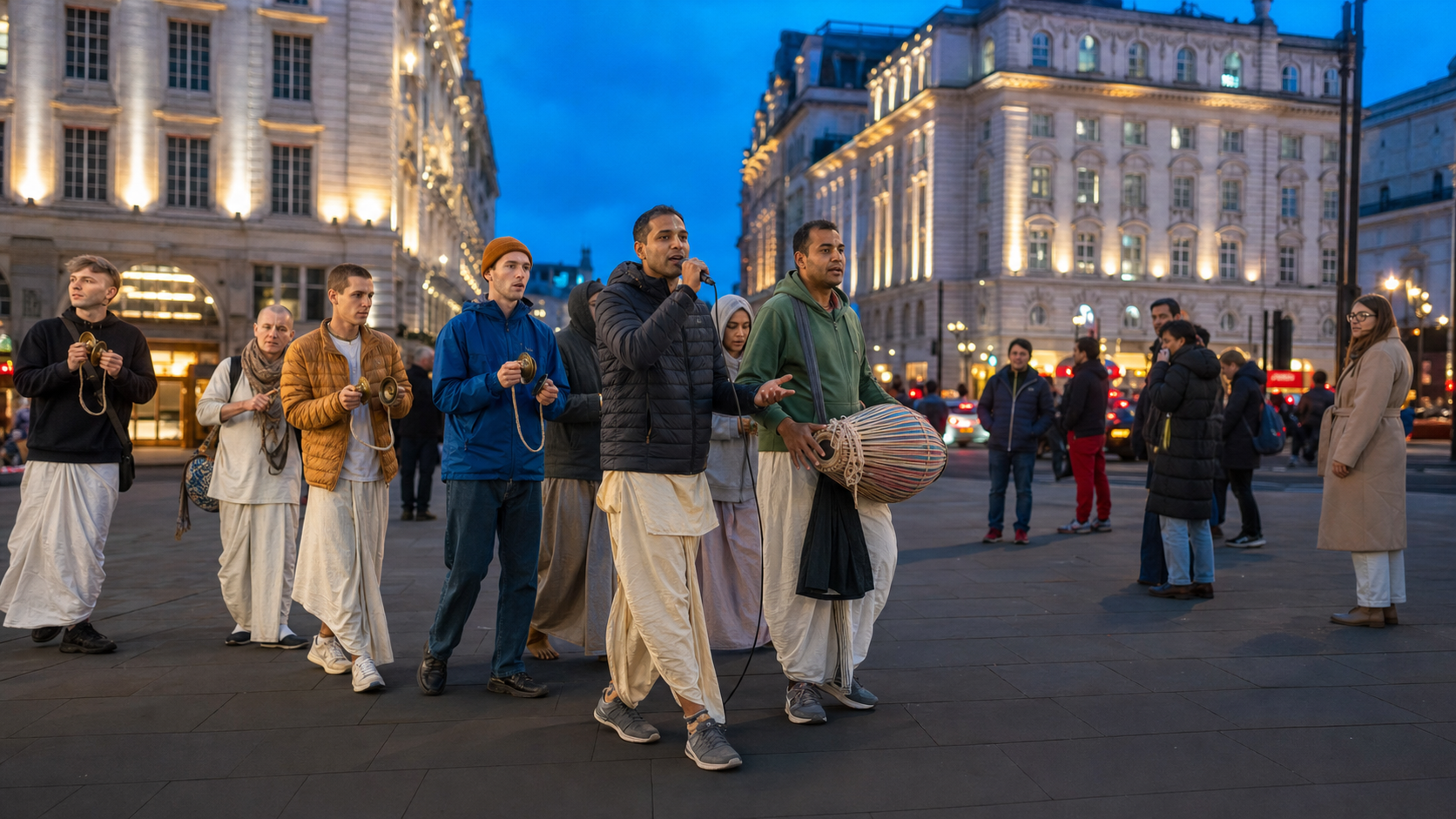
You are crossing Cambridge Circus after a show, dinner or a walk through Soho when bright hand cymbals cut through the traffic. A drum answers, a singer offers a short sacred phrase, and a moving circle of voices sings it back. Is this a performance to watch, a procession to avoid interrupting, or a devotional practice you may join?
If it is a small Vaishnava group singing sacred names in call-and-response, you are probably hearing Harinam sankirtan. You do not need musical training or prior knowledge to respond well. You need to recognise the structure, keep the pavement usable, and let the participants show you whether joining is welcome.
Key takeaways
- Listen for a lead voice followed by a repeated group refrain. That exchange, rather than any single instrument, is the clearest sign of kirtan.
- Public Harinam groups are mobile. Soho, Cambridge Circus, Oxford Street and Leicester Square are places where you may encounter them, not a guaranteed timetable.
- Stand at the outside of the group, clear of crossings and pedestrian flow. Wait until the response is predictable before singing it with the congregation.
- Match the clapping already happening instead of introducing a competing rhythm. If you lose the words or pulse, stop and listen until you find them again.
- Treat street kirtan as devotional practice, not merely as busking. At a temple, remove your shoes, keep conversation low and photograph only when it is clearly appropriate.
Recognise the devotional pattern beneath the street music
The West End gives you plenty of competing signals. At Cambridge Circus, Charing Cross Road and Shaftesbury Avenue carry buses, hurried footsteps and theatre crowds. The Palace Theatre adds the visual and auditory world of Harry Potter and the Cursed Child. Against that setting, an unamplified devotional procession can initially look like another piece of street entertainment.
The structure tells you otherwise. A leader sings a compact melodic phrase. The group answers with the same sacred words. The phrase returns until newcomers can anticipate it, and the melody or rhythm may then develop without abandoning the shared refrain. Repetition is not a lack of repertoire. It is the means by which strangers become participants without an audition, rehearsal or complicated score.
You may hear three characteristic instruments. The mridanga, a double-headed drum, provides the main rhythmic body. Kartals, small hand cymbals, articulate the pulse and off-beats. A portable harmonium may sustain the tonal centre beneath the voices. Not every procession will carry every instrument, so identify the relationship among leader, response and recurring rhythm before deciding what you are hearing.
The musical cycle may use kaharwa, an eight-beat pattern, or dadra, a six-beat pattern. Melodies can draw from Hindustani raga while remaining simple enough for untrained singers. You do not have to count the beats. Watch when experienced participants clap, notice where the drum pattern resolves, and allow several repetitions to teach you the shape.
This London practice belongs to the Gaudiya Vaishnava sankirtana lineage associated with Sri Chaitanya in the 16th century. ISKCON helped establish public kirtan on London streets in the late 1960s. Its continuing presence around Soho, Oxford Street and Leicester Square is therefore neither a historical reenactment nor a West End novelty. It is a living devotional tradition adapting its voice, portable instruments and movement to the city.
Let the response teach you how to participate
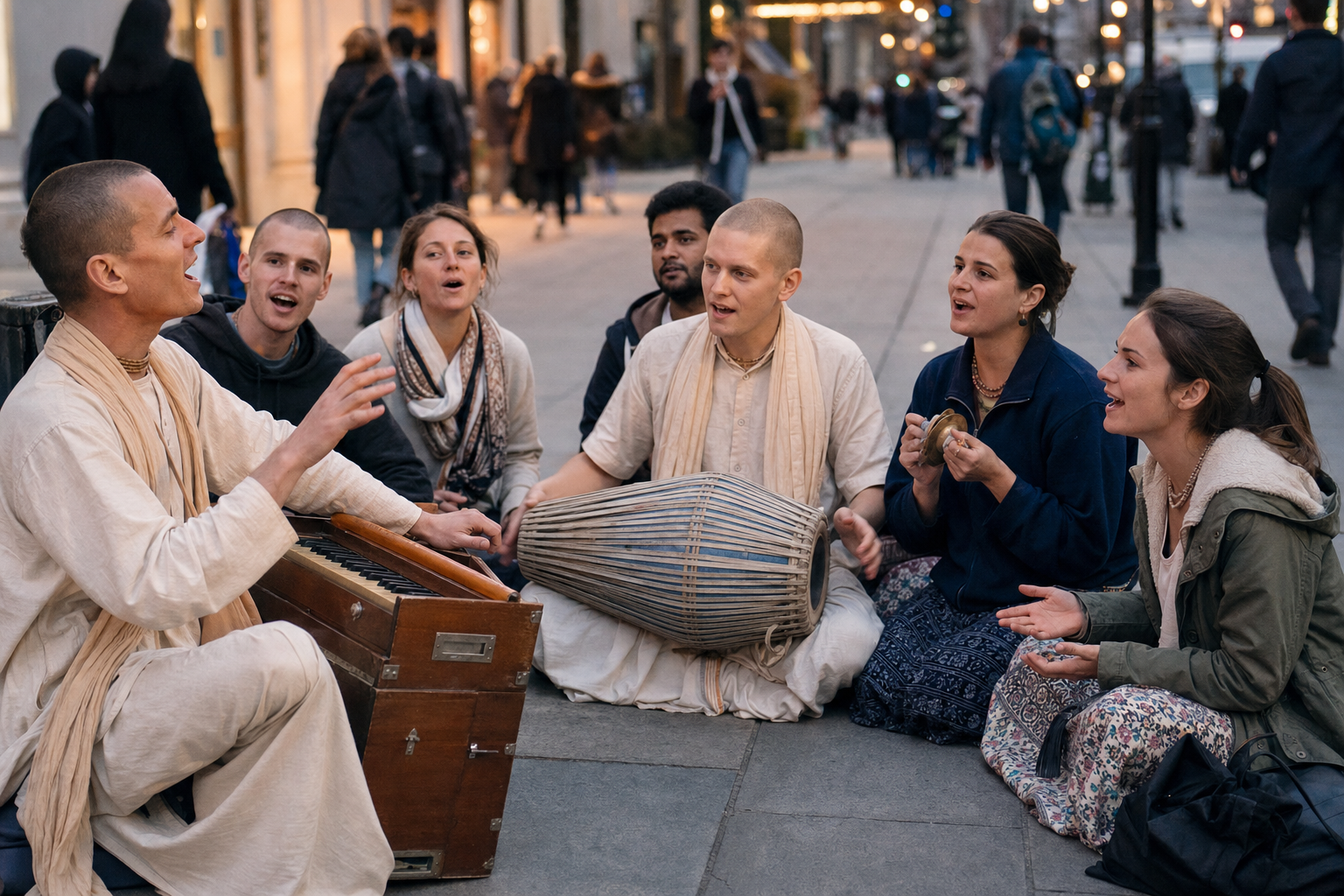
Kirtan is deliberately more accessible than a concert. You are not expected to demonstrate vocal range, master an unfamiliar language immediately or compete with the lead singer. Your task is to support the shared response. That difference should govern how you enter.
- Choose the outer edge. Stand where you can see the singers without closing a doorway, narrowing the pavement or separating the procession from a crossing.
- Find the complete exchange. Listen until you can distinguish the leader’s phrase from the congregation’s answer. Do not begin over the leader simply because you recognise part of the refrain.
- Enter with the response. Sing softly enough to hear the established group. If a word is uncertain, listen through it rather than replacing it with a guess.
- Borrow the visible rhythm. If people invite clapping, copy their placement. Kartals often mark off-beats, so an unrelated clap can pull against the groove even when your tempo seems correct.
- Follow the build without forcing it. Kirtan may gradually increase its tempo, volume and rhythmic density. Let the leader and mridanga establish that movement. If you lose the cycle, return to listening and re-enter at the next clear response.
This method works because every repetition lowers the amount of new information you must process. At first you hear an unfamiliar tune and words. Soon you know where to breathe, when the answer starts and where the rhythm returns home. Attention shifts from decoding the music to sharing it. That is why a pavement full of people who have never met can begin to sound like a congregation.
You are also free to remain silent. Attentive listening, a respectful nod or gentle clapping when invited can be a complete response. Kirtan’s openness should not be mistaken for pressure to display enthusiasm. The devotional centre is remembrance through sacred sound, not the production of an extroverted crowd.
Match your etiquette to the street or the temple
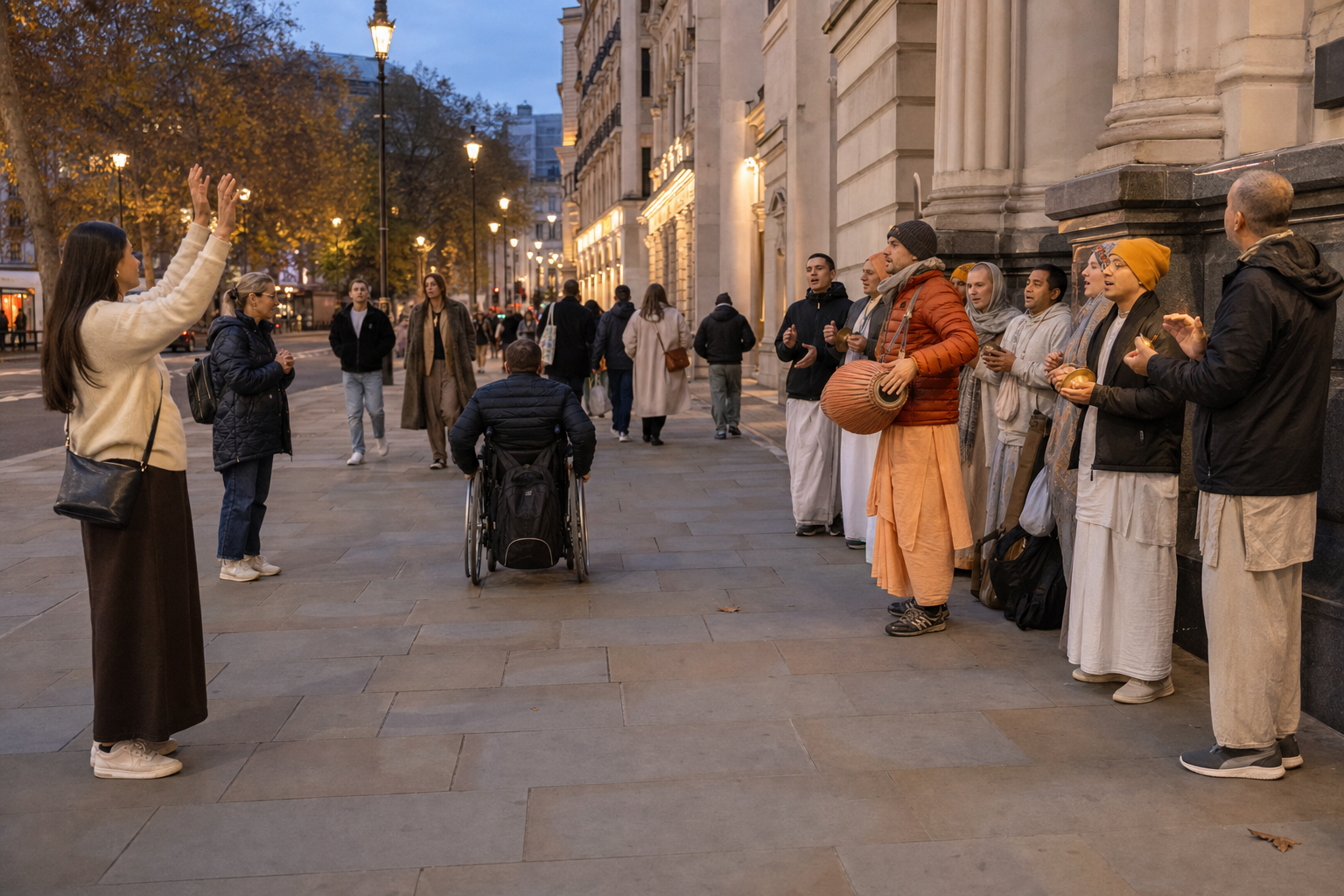
A street procession and a temple gathering may use the same refrain, but they do not create the same practical setting. In public, the group shares space with commuters, businesses and theatre queues. In a temple, you are entering a place organised around worship. Respect begins by noticing which space you are in.
For street Harinam, use these cues:
- Keep a clear route behind or beside you. A curious semicircle can become an obstruction even when the singers themselves are moving carefully.
- At a crossing, follow the group’s pause or movement rather than trying to preserve the song circle in the road.
- Do not push into the centre for a better recording angle. Public visibility is not the same as personal permission for a close-up photograph.
- If you want to ask what is being sung, wait for a natural pause or speak with someone who is not leading, drumming or managing the group’s movement.
- You may be invited to a meal, temple programme, meditation gathering or festival. Ask for the location and practical details; accept or decline without feeling that listening has created an obligation.
At a temple, slow down at the entrance. Remove your shoes where other visitors do so, keep your voice low, and follow the seating and movement of the congregation. Make photography discreet and secondary; if the local expectation is unclear, put the camera away. You will understand more by watching how worshippers respond to the sacred space than by treating the gathering as an acoustic attraction.
Questions are welcome when they arise from attention. Ask what the refrain means, which tradition is hosting the gathering, or how a newcomer should participate. Avoid beginning with a demand that someone defend every feature of Hindu theology while the kirtan is underway. The person beside you may simply be there to sing, just as you may simply be there to listen.
Read the West End as living Dharmic heritage
The city becomes part of the instrument
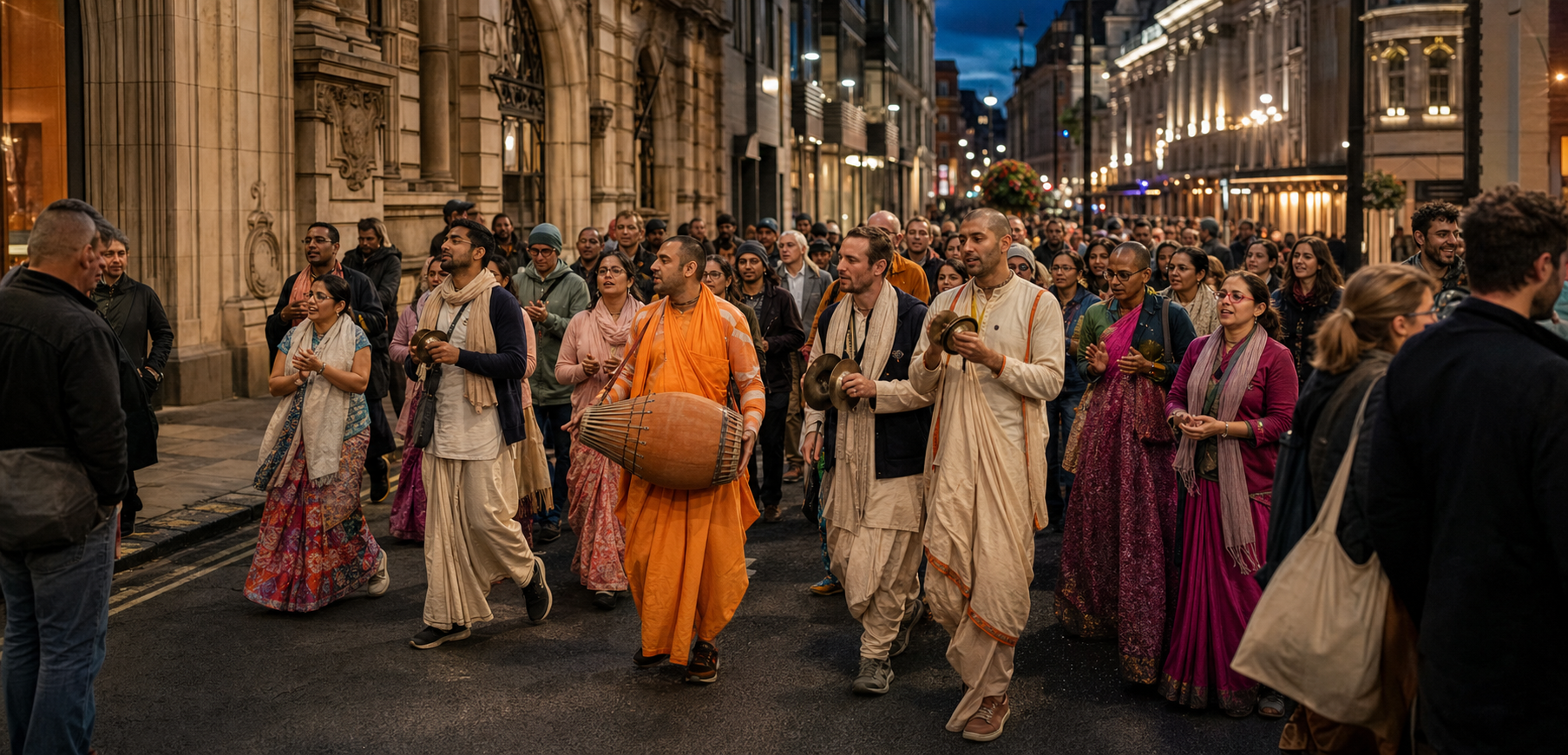
Cambridge Circus is not a neutral container for the music. Its tall facades form a street canyon that reflects the mid-range frequencies of voices and helps kartals carry through a busy junction. A modest unamplified group can therefore create a distinct pocket of audibility among engines, conversations, footsteps and the distant release of a theatre audience.
You can hear this interaction by resisting the urge to record immediately. First separate the sound into layers: the sustained harmonium tone, the mridanga cycle, the kartal accents, the leading phrase, the congregational answer and the surrounding traffic. Then notice how the buildings return some sounds while pedestrian movement continually changes what reaches you. This is a practical way to perceive the West End as a religious soundscape rather than as a theatre district with an incidental soundtrack.
The nearby theatre offers a revealing contrast. A West End production uses narrative, lighting, orchestration and a planned climax to focus an audience. Kirtan uses sacred words, repetition, gesture and an incremental musical build to cultivate bhava, a devotional mood, and darshan, a felt sense of presence. Both organise collective attention, but their purposes are not interchangeable. One presents a crafted drama to spectators; the other asks a congregation to participate in remembrance.
That distinction prevents two common mistakes. The first is dismissing public kirtan as colourful background entertainment. The second is romanticising every spontaneous response from a passerby as spiritual conversion. More often, the immediate change is smaller: someone slows down, listens, joins a refrain or begins a conversation. Living heritage survives through precisely such ordinary encounters as well as through formal institutions.
Dharmic kinship does not erase theological difference
London’s sacred soundscape extends beyond Vaishnava Harinam. Sikh shabad kirtan is grounded in the Guru Granth Sahib. Buddhist communities gather for mantra recitation and rhythmic chanting. Jain communities sing bhajans and stavans shaped by commitments such as equanimity and non-violence. These practices can share attentive listening, communal voice, ethical orientation and the repetition of sacred language without becoming versions of one generic religion.
When you encounter sacred singing, therefore, do not identify the tradition from a hand drum or repeated phrase alone. Ask what is being sung and what place the singing holds in that community. Is it the public sharing of divine names, a scriptural hymn, mantra recitation or a devotional composition? The answer lets you recognise genuine Dharmic family resemblances while respecting the commitments that make each path distinct.
This is where the West End’s cultural importance becomes concrete. A tradition carried from Bharat does not have to remain behind a museum case or a private front door to belong in London. It can move through Cambridge Circus with a portable harmonium, adapt to the rhythm of crossings, meet a theatre queue and remain devotional. Cultural continuity is not the refusal to change setting; it is the ability to preserve purpose while responding intelligently to a new one.
Next time sacred voices reach you near Cambridge Circus, begin with one deliberate act: step out of the pedestrian flow and listen until the call-and-response becomes clear. If the group’s gestures welcome participation, answer the refrain. If they do not, keep listening. Either choice allows you to meet the West End not only as a marketplace of stories, but as a place where Dharmic practice is still being lived.
References
