

You may have encountered two Hindu teachings that seem to pull in opposite directions. Pure consciousness is said to be changeless and untouched, yet the whole cosmos is said to arise through it. If consciousness never changes, how can anything emerge? And if the world is an appearance, do your body, duties, and relationships matter?
The apparent contradiction comes from treating consciousness as a very large mind and creation as a physical event happening to it. Neither assumption is necessary. Once you separate awareness from mental activity, and ultimate reality from its cosmic and embodied expressions, the teaching becomes a usable map rather than an abstract riddle.
Pure consciousness is the knower, not a refined object

Begin with something you can examine directly. A bodily sensation changes. A thought appears and disappears. A mood can dominate the morning and be absent by evening. Even the sense of being a particular person becomes stronger or weaker in different circumstances. Whatever changes can be noticed as an object of experience.
Pure consciousness names the knowing presence to which those changes appear. It is not another sensation hidden behind ordinary sensations. It is not an especially peaceful thought, a subtle light, or an image of cosmic space. In the language of witnessing awareness, or sākṣin, it is that by which body, senses, memories, thoughts, and silence are known.
This distinction prevents a common mistake. Pure does not mean morally spotless, emotionally numb, or emptied of every perception. It means that awareness itself is not reducible to the particular content it illuminates. A disturbed mind and a quiet mind are different conditions, but both conditions are known. Mental quiet is valuable because it makes the distinction easier to notice; it is not identical with the awareness that notices it.
The Yoga Sūtras express the same contemplative logic with unusual precision. Yoga Sūtra 1.2 concerns the restraint of the mind’s modifications, while 1.3 says that the seer then abides in its own nature. Citta, the changing mind, is therefore not simply another name for changeless consciousness. Quieting citta allows the seer to become evident; it does not manufacture the seer.
The Māṇḍūkya Upaniṣad sharpens the point through turīya, the fourth relative to waking, dreaming, and deep sleep. Turīya is not merely a fourth temporary condition to collect after the other three. It is the constant awareness in which all three states are disclosed. If a meditative experience begins, intensifies, and ends, that experience is still something known. Ask what knew its arrival and departure.
Intense concentration can make this inquiry vivid. When attention becomes one-pointed, bodily sensations, time, and self-commentary may recede from prominence. The organism has not vanished. Its signals have stopped occupying the center of experience. Similar attenuation can occur while you are absorbed in music, reading, or difficult intellectual work, so bodylessness by itself is not liberation.
That experience establishes a modest but important point: your normal sense of being located inside a sharply bounded body is not as fixed as it seems. It does not, by itself, establish every metaphysical claim made by Advaita, Sāṅkhya, or another school. The experience and its interpretation must be kept distinct.
The same caution applies to ānanda. Joy beyond ordinary sense pleasure may accompany deep absorption, but any bliss that arrives and leaves is still experienced content. Enjoy it without making it the final criterion. The more dependable signs are clear discernment, reduced reactivity, ethical steadiness, and an ability to return to ordinary responsibilities without confusion.
Hindu schools connect consciousness and cosmos differently
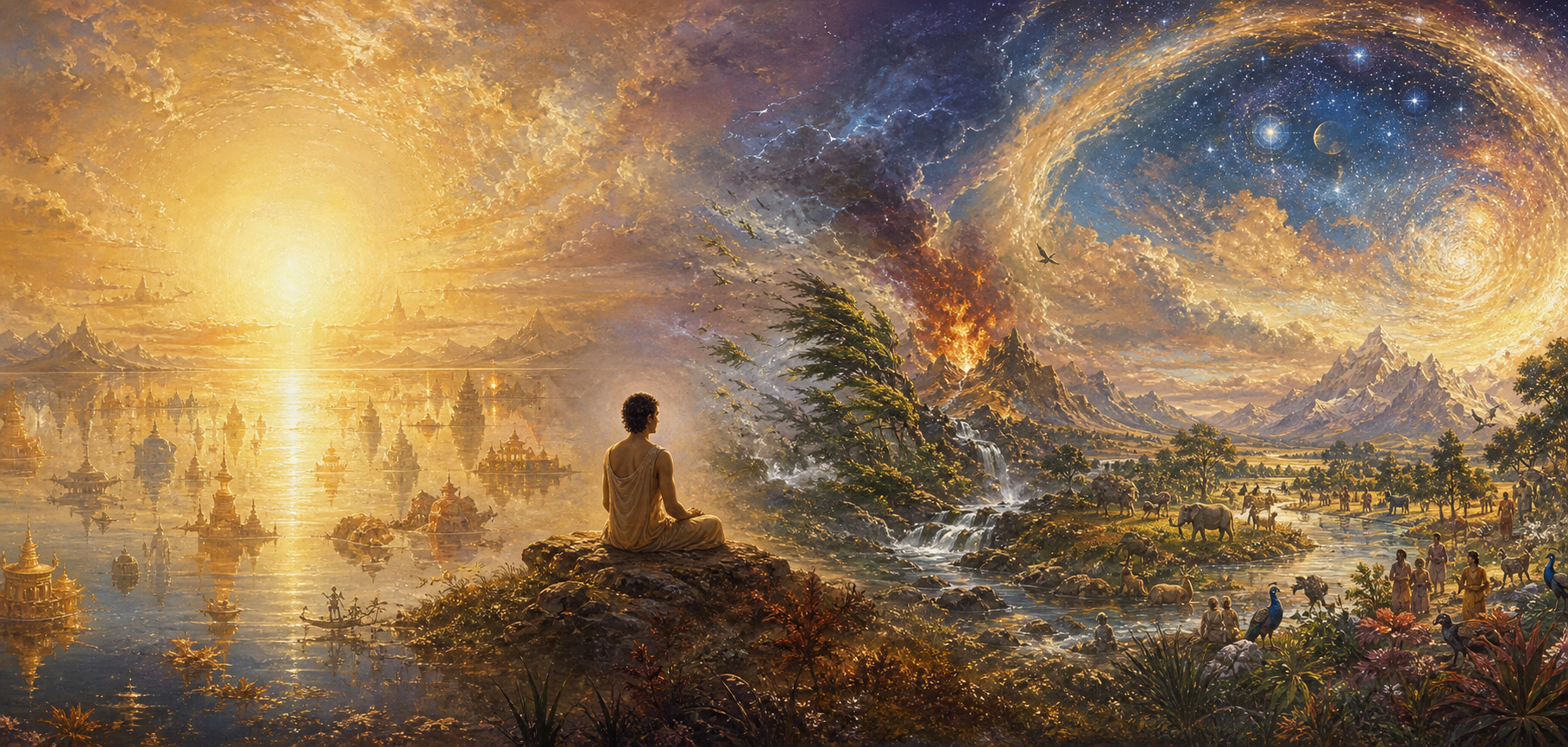
Hindu philosophy is a family of darśanas, not a single theory with interchangeable vocabulary. Brahman, Puruṣa, Śiva, Śakti, Īśvara, and citta cannot be collapsed into one vague idea called cosmic consciousness. Before accepting or rejecting a claim, identify the map in which its terms are being used.
| Philosophical map | How consciousness is understood | How the cosmos is understood | The question it asks you to examine |
|---|---|---|---|
| Advaita Vedānta | Brahman is non-dual reality; the true Self is recognized as not separate from it. | Name and form appear through Māyā, with Īśvara, Hiraṇyagarbha, and Virāṭ expressing cosmic levels. | Are you mistaking a dependent appearance for a second, independent reality? |
| Sāṅkhya-Yoga | Puruṣa is pure witnessing consciousness. | Prakṛti unfolds as intelligence, I-sense, mind, senses, subtle potentials, and elements. | What belongs to the seer, and what belongs to the changing field of the seen? |
| Śaiva-Śākta traditions | Śiva and Śakti express the inseparability of consciousness and its power. | Manifestation is a pulsation or self-expression of consciousness-energy. | Are you imagining the power of manifestation as something outside consciousness? |
| Purāṇic symbolism | The transcendent ground appears through divine personality and sacred form. | Cosmic waters, Nārāyaṇa, Ananta, the lotus, and Brahmā communicate ordered emergence. | What metaphysical relationship is the sacred image making available to contemplation? |
Advaita: the many does not become a second absolute
Advaita begins with non-duality. The Chāndogya Upaniṣad describes reality before differentiated manifestation as one without a second, while the Taittirīya Upaniṣad uses satyam jñānam anantam brahma to indicate limitless reality-consciousness. The point is not that a solitary object named Brahman once floated in empty space. Space, time, objects, and the relations between them belong to the manifested order being explained.
Nirguṇa Brahman and saguṇa Brahman are therefore not two competing gods. Nirguṇa indicates the absolute without limiting attributes. Saguṇa indicates that same reality apprehended with attributes as Īśvara, the intelligent and devotional ground of cosmic order. Māyā or Śakti accounts for the appearance of differentiation without requiring a second independent absolute beside Brahman.
A useful Vedāntic sequence is Īśvara, Hiraṇyagarbha, and Virāṭ. Īśvara indicates cosmic intelligence, Hiraṇyagarbha the subtle or archetypal totality, and Virāṭ the gross, manifest cosmos. This is a layered account of reality rather than a dated manufacturing schedule. Do not picture one object physically turning into the next.
This also corrects the careless statement that Hinduism calls the world unreal. Within a non-dual analysis, the world is not an independent absolute, but neither is it a disposable nothing. Your promises, injuries, duties, attachments, and disciplines operate within experienced order and bear consequences. Dependence on Brahman does not make conduct inconsequential. It makes the separation on which selfish conduct relies less defensible.
Sāṅkhya-Yoga: nature evolves, while the witness does not
Sāṅkhya offers a different analysis. Puruṣa is pure consciousness, while Prakṛti is primordial nature. When Prakṛti’s three guṇas move out of equilibrium, manifestation proceeds through mahat, or cosmic intelligence; ahaṅkāra, the I-sense; the subtle potentials or tanmātras; the senses and mind; and the five great elements.
This map places the ordinary mind on the side of nature, not on the side of pure consciousness. Ahaṅkāra also means more than boastful ego. It is the I-making function that appropriates a perception, role, memory, or action as mine. When you notice the thought I am angry, Sāṅkhya-Yoga asks you to distinguish the anger and its ownership-claim from the awareness to which both appear.
The practical movement is discrimination rather than cosmic fantasy. You do not need to imagine your individual thoughts projecting mountains and stars. You need to stop attributing the changing operations of Prakṛti to the changeless witness. Concentration helps because a steadier mind makes that misidentification easier to observe.
Śaiva, Śākta, and Purāṇic language: manifestation as sacred power
Śaiva and Śākta traditions resist imagining consciousness as inert. Śiva and Śakti name an inseparable consciousness-power, and Kashmir Śaivism uses spanda for the subtle pulsation through which appearances are projected and withdrawn. Spanda is not a claim about an ordinary physical vibration waiting to be measured by laboratory equipment. It is a metaphysical way of speaking about consciousness as dynamically expressive without ceasing to be itself.
The language of Om and śabda-brahman approaches manifestation as articulation. The unexpressed does not merely acquire physical bulk; it becomes intelligible as distinction, measure, name, and form. The Māṇḍūkya Upaniṣad’s identification of Om with the totality makes sacred sound a means of contemplation as well as a cosmological symbol.
Purāṇic imagery gives the same problem a form that devotion and imagination can hold. Nārāyaṇa rests upon Ananta in the cosmic ocean; a lotus rises from him, and Brahmā appears as the intelligence that orders worlds. You need not force this image into a choice between modern astronomical description and meaningless fiction. Ask what each relation conveys: the unbounded ground, latent possibility, ordered intelligence, and articulated worlds. A devotional practitioner may also receive the forms as sacred realities rather than reducing them to an intellectual code.
Use four checks whenever someone says that consciousness creates the universe:
- Identify the school. Does consciousness mean Brahman, Puruṣa, Śiva, the individual mind, or something else?
- Identify the level. Is the statement about ultimate reality, cosmic intelligence, subtle manifestation, or the gross world?
- Identify the kind of sequence. Is it chronological, causal, contemplative, or an ordering of ontological dependence?
- Identify the language. Is the passage philosophical analysis, yogic instruction, devotional theology, or Purāṇic symbolism?
The wider Dharmic family should be read with the same care. Buddhist practice can loosen body-centered identity while interpreting the result through anattā rather than an eternal Ātman. Jain thought affirms jīva and understands consciousness through upayoga and the removal of karmic obstruction. Sikh thought centers Ik Onkar, hukam, and remembrance of the Divine Name. Shared contemplative patterns do not erase different metaphysical conclusions. Dharmic unity is stronger when it preserves those distinctions.
Test the teaching in the microcosm without overclaiming

Hindu cosmology becomes practical when the structure attributed to the cosmos is examined in your own experience. The gross body, subtle senses and mind, causal latency, and witnessing awareness form an inward map. Its purpose is not to make you despise the outer layers. It is to stop any one layer from monopolizing your identity.
Use the following practice as an exercise in discernment, not as a hunt for extraordinary states:
- Establish the ethical frame first. Recall non-harming, truthfulness, moderation, and responsibility. If your spiritual aim requires neglecting a real duty or becoming indifferent to another person’s suffering, the aim is already distorted.
- Reduce avoidable sensory competition. Silence notifications, choose a quiet place, and complete any urgent task that would keep demanding rehearsal. This is a simple form of pratyāhāra: gathering the senses rather than waging war against them.
- Choose one object and keep it consistent from sitting to sitting. Use the breath at the nostrils, a mantra, a simple point of attention, or inner sound. Constantly changing the object trains selection; returning to one object trains continuity.
- Practice abhyāsa as a firm but unforced return. When sound, sensation, memory, or planning captures attention, recognize what occurred and return. Do not turn distraction into a verdict about yourself.
- Distinguish layers of experience. Notice a bodily sensation, then the mental label attached to it, then the I-sense claiming it. Each is known. Let the question what knows this remain experiential rather than answering it with a rehearsed doctrine.
- Use neti neti carefully. Not this, not this does not mean that the body and mind are hated or nonexistent. It means that no changing object exhausts the identity of the knower.
- Re-enter ordinary activity deliberately. Notice the room, feel the body’s contact with the ground, and perform the next duty with full attention. Integration is part of the practice, not an interruption of it.
As dhāraṇā becomes steadier and develops toward dhyāna, inner commentary may lessen and bodily boundaries may feel less prominent. Let that happen if it happens. Do not manipulate the breath, strain attention, or treat disappearance of body-sense as a target. The classical progression from posture and breath through sense-withdrawal, concentration, meditation, and absorption is meant to stabilize clarity gradually.
Afterward, judge the sitting by its effects on conduct. Are you a little less compelled by the first angry thought? Can you listen without preparing your defense? Does fear loosen without producing carelessness? Can you attend to the body without believing that bodily change threatens the whole of what you are? These are more useful tests than lights, bliss, altered time, or a dramatic feeling of expansion.
Contemplative bodylessness must also be distinguished from dissociation or derealization. Healthy absorption tends toward clarity, tranquility, and better integration after the sitting. Numbness, persistent disorientation, impaired daily functioning, or increasing social withdrawal are reasons to stop intensifying the practice and seek qualified guidance. If such symptoms continue outside meditation or cause distress, consult an appropriate mental-health professional. Meditation should not be used as a substitute for care.
Cyclic time turns cosmology into responsibility

Hindu cosmology does not normally require one absolute beginning after an eternity of nothing. Manifestation, sustenance, and dissolution form recurring rhythms. The Nāsadīya Sūkta even approaches origins by withholding easy assertions about being and non-being. That restraint matters: a tradition can offer immense cosmological scales while still treating ultimate origins as a question demanding intellectual humility.
A mahāyuga comprises four yugas totaling 4.32 million years. One thousand mahāyugas make a day of Brahmā, or a kalpa of 4.32 billion years, and fourteen manvantaras divide a kalpa with transitional periods. These cycles place human history inside a far larger rhythm of manifestation and withdrawal. Their philosophical work is to loosen the assumption that the cosmos exists for one generation, one empire, or one human biography.
The traditional distinctions among dissolutions make the inward relevance unmistakable:
- Naimittika pralaya is a periodic dissolution associated with the end of a kalpa.
- Prākṛtika pralaya returns differentiated forms to undifferentiated Prakṛti.
- Ātyantika pralaya is liberation: the final dissolution of ignorance and the appearance of bondage for the realized person.
The last meaning brings cosmology directly into your life. Dissolution is not only something imagined at the end of an inconceivably long age. Every serious practice asks which false identification can end now. A role may continue without defining the whole Self. A sensation may remain without becoming a command. An injury may be addressed without turning grievance into permanent identity.
This is why dharma cannot be treated as an optional moral appendix to metaphysics. If the same order holds body, mind, society, and cosmos, greater clarity should produce more responsible participation in that order. Yoga begins with ethical disciplines because concentrated attention amplifies whatever intention directs it. Non-dual language that makes you careless about truth, harm, or duty has been misunderstood.
The distinction between spiritual cosmology and physical cosmology must remain equally clear. Physics investigates measurable dynamics. Hindu darśanas examine being, consciousness, causation, value, experience, and liberation. Structural affinities, such as cyclicality or layered emergence, can support a worthwhile dialogue, but resemblance is not identity. A metaphysical sequence should not be advertised as a scientific prediction merely because its imagery sounds modern.
When you hear that Hindu cosmology anticipated a scientific theory, ask for the precise observable, mathematical relation, or testable prediction shared by both. If none is given, treat the comparison as philosophical analogy. Hindu thought does not need borrowed scientific authority to make its central challenge: explain how every fact about the universe becomes known, and whether the knowing itself can be reduced to one more known object.
Key takeaways
- Pure consciousness is not your private stream of thought enlarged to cosmic size. It is the principle of knowing distinguished from changing mental content.
- A quiet or bodyless state may reveal how contingent ordinary identification is, but the state alone does not prove a complete metaphysical system.
- Advaita, Sāṅkhya-Yoga, and Śaiva-Śākta traditions do not use consciousness and manifestation in identical ways. Identify the school before interpreting the claim.
- Īśvara, Hiraṇyagarbha, and Virāṭ describe cosmic levels; they should not automatically be read as objects produced one after another in historical time.
- The practical test of cosmological insight is not fascination with scale. It is clearer discernment, steadier conduct, and fuller participation in dharma.
In your next sitting, do not try to escape the body or manufacture a cosmic experience. Hold one object steadily, notice every sensation and thought as something known, and investigate the knower without rushing to name it. Then carry that clarity into one concrete duty. That movement from witness to responsible action is where cosmology stops being speculation and begins to shape a Dharmic life.
References
- DharmaRenaissance Blog – From Brahman to Cosmos: Decoding Hindu Cosmology, Cyclic Time, and Dharmic Unity
- DharmaRenaissance Blog – Beyond the Body-Illusion: How Intense Concentration Unveils Pure Consciousness in Hindu Thought
