

If you serve in an ISKCON temple or another Dharmic institution, the hardest question is often not how to preserve an elder’s words. It is how to preserve the quality of service those words were meant to produce after the elder is no longer carrying the work.
Badrinarayan Swami’s legacy offers a demanding answer: prepare others, entrust them with real responsibility, and understand leadership as seva. The measure of remembrance is not how warmly a community speaks of an elder. It is whether his way of encouraging, forming, and trusting people becomes part of the institution’s ordinary life.
The blessing that turned succession into spiritual duty

When Badrinarayan Swami learned that a younger devotee had accepted service as a member of ISKCON’s Governing Body Commission, he responded with unmistakable joy. He anticipated that the responsibility would bring mercy and spiritual realization through seva. Then he expressed the peace of an elder who had seen someone from the next generation step forward.
Now I can peacefully die.
Badrinarayan Swami
Heard only as a sentence about mortality, those words can sound startling. Their institutional meaning lies in the word “now.” His peace was connected to continuity. A younger devotee had not merely offered admiration; he had accepted responsibility for carrying the mission.
The sequence reveals how a living lineage makes a healthy handoff:
- A disciple or younger servant accepts a demanding responsibility.
- The elder welcomes that development instead of remaining possessive about authority.
- The responsibility is framed as an opportunity for purification and realization, not personal advancement.
- Trust in the successor allows the elder to release the need to remain indispensable.
This gives you a practical test for institutional health. Can your elders identify people who are being prepared to carry the work? Have those people already demonstrated steady service? Does the trust placed in them include clear duties and real accountability? Can an elder step back without the mission becoming paralysed?
A community may preserve an elder’s photographs, recordings, and affectionate stories while leaving these questions unanswered. That preserves memory, but it does not yet secure succession. Badrinarayan Swami’s words direct attention from commemoration to custodianship.
Why GBC leadership had to be understood as seva
Within ISKCON, the GBC is a worldwide leadership commission. Its responsibilities include shaping policy frameworks, nurturing standards of sadhana and education, and supporting temple administration and outreach. Membership therefore carries consequences for devotees and communities far beyond the person holding the role.
That scope is why Badrinarayan Swami’s encouragement should not be read as congratulations on receiving an honorific. The position signalled trust in character, competence, and commitment to a shared ethos. Its spiritual value would arise from shouldering the work faithfully.
In the bhakti understanding, kripa, or mercy, is received rather than manufactured as a personal achievement. Anubhava, or realization, matures as devotion is repeatedly applied in service. A leadership position does not automatically sanctify its holder. It creates situations in which motives are tested, limitations become visible, and dependence on guidance becomes necessary.
This distinction protects a spiritual institution from confusing prominence with advancement. When leadership is seva, authority follows responsibility. When leadership becomes a reward for ambition, the same office can nourish the ego it was supposed to discipline.
A dependable path into shared spiritual leadership moves through four forms of formation:
- Sadhana: Daily discipline keeps public work downstream of worship, study, and self-examination.
- Seva: Consistent service reveals whether a person remains dependable when the work is repetitive, difficult, or largely unseen.
- Shiksha: Teaching requires the servant to understand principles well enough to explain and apply them without reducing them to slogans.
- Shared sangha leadership: Deliberating with others tests whether conviction can coexist with listening, correction, and collective responsibility.
This is formation, not a bureaucratic ladder. Someone may be visible before becoming steady, articulate before becoming accountable, or efficient before learning how to care for people affected by a decision. Skipping those gaps does not serve the candidate or the community.
If you are being asked to accept leadership, seek clarity before saying yes. Who can correct you? Which decisions will actually be yours? Which sadhana practices must remain protected when the workload grows? Who is learning the service beside you? A role with no credible answers to those questions may confer a title without providing the conditions for responsible seva.
Guru–shishya grace forms custodians, not admirers
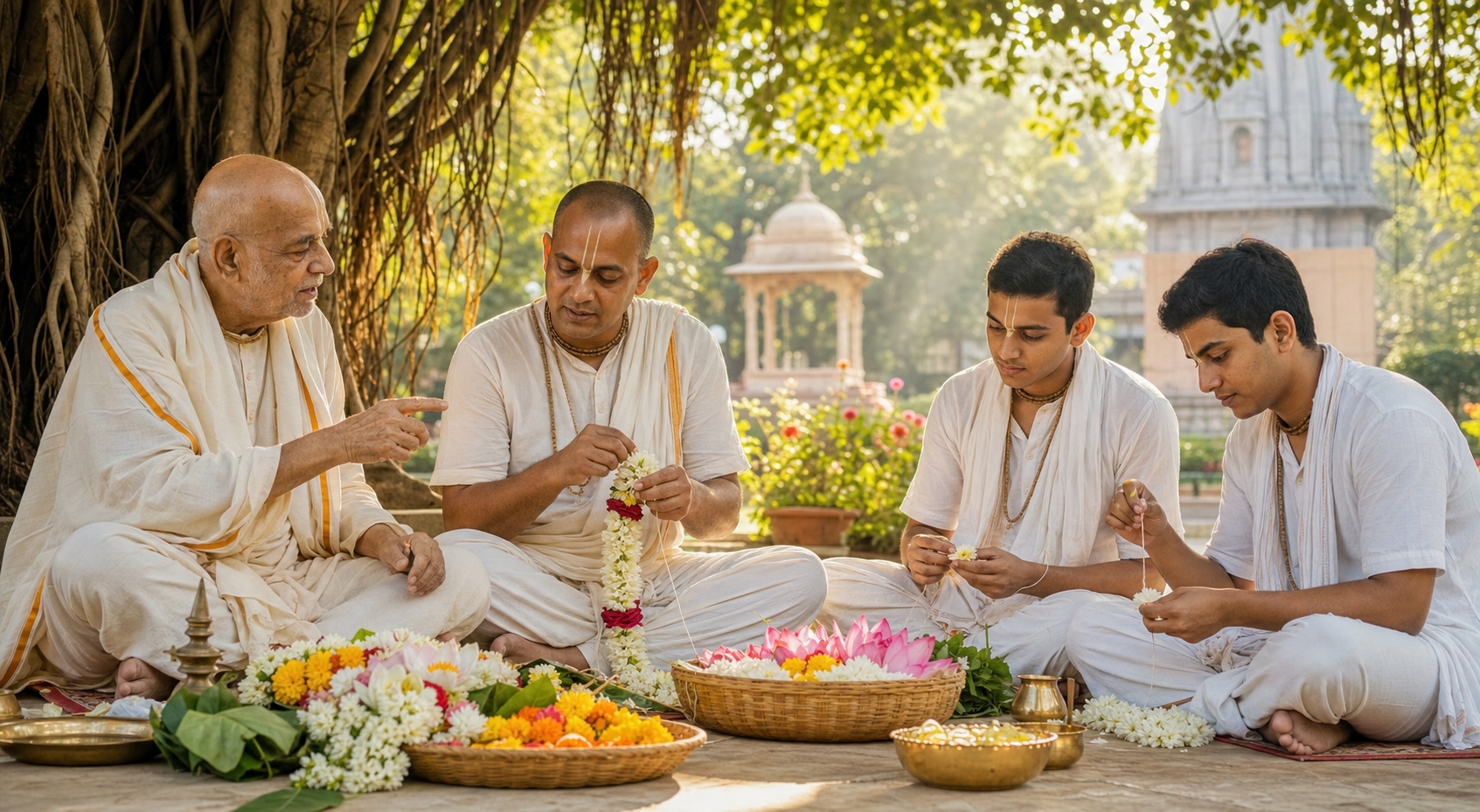
The guru–shishya relationship is sometimes pictured chiefly as a disciple receiving instruction. Parampara transmits more than propositions, however. It also transmits dispositions: humility, steadiness, courage under responsibility, and the reflex to encourage another person’s service.
Correction has an essential place in that relationship, but precise affirmation can accomplish something correction alone cannot. It tells a younger servant that the responsibility is truly becoming theirs. Badrinarayan Swami did not make encouragement vague or sentimental. He connected acceptance of duty with grace, realization, and the continuity of the mission.
If you mentor younger devotees, make your encouragement equally usable:
- Name the service you have actually seen rather than praising personality in general.
- Explain why that service matters to the mission and to the people who depend on it.
- Connect greater trust with deeper accountability, not greater privilege.
- Transfer a real decision along with the task, while keeping an appropriate review process.
- Remain available for questions without reclaiming the responsibility at the first imperfect result.
If you are the person receiving such a blessing, do not reduce it to a compliment. Write down the duty the elder has entrusted to you, the people your choices will affect, the principles that should govern those choices, and the peers or elders you will consult when uncertain. The blessing becomes formative when it changes how you serve after the emotional force of the moment has passed.
Being seen, encouraged, and entrusted can shift a devotee’s identity from participant to custodian. That shift should deepen humility rather than end it. Grace and accountability are not competitors: the more consequential the trust, the wider the circle of people to whom the servant becomes answerable.
Institutional structures must carry the lineage forward

Affection between an elder and a successor is precious, but succession remains fragile when essential knowledge lives only in one person’s memory. A spiritual handoff needs practices that preserve judgment, invite correction, and distribute responsibility without dissolving it.
Intergenerational mentoring that transfers judgment
Mentoring should include more than lectures and recollections. Let the younger servant observe how a difficult decision is made. Ask them to explain the principle they saw at work. Then let them own a comparable decision with review from the elder or mentoring circle.
This exposes misunderstandings while guidance is still available. It also distinguishes genuine transmission from imitation. The successor does not need to reproduce the elder’s personality; the successor needs to recognise the principles that made the elder’s service trustworthy.
Reflective supervision rooted in shastra and precedent
After a consequential decision, ask what scriptural or institutional principle guided it, which precedent was relevant, whose needs were considered, and what unintended effect appeared. Record the reasoning, not only the final outcome.
An unexplained rule leaves the next generation unable to tell when that rule applies and when circumstances require fresh deliberation. A recorded rationale preserves practical wisdom while still allowing later leaders to notice where a decision depended on a particular context.
Transparent councils with visible accountability
Distributed titles do not necessarily produce distributed authority. A functioning council allows members to question reasoning, records its decisions, assigns responsibility for carrying them out, and makes the path of correction visible to those entrusted with oversight.
Transparency does not require broadcasting every confidential pastoral matter. It requires enough clarity for responsible members to understand how authority was used, what standard governed it, and who must respond if the decision causes harm or proves ineffective. That is how shared governance reduces dependence on a single personality without creating leaderless ambiguity.
Mentoring, reflective supervision, and transparent councils turn personal encouragement into institutional memory. They also make personality cults and organisational drift easier to detect. No procedure can substitute for character, but good structures give humility, responsibility, and correction a durable form.
The shared Dharmic question
Other Dharmic communities answer the problem of continuity through their own authorities and forms. Buddhist monastic lineages depend on preceptors and the sangha. Jain traditions sustain acharya-led paramparas shaped by disciplined conduct. Sikh continuity rests in the guidance of the Guru Granth Sahib and the life of the Panth.
These traditions should not be flattened into doctrinal equivalence. Their comparison is useful at a more careful level: each must transmit guidance beyond one individual’s lifespan, form people capable of carrying it, and restrain authority through study, service, and ethical discipline.
When you examine your own community, ask where guiding authority resides, how future custodians are formed, and which disciplines prevent personal preference from being mistaken for dharma. ISKCON’s answer includes guru–shishya transmission, scripture, sadhana, seva, and shared governance through the GBC. Each element is strongest when the others can test and support it.
Key takeaways for carrying the legacy into practice
- Badrinarayan Swami connected an elder’s peace with the next generation’s willingness to accept real responsibility.
- GBC leadership matters spiritually when it is practised as seva rather than treated as personal elevation.
- In bhakti, responsibility can become a setting for mercy and realization, but office alone does not confer either.
- Guru–shishya encouragement should move a disciple from admiration to accountable custodianship.
- Succession becomes durable through intergenerational mentoring, reasoned review, transparent councils, and documented institutional memory.
- A worthy successor carries forward principles and service; copying an elder’s personality is neither necessary nor sufficient.
Choose one responsibility you currently hold in a temple, sangha, or Dharmic organisation. Write down the principle that governs it, the person who could carry it in your absence, and the authority that person would need. Then let them handle the next suitable instance with review. Begin while there is still time for questions, correction, and blessing. That is how remembrance becomes lineage.
References
