
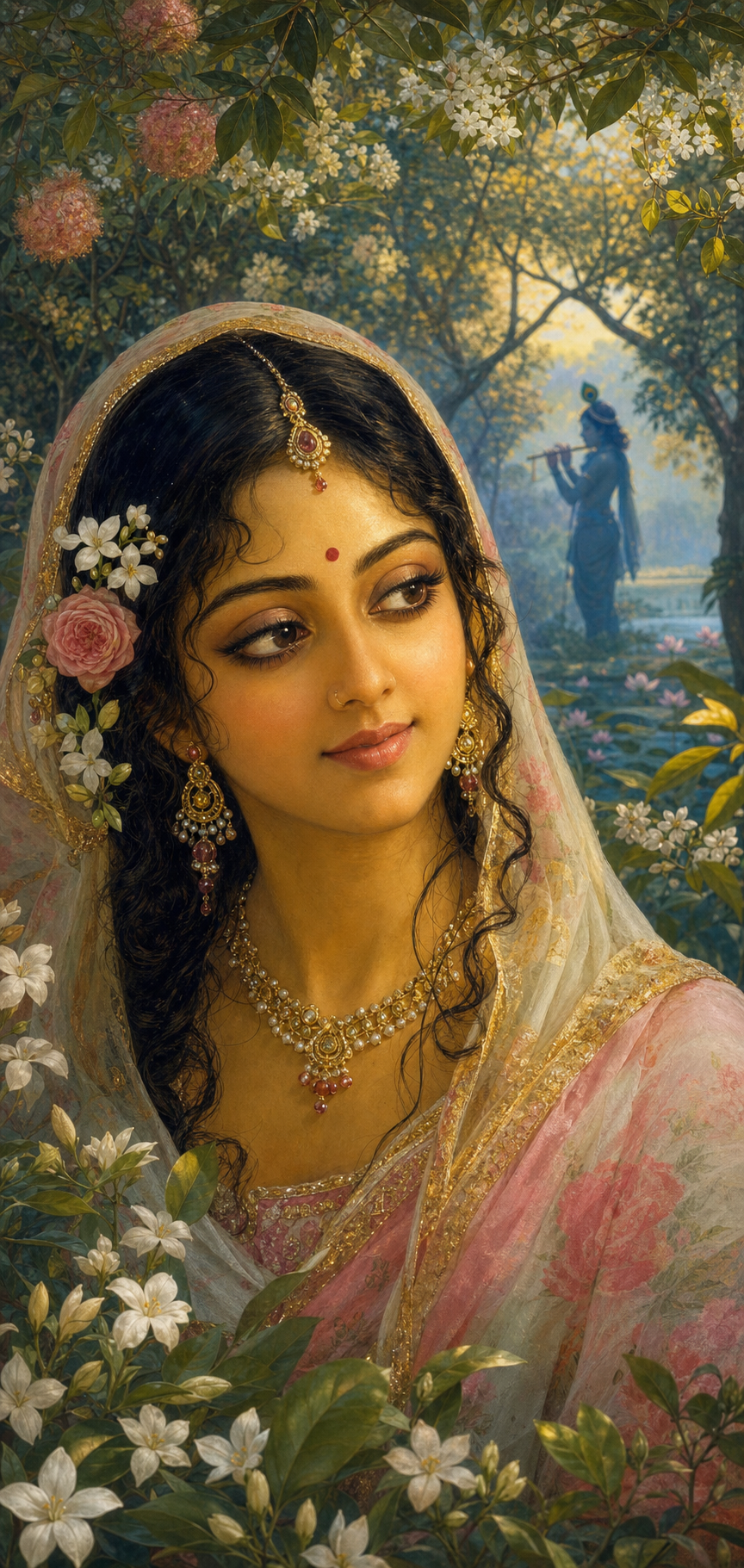
You pause before an image of Sri Radha and know that her face is meant to be received as more than a beautiful face. Yet beauty may be the first thing you notice, and you may not know where your attention should go next. That first response is not wrong. It is simply unfinished.
Devotional seeing lets visual beauty do spiritual work. You observe the image carefully, interpret it without presumption, recover the relationship within the scene, and allow the encounter to shape your own attention. This is how appreciation begins to become darshan rather than aesthetic consumption.
Start with the relationship the face makes visible
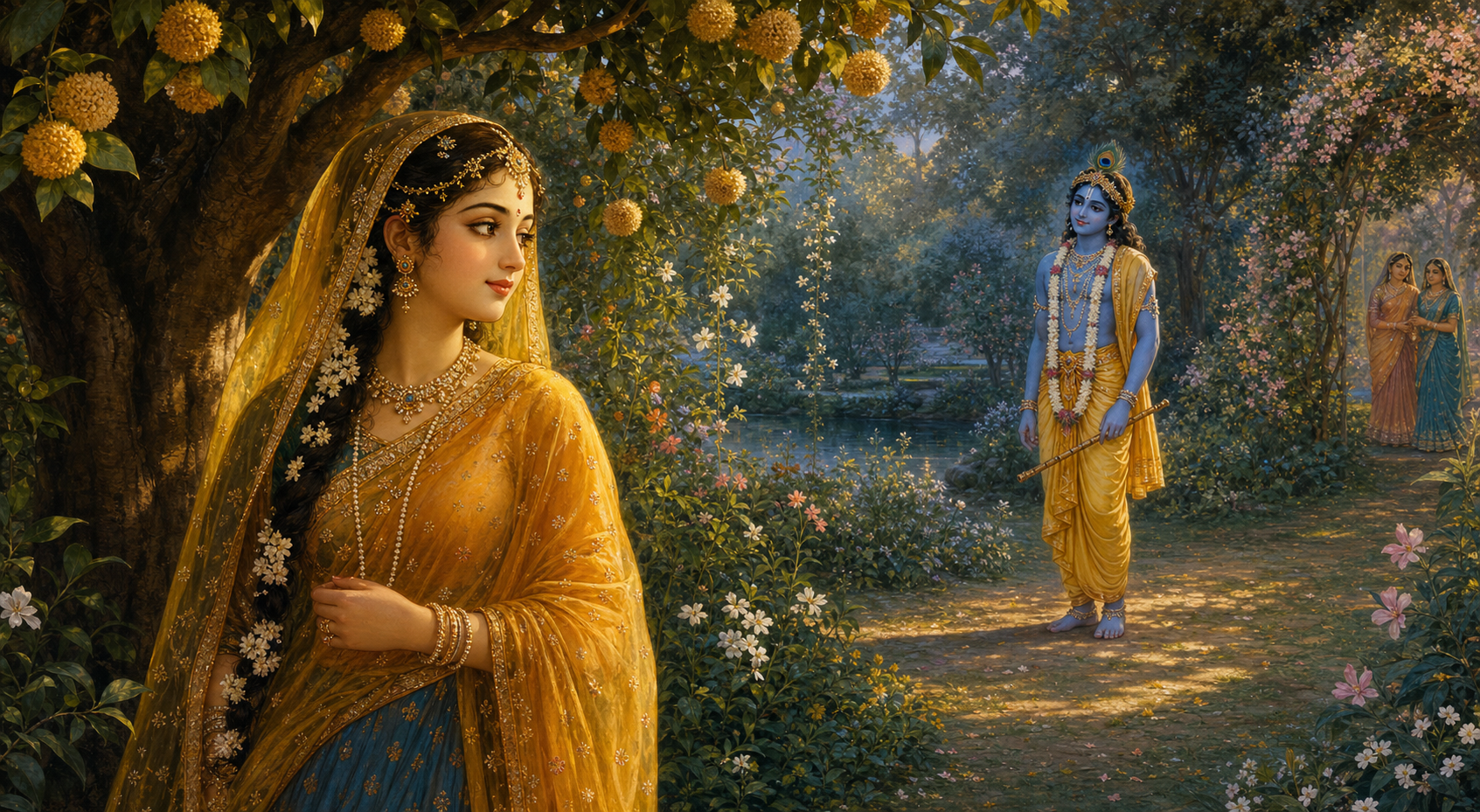
A face in devotional art is not an isolated arrangement of attractive features. Its meaning arises through relationship: where it turns, toward whom it looks, what presence it welcomes, what absence it makes felt, and where it places you as the beholder.
This is especially important with Sri Radha. If you begin by inventorying her eyes, brows, lips and ornaments, you can miss the devotional center of the image. Begin instead with the relationship that makes those features meaningful. Krishna may be present in the composition, implied beyond its frame, recalled through an object, or encountered through the direction and mood of her gaze. The surrounding image tells you how the face is being offered for contemplation.
Darshan is therefore not visual inspection with religious subject matter added afterward. It is a way of placing yourself before sacred presence. The decision to dwell on Sri Radha’s face as a stimulation for ecstatic love reflects this devotional logic: sustained attention is meant to awaken remembrance and affection, not merely produce a verdict about artistic beauty.
Before studying an individual feature, ask:
- Where is Sri Radha’s face turned, and where does her gaze appear to travel?
- Who or what is visible in that direction?
- If the object of her attention is outside the frame, how does that absence affect the scene?
- Does the composition invite you close, hold you at a reverent distance, or direct your attention elsewhere?
- What response does the image seem to ask from you: admiration, remembrance, prayer, restraint or service?
Try completing a simple sentence in your own mind: Her expression becomes meaningful here because… If you cannot complete it, zoom out from the face and receive the entire composition again. Context usually corrects the imagination before imagination hardens into certainty.
If you belong to a particular sampradaya, let its received teachings establish the theological frame. Visual interpretation can refine your attention, but it should not replace instruction or turn one artist’s choice into a universal doctrine.
Read the whole expression before interpreting a feature
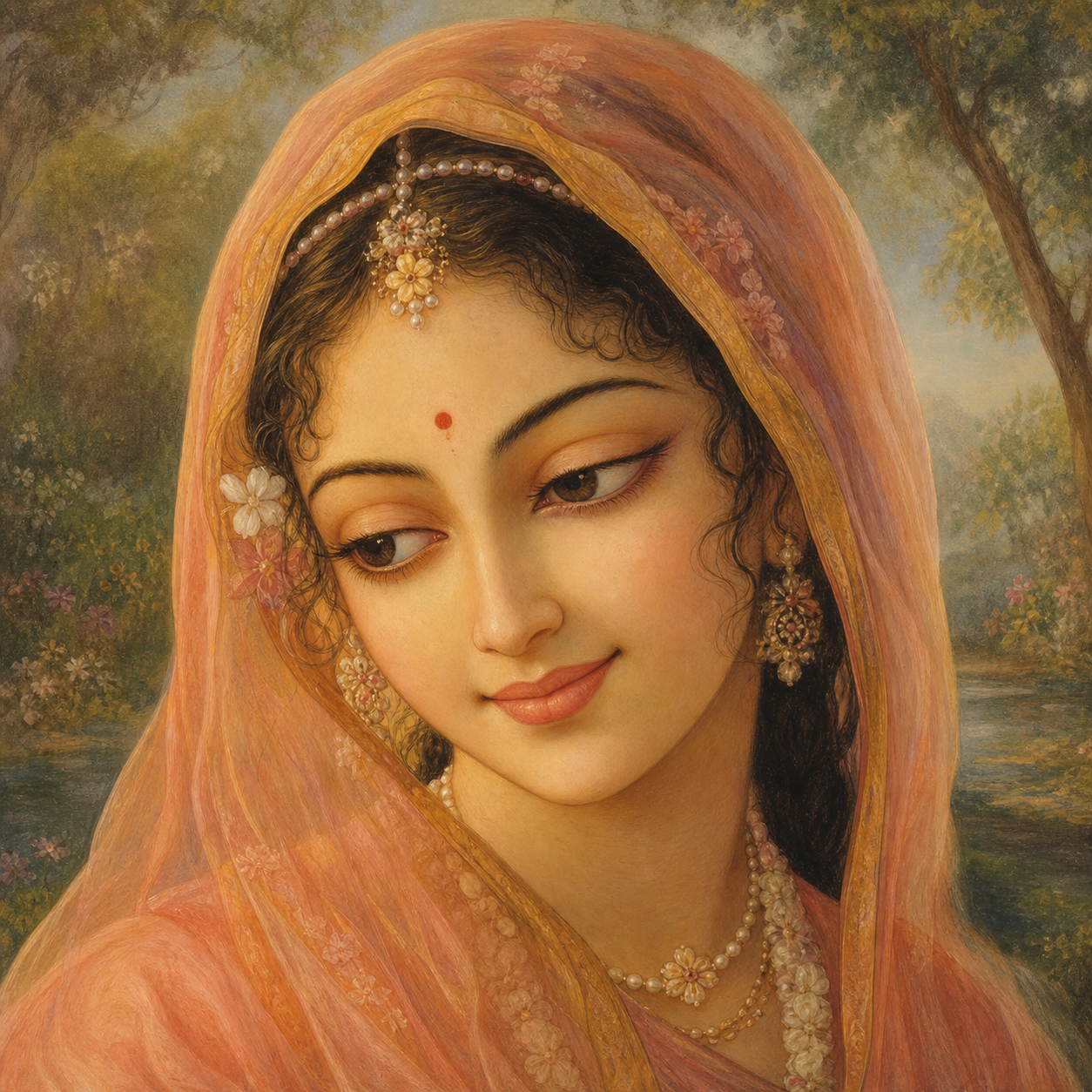
Devotional images encourage close attention, but close attention can produce overconfidence. A lowered gaze, curved brow or restrained smile may feel charged with meaning. That does not make any isolated detail a fixed code that can be carried unchanged from one image to every other image.
Read the face in a disciplined order:
- Receive the whole image. Notice the placement of figures, the direction of bodies, the setting, the gestures and the visual center of the composition.
- Describe what is actually visible. Attend to the direction of the eyes, the set of the brows, the mouth, the angle of the head and the relation between these elements. Avoid assigning an emotion yet.
- Look for interaction. Ask how the face responds to another figure, gesture, object or open space in the composition.
- Offer a modest interpretation. Use language such as may convey, can be received as, or within this scene. This keeps an aesthetic response from pretending to be certain knowledge of divine interiority.
- Return the interpretation to devotion. Ask how this possible mood changes the way you remember Sri Radha and Krishna or approach your own practice.
Suppose an artist has lowered the eyes and quieted the mouth. That is an observation. Reserve, tenderness or inward attention may be possible interpretations, depending on the rest of the image. Declaring that the detail necessarily has one theological meaning goes beyond what the visual evidence can carry.
Description should come first, relational interpretation second, and theological assertion last. This order does not weaken devotion. It protects devotional attention from becoming projection.
Artistic technique still matters. Line, color, proportion, rhythm, ornament and contrast guide the eye and pace the encounter. You do not have to choose between noticing craft and receiving darshan. The useful distinction is between treating technique as a pathway into contemplation and treating it as the final object of judgment.
Let beauty lead to reverence rather than possession
Calling Sri Radha’s face beautiful is not a shallow response. Beauty attracts attention. The devotional question is what happens to that attention after it has been attracted.
One dead end is aesthetic scoring: deciding whether the face matches your preferred style, comparing it with another depiction, or reducing the encounter to technical approval. Another is sentimental projection: placing your present emotion into the face and then treating your own feeling as a revelation about Sri Radha.
You can redirect both tendencies without suppressing delight. When beauty catches your eye, move through these questions:
- What has the artist actually presented: softness, composure, luminosity, reserve, openness or another visible quality?
- How does that quality become meaningful through Sri Radha’s relation to Krishna and the rest of the scene?
- What does your response become when you move from rating the image to receiving it?
- Does the encounter leave you more attentive, grateful, restrained or ready for seva?
Reverence does not require emotional coldness. Devotional art can communicate sweetness, intimacy and tenderness without making sacred beauty available for possession. The grammar changes from I rate and I consume to I receive and I respond. That shift allows intimacy to remain devotional.
This distinction also matters when you publish or share an image. A face-only crop may intensify visual appeal while removing Krishna, companions, gestures, altar elements or other features that orient the face relationally. Preserve enough of the composition for its devotional direction to remain legible. Use a caption that names the sacred subject rather than presenting Sri Radha as anonymous feminine decoration.
Before posting, ask whether the framing encourages remembrance or merely seeks attention. A devotional image should not lose its sacred identity in the pursuit of an attractive thumbnail.
Use a repeatable practice of devotional seeing
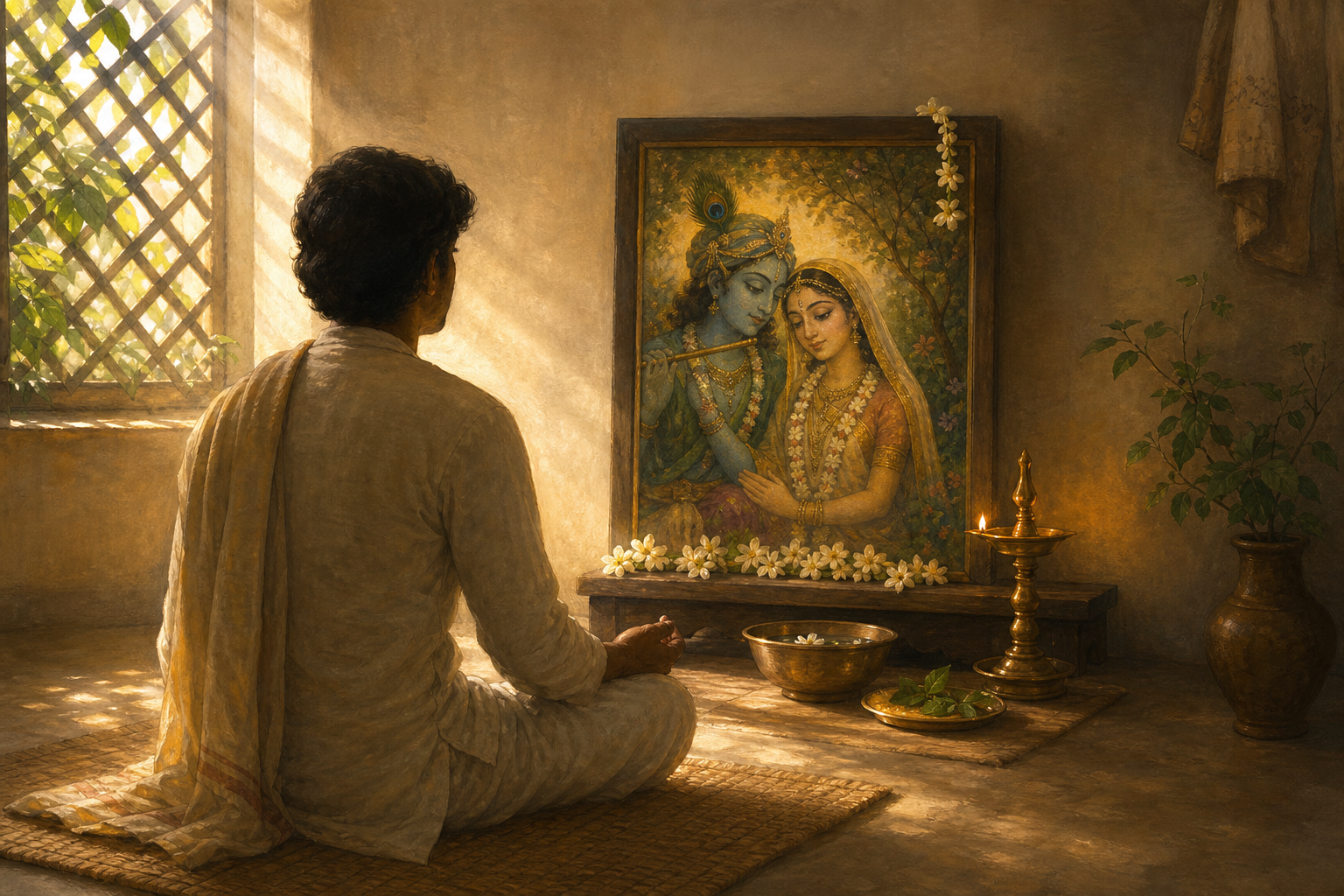
You can use the following practice before a painting, print or murti. In a public temple, keep the exercise inward, respect the movement of other devotees, and follow the local customs governing darshan.
- Set your intention. Name why you are looking: to remember, pray, receive darshan or study the work reverently. This prevents preference from silently becoming the purpose.
- Receive the whole form. Resist the urge to zoom immediately into the face. Let the full composition establish presence, direction and relationship.
- Describe before interpreting. Notice the gaze, brows, mouth, head angle and their interaction. Keep what you see separate from what you think it means.
- Restore the relationship. Ask toward whom the expression is directed and how Krishna is present, implied or remembered within the image.
- Allow a fitting response. Remain with a prayer, a mantra already received in your practice, gratitude, silence or a resolve toward service. Do not manufacture an emotion to prove that the encounter was devotional.
- Carry one consequence forward. Let the attention given to the image become a small act of care, restraint, remembrance or seva after you turn away.
If you keep notes, separate them under three simple labels:
- Observation: what is visibly present in the image.
- Interpretation: what those choices may communicate in this composition.
- Response: what the encounter asks you to remember or do.
This separation is valuable because your response can change from one viewing to another. A change in feeling may reveal something about your own attention; it does not prove that the theological meaning of the image has changed. Devotional maturity includes knowing the difference.
If no strong feeling arises, do not imitate one. Emotional intensity is not the only measure of attention, and it is not proof by itself. Honest stillness, exact observation and respectful remembrance are better than performed ecstasy.
Questions that clarify the encounter
Does every facial detail have a fixed spiritual meaning?
No. A detail receives meaning from the whole composition, the artist’s visual language and the devotional tradition in which the image is situated. Begin with description, consult the teachings of your tradition where appropriate, and avoid building doctrine from a single feature.
What if Sri Radha’s face does not awaken an immediate emotion in me?
Remain honest. Look carefully, offer respect, and let remembrance be simple. You do not need to manufacture sweetness, tears or intensity. A truthful act of attention gives devotion firmer ground than an emotion performed for yourself or others.
Can I examine artistic technique without reducing darshan to art criticism?
Yes. Notice how line, color, proportion and composition guide your attention, but do not stop at whether you approve of them. Ask what devotional relation the technique makes visible and what response that relation calls from you. Craft is then part of the encounter rather than a distraction from it.
The next time you behold Sri Radha’s face, begin one step farther back than instinct suggests. Receive the whole relationship, observe without rushing to decode, and let beauty end in remembrance or service. That movement from looking to responding is where devotional aesthetics becomes practice.
References
