
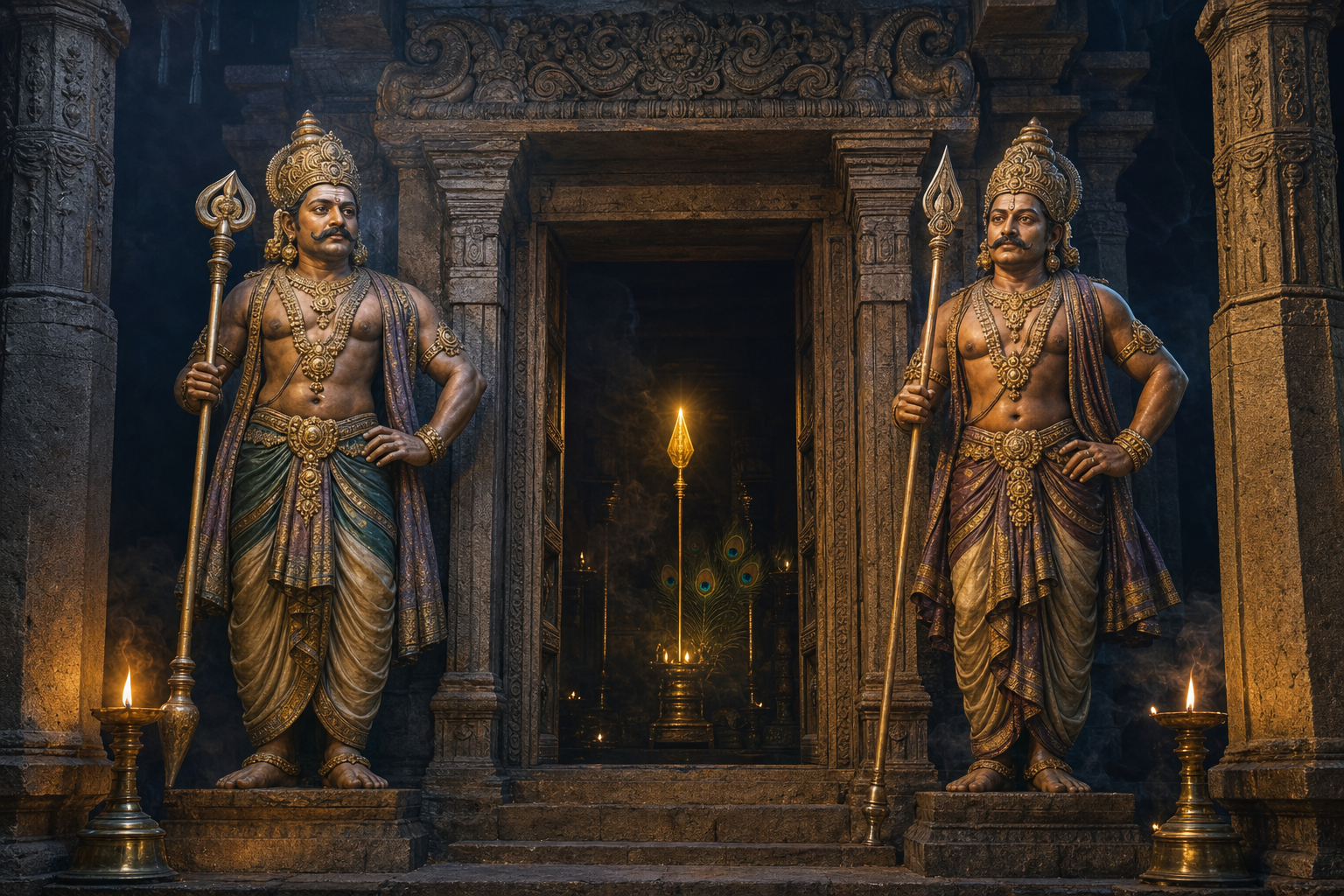
If you have stood before a Murugan sanctum and wondered about the two commanding figures beside the doorway, you have already encountered the question that Sumukha and Sudeha answer: what must change in us before we approach the Divine?
Regional Murugan traditions remember Sumukha and Sudeha as the sons of Veerabahu and as guardians serving Lord Murugan. That identification is meaningful, but it should be used carefully. Not every pair of unlabeled Dwarapalakas at every Murugan temple can automatically be given these names. Once you understand the distinction between a guardian’s function and a temple’s local identification, you can approach the figures with both devotion and accuracy.
Key takeaways for the temple visitor
- Sumukha and Sudeha are remembered in regional temple lore as the sons of Veerabahu, Murugan’s commander and protector.
- They are servants of Murugan’s dharma, not independent powers competing for the devotee’s attention.
- Dwarapalakas mark the passage from ordinary activity into sacred attention. Their position is part of their teaching.
- A heroic stance, weapon or martial appearance identifies a guardian function, but it does not by itself establish the personal names Sumukha and Sudeha.
- You do not need to invent a separate ritual for them. A composed pause, folded hands and respectful entry are enough unless the temple maintains a particular custom.
Who Sumukha and Sudeha are, and what we can responsibly claim
A Dwarapalaka is a keeper of the doorway. In South Indian temple architecture, guardian figures commonly stand at gopurams and at especially important inner thresholds, including the entrance to the garbhagriha. Their location explains their office before their weapons or ornaments do: they stand where one kind of space gives way to another.
In local Murugan traditions, the two guardians are sometimes named Sumukha and Sudeha. They are described as valiant sons of Veerabahu who continued their father’s disciplined service to Murugan. Their remembered roles reach beyond standing at a door. Regional accounts associate them with Murugan’s campaign against Surapadman and with the celebrations of order restored, including Murugan’s marriage festivities.
The textual distinction matters if you are trying to explain them to a child, a visitor or a study group. Veerabahu belongs to the larger narrative world of the Skanda Purana and the Tamil Kanda Puranam, where he acts as Murugan’s lieutenant, envoy and strategist. The specific naming of the two doorway guardians as Sumukha and Sudeha is more closely tied to localized temple and sthala-purana memory. It is therefore better to say, “This temple’s tradition identifies them as Sumukha and Sudeha,” than to claim that every Murugan temple uses the same names.
You can verify a local identification without turning darshan into an investigation:
- Look for an inscription, name plaque, temple guide or festival booklet near the sannidhi.
- Ask a priest or knowledgeable temple attendant, “What names does this temple use for the two guardians at Murugan’s doorway?”
- Ask whether the identification comes from the temple’s sthala-purana or from an established oral tradition.
- If no definite name is preserved, simply refer to the figures as Murugan’s Dwarapalakas. Uncertainty does not diminish their sacred function.
This is particularly important at celebrated Murugan shrines such as Tiruchendur and Tirupparankunram, where the martial dimension of Murugan’s story is strongly present. The setting may make the guardian symbolism especially vivid, but the exact names should still be confirmed through that temple’s own tradition.
Why their descent from Veerabahu changes the meaning
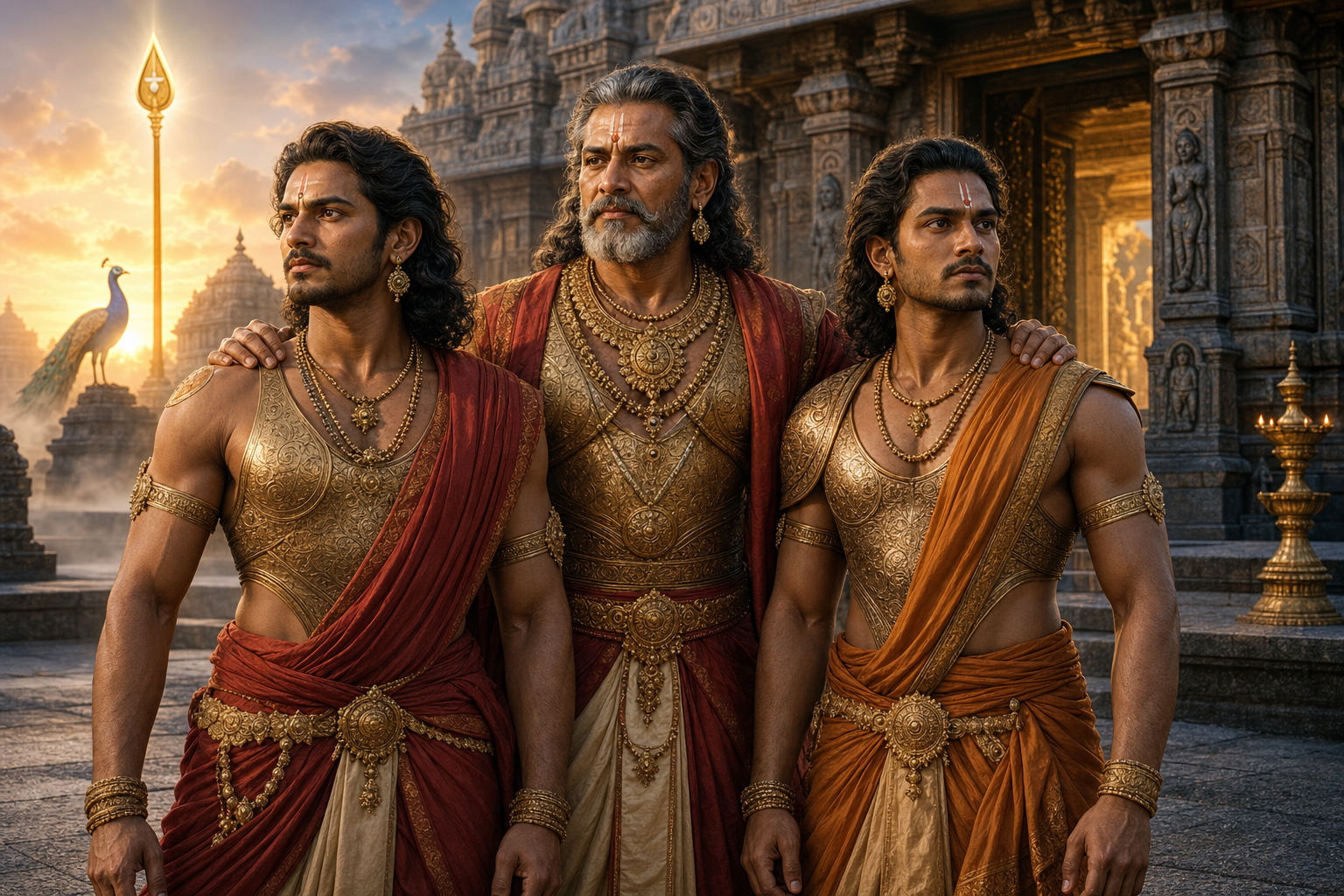
Veerabahu is not remembered merely as a fighter. He serves as envoy, strategist and commander in Murugan’s campaign against Surapadman. Those duties join courage to obedience, speech to force, and strategy to dharma. Calling Sumukha and Sudeha his sons places them within that same lineage of disciplined service.
This gives their guardianship a sharper meaning. They do not represent aggression waiting for a target. They represent strength held under rightful command. A guardian must be powerful enough to defend a boundary, restrained enough not to misuse that power, and attentive enough to distinguish a threat from a sincere seeker.
The Surapadman narrative deepens that lesson. Murugan’s victory does not end with the simple disposal of a defeated enemy. Surapadman’s power is transformed: the peacock becomes Murugan’s vahana, while the rooster becomes his emblematic flag. The movement is from hostile force to force placed in divine service. Sumukha and Sudeha embody the same dharmic pattern at the doorway. Power has reached maturity when it protects what is sacred.
Their association with Murugan’s wedding celebrations adds another dimension. The qualities needed during conflict do not become irrelevant when peace returns. A wedding requires order, hospitality, steadiness and protection as surely as a campaign does. The guardians therefore belong to both moments: the defeat of adharma and the responsible enjoyment of restored harmony.
You can use this lineage as a practical test whenever you are preparing for a difficult decision. Ask three questions before acting: What am I actually protecting? What impulse must remain outside this decision? Is my strength serving dharma, or is it serving wounded pride? These are threshold questions, and that is precisely why the two guardians stand where they do.
How to read the guardians at the sanctum door
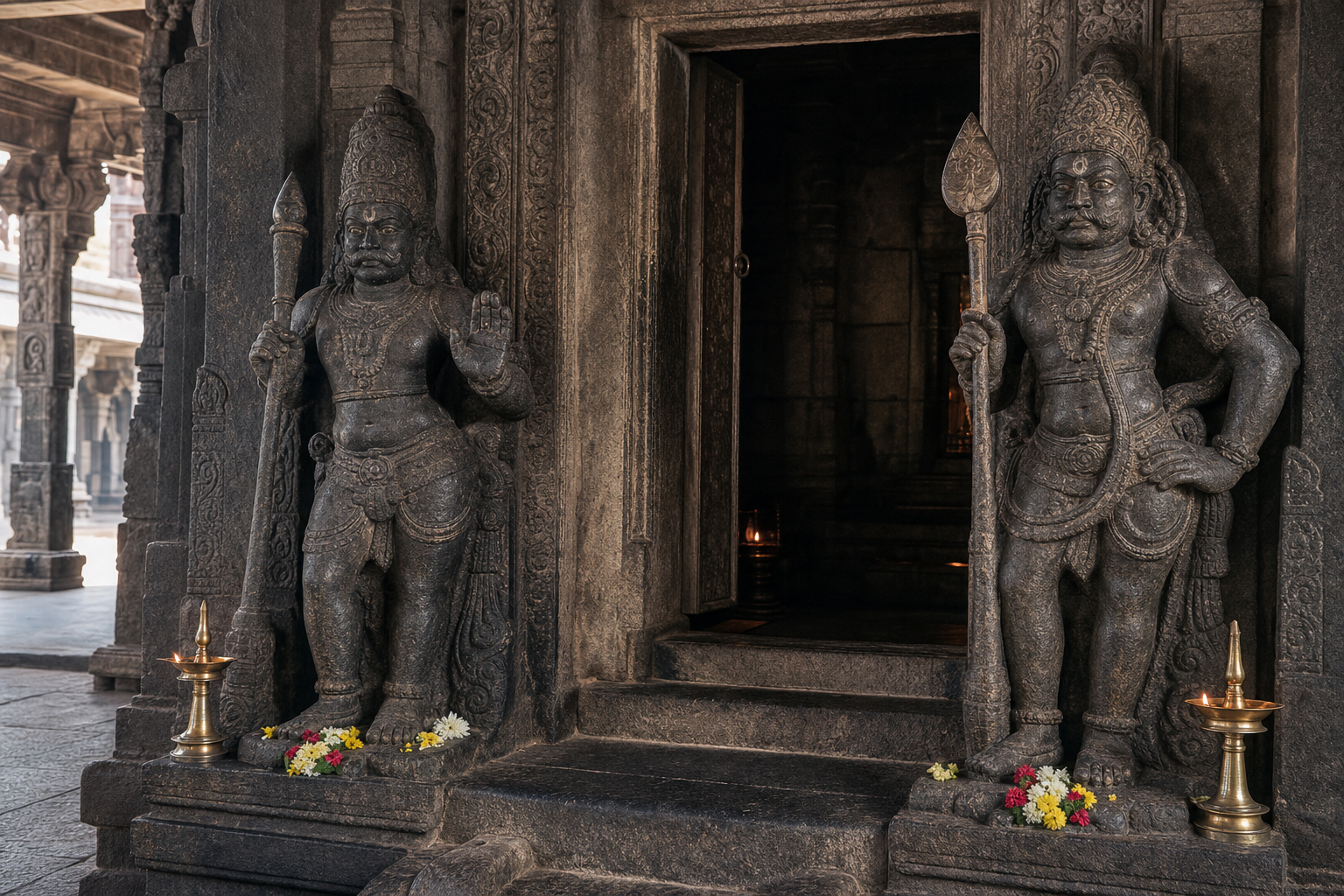
Traditional architectural canons such as the Manasara and Mayamata place guardian figures at consequential boundaries. In Murugan temples, the sculptural form may vary by region and period, but the visual vocabulary is usually direct: a heroic stance, an alert gaze, martial ornaments, an assertive moustache, and weapons such as a gada or sword. These features communicate readiness before the devotee knows any name.
Form tells you the office; local memory tells you the identity. That is the most reliable rule for reading the figures. Do not identify one as Sumukha and the other as Sudeha merely by guessing from weapon, posture or side of the doorway unless the temple itself preserves that distinction.
The guardians also belong to Murugan’s wider iconographic language. The Vel represents wisdom capable of piercing ignorance. The peacock represents pride and lower impulse brought under divine mastery. Shanmukha, the six-faced form, conveys awareness and protection in every direction. Sumukha and Sudeha translate those vast meanings into the discipline of a single moment: before you move forward, become attentive.
When you next see a pair of Dwarapalakas, notice three things:
- Their position: they do not occupy the centre. Their greatness lies in protecting access to the One who does.
- Their readiness: their martial form is controlled and purposeful, showing courage without disorder.
- The direction they create: the pair frames the sanctum and turns your attention away from themselves and toward Murugan.
This is why calling them decorative attendants misses the point. Their architecture performs a spiritual function. The outer temple has allowed movement, conversation and many competing impressions. At the inner doorway, the field narrows. The guardians make that narrowing visible.
A simple way to acknowledge Sumukha and Sudeha
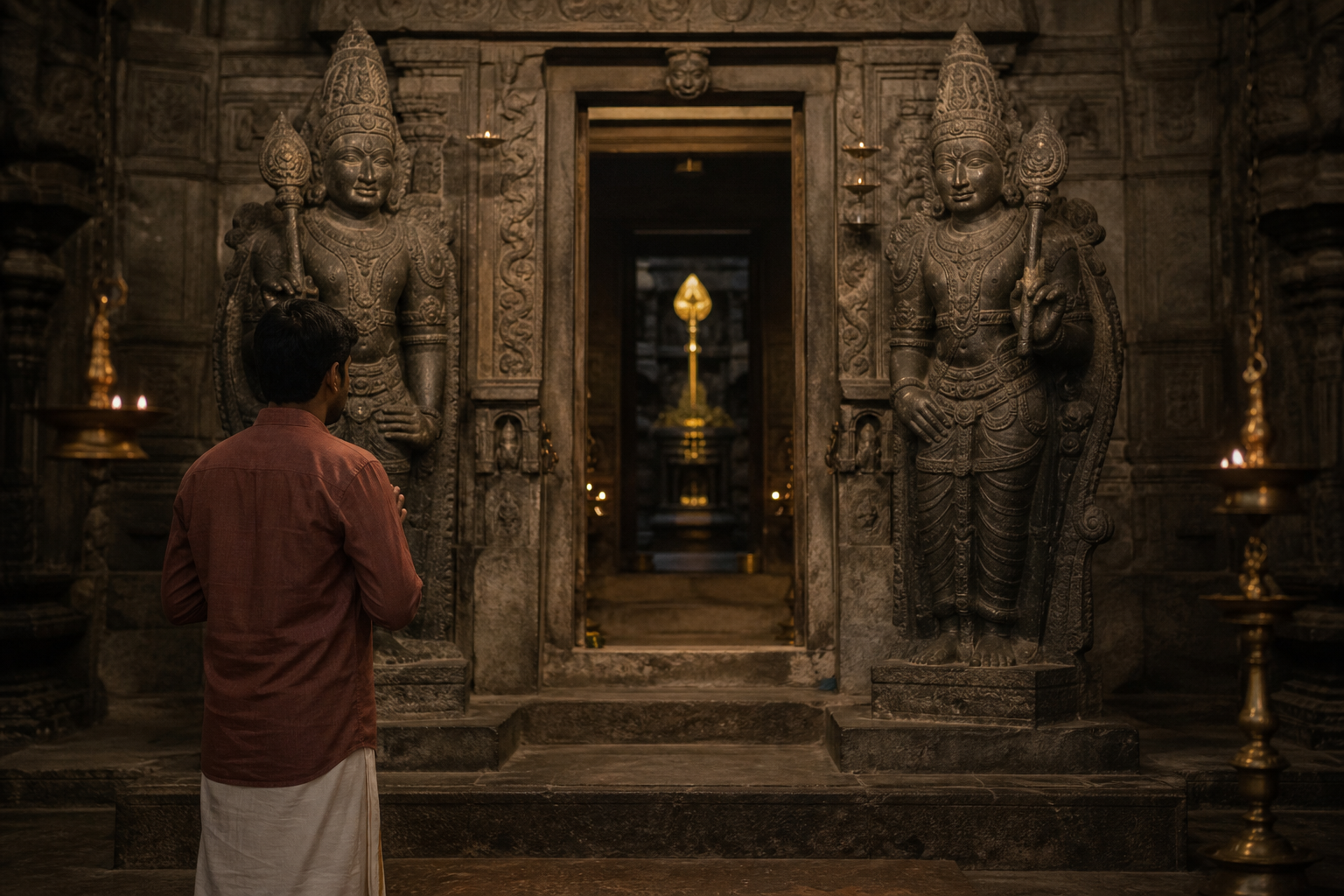
There is no need to manufacture an elaborate observance. Temple practice belongs to the temple, and local instructions should come before a visitor’s personal preference. Within that boundary, you can turn the encounter into a brief discipline of attention:
- Settle before you reach the doorway. Finish your conversation, put away your phone and allow the queue to move without creating a disturbance.
- Pause briefly when space permits. Do not block other devotees. Bring your hands together and let one steady breath mark the transition.
- Acknowledge both guardians. If the temple identifies them as Sumukha and Sudeha, recall their names silently. If it does not, offer respect to them simply as Murugan’s Dwarapalakas.
- Choose one condition you will not carry farther: hurry, anger, display, argument or scattered attention. The point is not to pretend the feeling has vanished. It is to refuse to let it govern your darshan.
- Enter with attention directed toward Murugan. Where those forms are present, notice the Vel, the peacock or the six-faced form without trying to absorb every detail at once.
If the Skanda Sashti Kavasam is part of your regular practice, you may silently recall a familiar line while waiting. Keep the recitation inward when the space is crowded or another liturgy is underway. Do not improvise touching the sculptures, placing offerings on them or stepping out of the prescribed path unless the temple explicitly permits it.
For a child, make the teaching concrete. Before entering, ask the child to find the two guardians, stand still for one breath and fold their hands. After darshan, ask what the guardians appeared to be protecting. This gives the child something specific to notice without frightening them or reducing the figures to fantasy warriors.
The same practice can follow you home. A doorway may precede a difficult conversation, a family responsibility or a decision made under pressure. Pause there. Decide what you are protecting and what you must leave outside. Then act with the quality Sumukha and Sudeha represent: courage governed by service.
On your next visit to a Murugan temple, do not hurry past the two figures at the sanctum entrance. Learn the names preserved by that shrine, offer one composed namaskara, and cross the threshold with less distraction than you brought to it. That small change turns the guardians from figures you merely see into teachers whose duty you can practice.
References
