

If you are a young British-Indian wondering whether local civic life has room for you, Tushar Kumar’s path offers a useful answer. He became the United Kingdom’s youngest-ever Indian-origin mayor at 23, but the title is only the visible part of the story.
The more instructive part is what came before it: ward casework, committee participation, cooperation across party lines, a deputy mayoralty and policy work inside government. Kumar’s rise shows how representation becomes credible when identity, administrative competence and practical service reinforce one another. It also gives you a clear way to judge whether youthful leadership is producing more than an encouraging photograph.
Understand what the mayoral office can actually change

The mayor of an English town or parish council is not the same as an executive metro mayor. Kumar’s colleagues elect the mayor annually to chair council meetings, represent the community at civic occasions and act as the council’s principal public figure. The office has convening and agenda-setting influence rather than broad executive control.
That distinction changes how you should assess his leadership. It would be unreasonable to expect a town mayor to command every local service or unilaterally redirect large public budgets. It is reasonable to expect him to bring the right people into the same room, keep attention on declared priorities, make civic institutions easier to approach and use public visibility to open doors for residents who are usually overlooked.
When you hear a mayoral promise, sort it into one of three practical categories:
- Direct council work: chairing meetings properly, improving council information and ensuring that agreed actions are followed through.
- Convening work: connecting schools, community organisations, faith groups, local employers and volunteers around a shared project.
- Advocacy work: taking a resident’s concern to the institution that actually owns the decision and keeping that concern visible.
This is a fairer test than asking whether one young mayor can personally solve every local problem. It also exposes empty leadership quickly. If a proposal has no named partner, no route through the council and no way for residents to see what happened, the proposal is still an aspiration.
For a Dharmic reader, the relevant standard is seva made concrete. Public service is not established by ceremonial language alone. It becomes visible when a resident can understand a form, a young person gains a real voice in a decision, or a family sees its heritage welcomed without another neighbour being excluded.
Kumar’s path shows what must come before the title
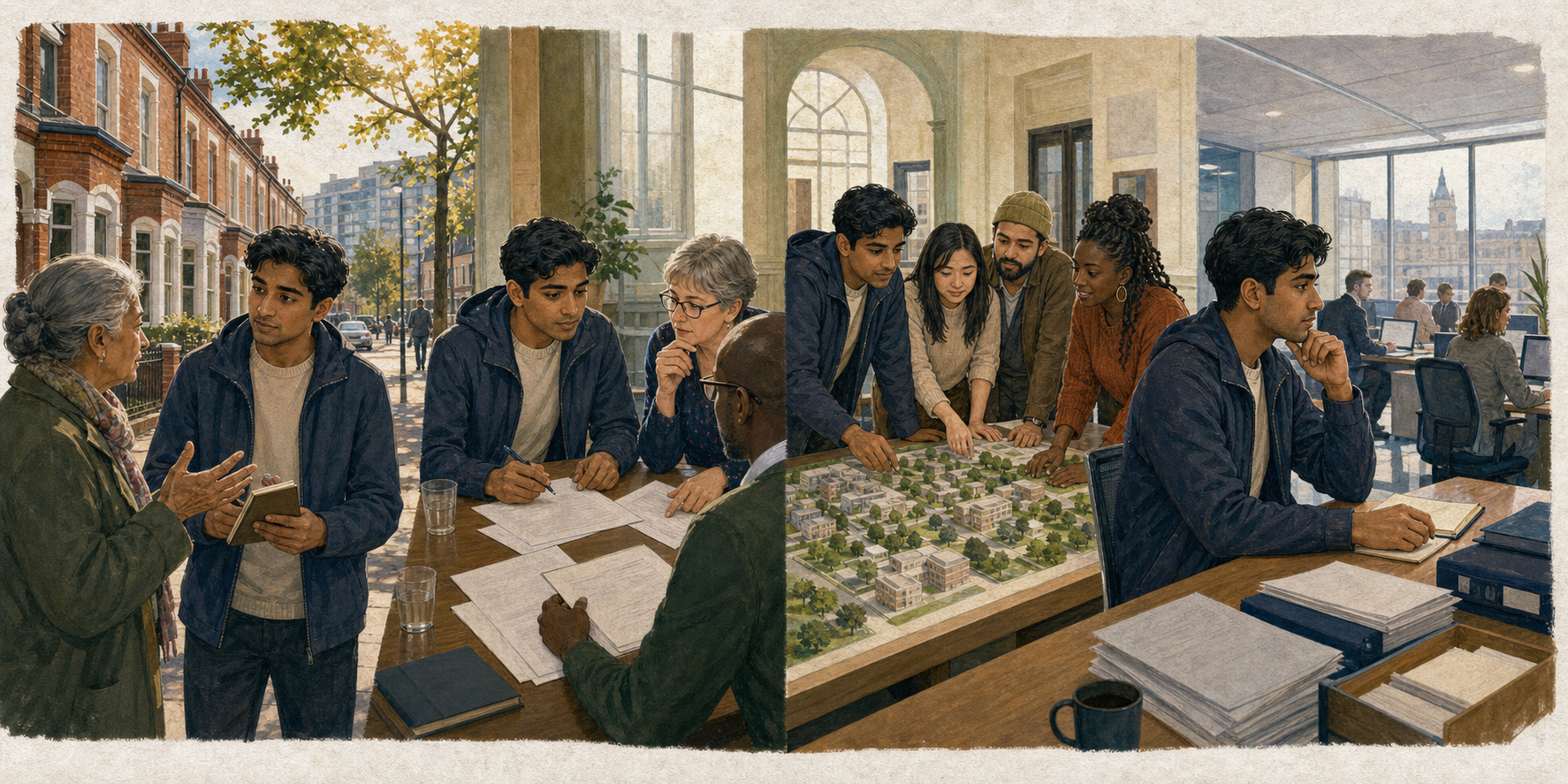
Kumar was elected as a Labour councillor at 20 while studying at King’s College London. Before assuming the civic chair, he had handled ward-level casework, participated in committees, worked across political lines, served as Deputy Mayor under Dan Ozarow and worked as a policy adviser within the UK government. That combination of local and government experience is unusual at his age.
The sequence matters more than the speed. A young person who wants to follow this path should not begin by imitating the ceremony of a mayoralty. Begin with the work that makes other people trust you with the ceremony.
- Learn casework. Choose a genuine ward-level problem and trace it from the resident’s first request to its resolution. Identify which body owns the decision, what information it needs and where the handoff tends to fail.
- Learn the committee system. Find out where decisions are prepared, recorded and reviewed. Read agendas before meetings and minutes after them. A good idea that misses the relevant decision point can remain dormant for months.
- Become reliable across disagreements. Party affiliation provides a political home, but town-level delivery frequently requires support from people outside it. Cooperation does not require abandoning conviction; it requires separating the shared task from the unresolved argument.
- Practise public explanation. Residents should be able to understand what the council can do, what it cannot do and what happens next. Plain language is a form of accountability, especially when administrative processes are unfamiliar.
- Add wider policy knowledge to local evidence. Government experience can clarify how rules and institutions operate, but ward casework shows where those rules collide with daily life. Youth leadership is strongest when neither perspective is allowed to erase the other.
This is also why age should not become the sole story. Being young can create access to students and first-time civic participants, but it does not automatically produce competence. Kumar’s case is persuasive because the milestone sits on top of an early record of service. If you are assessing another young leader, look for the same foundation: handled cases, understood procedures, maintained relationships and completed modest commitments.
Three priorities can turn representation into public service

Kumar has placed youth engagement, digital accessibility and cultural preservation at the centre of his mayoral programme. These priorities fit the real powers of a civic mayor because each can advance through partnerships, visibility and persistent convening. Each can also become superficial unless residents insist on a delivery mechanism.
Give young residents a role before asking for their support
A youth event is not the same as youth participation. The decisive question is whether young residents help shape an initiative before its format and outcomes have already been fixed.
A credible youth advisory panel should recruit through several routes, including schools and faith or community organisations, so that participation is not limited to the most confident pupils. Its questions should concern real local choices. Quarterly open forums can then show which ideas were accepted, which were redirected to another institution and which could not proceed.
The practical pipeline should connect immediate participation with future opportunity. Volunteering can lead to mentorship, exposure to apprenticeships and a clearer understanding of public-service careers. The council should therefore track more than total attendance. First-time participation, youth-volunteering uptake and whether young people’s proposals produced a recorded action are more revealing.
If you are helping organise such a panel, publish an action log after every meeting. Use three labels: accepted for council action, referred to a named partner, or not proceeding with a reason. That small discipline prevents consultation from becoming a performance in which adults listen politely and nothing changes.
Treat accessibility as infrastructure, not publicity
Digital leadership is often mistaken for frequent social-media activity. Kumar’s accessibility priority asks a more serious question: can a resident actually use the council’s information and democratic processes?
The Public Sector Bodies (Websites and Mobile Applications) Accessibility Regulations 2018 make accessibility a compliance responsibility for UK public bodies, with WCAG 2.1 AA providing the relevant technical baseline in Kumar’s programme. At council level, this reaches keyboard navigation, screen-reader compatibility, colour contrast, captions, plain-language summaries and accessible PDFs.
You do not need to be a software specialist to notice common failures. Try to find meeting papers without a mouse. Check whether a video communicates its meaning without sound. Look at whether a scanned PDF contains selectable text. Follow a consultation from its introductory page to submission and note where instructions become ambiguous. These tests do not replace a proper accessibility review, but they reveal where a resident may be excluded.
Digital inclusion clinics could serve two groups at once: residents who need help navigating online services and small community organisations that need basic guidance on accessible publishing. The council should still retain responsibility for fixing its own systems. A clinic must not become an excuse to teach residents how to endure a needlessly difficult process.
Data collection needs equal care. If a council asks young people, disabled residents or event participants for personal information, it should collect only what the stated purpose requires and handle it in line with GDPR. Accessibility and privacy are not competing favours. Both determine whether a resident can approach public institutions safely.
Make heritage an invitation into shared civic life
Kumar’s cultural programme includes free Hindi classes and inclusive multicultural events. This matters to British-Indian families who worry that language, memory and cultural confidence will weaken across generations. Its civic value, however, depends on whether preservation is designed as a bridge rather than a boundary.
A strong programme can welcome Hindu, Buddhist, Jain and Sikh families while remaining open to neighbours of every faith and none. Hindi teaching can give children and adults access to family conversation and cultural expression. Multicultural occasions can place Indic classical arts beside contemporary British culture and the heritages of other local communities. The point is neither to hide difference nor to turn it into a loyalty test.
Vasudhaiva Kutumbakam, the understanding that the world is one family, gives this work an appropriate Dharmic measure. A family does not require every member to be identical. It requires a form of belonging in which distinct inheritances can be carried without treating another person’s inheritance as a threat.
Organisers should build the safeguards into the programme before announcing it. Activities involving minors or vulnerable adults need appropriate safeguarding. Civic invitations should be neutral and inclusive. Procurement should be transparent and tested for value. Equality and accessibility reviews should cover the venue, registration process and programme itself. These details protect participants and make the cultural claim of hospitality credible.
A one-year mayoralty needs a public scorecard

A priority is not an outcome. Kumar’s stated agenda establishes where he wants to direct civic attention; residents still need evidence of what was attempted, completed and learned. This is especially important when the mayor is selected for a one-year term and initiatives must move from announcement to delivery quickly.
A compact dashboard would let residents judge progress without burying them in administrative data. It could use the following structure:
| Priority | Visible delivery | Useful indicator | Public proof |
|---|---|---|---|
| Youth voice | Youth advisory panel, quarterly open forums and partnerships with schools or community groups | Youth-volunteering uptake, first-time participation and proposals moved to action | Meeting dates, anonymised participation totals and an action log |
| Digital access | Accessibility review, corrected documents and digital inclusion clinics | Accessibility-statement compliance, identified barriers resolved and user satisfaction | Updated accessibility statement, issue status and plain-language project review |
| Culture | Free Hindi learning and inclusive multicultural programming | First-time attendance, breadth of participation and post-event feedback | Published programme, partner list and anonymised feedback summary |
| Governance | Safeguarding, privacy, accessibility and value-for-money checks | Checks completed before delivery and corrective actions closed | Short compliance record and post-project review |
The distinction between output and outcome is essential. Holding an event is an output. Reaching residents who had not previously participated is an outcome. Publishing a new form is an output. Making it possible for a keyboard or screen-reader user to complete the form is an outcome.
Targets should be set only after a baseline is known. Otherwise, a council can select an impressive-looking number that says little about improvement. It should also publish the method: what was counted, what was not counted and whether repeat participants were separated from first-time participants.
Numbers alone cannot show whether people felt heard or welcomed. Combine participation totals with short feedback and a record of actions taken. Keep feedback anonymous where identification is unnecessary, particularly when young people or vulnerable residents are involved. The aim is enough evidence for accountability, not maximum collection of personal data.
Key takeaways for young civic leaders
- Learn the office before pursuing the title. Know which decisions are direct, which depend on partnerships and which require advocacy to another public body.
- Begin with casework. Solving a small, defined resident problem teaches responsibility, institutional boundaries and follow-through.
- Build procedural competence. Read agendas, understand committees and identify the next real decision point rather than relying on public statements alone.
- Cooperate without becoming indistinct. Hold your political convictions, but build working relationships across party and community lines when residents need a practical result.
- Make youth participation consequential. Give young people a question that matters, record the response and show what action followed.
- Test access through the resident’s journey. A polished website means little if its forms, PDFs, videos or consultations cannot be used by disabled residents.
- Let cultural confidence widen belonging. Preserve language and Dharmic heritage in a form that welcomes neighbours rather than making ancestry a condition of participation.
- Publish a small scorecard. Separate events held from barriers removed, first-time participants reached and commitments completed.
Tushar Kumar’s achievement matters because a 23-year-old British-Indian now occupies a visible civic office. Its lasting value will depend on whether that visibility produces habits other people can inherit: accessible institutions, meaningful youth participation, open cultural confidence and public evidence of delivery.
If you want to follow that example, do not begin by asking how quickly you can become mayor. Choose one local problem, find the institution responsible for it, help one group of residents navigate it and publish what happened. A civic career becomes credible through that repeated movement from attention to service.
References
