
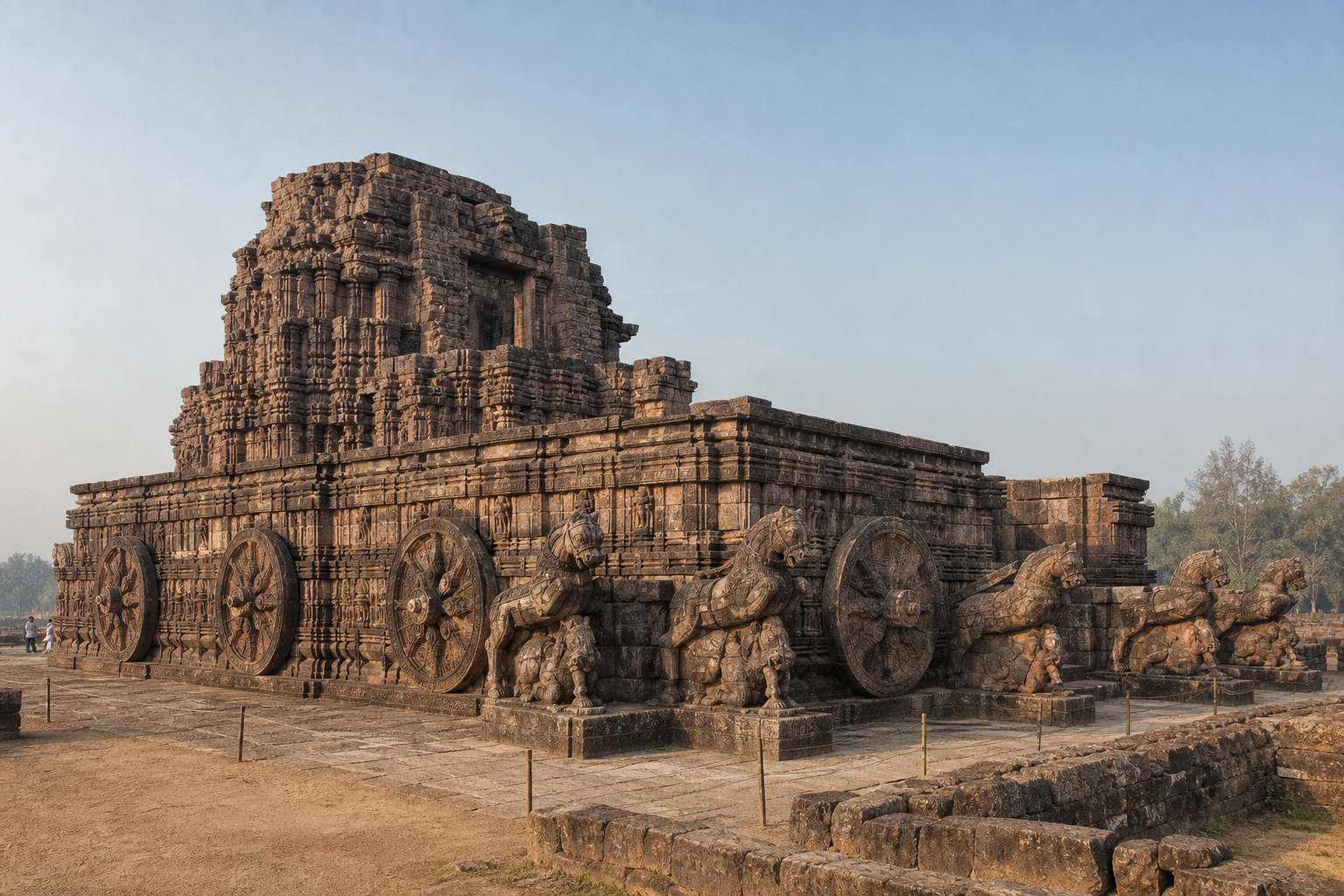
If you are going to Konark with one question — “What exactly am I looking at?” — resist the urge to begin with the most photographed wheel. Step back first. The temple becomes intelligible when you see one idea connecting its immense platform, moving shadows, sculpted bodies, ruined sanctum, and continuing worship: Surya carries life through time.
You can read Konark at three scales. From a distance, it is a celestial chariot. At the wheels, it is an encounter with measured time. Across its sculptural surface, it is a sacred and social world rendered in stone. Use those scales in that order, and the monument stops looking like an overwhelming mass of ornament.
Begin with the chariot, not the individual carvings
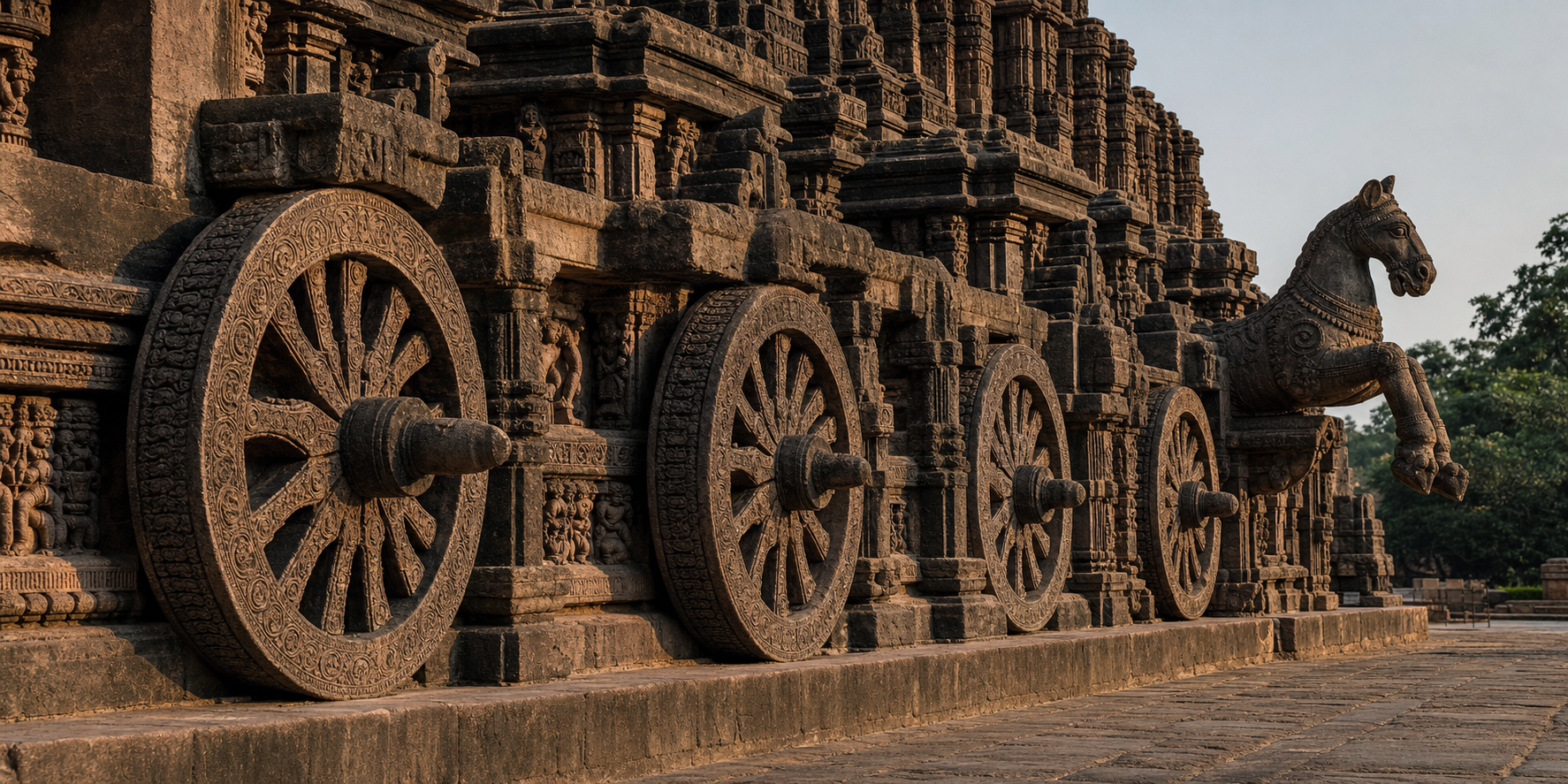
Konark was built on Odisha’s coast in the mid-13th century under the patronage of Narasimhadeva I of the Eastern Ganga dynasty. Its builders did more than dedicate a conventional shrine to Surya. They conceived the monument itself as the Sun deity’s chariot: twelve pairs of wheels line the platform, while seven stone horses appear to draw the whole structure eastward.
That chariot is your first interpretive key. The temple does not merely contain images about cosmic movement; its architecture performs movement. Massive masonry seems to advance toward the rising sun. Wheels turn conceptually even though they are fixed. Changing light activates surfaces that would otherwise appear still. Architecture, sculpture, and the daily solar cycle therefore belong to one composition.
The original complex followed the principal forms of Kalinga temple architecture. It had a curving sanctum tower, or rekha deul; a great assembly hall, or jagamohana; and a dance pavilion, or natamandira. The sanctum and its tower have collapsed, the assembly hall survives as the dominant mass, and the dance pavilion remains only in part. The original tower may have approached 70 metres in height, so the monument encountered by a medieval pilgrim would have risen far beyond the profile you see now.
Do not mistake the surviving assembly hall for the entire original temple. That error distorts both the plan and its theology. The missing sanctum was the culmination of the east–west progression, while the surviving halls prepared the devotee through gathering, movement, music, and sight. Dawn entered this spatial logic as a sacred event: the orientation placed the rising sun, rather than an arbitrary facade, at the head of the composition.
- Move far enough away to see the platform as one long architectural body.
- Locate several wheels before studying any single wheel. Their repetition establishes the chariot’s rhythm.
- Find the horses and face east with them. This turns the orientation from an abstract fact into something you can feel spatially.
- Identify the standing assembly hall, the partial dance pavilion, and the place once occupied by the sanctum. Mentally restoring that sequence will prevent you from reading a fragment as the original whole.
Read the wheels as instruments of sacred time
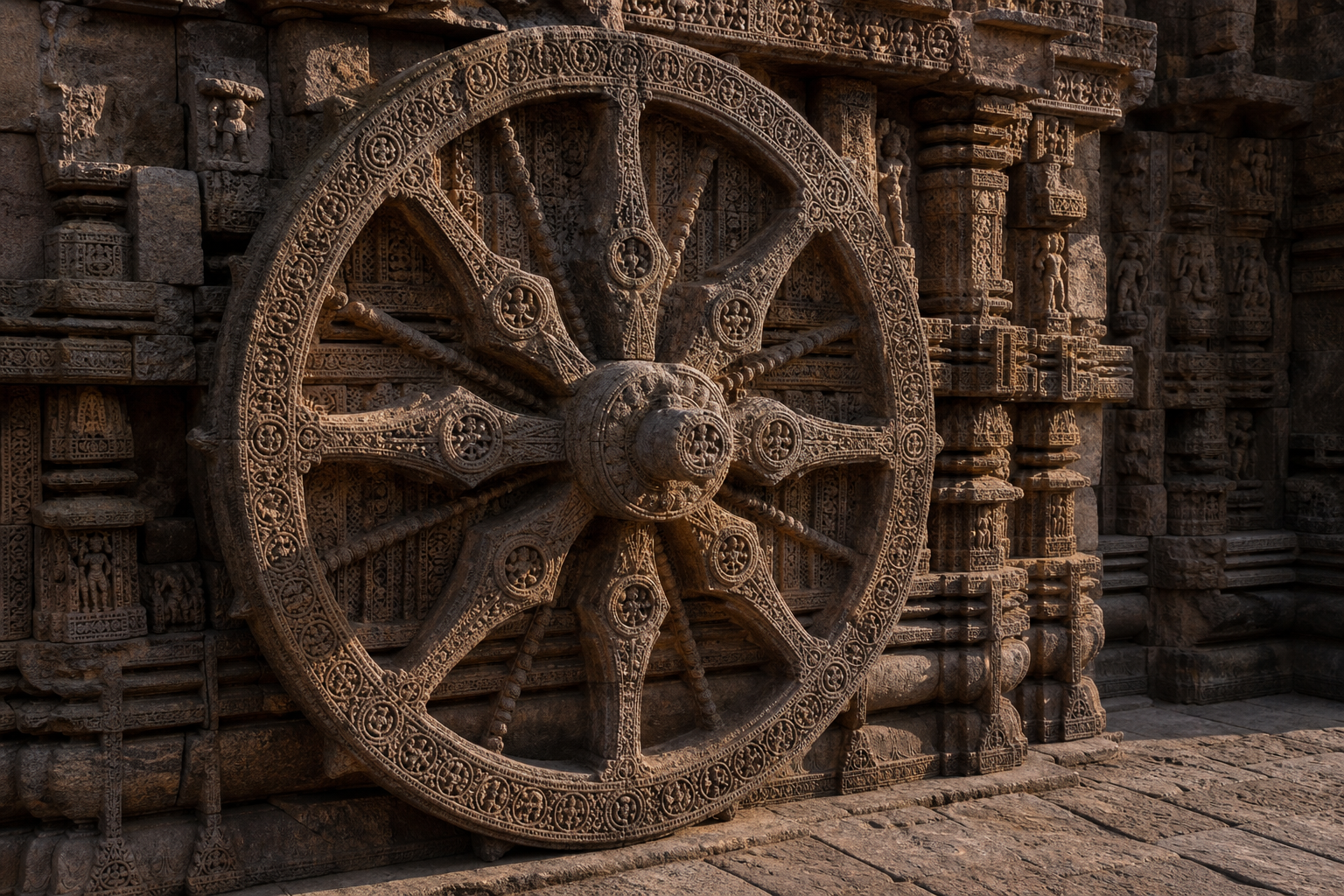
The wheels are symbols, sculptures, and observational devices at once. Each has eight principal spokes, and the position of a solar shadow in relation to those spokes can provide an approximate indication of the time of day. Smaller divisions support closer readings. This is why calling the wheels decorative alone misses their intellectual force.
“Approximate” matters. A stone wheel is not a modern clock face waiting for you to assign a familiar number to every spoke. Its reading depends on sunlight, shadow position, orientation, surviving condition, and a correct understanding of its markings. If you do not know the interpretive method, observe first: note where the shadow falls against a spoke and return later to see how it has moved. That simple comparison reveals the underlying principle without pretending to a precision you have not established.
This is astronomy in an older, integrated sense. Solar observation did not sit in a compartment separate from ritual, calendrics, architecture, or philosophy. At Konark, the visible motion of the sun helps organize sacred space and human activity. The wheels make cyclical time tangible, while the chariot makes time appear purposeful rather than inert: the cosmos moves, seasons return, ritual occasions recur, and human life proceeds within that order.
| What you encounter | What it reasonably supports | What not to claim |
|---|---|---|
| Wheel spokes and moving shadows | Solar observation and approximate timekeeping were embodied in the monument. | Every casual reading gives an exact clock time. |
| The east–west axis and eastward-moving chariot | Dawn and the rising sun are central to the architectural conception. | Every popular claim about a special alignment has therefore been proved. |
| The story of a powerful magnet or lodestone | The legend belongs to Konark’s enduring oral and imaginative heritage. | The magnetic mechanism is established archaeological fact. |
The magnet story is a useful test of how you handle heritage claims. It tells you something real about Konark’s hold on collective memory, but corroborating archaeological evidence for the mechanism is lacking. You do not have to mock a legend to distinguish it from demonstrated engineering. Respect for tradition becomes stronger, not weaker, when different kinds of truth are named honestly.
Notice how mass, material, and ruin tell an engineering story
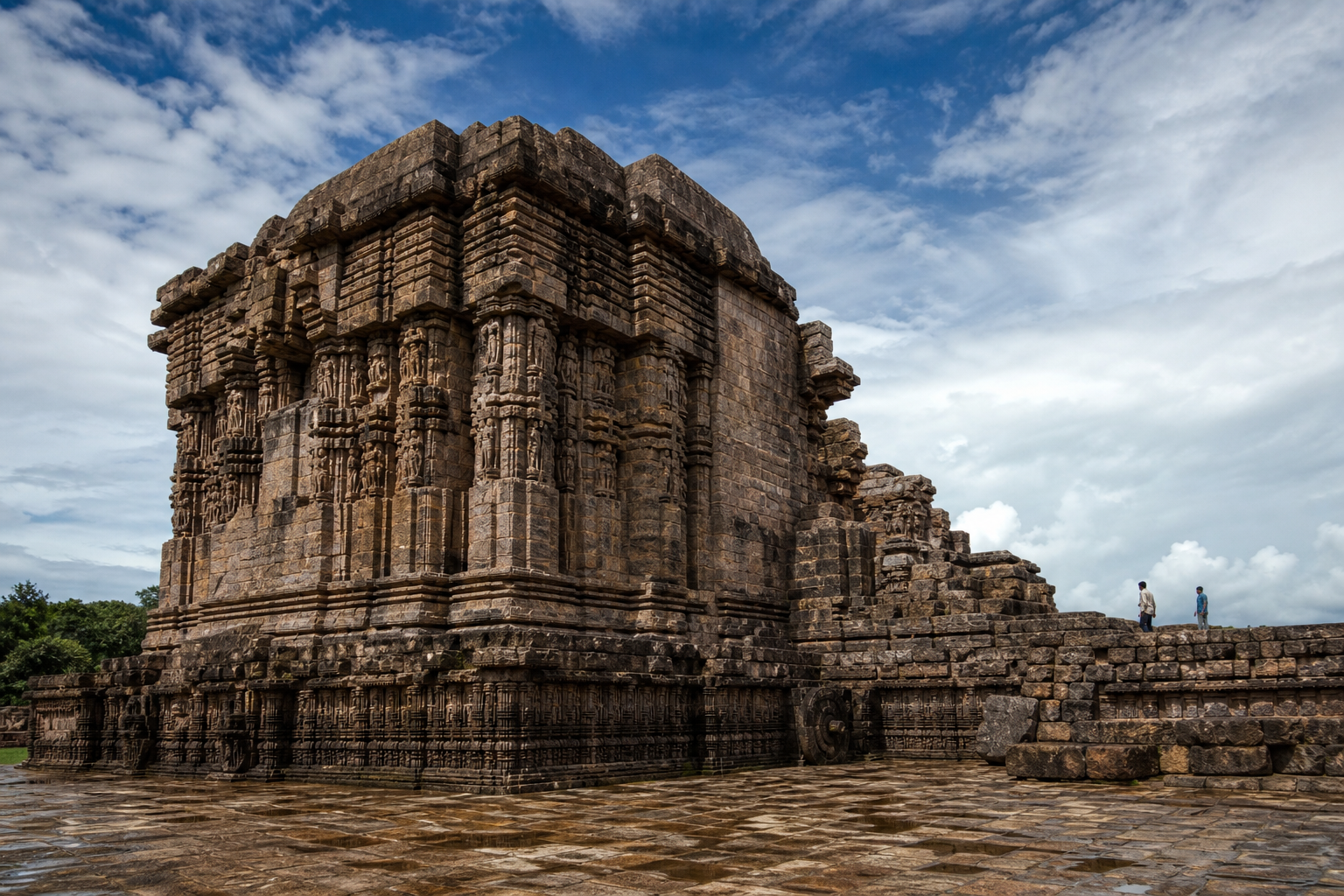
Konark’s builders worked at a scale that demanded a disciplined relationship between material and load. Khondalite supplied much of the richly carved exterior, while laterite served inner cores. Iron cramps and dowels joined masonry courses. In the assembly hall, a pyramidal pidha deul roof rises through corbelled courses, shifting weight without relying on a true arch.
You can use those distinctions while looking at the monument. Treat the carved outer surface and the load-bearing inner mass as related but different systems. The sculpture gives the building its visible language; the core, joints, and corbelled construction make its extraordinary volume possible. Weathering on an exposed carving and movement within a massive roof therefore present different conservation problems, even when both occur in the same structure.
The coast is not a neutral setting. Salt crystallization, biological growth, temperature changes, wind, and moisture continually act on the stone and metal. Conservation has to respond to an environment, not merely repair isolated broken figures. Modern work has consequently included drainage, vegetation control, chemical treatment, structural documentation, photogrammetry, three-dimensional scanning, and condition mapping.
The sand inside the assembly hall is another detail commonly misunderstood. In 1901, the interior was filled with sand to reduce stress on the corbelled structure. It was a stabilization measure, not part of the medieval design. More recent consideration of removing that sand has required structural monitoring because extracting a century-old support system can create risks of its own.
The collapse of the main sanctum, probably between the 16th and 17th centuries, should also be approached with restraint. Structural fatigue, cyclonic weather, later removal of stone, and human interference have all entered the discussion; no single explanation supplied here resolves the entire event. When you see the ruined portion, read it as a layered history of construction, environmental exposure, loss, reuse, and conservation — not as proof of whichever dramatic story you encountered first.
Read the sculpture as a complete world, not a gallery of curiosities
Konark’s sculptural programme is dense because it connects cosmic, devotional, royal, artistic, and everyday life. Surya appears with attendants, while the navagraha, guardians, celestial musicians, dancers, animals, courtly figures, and processions populate the architectural surface. Scenes of music, dance, artisanship, and martial life preserve evidence of 13th-century Odisha while also participating in the temple’s sacred order.
Look closely at Surya’s clothing. The deity is represented in high boots and a belted tunic, features often associated by art historians with Central Asian modes of dress. The important point is not that the image ceases to be Indian. It is that Odisha’s sacred art could absorb a cosmopolitan visual vocabulary and make it serve a distinctly Kalinga conception of Surya.
The erotic mithuna and maithuna figures require the same contextual discipline. Seen in isolation, they can be reduced either to embarrassment or sensation. Within Kalinga temple aesthetics, they participate in ideas of fertility, auspiciousness, generation, and the sustaining abundance of creation. Their presence does not make every sexual interpretation correct, but excluding them from the sacred programme also misreads the temple.
- Read the whole facade. Notice how figures, architectural projections, wheels, animals, and bands create an ordered surface.
- Read one horizontal band. Follow its sequence to see whether it presents movement, procession, performance, animals, or social activity.
- Read one figure. Only after locating it within the larger composition should you interpret its posture, dress, gesture, or theological meaning.
This three-distance method keeps one famous motif from swallowing the monument. It also helps you understand the partial dance pavilion. Dance at Konark is not a modern decorative association pasted onto an old ruin. The natamandira, musical imagery, and sculpted performers show that embodied art belonged to the temple’s conception of worship and culture.
Konark is first and specifically a Hindu temple of Surya. Its wider Dharmic significance need not blur that identity. Hindu practice venerates Surya as a visible manifestation of sacred power; Buddhist, Jain, and Sikh traditions also employ light, celestial order, or the sun within their distinct accounts of awakening, cosmic time, and divine reality. The honest connection is a shared civilizational attentiveness to light and order, not a claim that four traditions teach the same doctrine.
Plan a visit that includes living heritage as well as stone
Konark stands roughly 35 kilometres from Puri and 60 kilometres from Bhubaneswar. If you can choose the season, November through February generally offers more comfortable conditions. Distance and weather are the easy planning decisions. The more important decision is whether you will treat Konark as a quick collection of famous objects or give its light, scale, and sacred landscape time to work together.
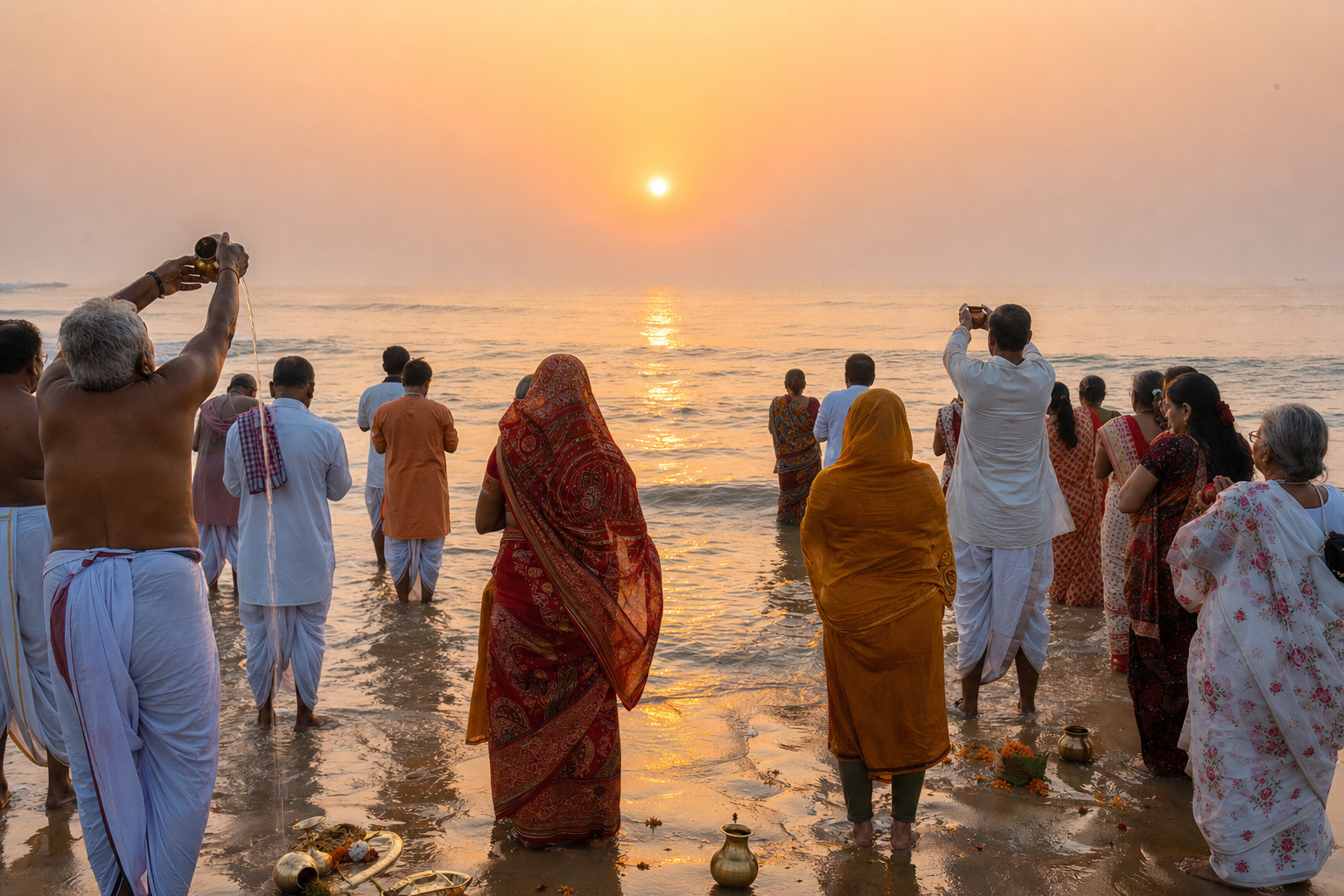
Chandrabhaga belongs to that larger landscape. On Magha Saptami, pilgrims gather there for a ritual bath at sunrise and the veneration of Surya. The annual Konark Festival brings Odissi and other classical traditions into conversation with the temple’s performative inheritance. These practices show why “heritage” cannot mean stone alone. Ritual memory, pilgrimage, dance, and seasonal return keep the site culturally active even though its main sanctum no longer stands.
The sea also expands the frame. Mariners once used Konark’s dark profile as a coastal landmark, giving it the name “Black Pagoda,” in contrast with Puri’s “White Pagoda.” Sacred architecture was therefore visible not only to pilgrims approaching by land but also to people moving through the Indian Ocean world. Konark announced the religious confidence, artistic skill, royal authority, and maritime presence of eastern Bharat on the same horizon.
Key takeaways
- Start with the complete chariot form: twelve pairs of wheels, seven horses, and an eastward orientation toward sunrise.
- Distinguish the standing assembly hall from the collapsed sanctum and partial dance pavilion; the surviving mass is not the original whole.
- Treat the wheels as genuine solar-observation devices, but describe their readings as approximate unless you know the specific method.
- Read carvings at three distances — facade, narrative band, and individual figure — before deciding what any isolated image means.
- Keep engineering evidence, theological interpretation, and oral legend in their proper categories. All belong to Konark’s heritage, but they do not establish the same kind of claim.
- Include the wider landscape of sunrise, pilgrimage, performance, and maritime memory in your understanding of the temple.
Before you leave, return to one wheel you examined earlier and look at its shadow again. That small act lets Konark make its own argument: stone can hold still while light reveals movement, and a sacred monument can teach you to notice time rather than merely count it.
References
