

If suffering has made the sentence “God is good” sound too easy, you do not need to suppress the objection. Nor do you need to leap from disappointment with one idea of God to the conclusion that every form of spiritual reality is false.
A Dharmic inquiry begins by defining the claim, matching it to the right kind of evidence, and then testing what disciplined practice does to your perception and conduct. This will not manufacture certainty on demand. It will help you distinguish reasoned belief, lived knowledge, inherited testimony, useful practice, and wishful thinking.
Name the claim before you demand evidence
“Does God exist?” sounds like one question, but Indic philosophy places several very different propositions inside it. If you leave the word God undefined, evidence for one proposition will be mistaken for evidence for another.
- Īśvara as an intelligent cause: Nyāya reasons from the ordered, intelligible coordination of the world toward a superintending consciousness. Vaiśeṣika supplies an account of atoms and causal regularities that Nyāya philosophers connect to this inference.
- Īśvara as the Lord approached through devotion: Viśiṣṭādvaita and Dvaita preserve a real distinction between the individual self and God, though they explain that relationship differently. Bhakti therefore involves an actual relation, not merely a temporary aid to an impersonal realization.
- Brahman as ultimate reality: Advaita Vedānta does not merely place a very powerful being somewhere in the cosmos. It asks whether the deepest self, ātman, is identical with nondual Brahman. The mahāvākya tat tvam asi expresses this inquiry in a radically different form from a creator argument.
- Ik Onkar as the one formless Reality: Sikh thought affirms a timeless Reality that is both beyond the world and present throughout it. The practical response is remembrance through simran, alignment with hukam, and service rather than detached speculation.
- Liberation without a creator: Classical Sāṅkhya explains experience through Puruṣa and Prakṛti without requiring a creator. Buddhism centres dependent origination, dukkha, and nirvāṇa; devas may appear, but none is ultimate. Jainism holds the universe to be beginningless and understands liberated Jinas as perfected exemplars rather than creators.
These positions do not rise or fall together. A persuasive inference to an intelligent cause would not, by itself, establish the Advaitic identity of ātman and Brahman. An experience of nonduality would not, by itself, prove that a personal creator made the cosmos. Refuting a particular creator argument would not refute Ik Onkar, nirvāṇa, the Jain path of liberation, or the possibility of contemplative knowledge.
Before reading another debate, complete this sentence in writing: The claim I am examining is… You might be asking whether the universe requires intelligence, whether a personal Lord can be known, whether consciousness is fundamental, whether the self is identical with Brahman, or whether liberation is possible without a creator. If you cannot yet finish the sentence, your first task is clarification rather than proof.
Use each pramāṇa for the job it can actually do
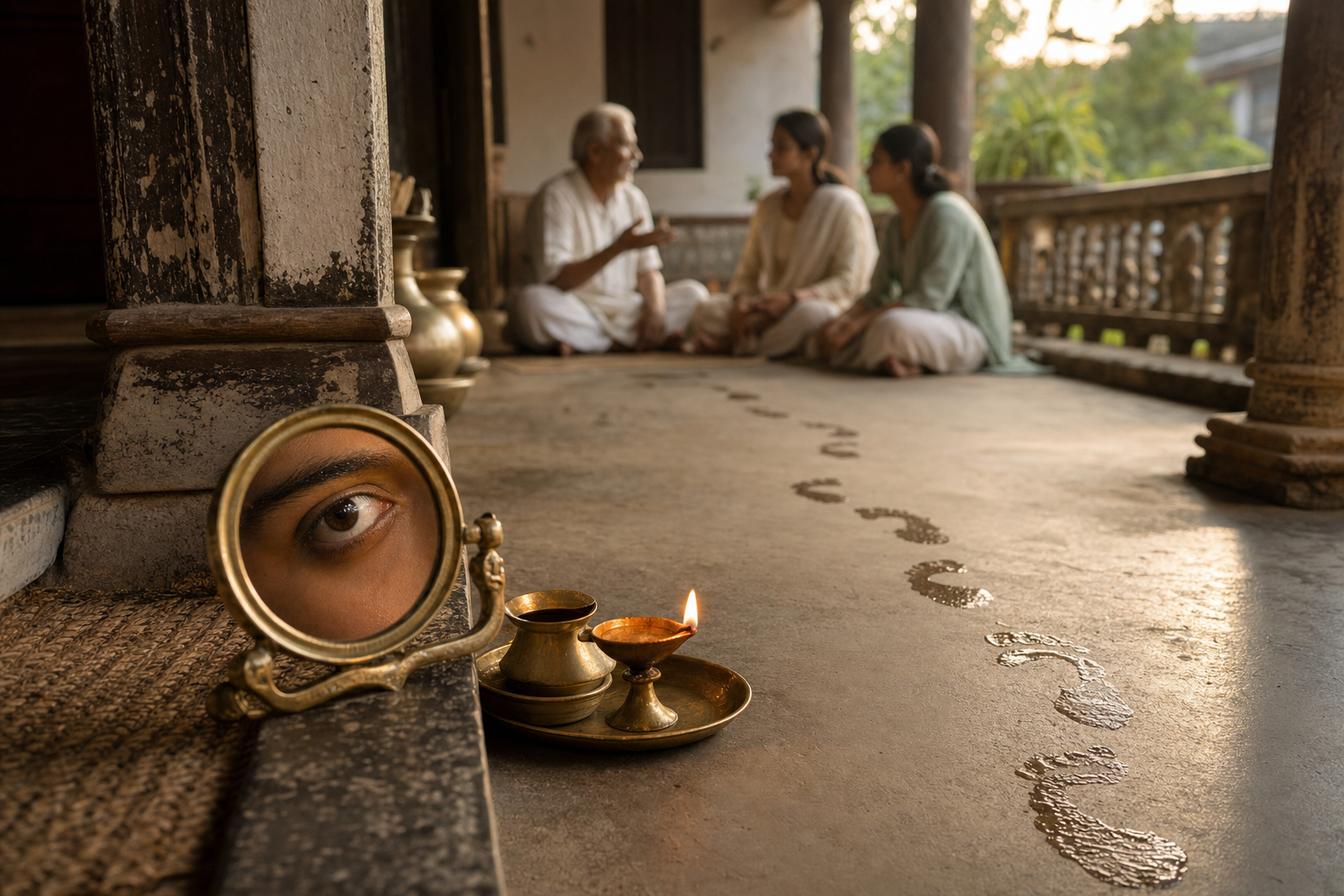
Classical Indian philosophy asks not only what you believe but how you know it. A pramāṇa is a valid means of knowledge. Three are especially useful for this inquiry:
- Pratyakṣa, direct perception: You know an immediately present object or experience through perception. Contemplative disciplines also claim to refine attention sufficiently for forms of yogic or meditative perception. Such experience may carry great force for the practitioner, but its interpretation still requires care.
- Anumāna, inference: You reason from what is observed to what would explain it. Nyāya arguments concerning order, causality, regularity, and intelligibility belong here. Their strength depends on the premises and on whether rival explanations account for the same facts.
- Śabda, reliable testimony: You receive knowledge from trustworthy testimony, including scripture and realized teachers. Testimony is indispensable in ordinary life and spiritual training, but its reliability must be examined rather than assumed merely because a claim is ancient or confidently delivered.
The practical mistake is to let one means of knowledge impersonate another. A scripture can disclose a tradition’s metaphysical vision and guide you into a discipline; citing it to someone who does not yet accept its authority is not an independent public proof. An intense meditative state is direct evidence that an experience occurred; it does not automatically establish every doctrine used to describe that experience. A philosophical inference can make Īśvara rationally credible; it cannot manufacture devotional recognition.
Scientific reflection belongs in the inquiry, but it does not settle it. Cosmic lawfulness, mathematical elegance, what is often called fine-tuning, and the continuing difficulty of explaining consciousness can make a deeper ground of reality reasonable to consider. None of them uniquely compels a creator, much less selects one complete theology. The honest conclusion is openness where the evidence permits openness, not certainty borrowed from scientific vocabulary.
Use a simple evidence ledger for any spiritual claim that matters to you:
- Write the claim without poetic ambiguity.
- Place each supporting reason under perception, inference, or testimony.
- State the strongest alternative explanation you can understand.
- Name what would weaken your confidence. If nothing could count against the claim, call it a commitment of faith rather than an inference.
- Separate the claim’s metaphysical truth from the practical value of the discipline attached to it.
This protects both faith and reason. Faith no longer has to disguise itself as laboratory demonstration, while reason is not arbitrarily limited to whatever can be weighed or photographed.
Let suffering test your interpretation of karma
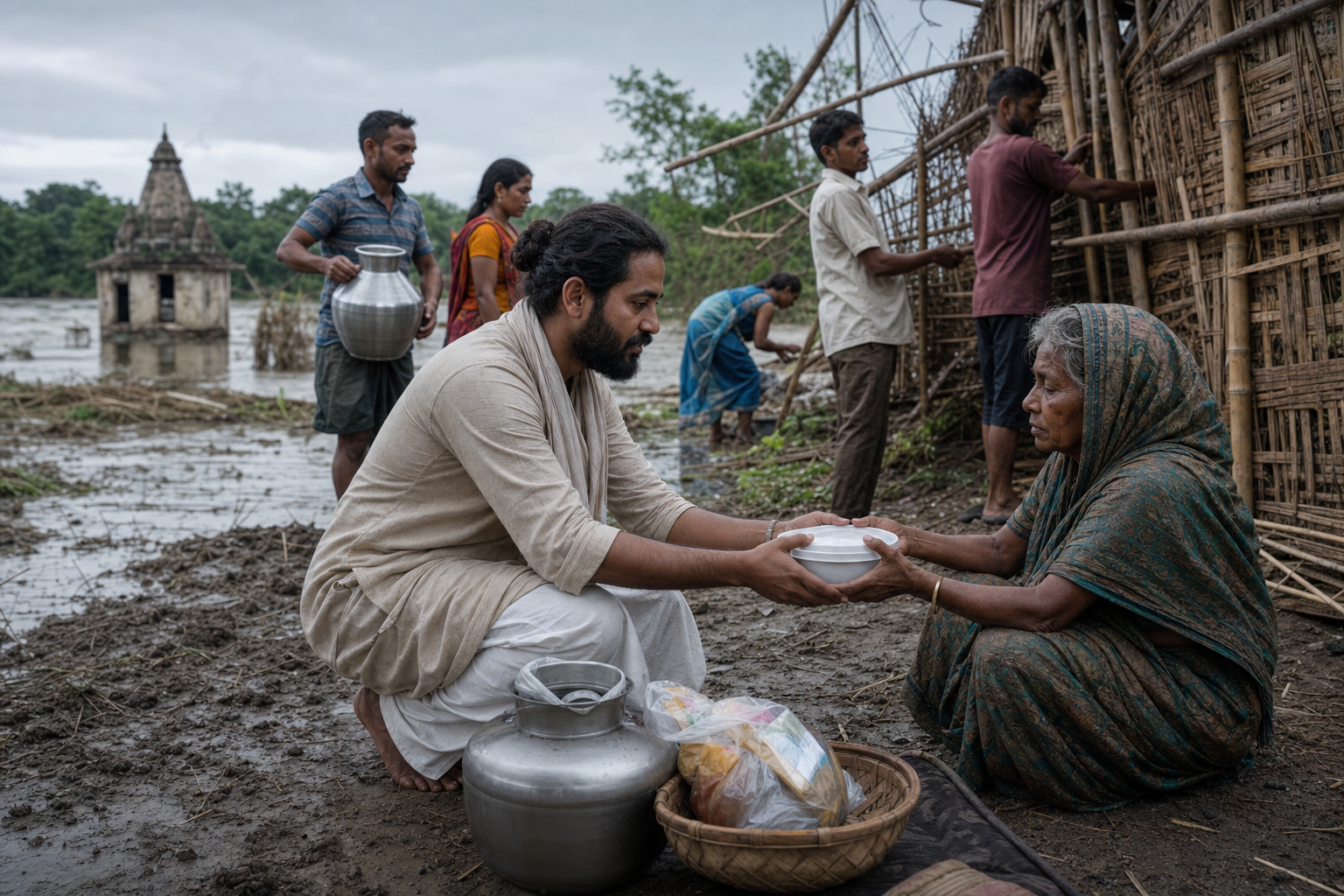
For many people, the question of God is really an objection: if reality is governed by goodness or intelligence, why is there so much pain? A response that merely repeats doctrine will sound evasive because the problem is moral before it is technical.
Many Indic systems place suffering within saṃsāra and moral causality rather than treating it as a single act of divine punishment. Buddhism examines dukkha through dependent causes and the path to cessation. Jainism describes conscious beings as bound through karmic matter in a beginningless universe. Theistic Hindu paths combine karma with Īśvara in different ways. Sikh practice asks the person to live truthfully within hukam while serving others. These are not identical explanations, but none requires you to regard another person’s misery with passive indifference.
Karma is especially easy to misuse when it is applied outward. You do not possess direct knowledge of another person’s previous births or the complete chain of causes behind a tragedy. Saying that a sufferer must have deserved the condition turns a metaphysical doctrine into an unsupported accusation. It also allows the speaker to avoid the duty directly in front of them.
- Respond to visible suffering first. If hunger can be relieved, feed. If an injury can be treated, seek treatment. If injustice can be opposed, act. A remote karmic theory does not cancel an immediate cause or an available remedy.
- Keep levels of explanation separate. Material causes, human decisions, social conditions, habits, and metaphysical interpretations may all be discussed, but one should not be used to erase the others.
- Apply karma inward as responsibility. Ask what intention you are strengthening, what consequence your present action is likely to carry, and what repair is possible now.
- Use compassion as a diagnostic. If your interpretation makes you less willing to protect life, tell the truth, or serve someone in pain, treat that result as evidence that the interpretation has gone wrong.
Suffering therefore neither proves nor disproves every conception of God at once. It does expose shallow conceptions. A belief that survives only by calling every objection a mystery has ceased to function as an argument. A Dharmic response must preserve inquiry while producing compassionate action.
Kali Yuga changes the appropriate method, not the standard of truth

Within Hindu cosmology, Yuga Dharma distinguishes Satya, Tretā, Dvāpara, and Kali as ages with different moral and spiritual conditions. The traditional account places humanity in Kali Yuga, an age marked by ethical confusion, social strain, and restless attention.
That claim belongs primarily to scriptural and cosmological testimony; it is not a laboratory result. You may accept it, suspend judgment, or understand it symbolically while still testing its practical diagnosis. The diagnosis is recognizable: when attention is scattered and life is crowded, an elaborate discipline that is never performed has less value than a simple discipline you can actually sustain.
Yuga Dharma does not mean that truth and falsehood exchange places in a difficult age. It means that the spiritual medicine must fit the condition. Kali Yuga practice therefore emphasizes accessible forms of remembrance, devotion, restraint, meditation, generosity, and service. Simple does not mean casual. Repetition exposes motives and habits that an occasional dramatic experience can leave untouched.
Choose one coherent lane
The Dharmic traditions share important ethical disciplines, but they do not teach one interchangeable metaphysics. Respecting their kinship requires preserving their differences:
- A Hindu practitioner may centre nāma-japa, bhakti, meditation, yama-niyama, study of the Upanishads or Bhagavad Gita, dāna, and sevā according to a sampradāya.
- A Sikh practitioner may centre simran, sevā, humility, equality, moral courage, and conscious alignment with hukam.
- A Buddhist practitioner may use mindfulness and mettā to examine craving, aversion, ignorance, dependent arising, and the cessation of dukkha without inserting a creator into the path.
- A Jain practitioner may centre ahiṃsā, aparigraha, pratikramaṇa, and the example of the Jinas while remembering that anekāntavāda warns against treating one verbal standpoint as the whole truth.
Choose the lane whose truth claim you are genuinely examining. Do not create a spiritual sampler and then attribute the mixed result to every tradition involved. If you belong to a lineage, use its vocabulary, safeguards, and method. If you are still exploring, begin with attention, non-harm, truthfulness, generosity, and service while remaining explicit that ethical benefit alone does not settle the metaphysics.
Run a daily experiment that can survive a distracted age
Fix the practice before your mood decides whether to perform it. A workable routine can follow the same cues each day:
- Begin with remembrance. Before opening the stream of messages and demands, practise the Divine Name, simran, or the contemplative anchor proper to your path.
- Carry one ethical restraint into the day. Select a concrete expression of ahiṃsā, truthfulness, non-grasping, or another discipline recognized by your tradition. Define it behaviourally, such as refusing a harsh reply or declining an unnecessary act of consumption.
- Study a small passage. Use svādhyāya to read closely rather than accumulating pages. Write the instruction in your own words and identify the situation in which it applies.
- Perform one act of service or generosity. Choose something useful that does not depend on recognition. Sevā and dāna prevent spiritual inquiry from becoming private self-absorption.
- Return to attention during friction. The revealing moment is not only the formal sitting. Notice what happens when pride, fear, anger, or craving is activated.
- Close with an honest review. Record what triggered you, what you did, whether repair is needed, and whether the practice was actually performed. Record an unusual feeling as an experience, not as automatic proof of a cosmic explanation.
Choose a trial period in advance and keep the method stable through it. Constantly changing the name, teacher, meditation, or philosophy mostly measures novelty. Missing a session does not require theatrical guilt; resume at the next established cue and examine the cause of the lapse.
Judge the path by its fruits without calling the fruits proof

A disciplined practice can produce several kinds of result, and they should not be confused. A quieter mind shows that attention has changed. Greater honesty shows an ethical effect. A sense of divine presence is genuine as an experience for the person who has it. None of these observations, standing alone, deductively proves every metaphysical interpretation attached to it.
The reverse caution also matters. One restless meditation does not disprove Brahman, Īśvara, Ik Onkar, nirvāṇa, or liberation. The method may have been poorly understood, inconsistently practised, or unsuited to the question. Make the smallest warranted conclusion: this practice had this observable effect under these conditions.
Look for changes that are difficult to fake in ordinary life:
- The interval between provocation and reaction becomes large enough for you to choose a response.
- You tell the truth when concealment would protect your image.
- You notice possessiveness before it turns into harm.
- You serve without converting service into a performance of superiority.
- You can remain present to another person’s suffering without blaming, fleeing, or making yourself the centre.
- You repair harm more readily instead of using spiritual language to defend it.
Reliable testimony still has a place. Satsanga can expose you to lives and insights you do not yet possess. Viveka and parīkṣā should remain active within that good company. Ask whether a teacher permits sincere examination, distinguishes doctrine from personal interpretation, and produces humility rather than dependence on charisma. Testimony becomes more credible when teaching, conduct, reason, and practice point in the same direction.
Key takeaways
- Define whether you are examining a creator, a personal Lord, Brahman, Ik Onkar, consciousness, or liberation without a creator.
- Classify each reason as direct perception, inference, or reliable testimony; do not let one masquerade as another.
- Use karma to deepen your responsibility, never to invent guilt for someone else’s suffering.
- Treat Kali Yuga as a reason for steady, accessible discipline, not as an excuse for fatalism or lowered ethics.
- Measure practice through attention, truthfulness, restraint, compassion, repair, and service while keeping metaphysical conclusions proportionate to the evidence.
You do not have to wait for perfect belief before beginning. Write the exact claim you are examining, choose one practice and one restraint from a coherent path, perform one useful act of service, and review your conduct before sleep. Certainty may not arrive on command, but clarity can grow when doubt is joined to viveka, disciplined practice, and compassion.
References
