

You may have been told there are only two intellectually honest positions: accept evolution and regard life as an accidental arrangement of matter, or defend Vedic wisdom by rejecting evolution. That choice is badly framed. It turns a biological account of change into a metaphysical verdict about consciousness, meaning, and purpose.
You can take evolutionary biology seriously without quietly adopting materialism as your philosophy. You can also affirm an intelligible, meaningful cosmos without presenting every unresolved biological problem as proof of a designer. The practical task is to identify which question is being answered, what kind of evidence could answer it, and where interpretation begins.
The real choice is not evolution or a meaningful cosmos
Four questions are often compressed into one argument: whether populations change over generations, how complex biological systems arose, how the first evolvable life began, and whether life exists within a purposeful order. They are related, but success or failure at one level does not automatically settle the others.
Evolutionary biology investigates heritable change, adaptation, common ancestry, and the diversification of lineages. Its working method is methodological naturalism: explanations are built from causes that can be observed, modeled, compared, or tested within nature. That method does not prove metaphysical naturalism, the much stronger assertion that matter is all that exists. A rule governing scientific investigation cannot, by itself, become a complete inventory of reality.
It is equally important not to describe evolution as pure chance. Mutational and other sources of variation contain stochastic elements, but natural selection is a systematic filter: variations that affect survival and reproduction do not all persist equally. Selection has no foresight, yet it is not equivalent to an unfiltered lottery. Saying that evolution involves chance is therefore different from saying that biological order is causeless.
Origin-of-life chemistry is a separate field. Evolutionary mechanisms explain change once heredity, variation, and differential reproduction are operating; they do not by themselves explain how the first integrated system capable of those processes appeared. Consciousness raises another distinct question. A history of nervous-system adaptation may illuminate the development of cognition without settling what subjective awareness ultimately is.
The modern Vedic engagement with these distinctions has an institutional history. The Bhaktivedanta Institute was founded in 1973 by scientists influenced by A.C. Bhaktivedanta Swami Prabhupada’s criticism of strictly materialistic accounts of life and consciousness. Chemist Thoudam Damodara Singh and mathematician Richard L. Thompson were among those who asked whether scientific mechanisms could be situated within a wider Vedic account of reality. Their question remains useful, but it should not be reduced to a demand that biology choose between molecules and meaning.
The bacterial flagellum is a test case, not a trump card
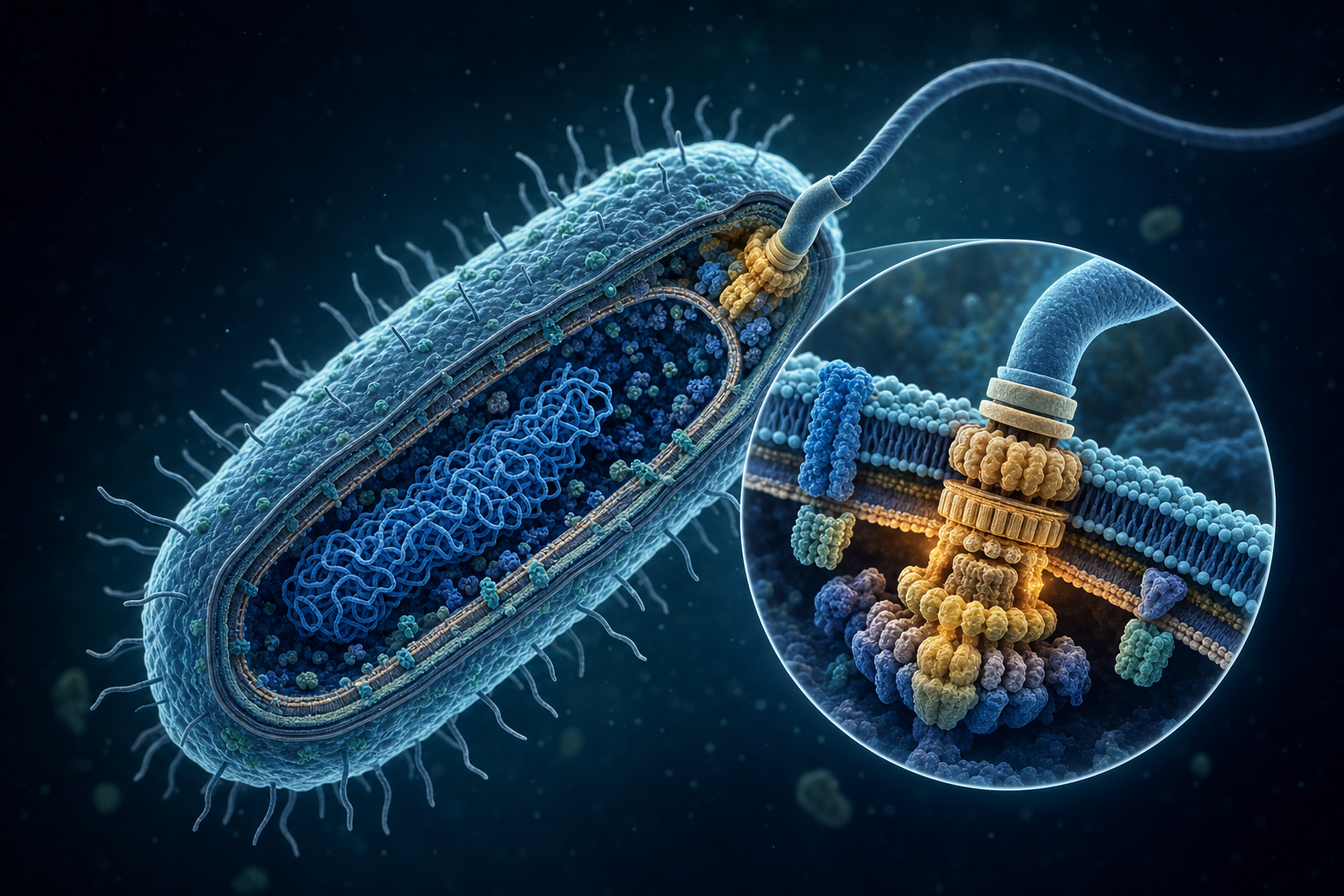
The bacterial flagellum attracts design arguments because it is strikingly integrated. In bacteria such as Escherichia coli and Salmonella, a rotor-stator assembly turns a hook and external filament. A proton-motive force powers many such motors, while sodium gradients perform that role in certain marine species. The MS ring, the C-ring switch complex, stator units such as MotA and MotB, an export apparatus, the hook, and the filament participate in coordinated propulsion.
This is not a loose mechanical analogy imposed on a simple object. The motor can reverse direction rapidly, rotate at several hundred revolutions per second, and produce torque on the order of 103 pN·nm. Chemotactic networks also alter its behavior in response to environmental signals. The system deserves wonder, but wonder is the beginning of an inquiry, not its conclusion.
The irreducible-complexity argument begins with a real observation: remove certain core components from the present motor and its current function fails. It then proposes that a system requiring many coordinated parts could not have arisen through selectable intermediates. Specified-complexity arguments add that an improbable arrangement matching an independently identifiable function is better explained by intelligence than by undirected processes.
The crucial word is then. Present dependence does not reveal historical order by itself. A stone arch may collapse when its central stone is removed even though temporary supports were used during construction. Biological evolution does not employ a literal scaffold, but it can change functions, duplicate genes, modify earlier structures, and recruit parts from one role into another. The function of an intermediate need not be a weaker version of the final function.
Comparative biology has therefore examined homologies between flagellar basal-body components and Type III secretion systems, along with gene duplication, divergence, horizontal transfer, and co-option. The direction of the relationship and the exact history remain debated; resemblance alone does not provide a complete chronological pathway. It does show, however, that some components can participate in functions other than propulsion. That makes the statement “the modern motor stops when this part is removed” inadequate as a refutation of every possible precursor.
Archaea add another caution. Their archaella generate motility through a molecular system distinct from the bacterial flagellum, while type IV pili can support twitching movement. Multiple biological solutions to movement reveal both functional constraint and historical diversity. They do not prove purposelessness, but they complicate the picture of a single machine assembled once in an obvious final form.
A fair judgment therefore runs in both directions. Evolutionary models must do more than announce that co-option is possible; they must reconstruct plausible sequences and compare them with genomic and structural evidence. Design proponents must do more than identify a difficult step; they need positive, discriminating evidence for design and a method for distinguishing it from an evolutionary history not yet recovered. An unanswered question is not a demonstrated designer, just as a plausible evolutionary scenario is not proof that reality lacks purpose.
Vedic causation keeps mechanism, meaning, and value distinct

Vedic intelligent design is most defensible when it names a layered philosophy of nature rather than a substitute biochemical mechanism. Indian traditions have used more than one causal vocabulary, and their schools do not arrange the categories identically. Still, the distinction between material cause, often discussed as upādāna kāraṇa, and operative or efficient cause, nimitta kāraṇa, gives you a disciplined starting point. Questions of form, order, and purpose can then be asked without pretending that they replace molecular analysis.
| Level of inquiry | Question it answers | Flagellum example | Common mistake |
|---|---|---|---|
| Mechanistic | How does the system operate now? | Ion gradients, rotor-stator interactions, switching, assembly, and torque | Treating present operation as a complete origin history |
| Historical and evolutionary | Through what sequence could the system change? | Duplication, divergence, co-option, transfer, and selection | Assuming a natural pathway settles whether existence has meaning |
| Metaphysical | Why is nature intelligible, ordered, or capable of consciousness? | Interpretation through ṛta, dharma, Brahman, prakṛti, or conscious potency | Presenting a metaphysical commitment as a laboratory measurement |
| Ethical | How should knowledge shape conduct? | Ahimsa, seva, restraint, stewardship, and responsible technology | Deriving moral duties from biological facts without an ethical argument |
At the mechanistic level, a proton gradient can explain how torque is generated. At the historical level, comparative genomics can test whether related proteins were duplicated, transferred, or recruited. At the metaphysical level, concepts such as ṛta, dharma, and citi-śakti can frame the lawfulness and intelligibility within which those processes occur. These explanations need not compete because they are not answering identical questions.
This layered view also prevents a “God of the gaps” argument. If divine intelligence is invoked only where a natural account is missing, every new mechanism appears to reduce the divine role. A more coherent Vedic position locates natural regularities, lawful transformation, and creaturely processes within the order being interpreted. Finding an evolutionary pathway would then deepen knowledge of that order rather than evict intelligence from it.
The same discipline limits overreach in the opposite direction. A successful account of flagellar assembly or common ancestry does not establish that consciousness is reducible to chemistry, that moral value is a reproductive strategy, or that the cosmos has no purpose. Those conclusions require additional philosophical arguments. They cannot be smuggled into the word “science.”
Classical discussions of pramāṇa reinforce the point. Perception, inference, and testimony do different epistemic work, even though Indian schools disagree about precisely which means of knowledge they accept and how each should be ranked. Use observation to establish what a molecular structure does. Use carefully constrained inference to reconstruct an unobserved past. Use philosophical reasoning and, within a tradition, testimony to discuss ultimate reality. Confusion begins when authority is used to dictate a protein’s structure or when a protein’s structure is made to pronounce on moksha.
Dharmic unity does not require one creation doctrine
“Vedic” and “Dharmic” should not be used as if every Hindu, Buddhist, Jain, and Sikh school teaches the same cosmology. The traditions share civilizational conversations and important ethical resonances, but their accounts of self, causation, divinity, and liberation differ. A durable unity respects those differences rather than concealing them beneath a Western design-versus-evolution binary.
Within Hindu thought, Nyāya-Vaiśeṣika offers detailed causal and ontological analysis. Sāṅkhya examines the relation of puruṣa and transforming prakṛti. Vedānta schools interpret Brahman, consciousness, and the world in different ways. Consequently, a Hindu response to evolution should name its darśana. “The Vedic view says” is usually too imprecise to carry a serious argument.
Buddhist pratītya-samutpāda, or dependent origination, analyzes phenomena through interdependent conditions without requiring a personal creator. It should not be turned into disguised theism merely to make it fit intelligent-design language. Its contribution here is a rigorous refusal to isolate an entity from the conditions through which it arises.
Jain anekāntavāda brings many-sided analysis. A molecular, evolutionary, ecological, and metaphysical description may each disclose something relevant from a particular standpoint. Many-sidedness is not permission to declare incompatible empirical claims equally correct; it asks you to specify standpoint and scope before making an absolute judgment.
Sikh thought approaches cosmic regularity through hukam, the Divine Order within which existence unfolds. Hukam need not compete with a biochemical mechanism any more than the meaning of dharma competes with a measurement of torque. It answers a different kind of question about the order in which the measured process has its place.
The common ground is therefore methodological humility, not a uniform designer theory. No single empirical description exhausts life. No metaphysical affirmation excuses careless science. And no scientific mechanism automatically eliminates ethical obligation. This is enough ground for a Dharmic conversation without forcing all traditions into one theological formula.
Use six questions to evaluate any design-or-evolution claim

Origin-of-life debates show why a method matters. Prebiotic chemistry has produced nucleotides, amino acids, and lipids under plausible geochemical conditions, while work on ribozymes and protocells explores routes toward heredity and compartmentalization. Serious difficulties remain, including robust routes to homochirality, sufficiently faithful information copying, coupled energy transduction, and the integration of metabolism with genetics. The honest description is neither “life has been created from scratch” nor “chemistry has accomplished nothing.”
When you encounter a confident claim from either side, work through the following questions in order:
- What exactly needs explaining? Write down the target: present operation, evolutionary history, the origin of heredity, consciousness, cosmic order, or moral meaning. If the target changes halfway through the argument, the conclusion no longer follows.
- Is the claim an observation, a reconstruction, or an interpretation? A measured rotation rate is an observation. A proposed sequence of ancestral systems is a historical reconstruction. The judgment that ordered life ultimately expresses intelligence is a metaphysical interpretation. All can be rational, but they carry different kinds of warrant.
- Does the argument offer positive evidence or only point to a gap? “No pathway is currently known” identifies an open problem. It becomes evidence for design only if a reliable method shows why the alternatives fail and why intelligence predicts the observed pattern better.
- Has the strongest alternative been addressed? A critique of gradual addition is incomplete if it ignores co-option, functional change, duplication, and transfer. An evolutionary proposal is incomplete if it merely labels parts homologous without testing direction, sequence, and feasibility.
- What would count against the claim? A scientific proposal needs some possible observation that would weaken it. If every conceivable result is said to prove design, or every difficulty is absorbed by an unspecified future evolutionary pathway, the position has stopped taking evidential risk.
- Has a mechanism been mistaken for a worldview? Natural selection is a biological mechanism, not proof of nihilism. Divine order is a metaphysical affirmation, not a replacement for genetics. Keep each conclusion within the reach of its premises.
Key takeaways
- Accepting evolutionary mechanisms does not logically require accepting metaphysical materialism.
- The flagellum’s present interdependence is real, but present interdependence alone cannot reveal the complete order in which its components arose.
- Homology, co-option, and comparative genomics provide testable evolutionary routes; they do not, by themselves, establish that nature is purposeless.
- Biological evolution, the origin of life, consciousness, and cosmic purpose are distinct questions requiring different evidence.
- A Vedic design perspective is strongest as a layered interpretation of nature unless it produces distinctive predictions that can be tested against alternatives.
- Dharmic unity is compatible with genuine disagreement among Hindu, Buddhist, Jain, and Sikh accounts of causation and divinity.
The next time this debate arises, put one label beside every claim: mechanism, history, origin of life, consciousness, metaphysics, or ethics. Then ask for evidence suited to that label. If the speaker crosses into another category, require the missing argument before following. That small habit lets you defend scientific rigor without surrendering the larger Dharmic questions that science, by its own method, was never designed to settle alone.
References
