
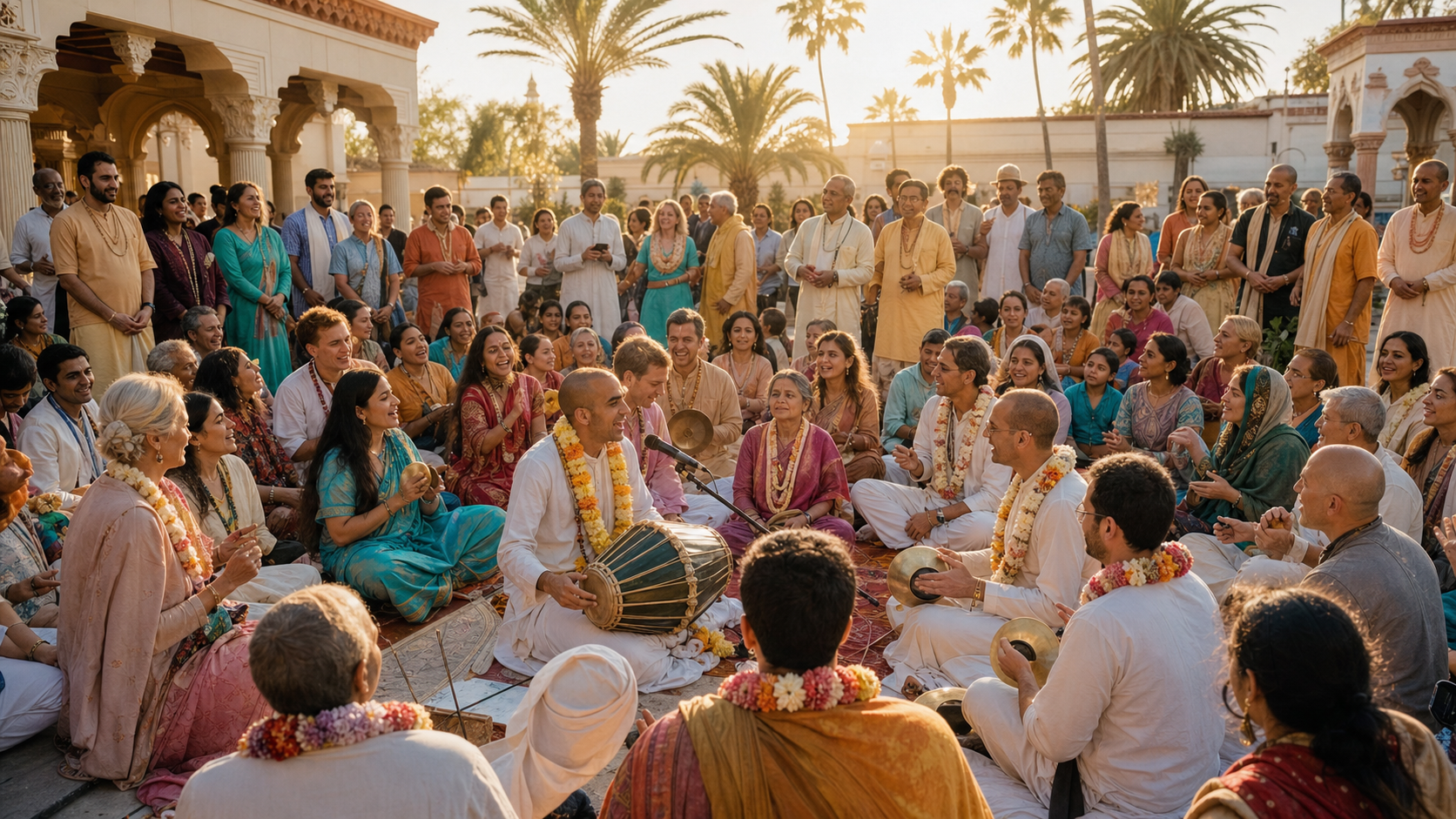
If you are trying to decide whether the Srila Prabhupada Festival in Los Angeles is a memorial, a temple celebration, or a day of spiritual practice, the clearest answer is that it is all three, with practice at the centre. The May 23, 2026 gathering at New Dwarka Temple commemorated thirty-five years of gratitude to His Divine Grace A.C. Bhaktivedanta Swami Prabhupada.
You will understand the festival more deeply if you look beyond the stage programme. Kirtan, japa, scriptural study, prasadam, books, art, and volunteer service are different ways of asking the same practical question: how can elevated thought reshape an ordinary life?
Key takeaways
- The Los Angeles festival reached its thirty-five-year milestone in 2026 and is anchored at New Dwarka Temple, home of Sri Sri Rukmini Dwarakadish.
- "Simple Living, High Thinking" means reducing unnecessary consumption and distraction so that study, remembrance, devotion, and service receive serious attention.
- Kirtan, guided japa, discourse, exhibitions, devotional arts, and prasadam should be approached as connected practices rather than unrelated attractions.
- The most useful framework to take home is sadhana, seva, and sangha: personal discipline, selfless service, and supportive association.
- Families, students, newcomers, and members of other dharmic traditions can participate meaningfully without pretending that every tradition teaches exactly the same theology.
Why a thirty-five-year festival is more than an anniversary
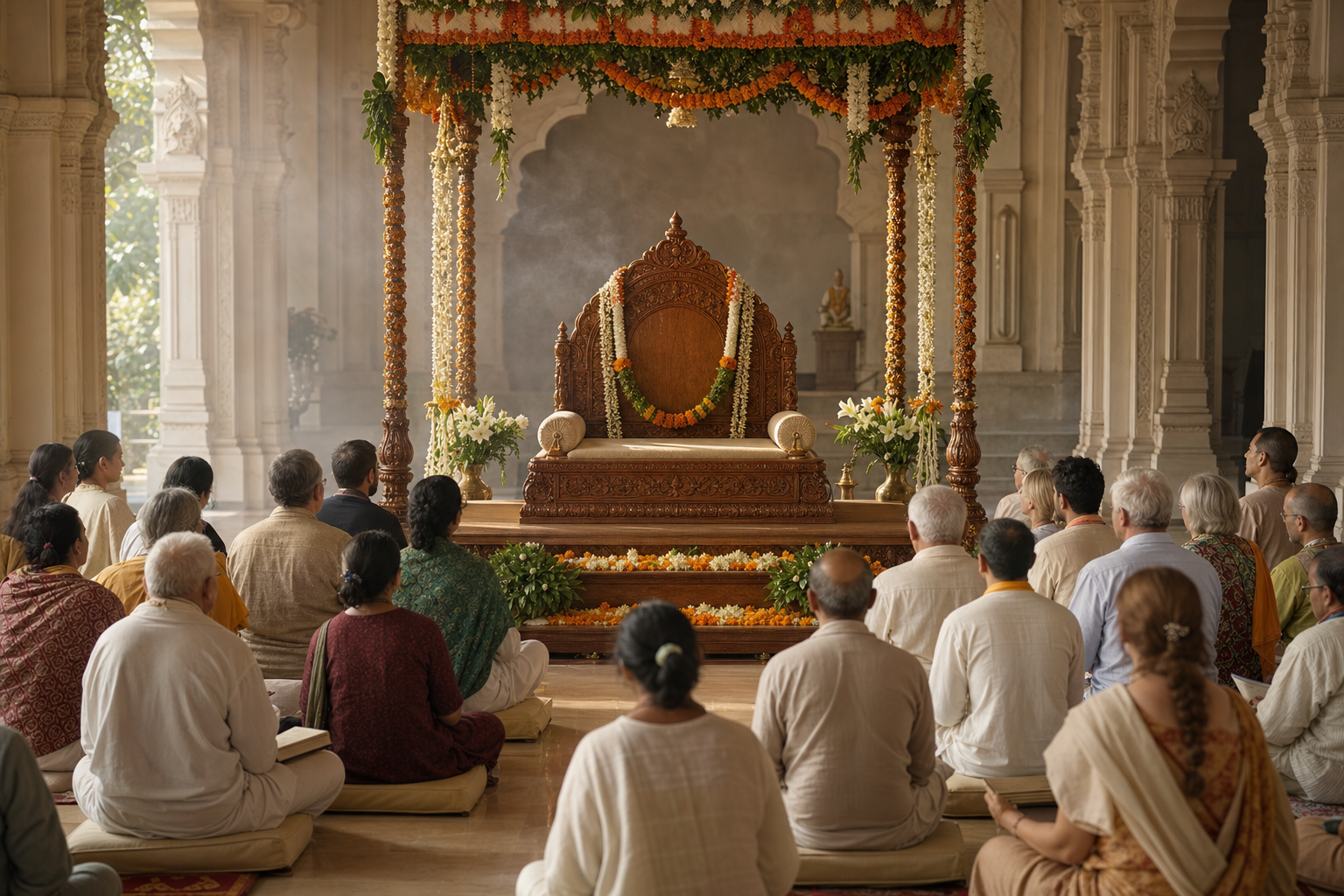
A spiritual anniversary can easily become nostalgic: photographs are displayed, respected names are remembered, and everyone returns home unchanged. That would miss what makes this observance important. Over more than three decades, the celebration developed from a modest offering into a recognised spiritual and cultural gathering for Southern California’s Vaishnava and wider dharmic community.
The continuity itself deserves attention. A diaspora preserves its inheritance only when another generation can practise it, question it, serve within it, and eventually take responsibility for it. Language, music, ritual, philosophy, hospitality, and ethical habits survive through repeated participation, not through memory alone. This is why the presence of families, students, experienced devotees, and seekers matters as much as the formal anniversary.
New Dwarka Temple gives that continuity a physical centre. The worship of Sri Sri Rukmini Dwarakadish anchors the gathering in living Vaishnava practice, while talks, books, photographs, and educational displays place Srila Prabhupada’s work in historical and philosophical context. The literary dimension is especially significant in Los Angeles because scriptural education and the work associated with the Bhaktivedanta Book Trust have long accompanied the region’s devotional life.
When you encounter a festival like this, notice the mechanisms of transmission. Watch how volunteers turn seva into hospitality, how musicians make participation possible for newcomers, how teachers translate Sanskrit concepts without emptying them of meaning, and how families give younger participants a real role. Those details tell you whether a tradition is merely being displayed or is still being handed forward.
How to move through the devotional programme with purpose
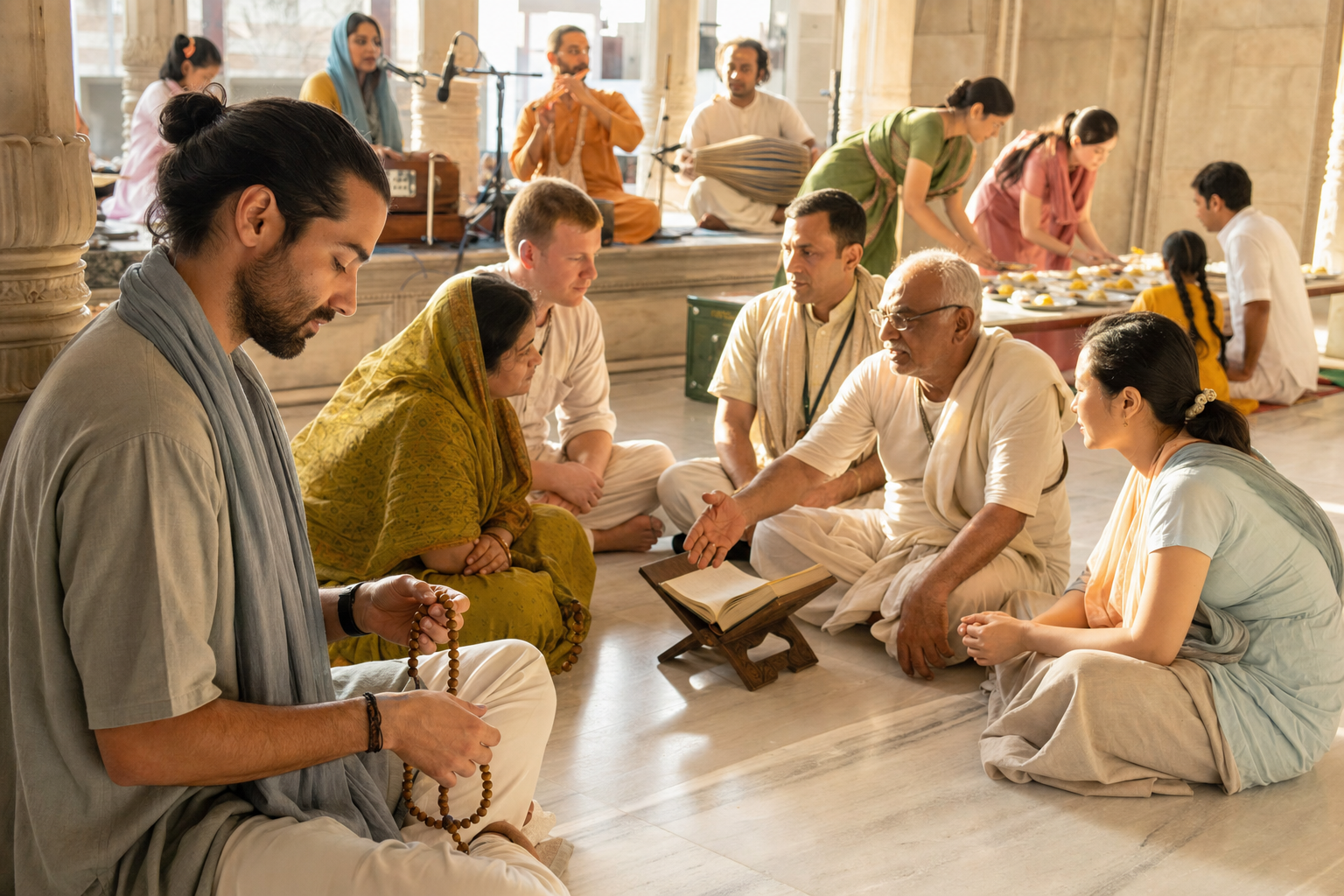
The festival’s activities are not interchangeable. Each trains attention in a different way. Moving through them deliberately will give you more than treating the programme as a sequence of performances.
- Enter kirtan through listening. Nama-sankirtana is congregational chanting of the holy names, commonly supported by mridanga and kartals. You do not need musical training or prior familiarity. Listen for the recurring response, join when you are comfortable, and let repetition gather an otherwise scattered mind. The point is collective remembrance, not vocal display.
- Distinguish japa from kirtan. Guided japa turns toward personal, sustained repetition. Put away the phone, follow the instruction being given, and notice how quickly attention wanders. That wandering is not a reason to abandon the practice; noticing it is part of learning how little command we often have over our own attention.
- Take one question into every discourse. Talks and seminars commonly draw upon the Bhagavad Gita’s teachings on self-mastery, duty, and devotion, together with the Srimad-Bhagavatam’s treatment of compassion, cosmology, and dharmic leadership. Ask what the teaching expects you to change in conduct. A talk becomes useful when a principle moves from vocabulary into a decision.
- Use the exhibition as a doorway to study. Archival photographs establish historical continuity, while Srila Prabhupada’s translations and commentaries provide the intellectual structure behind the devotional culture. Choose one text or teaching to pursue further instead of trying to absorb every display. Record the question that remains unresolved.
- Treat devotional art as teaching. Dance, theatre, music, and storytelling can translate philosophical ideas into forms that children and adults remember. Do not dismiss them as intervals between serious sessions. Ask which choice, virtue, attachment, or consequence the story is making visible.
- Receive prasadam as part of the practice. The shared vegetarian meal embodies gratitude, hospitality, and ahimsa. It also softens ordinary social boundaries because people receive and eat together. If you have an allergy or another dietary restriction, ask about ingredients rather than assuming that "vegetarian" means safe for every diet.
This sequence joins experience to understanding. Kirtan can open the heart, japa can expose the undisciplined mind, discourse can clarify ideas, books can sustain study, art can preserve memory, and prasadam can express compassion through a shared act. Removing any one element does not invalidate the rest, but seeing their relationship reveals the festival’s educational design.
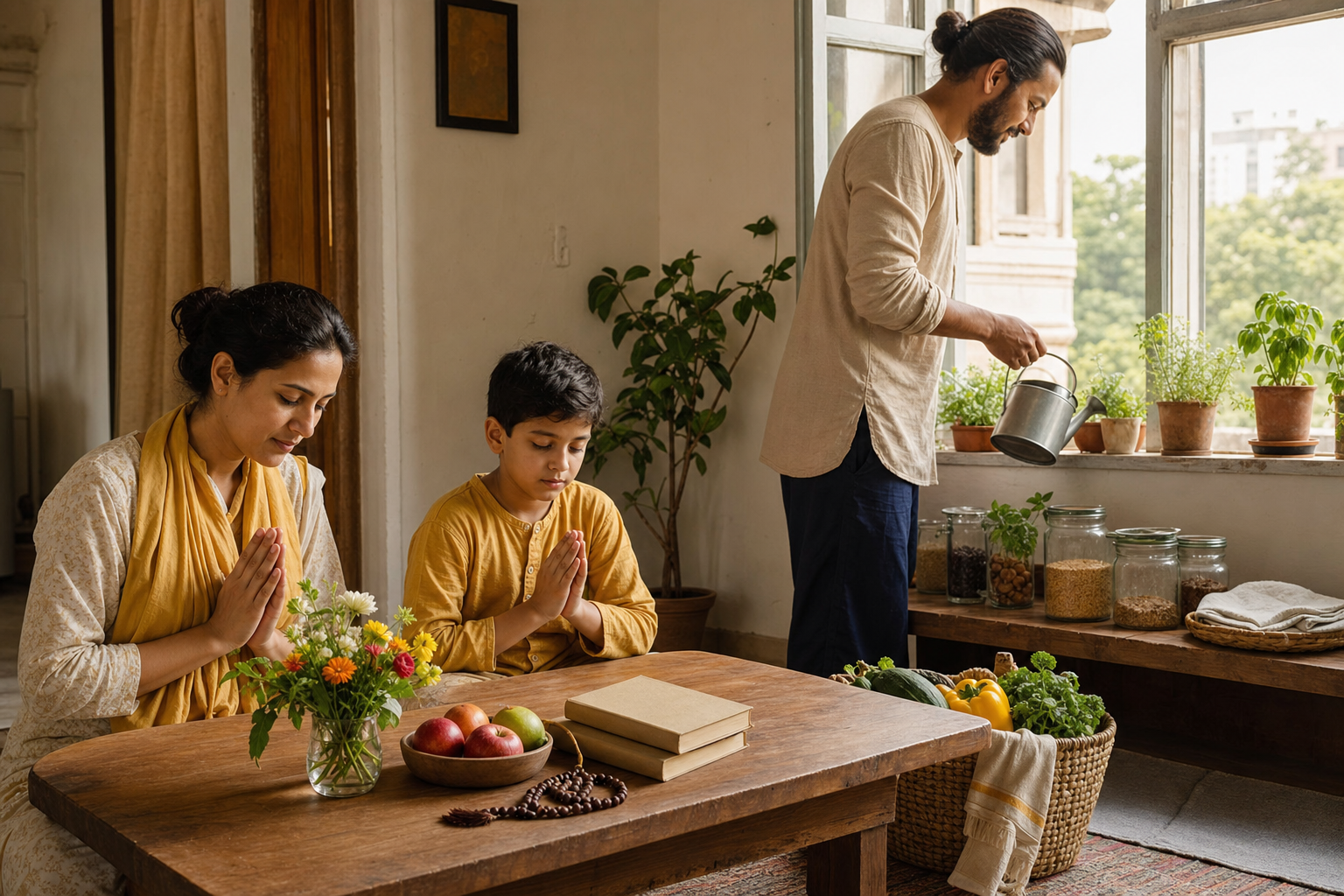
Turn "Simple Living, High Thinking" into a home practice
"Simple Living, High Thinking" is easily reduced to a pleasing slogan. It is not a demand for poverty, rejection of the city, or austerity performed for its own sake. It asks you to remove excess deliberately so that consciousness is not governed by consumption, noise, and restless desire.
The two halves must remain together. Simplicity without higher purpose can become mere minimalism. High thought without disciplined living can become spiritual talk resting on unchanged habits. In the Gaudiya Vaishnava framework, intentional restraint supports sattva, or clarity and harmony, while bhakti-yoga directs that clarity toward loving devotional service.
A practical way to test the principle is to work through sadhana, seva, and sangha:
- Sadhana: Choose a spiritual discipline you can repeat consistently, such as attentive japa or focused reading from the Bhagavad Gita or Srimad-Bhagavatam. Attach it to a stable point in your daily routine rather than waiting for an ideal mood.
- Seva: Convert some of the time, money, or attention released by simplification into a specific service. Help with hospitality, teaching, cleaning, food distribution, music, administration, or another task suited to your actual capacity. Service becomes transformative when it is dependable, not merely enthusiastic.
- Sangha: Stay connected to people who support the discipline. Association is not a substitute for personal effort, but it makes self-deception easier to notice and good habits easier to sustain.
Begin by naming one form of excess that repeatedly displaces what you claim to value. It might be impulsive consumption, unnecessary digital stimulation, overfilled commitments, or the habit of turning every quiet moment into entertainment. Set a clear boundary around that behaviour. Then decide in advance what higher practice will occupy the space you recover.
Judge the change by its fruit. Does it make you more attentive during japa, more willing to serve, more patient with family, more serious in study, or more reliable in community? If the simplified habit merely makes you proud of being austere, it has not yet produced high thinking.
How families, seekers, and dharmic neighbours can enter well
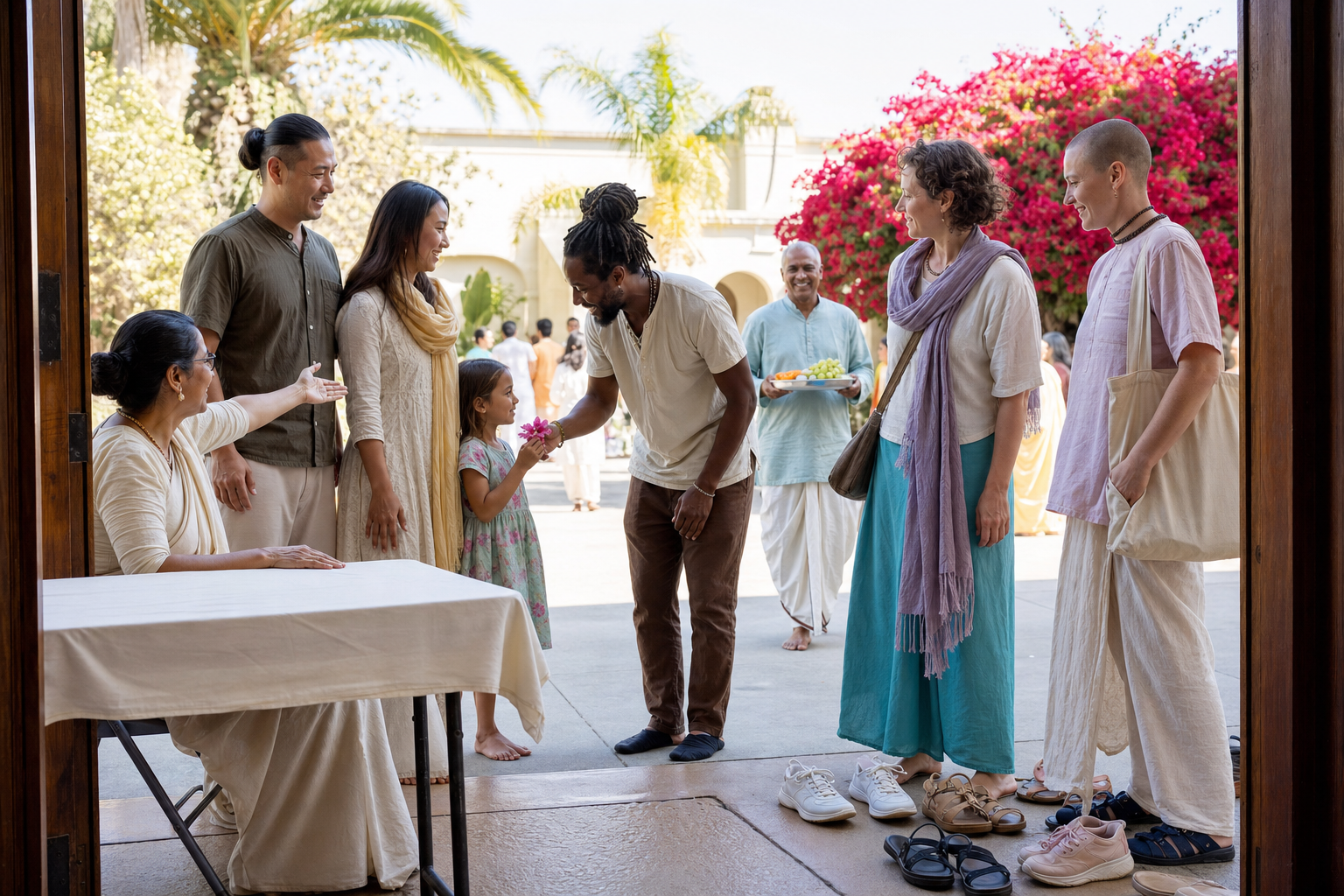
You do not need specialist knowledge to participate, but you should arrive ready to listen. A newcomer will usually learn more by following one practice attentively than by trying to decode every Sanskrit term at once. During discussions, ask for the practical meaning of an unfamiliar concept. During worship, follow the guidance of the temple community rather than copying gestures without understanding them.
For families, the most valuable question is not whether children remained occupied. Ask what they understood. Storytelling from the epics, music, visual art, and age-appropriate discussions about ethics, ecology, and digital mindfulness can connect inherited teachings to choices children already face. When such activities are offered, invite the child to identify one decision a character made, one consequence that followed, and one value worth practising at home.
The theme also offers genuine points of contact across dharmic traditions. Buddhist ethical restraint and mindfulness, Jain aparigraha and ahimsa, and Sikh seva and remembrance of the Divine all resonate with the effort to reduce grasping and elevate consciousness. Resonance, however, is not sameness. The festival remains rooted in Gaudiya Vaishnava bhakti, the worship of Krishna, and the teaching mission of Srila Prabhupada. Mutual respect grows when shared values open conversation without erasing real theological distinctions.
If you plan to attend a later observance at New Dwarka, confirm the current schedule, admission arrangements, parking, accessibility, photography rules, food provisions, and facilities for children directly with ISKCON Los Angeles. Do not assume that programme elements or logistical arrangements remain identical from one celebration to another.
The strongest response to Srila Prabhupada’s legacy is a visible change in practice. Before you move on, choose the excess you will reduce, the sadhana that will replace it, and the service through which another person will benefit. That is how a festival leaves the temple and enters daily life.
References
