
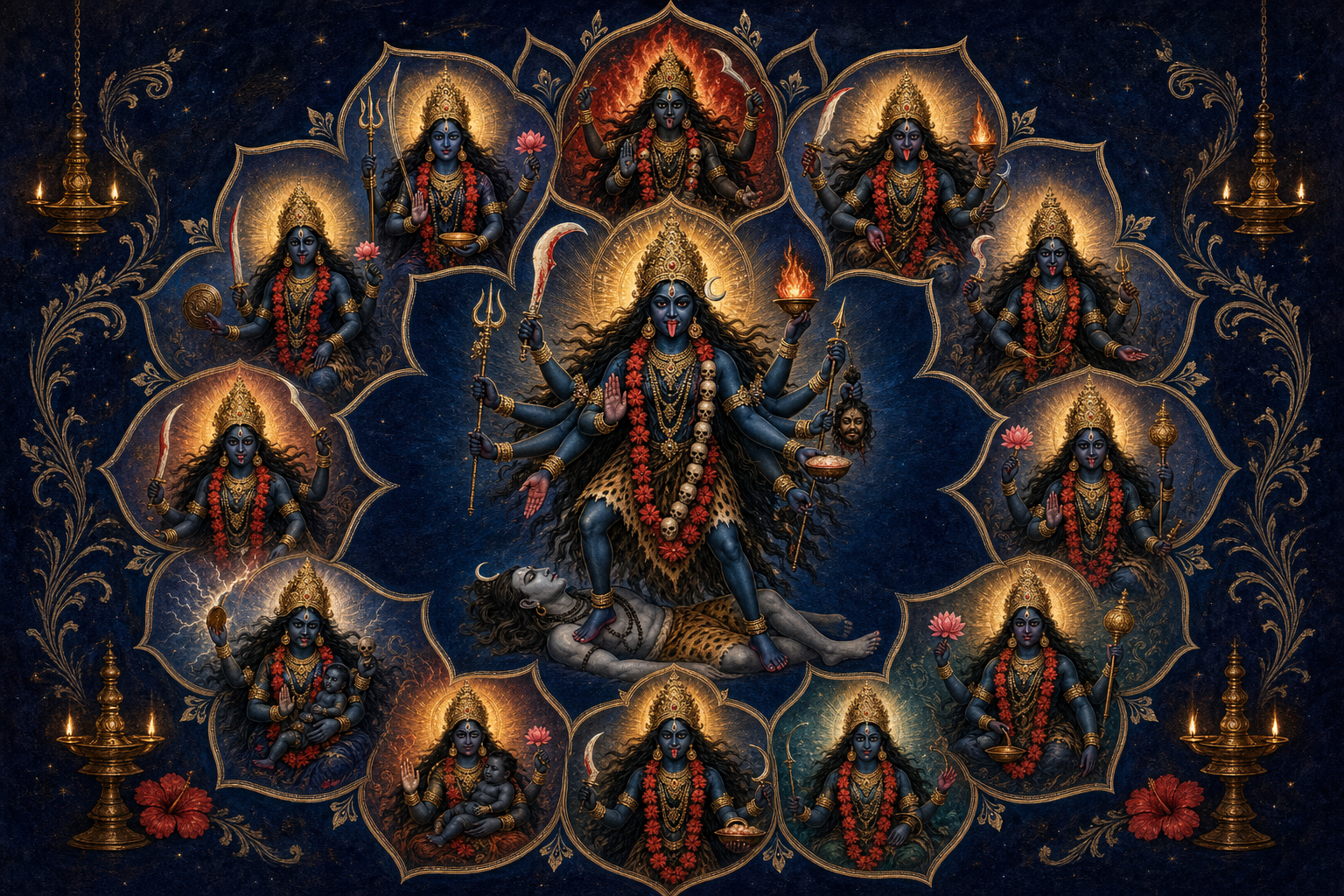
If you came looking for one definitive list of Kali’s eleven forms, you may already have found a problem: another temple, lineage, or book can give you a different roster. You don’t need to choose one list and dismiss the rest. You need to know what kind of map you are reading.
This guide gives you a commonly cited Bengali-Shakta enumeration, shows what distinguishes each form, and helps you decide how to approach them responsibly. The goal is not to memorize eleven names. It is to recognize how one Kali meets different human conditions: affection, danger, discipline, mortality, discernment, secrecy, and the need for uncompromising courage.
Why one Kali can appear in eleven forms
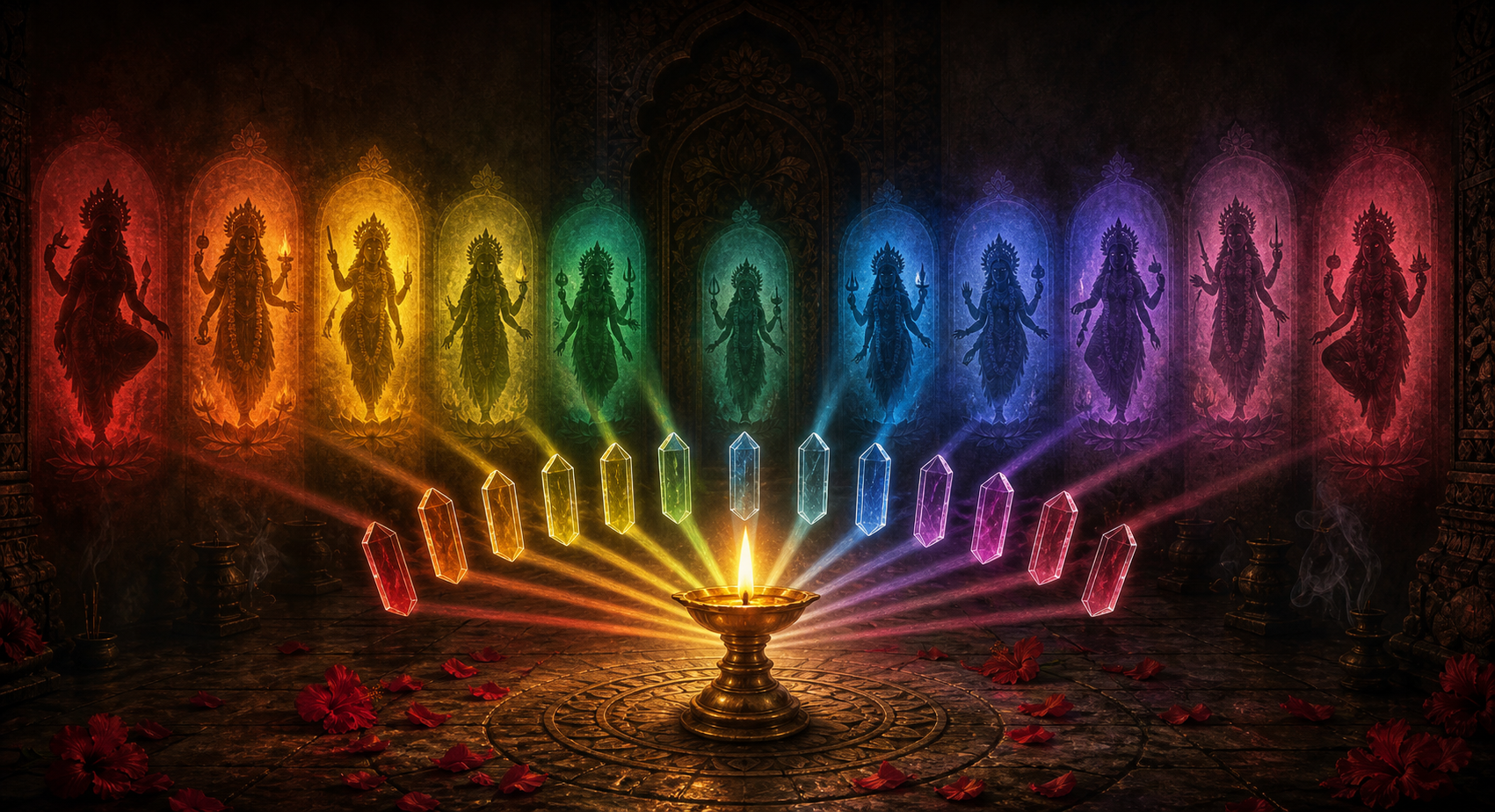
Ekadasha Kali means an enumeration of eleven forms of Kali, but it is not a universally fixed catalogue binding every Shakta community. Bengal, Assam, individual temples, family traditions, and initiatory lineages preserve overlapping but sometimes different rosters. Treat the list below as a well-established Bengali-Shakta map, not as a weapon for declaring another community’s worship incorrect.
The unity behind the list matters more than the number. Adya, Dakshina, Shyama, Raksha, Smasana, and the other names do not describe eleven rival divine powers. They express one undivided Shakti under different conditions. When a devotee needs maternal nearness, Kali can be approached as Shyama. When a community faces danger, the protective force of Raksha or Bhadra comes forward. When a practitioner must confront death and attachment directly, Smasana Kali reveals another face of the same Mother.
This is also why the gentle and fierce forms should not be divided into good and bad. Shakta thought distinguishes between saumya, the gracious and reassuring mode, and raudra, the terrifying and ego-shattering mode. Both can be compassionate. One steadies you through affection; the other removes the illusion you are unwilling to surrender.
The plurality grew within an eastern Indian religious world in which Hindu Shakta, Buddhist Vajrayana, and regional folk traditions interacted, particularly around the Pala-Sena period. That history helps explain why a local temple’s iconography or name may not fit a modern chart perfectly.
Use a simple rule: let an eleven-form list orient your study, but let the living temple, sampradaya, or family lineage determine the form of actual worship. If the two differ, local tradition is not a defective version of the chart.
The eleven forms and the spiritual question each one answers
The clearest way to distinguish the forms is by their spiritual function rather than by appearance alone. Several share the dark complexion, sword, severed head, garland, and protective gestures associated with Kali. Ask what aspect of spiritual life the form brings into focus.
| Form | Central emphasis | What you should notice | Appropriate doorway |
|---|---|---|---|
| Adya Kali | Primordial, undivided Shakti | Every specialized form returns to one source beyond birth and decay. | Begin here when you want the philosophical unity behind the eleven names. |
| Dakshina Kali | Protective grace joined to spiritual clarity | Her right-foot-forward stance, fierce emblems, and fear-dispelling hands unite power with maternal reassurance. | A widely established householder-facing form, especially in Bengal and eastern India. |
| Shyama Kali | Affectionate nearness of the Mother | The dark-blue or black Mother is approached through intimate devotion, lamps, food offerings, hibiscus, and song. | Daily household devotion, Kali Puja, and the emotional vocabulary of Shyama sangeet. |
| Bhadrakali | Auspicious protection and restoration of dharma | Bhadra does not make her powerless or merely mild. Her fierceness protects order, justice, and communal well-being. | Community worship concerned with resilience, calamity, and the defence of dharmic order. |
| Smasana Kali | Impermanence, death, and the destruction of attachment | The cremation ground removes social disguises and forces a direct encounter with the end of every embodied identity. | Householders can contemplate her teaching; cremation-ground rites belong to qualified initiates. |
| Raksha Kali | Direct protection during collective danger | Her worship has been associated with disease, famine, conflict, and other threats to communal life. | Collective vows and prayer joined to hygiene, care for the vulnerable, mutual aid, and justice. |
| Siddha Kali | Disciplined accomplishment | Siddhi should mean maturation of practice, attention, character, and insight, not a public display of unusual powers. | Structured practice, scriptural study, and mantra under the guidance of a lineage. |
| Guhya Kali | The secret and inward dimension of realization | Her secrecy protects the integrity of initiatory knowledge and points toward awareness where ordinary language falls away. | Parampara-based practice; for everyone else, she teaches privacy, sincerity, and freedom from spiritual exhibitionism. |
| Hansa Kali | Discriminative wisdom, breath, and subtle awareness | The hamsa or swan represents the ability to distinguish the essential from the inessential; the Hanseshwari tradition also links her with breath and subtle channels. | Contemplation that joins devotion to yogic discernment, especially within a tradition that can explain its method. |
| Bhima Kali | Formidable protective power | This form gives a fierce language to courage when danger cannot be minimized or politely ignored. | Approach through the regional or temple tradition that preserves her identity and worship. |
| Chamunda | Uncompromising fierce protection | She belongs to the most severe protective register of the roster, where destructive forces are faced without sentimentality. | Temple and lineage practice are safer guides than attempting to reconstruct rites from an image or short description. |
These forms make an arc rather than a hierarchy. Adya reveals the source. Dakshina and Shyama bring that source near. Bhadra and Raksha protect life and order. Siddha disciplines capacity. Hansa sharpens discrimination. Guhya turns awareness inward. Smasana, Bhima, and Chamunda refuse to let fear dictate the limits of spiritual life.
Dakshina and Shyama Kali are especially visible in Bengali household and community worship. Dakshina Kali’s reach beyond Bengal is closely associated with Dakshineswar and Sri Ramakrishna, while Shyama Kali shapes the devotional atmosphere of Kali Puja, also called Shyama Puja, during Deepavali. Their familiarity does not make them spiritually weaker than the more esoteric forms. Accessibility is itself a form of grace.
Bhadrakali also has powerful traditions outside this Bengali enumeration, including in Kerala. Do not assume that every temple bearing her name interprets her through the same eleven-form framework. The temple’s own history, ritual vocabulary, and community memory come first.
Read Kali’s image as a spiritual grammar
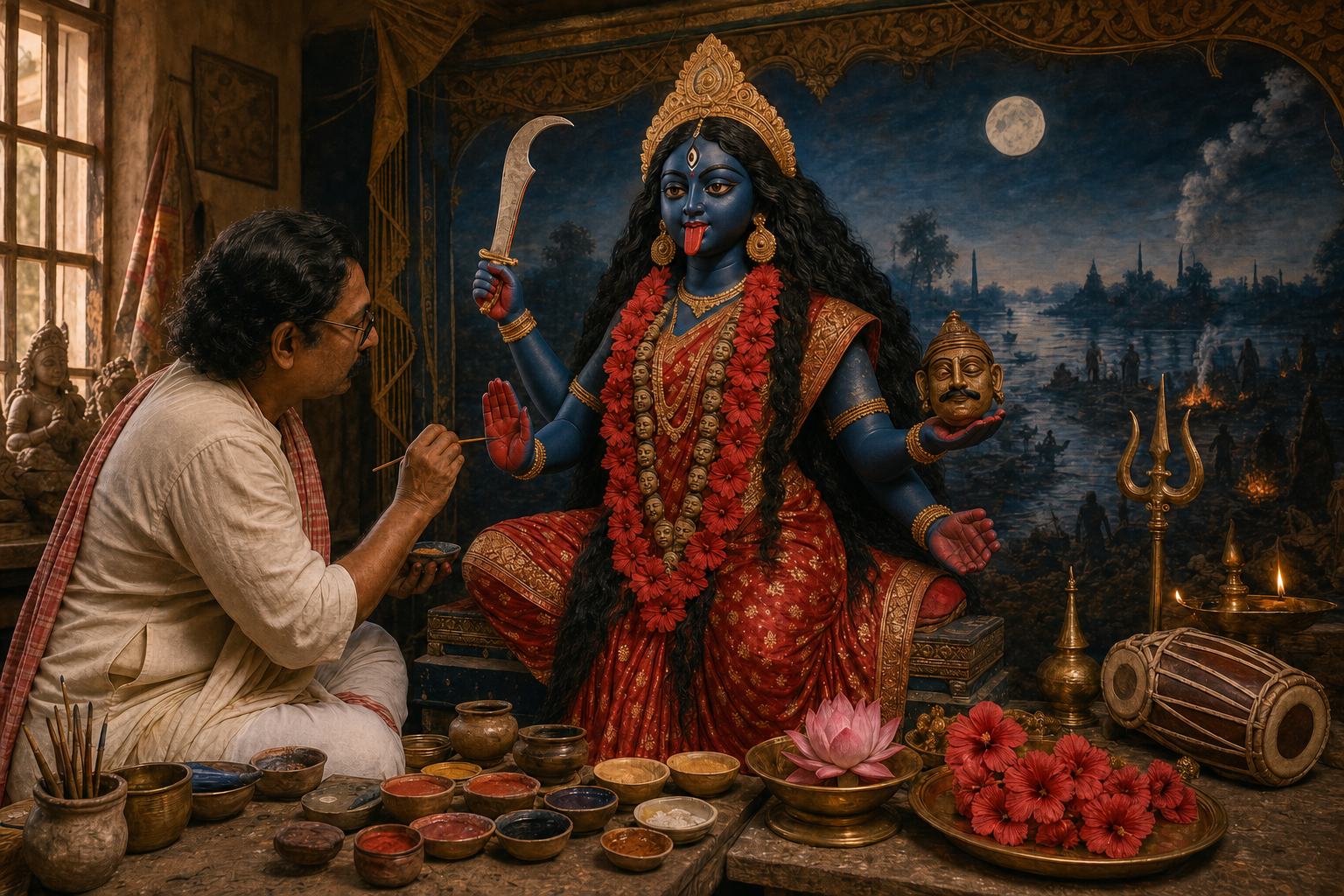
A single attribute rarely identifies a form. The sword, garland of heads, extended tongue, dark complexion, and Shiva beneath her feet recur in more than one Kali image. To read an image responsibly, move from the whole composition to the details.
- Start with posture and orientation. A right-foot-forward image commonly signals the Dakshina orientation and its tempered, householder-facing grace. A left-foot-forward or Vama orientation can indicate a more unmediated movement beyond convention. This is not a ranking of virtuous right against sinful left.
- Count the hands and identify their functions. A sword or curved blade cuts ignorance. A severed head represents the ending of avidya, not violence celebrated for its own sake. Open hands in abhaya and varada promise fearlessness and blessing.
- Read the setting. A cremation ground makes impermanence central. Jackals and Bhairava can mark a liminal, guarded space. A household altar, public festival, or protective procession places similar imagery in a different devotional context.
- Look at expression, colour, and ornament. A serene or smiling face may pull the image toward the maternal Dakshina or Shyama register. Blue-black darkness signifies an infinity that absorbs every finite form. A garland of heads can represent the sounds or letters from which articulated experience arises, as well as the dissolution of fixed ego-identities.
- Ask how the worshipping community names her. A priest, family elder, temple history, festival name, or lineage teaching can settle what visual comparison cannot. The living name is part of the iconography.
The image of Kali standing upon Shiva is among the most easily misunderstood. Within Shakta symbolism, it is not a scene of one deity humiliating another. Shiva represents still consciousness; Kali is the dynamic power through which consciousness acts and the cosmos moves. Without consciousness, power has no ground. Without Shakti, consciousness remains motionless. The image holds the two together.
Her extended tongue also should not be reduced to one dramatic story or a sign of demonic appetite. In this symbolic language, Kali consumes and purifies time. The garland is not merely a trophy, and the blade is not a celebration of cruelty. The terrifying elements turn inward: what must be cut is ignorance, what must die is false identification, and what must be faced is the impermanence you cannot bargain away.
This changes how you look at the image. Instead of asking, “Why is this goddess frightening?” ask, “Which fear, attachment, or illusion is this feature training me to confront?” That question turns iconography into sadhana without pretending that looking at a picture is equivalent to receiving initiation.
Choose a devotional doorway without crossing its boundaries
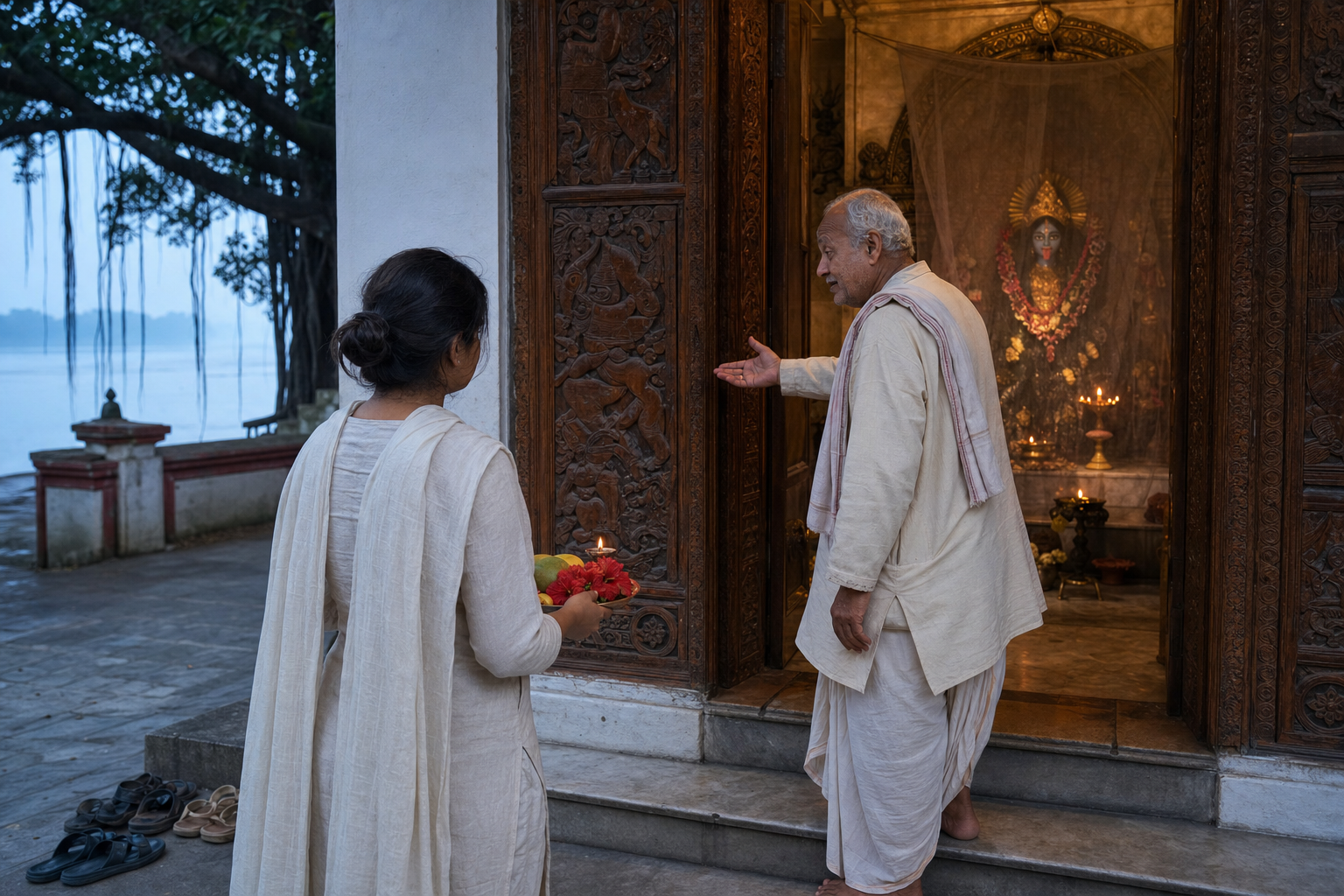
Your first form of Kali should not be chosen by searching for the most visually extreme image. Fierceness is not a higher spiritual rank, and secrecy is not proof of greater authenticity. Choose according to your actual relationship with a temple, family practice, or sampradaya and according to the work you are prepared to do.
- For regular household devotion: Dakshina Kali or Shyama Kali is usually the clearest Bengali-Shakta doorway. Their worship joins protection, affection, moral courage, and ordinary responsibilities.
- For understanding the unity of Kali’s forms: study Adya Kali. She prevents the eleven names from turning into eleven disconnected divine personalities.
- For community protection: Bhadrakali and Raksha Kali place collective welfare at the centre. Prayer should produce responsible action, not replace it.
- For confronting grief and endings: contemplate the meaning of Smasana Kali and the cremation ground. Accepting impermanence is different from imitating cremation-ground ritual.
- For disciplined spiritual attainment: approach Siddha Kali through a qualified lineage. If your interest is mainly in displaying powers, her teaching has already exposed the obstacle.
- For inward or yogic contemplation: Hansa Kali offers a language of discernment, breath, and subtle awareness. Guhya Kali reminds you that the deepest practice does not need an audience.
- For fierce protective devotion: let an established Bhima Kali or Chamunda temple explain its own form. Sparse online descriptions are not enough to reconstruct regional rites.
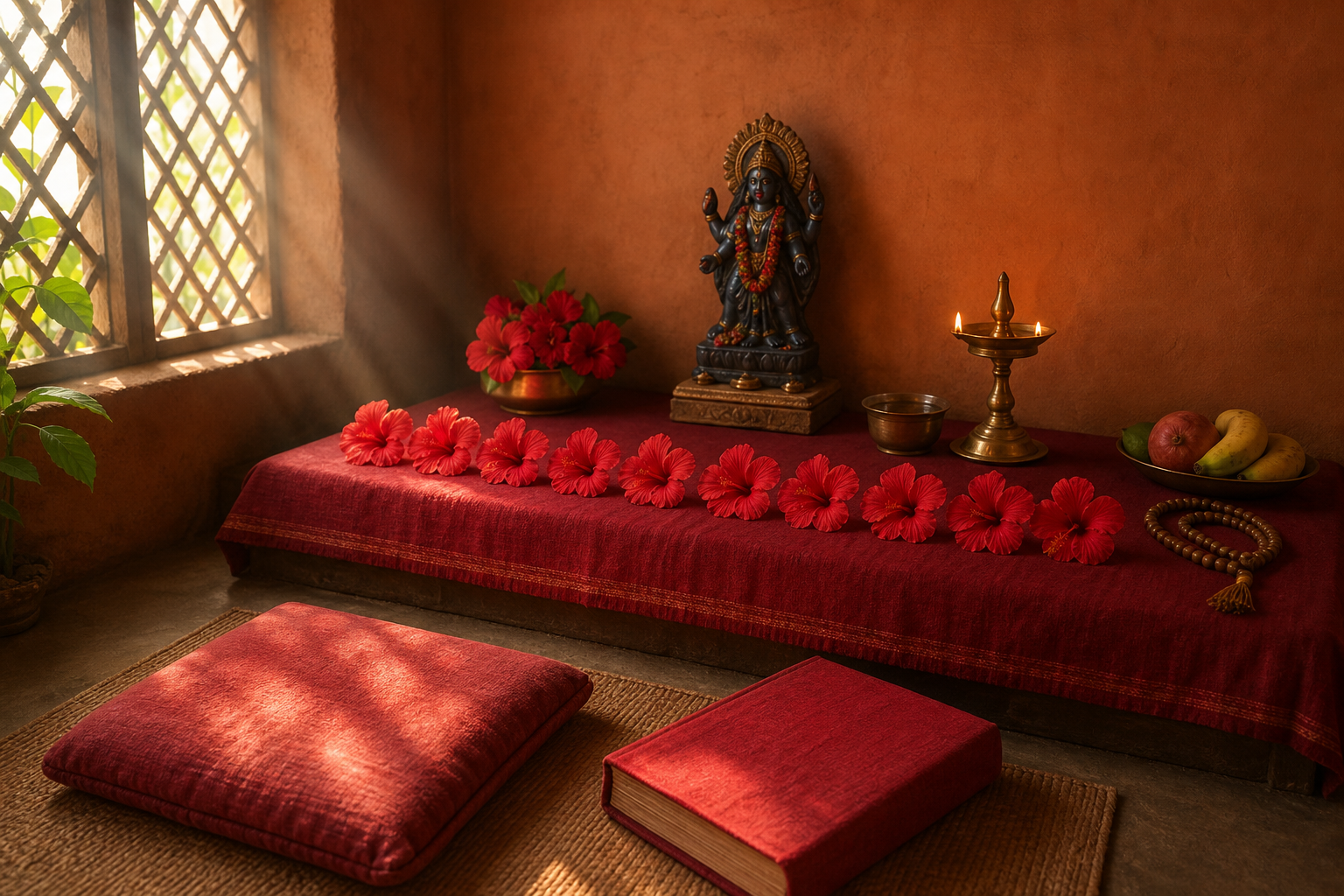
A modest household practice does not require you to assemble every element associated with Kali Tantra. In Bengali devotional life, a lamp, suitable naivedya, red hibiscus, and Shyama sangeet can place worship in an intimate maternal register when these belong to your custom. Participation in an established Kali Puja is more reliable than inventing a private ritual from disconnected details.
Black sesame, deep-night timing, the cremation ground, and the bija krim belong to more specialized ritual frameworks in particular contexts. Their appearance in a description is not an instruction to combine them. Smasana, Guhya, and Siddha currents preserve initiatory boundaries because mantra and ritual are meant to be transmitted as coherent disciplines, not collected as potent-looking fragments.
Raksha Kali provides an equally important boundary in the other direction. Her protection during disease or crisis should not become an excuse for passivity. In nineteenth- and early-twentieth-century Bengal, protective worship became especially visible during epidemics and periods of social danger. Its ethical meaning joins the vow for protection to hygiene, mutual aid, care for children and elders, and concern for justice. Devotion should make responsibility more urgent.
FAQ: placing the eleven forms in your own practice
Are the eleven forms eleven separate goddesses?
No. In this Shakta framework, they are distinct manifestations of one Kali, who is the undivided Shakti. Their names distinguish functions and modes of encounter without dividing the Mother into competing powers.
Which form is most suitable for a home?
Dakshina Kali and Shyama Kali are the most established householder-facing choices in Bengali practice. If your family or local temple already worships another form, follow that living relationship rather than replacing it with a generic recommendation.
Why does another list of eleven Kali forms use different names?
Ekadasha Kali rosters vary by region, text, temple, and lineage. First identify whether the list is Bengali, Assamese, temple-specific, or tied to a particular sampradaya. Compare lists only after preserving those contexts; otherwise, a legitimate difference can look like an error.
Does terrifying iconography mean a form is dangerous or evil?
No. The fierce imagery expresses protection, the destruction of ignorance, the power of time, and freedom from attachment. It does, however, warn you not to trivialize the form. You can study the symbolism openly while leaving initiatory mantras and specialized rites to qualified transmission.
Choose one doorway that answers the work in front of you. Learn its name and iconography from a temple, family tradition, or lineage you trust, then keep your devotion modest and consistent. You do not need to collect eleven practices. Let one form train you in fearlessness, responsibility, discernment, or surrender until you begin to recognize the single Mother shining through them all.
References
