

You can understand that anger clouds judgment and still send the message you later regret. You can value truth and still exaggerate when your status feels threatened. You can promise discipline in the morning and abandon it when fatigue, appetite, or distraction arrives.
That gap between conviction and conduct is where character is formed. Dharmic self-mastery closes the gap by training attention, ethical restraint, strength, and recovery together. The aim is not to become emotionless. It is to remain capable of choosing a dharmic response when fear, desire, anger, pride, or attachment would prefer to choose for you.
Start with the reaction chain, not your self-image

Calling yourself patient, disciplined, spiritual, or strong tells you very little about what will happen under pressure. Character becomes visible in a sequence: something touches the senses, a pleasant or unpleasant feeling appears, attraction or aversion gathers force, the mind builds a personal story, and speech or action follows. Repetition turns that route into a habit.
The practical opening lies between feeling and command. A feeling can be noticed without being obeyed. An unpleasant sensation does not require an insult. A pleasurable possibility does not require pursuit. An identity threat does not require immediate defence. Once you distinguish the first sensation from the story added to it, choice returns.
Different Dharmic traditions diagnose this sequence through distinct philosophical systems:
- Advaita Vedanta examines adhyasa, the superimposition through which a passing condition is mistaken for the self or for the whole truth. Viveka asks you to distinguish what is changing from what is not reducible to that change.
- Yoga identifies afflictions such as asmita, raga, dvesha, and abhinivesha. Practice weakens their authority through abhyasa, ethical discipline, attention training, and pratyahara.
- Buddhist practice watches vedana, the pleasant, unpleasant, or neutral tone of experience, before it hardens into craving, aversion, and grasping.
- Jain thought names anger, pride, deceit, and greed among the kashayas that bind conduct. Anekantavada counters the conceit that one partial view exhausts reality.
- Sikh teaching confronts kam, krodh, lobh, moh, and ahankar through remembrance of Naam, seva, and the steadying influence of sangat.
These terms are not interchangeable, and the traditions do not share one metaphysics of self or liberation. Their practical convergence is narrower and more useful: confused perception feeds passion, passion recruits identity, and identity tries to make reaction look necessary.
When you feel provoked, answer these questions before deciding what to do:
- What happened before I interpreted it?
- Is the immediate feeling pleasant, unpleasant, or neutral?
- What meaning have I added to the event?
- Which passion is asking to take control: anger, pride, greed, fear, craving, or attachment?
- What response would serve duty, truth, and the welfare of those affected?
A pause without the final question can become mere hesitation. Self-mastery needs discernment because calmness alone does not tell you what is right.
Train purpose, strength, and steadiness as one system
One contemporary Dharmic educational vocabulary uses Aashishta, Balishta, and Driddhishta for deep trust, integrated strength, and firm stability. For character formation, their value lies in their interdependence. Purpose selects a worthy direction. Strength bears its cost. Steadiness keeps returning after novelty and emotion fade.
Purpose: trust that remains open to correction
Shraddha is not permission to stop thinking. It is enough trust in truth, practice, and guidance to continue learning before every doubt has disappeared. Buddhist saddha, Jain samyag-darshana, and Sikh vishvas arise within different doctrines, but each points toward confidence that must be borne out in practice rather than protected from inquiry.
Make purpose behavioural. Complete this sentence: When this pressure appears, the duty I accept is… If you cannot name the duty before pressure arrives, appetite and ego will define it for you during the event.
Strength: the capacity to pay the cost of the right action
Strength is not loudness, hardness, or domination. It includes bodily vitality, persistence with difficult work, and moral courage when a shortcut would be easier. Hindu tapas, Buddhist viriya, Jain virya, and Sikh chardi kala belong to their own traditions, yet each refuses the idea that worthy intention is sufficient without sustained energy.
Train strength at the exact point where you bargain with yourself. If you evade difficult feedback, the practice is to stay present and ask for a concrete example. If you distort facts to protect status, the practice is to state what you know, what you infer, and what you do not know. If you abandon duty when tired, prepare the smallest honest next action before fatigue arrives.
Steadiness: the ability to return without drama
Steadiness is not the absence of emotion. It is continuity of attention and conduct while emotion changes. Yoga speaks of abhyasa and samatva; Buddhist practice cultivates upekkha; Jain discipline values samyama; Sikh teaching honours sehaj. None requires pretending that pain, anger, or disappointment is not present.
The revealing question is not whether you can practise intensely on an inspired day. It is whether you return at the next ordinary cue after distraction, embarrassment, or failure.
| Pattern you notice | Likely weak point | Useful correction |
|---|---|---|
| You keep changing methods | Steadiness | Keep one attentional anchor and attach it to a fixed daily cue. |
| You know your duty but avoid its discomfort | Strength | Reduce the task to the next honest action while keeping the ethical line intact. |
| You are consistent but increasingly vain or bitter | Purpose | Reconnect effort to seva or lokasangraha, and invite correction. |
| You treat honest questions as disloyalty | Trust distorted into dogma | Protect respectful inquiry and test confidence through conduct. |
Build a daily rule that survives an inconvenient day
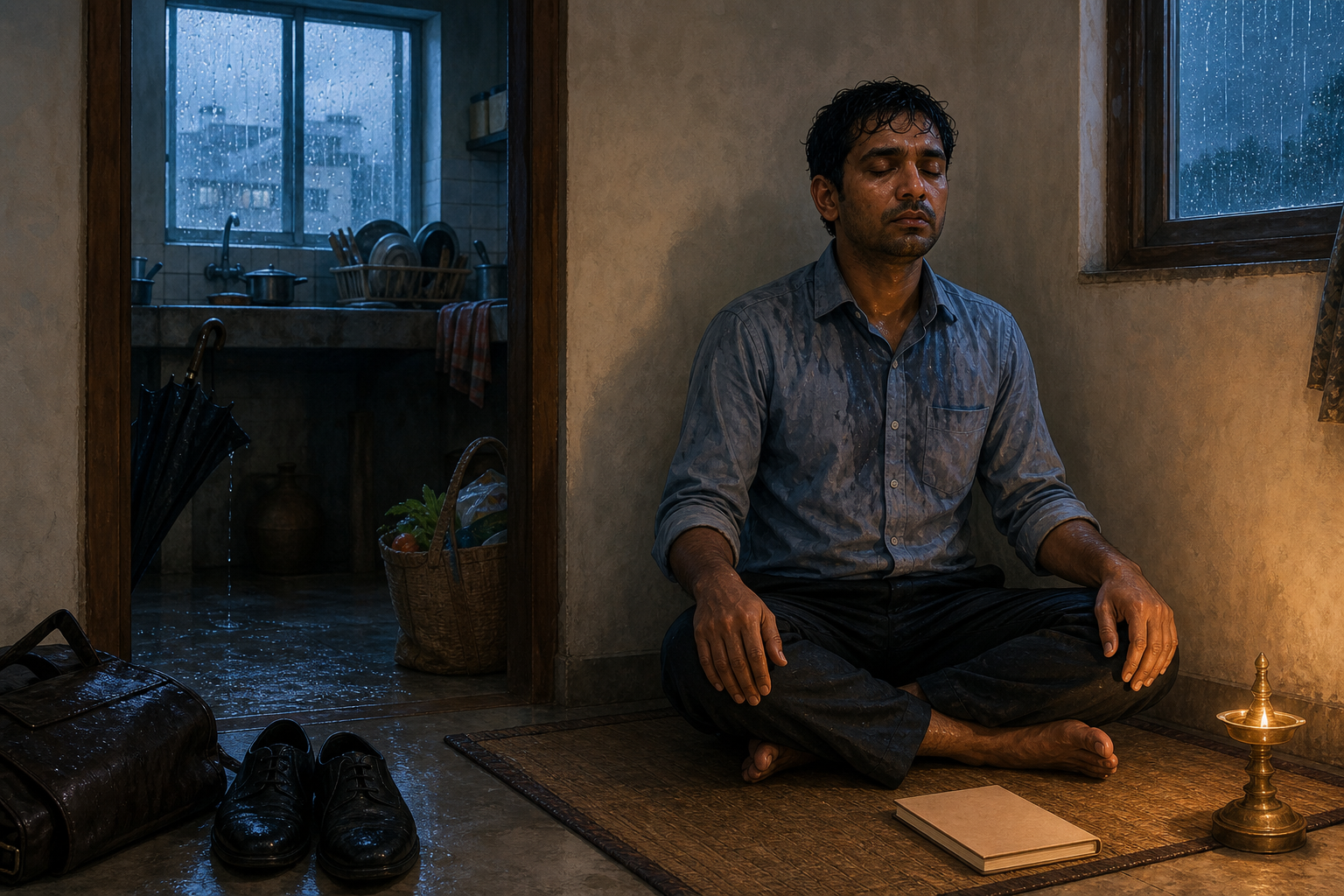
A long list of spiritual ambitions creates more opportunities for negotiation. A useful daily rule is smaller. It prepares your values, your surroundings, your attention, your response to pressure, and your method of repair.
- Choose one weekly vrata. Select one ethical line you currently cross under pressure. Define it as observable conduct. Instead of resolving to practise ahimsa, write: When criticised, I will not insult the person; I will ask for one concrete example. Instead of promising perfect truthfulness, write: I will not present an inference as a verified fact.
- Begin the day with remembrance and duty. Use the practice proper to your path: Naam Simran, japa, breath awareness, contemplative recollection, or another received discipline. Then name the duty most likely to be tested that day. Remembrance establishes orientation; the behavioural statement gives it somewhere to land.
- Practise pratyahara before temptation. Mute nonessential notifications, place the device beyond immediate reach during concentrated work, and confine reactive news consumption to chosen windows. This is not hostility to the senses. It is stewardship of the conditions that repeatedly train them.
- Train attention before you need composure. Return daily to one anchor such as a mantra, the breath, or a compassionate phrase. Single-pointed attention develops stability; open observation then teaches you to notice thoughts and feelings without immediately grasping them. Regular practice matters more than occasional intensity.
- Use a fixed protocol when activation rises. Stop typing or speaking if the situation permits. For two to five minutes, use an even, unforced rhythm such as four comfortable counts in and four out. If controlled breathing is uncomfortable, breathe normally and continue with observation. Label the feeling tone, distinguish sensation from interpretation, and consider at least two other plausible perspectives before choosing an action.
- Close with a pratikraman-style review. Ask where reaction took over, whom it affected, what repair is required, and which condition should change tomorrow. Record the event without euphemism and without turning the review into self-condemnation. The point is acknowledgement, restraint, repair, and renewed attention.
Ethical disciplines such as the yamas and niyamas, Buddhist precepts, Jain anuvratas, and Sikh rehat are more than ideals displayed after a good decision. They are commitments made before the heated moment. They reduce the ego’s room to invent a convenient morality while agitated.
Pressure-test the rule where your character usually breaks

A practice that exists only on the meditation seat remains untested. Apply it to the places where speed, status, and attachment are strongest.
When an inflammatory claim appears online
Outrage often arrives first as an unpleasant feeling and then recruits identity: an attack on a claim becomes an attack on my community, my intelligence, or my worth. Before replying, rewrite the claim in neutral language. Mark what is known, what is inferred, and what is feared. Then formulate other plausible readings of the situation.
This use of anekantavada does not mean that every assertion is equally true or that falsehood should go unanswered. It means your first angle is not automatically exhaustive. After widening the view, choose deliberately among silence, a civil question, a documented correction, or a firm boundary. The same outward response can carry very different character depending on whether it arose from discernment or the need to discharge anger.
When criticism threatens your status
Separate the speaker’s tone from the observable content, and separate both from the conclusion that your entire identity is on trial. Restate the feedback in your own words before defending yourself. Ask which specific behaviour should change. Accept whatever is valid without endorsing contempt, and address an inappropriate tone as a separate matter.
This is neither submission nor aggression. You retain dignity, extract useful information, and decide what dharma requires. Summarising feedback before responding is a simple way to reduce defensive error and make correction possible.
When you break your own vow
Do not protect a virtuous self-image by minimising the lapse. Name the act plainly. Trace the trigger, feeling, passion, and story that preceded it. Make a concrete repair where another person was affected. Change the condition that made repetition easy, then resume the discipline at the next cue.
Repair is part of character formation, not an admission that the practice failed. The real failure is using shame, spiritual language, or perfectionism to avoid responsibility. Keep the ethical standard firm while making the method realistic enough to repeat.
Measure recovery, repair, and the quality of your action

Do not measure self-mastery by whether difficult feelings still arise. Look for a shorter interval between activation and clarity, fewer impulsive acts that require regret, greater tolerance for ambiguity, calmer speech, and more willingness to repair harm. These are practical signs that response is replacing reflex.
A weekly ledger can show the pattern without turning character into a score. For each significant lapse or success, record the trigger, the first bodily or emotional signal, the passion that tried to take control, the pause you used, the action you chose, and any repair still owed. Review the entries for recurring conditions. If the same digital input, person, hour, or unmet duty repeatedly precedes the lapse, redesign that condition rather than relying on another promise of willpower.
Keep four distortions in view. Faith without inquiry can become dogma. Strength without service can become domination. Steadiness without emotional honesty can become suppression. Talk of Maya or detachment can become an excuse for passivity, neglected duty, or avoidance of a necessary conversation. A spiritual explanation that prevents apology and repair is not mastery; it is a more refined defence of ego.
Key takeaways for your next week
- Choose one ethical vow and express it as conduct that can be observed.
- Remove one recurring trigger before it captures attention.
- Use one daily contemplative anchor and return to it consistently.
- When activated, label the feeling, steady the breath, and examine other plausible perspectives.
- Review each day for reaction, responsibility, repair, and the next useful adjustment.
- Judge progress by better choices and faster honest recovery, not by an image of permanent calm.
Begin tonight with one recent situation in which you knew the right action but did something else. Trace the chain, write the vow that would interrupt it, and remove one condition that makes the lapse easy. Tomorrow will provide the pressure. Your work is to meet it with one more response that belongs to the person you intend to become.
References
- DharmaRenaissance Blog – From Reactivity to Freedom: Dharmic Wisdom on Maya, Attention, and Inner Mastery
- DharmaRenaissance Blog – Forge Unshakable Students: Aashishta, Balishta, Driddhishta as the Pillars of Mastery
