

You are standing before a deity who holds a looped cord. Nearby, another image shows a fierce Shiva beneath a parasol. A museum label may call the first object a weapon and the second figure a victorious god. Neither description is false, but neither tells you what kind of power the image asks you to recognize.
Look for a sequence instead: what has been stopped, what is being redirected, who is protected, and whether release remains possible. The pasha, or sacred noose, and the chatra, or ceremonial parasol, reveal a demanding Hindu account of sovereignty. Power becomes Dharmic not merely when it defeats disorder, but when it restrains proportionately, restores order, accepts responsibility, and creates shelter afterward.
Before you name the deity, read the action
Iconographic attributes work like verbs. A blade cuts. A goad prods and redirects. A noose catches, draws, limits, or holds. A parasol covers, dignifies, and shelters. Treating all of them as interchangeable weapons erases the ethical distinctions built into their forms.
This does not make Hindu iconography passively pacifist. Samhara images preserve the legitimacy of force when disorder must be overcome. Their deeper question is what governs that force. In the Jalandhara Samhara form, for example, Shiva’s fierce action serves the restoration of equilibrium; when a chatra crowns the scene, victory is placed under an emblem of protection and stewardship. Ferocity has a task and a boundary. It is not celebrated as an appetite.
The pasha makes the boundary even clearer. Unlike an implement whose physical purpose is to cut or crush, a loop can arrest movement while leaving its captive intact. That pause may allow correction, recognition, transition, or eventual release. The noose is therefore not automatically compassionate, but it can represent compassion exercised through restraint. Its meaning depends on who holds it, what is being held, and what happens next.
Key takeaways
- A pasha should first be read as an instrument of binding, drawing, or limiting, not casually classified as a striking weapon.
- The accompanying attribute matters: Ganesha’s pasha and ankusha express attraction toward right conduct and correction away from obstacles or adharma.
- A chatra does more than announce rank. It makes shelter and responsibility part of the meaning of victory.
- Fierce power and compassionate power are not always opposites in Hindu iconography. The decisive questions are what the power serves, how it is limited, and whether it restores order.
- Visual identification should begin with observable details such as contour, hand, posture, pairing, recipient, and narrative setting before moving to theological interpretation.
The pasha changes meaning with the hand that holds it
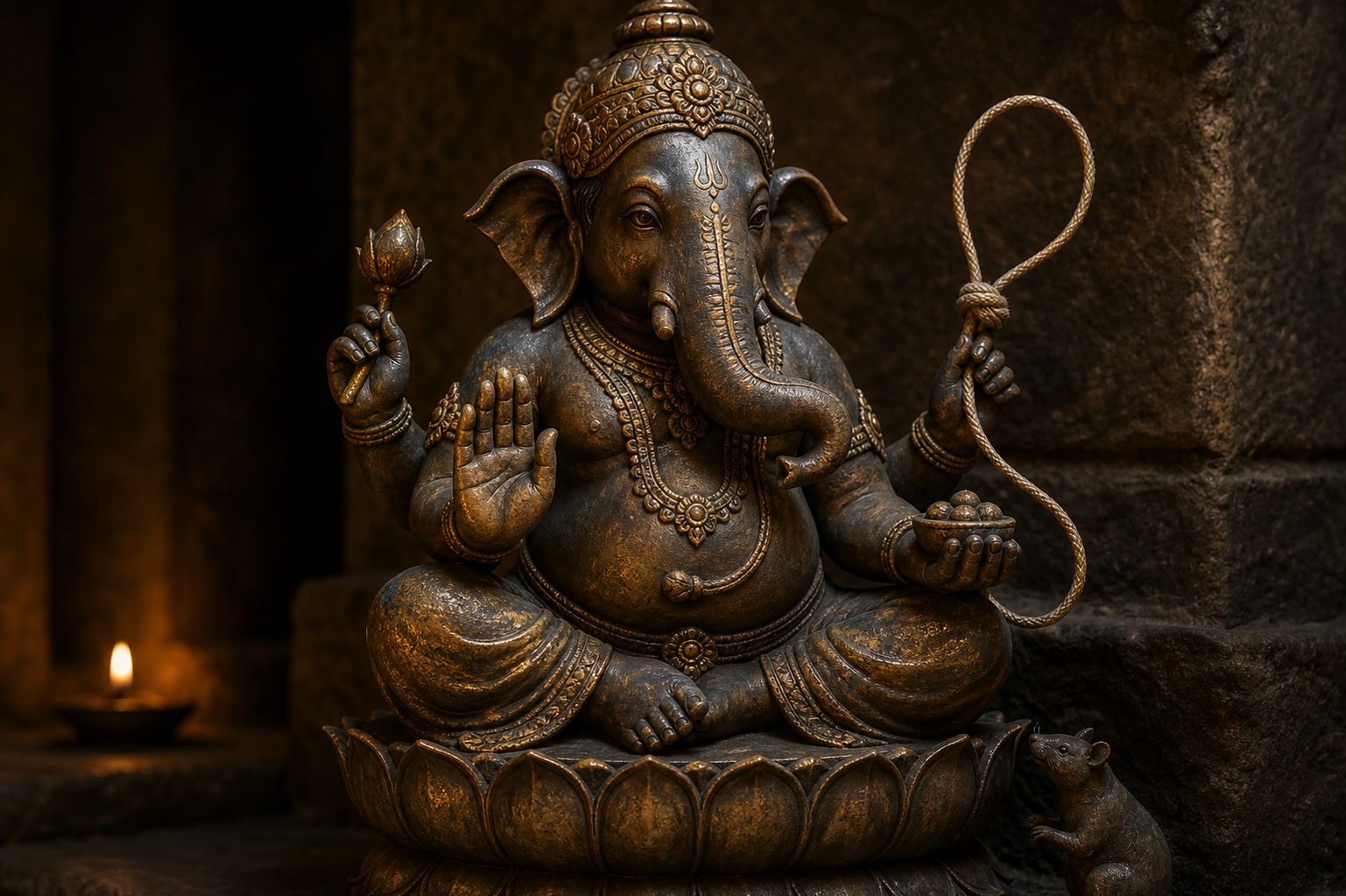
A looped cord does not carry one fixed message in every image. Its physical action remains recognizable, but its theological register changes with the deity and setting. Use the following distinctions as viewing prompts rather than as substitutes for a temple’s local tradition or a complete iconographic identification.
| Context | What the pasha emphasizes | Question to ask while viewing |
|---|---|---|
| Ganesha with pasha and ankusha | Drawing the devotee toward auspicious conduct while redirecting the person away from obstacles and adharma | What is being attracted, and what is being corrected? |
| Varuna | Accountability under rta, including the bond between conduct and consequence | Is the binding connected with truth, an oath, or moral order? |
| Yama | The inevitable transition of the jiva and the impartial operation of cosmic adjudication | Does the image express cruelty, or the measured certainty of a threshold? |
| Lalita Tripurasundari and related Devi settings | Desire, attachment, love, or grace as forces that can bind but can also be governed and redirected | Is attachment merely condemned, or is its energy being turned toward liberation? |
| Shaiva-Siddhanta reflection | The bonds of ignorance, karma, and maya within the Pati-Pashu-Pasha triad | Does the visible cord also point to an interior or metaphysical fetter? |
Ganesha offers the most immediately practical example. The pasha and ankusha form a paired discipline: one draws closer, while the other supplies a corrective nudge. If you notice only the noose, you miss half the instruction. The image does not present spiritual direction as attraction alone or deterrence alone. A durable discipline needs both a worthy object of love and the capacity to turn away from what obstructs it.
Varuna’s pasha moves the emphasis from personal guidance to moral order. His ancient association with rta makes the noose a sign of accountability: deeds and speech cannot be separated indefinitely from their consequences. The cord is frightening only if accountability itself is treated as hostility. Read more carefully, and it represents a universe in which truth matters enough to bind.
Yama’s noose belongs to another threshold. It gathers rather than slashes, and it marks the appointed transition of the departing jiva. Popular imagery can make Yama-pasha seem like an emblem of terror, but its procedural quality is important. Mortality is not depicted as random appetite. It arrives within an order that applies without exemption, directing attention back to the ethical shape of the life being lived now.
In the iconography of Lalita Tripurasundari, the noose reaches deeper into the psychology of attachment. The Lalita-sahasranama praises her as Raga-svarupa-pashadhya, bearing the noose associated with raga. Desire is adhesive: it fastens attention to an object and makes the mind return to it. Yet the same capacity can be reoriented toward bhakti and jnana. Liberation is not always portrayed as the destruction of every human energy; sometimes it is the wise redirection of the energy that previously bound us.
Shaiva-Siddhanta sharpens the metaphysical distinction through Pati, Pashu, and Pasha: Lord, bound being, and bond. This prevents a common misreading. The cord may signify the fetter, but it may also appear in the hand of the power capable of mastering that fetter. Bondage and the means of rescue can share a visual form because the decisive difference lies in agency, knowledge, and purpose.
When you inspect the object itself, look for a coiled cord and a clearly articulated loop. It may be knotted or tasselled, and a naga-pasha may take on a serpentine form. Stone versions can resemble a ribbon with defined edges; bronze versions may appear rounder and more supple. A rear hand can place the loop against open space so that it remains legible during circumambulation. Damage, viewing angle, or heavy ornament can make it resemble a ring or serpent, so do not base an identification on the loop alone.
The chatra turns triumph into an obligation

The chatra is easy to dismiss as decorative regalia. Its everyday function explains its sacred force: a parasol creates shade. In a royal setting it marks dignity and victory, but its canopy also identifies the sovereign as a source of protection. Authority is pictured not only as standing above others, but as holding a sheltered space above them.
That distinction becomes especially powerful in Jalandhara Samhara with Chatra. The image may contain a dynamic martial posture, Shaiva weapons, an antagonist or the implication of one, and the parasol held above Shiva, carried by an attendant, or incorporated into the composition. Read the vertical arrangement. Conflict occupies the field of action; Shiva restores order at the center; the canopy places that victory beneath a sign of office, restraint, and shelter.
The chatra does not deny the necessity of samhara. Nor does it soften the image into a vague message about kindness. It sets a standard for what must follow successful force. A victory worthy of the canopy must produce security, restored order, and the conditions for a community to flourish. Conquest that leaves only fear beneath it has failed the symbol’s demand.
This is also why the parasol should not be read as a trophy. A trophy points backward to the vanquished rival. A canopy points outward and forward to those now placed within its shade. In practical terms, it converts status into duty. The sovereign does not merely possess power; the sovereign becomes answerable for the space that power has reclaimed.
Identification still requires caution. Jalandhara Samhara icons with an explicit chatra are uncommon, regional workshops vary, and museum catalogues may use broad descriptions such as Combat Shiva or Samharamurti. A canopy by itself is not enough. Check whether the posture and weapons belong to a samhara composition, whether an adversary or narrative confrontation is present, and whether the chatra is integral to the image rather than a generic ceremonial covering.
In a South Indian temple, ask whether a Samharamurti is preserved among the utsava murtis and whether narrative alankaras appear on particular festival days. Examine sculpted plinths, subsidiary shrines, and processional pavilions rather than assuming every significant form stands on the principal sanctum axis. Priestly explanations and sthala-purana traditions can clarify an image whose surviving attributes are damaged or whose local form differs from a general catalogue description.
Ritual treatment may complete what the sculpture begins. Cooling substances, white garlands, and the dignifying canopy can balance a fierce form during abhishekam and alankaram. The movement from conflict to calm is then not merely narrated; it is enacted in worship. The community encounters force already being returned to composure and guardianship.
Use a six-pass method to read the image in front of you
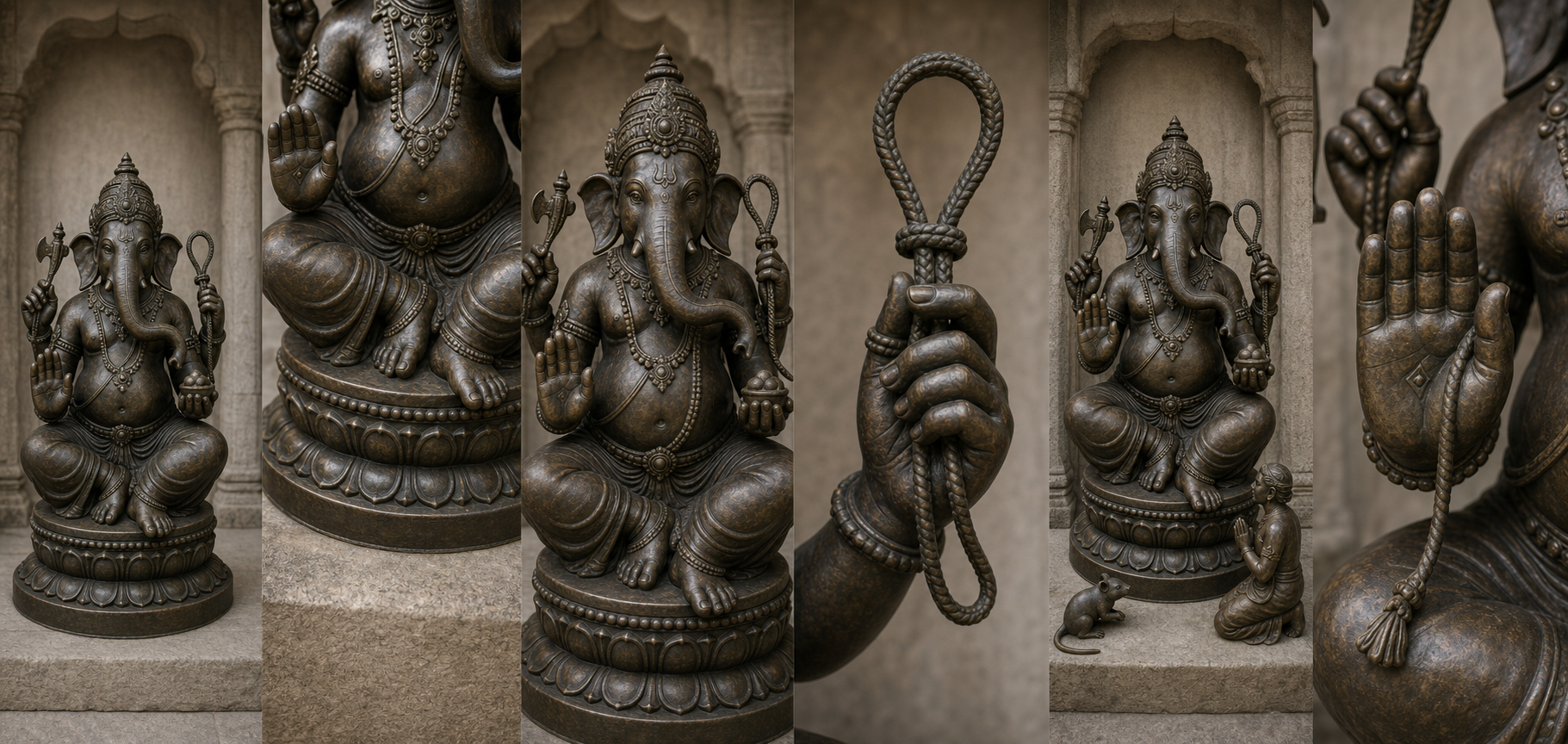
You do not need to memorize every murti before looking intelligently. You do need to separate what you can see from what you infer. On your next temple or museum visit, use six passes.
- Trace the object’s contour. Decide whether you are seeing a flexible loop, a rigid ring, a serpent, a goad, a blade, or a canopy. Follow the line all the way to the hand or attendant rather than identifying it from one fragment.
- Locate the object within the hand arrangement. A pasha paired with an ankusha says something different from a pasha surrounded by martial weapons. A rear-hand attribute may define the deity’s continuing authority while the front hands address the devotee more directly.
- Read the body’s action. A composed standing figure, a dynamic combat posture, and a transitional scene occupy different moments. Ask whether the image shows pursuit, capture, judgment, subjugation, restoration, or repose.
- Identify the recipient. Is the cord directed toward a devotee, an asura, the departing jiva, or no visible figure at all? Is the parasol shading only the crowned deity, or does its visual canopy organize the whole scene beneath it?
- Look for the implied outcome. Does restraint prevent harm, enforce accountability, redirect desire, permit a transition, or prepare for release? Does victory end in domination, or does it establish shelter?
- Test the reading against local evidence. Use accompanying deities, pedestal figures, festival use, inscriptions where available, and the temple’s own narrative memory. If these indicators do not converge, keep the identification provisional.
Write or remember one sentence of observation before one sentence of interpretation. For example: a looped cord appears in the rear hand and a goad appears in the corresponding hand. That is observation. The pair expresses attraction toward dharma and correction away from obstruction. That is interpretation. Keeping the two sentences distinct prevents a plausible theological idea from being mistaken for a secure identification.
You can also assign a simple confidence level. Call the reading secure when the attribute, pairing, posture, and narrative setting agree. Call it probable when the context agrees but a key object is damaged or obscured. Leave it open when the identification depends on a canopy, weapon, or catalogue title that could fit several forms. Intellectual restraint is especially appropriate when studying an icon of restraint.
Bring the symbol into life without misusing it
Sacred imagery can discipline our view of human authority, but it must not become a convenient excuse for coercion. A ruler, institution, teacher, or family elder cannot make an act compassionate merely by calling it restraint. The pasha and chatra supply an ethical test, not an exemption from one.
First, name the bond or disorder precisely. Varuna’s moral noose has meaning because truth and consequence are connected; vague accusations do not meet that standard. In personal practice, the equivalent may be a recurring compulsion, dishonest speech, an unexamined fear, or a habit that repeatedly carries you away from your chosen discipline. If you cannot name what is being restrained, you cannot judge whether restraint is justified.
Second, limit the intervention to its purpose. A noose arrests movement; it need not annihilate what it catches. The practical question is whether a pause, boundary, correction, or redirection is enough. This is where restraint differs from vengeance: it does not enlarge itself after the danger or disorder has been contained.
Third, keep the sheltered person or community in view. The chatra asks who can live safely under the restored order. If a claimed victory protects only the prestige of the victor while leaving everyone else exposed, its sovereignty is incomplete. Dharmic authority must be evaluated from beneath the canopy, not only from the throne.
Fourth, specify the path to release. A temporary boundary without a purpose can quietly become permanent domination. The pasha’s richest symbolism depends on the possibility that binding can lead to recognition and freedom. Ask what change completes the restraint, who has authority to recognize that change, and whether the conditions are just and intelligible.
The same questions turn inward. What currently binds your attention? What deserves to be held firm rather than indulged? Which desire could be redirected toward study, seva, bhakti, or disciplined practice? Which attachment has completed its lesson and should now be released? Saṃyama becomes concrete when it is attached to one identifiable habit rather than admired as an abstraction.
Related images across Dharmic traditions broaden this reflection without making the traditions identical. Amoghapasha Avalokiteshvara bears an unfailing lasso that draws beings from suffering. Jain teaching analyzes bandha, karmic bondage, and seeks its cessation through right knowledge, discipline, and ahimsa. Sikh scriptural imagery of the noose of death or time intensifies the call to nam-simran and righteous conduct. The protective language of the parasol also appears in Buddhist, Jain, and Sikh ceremonial settings. The shared civilizational question is not whether bonds exist, but how disciplined life loosens them and how legitimate authority protects the path toward freedom.
On your next encounter with a Hindu murti, spend the first minute tracing the object, the hand, the pairing, the recipient, and the outcome. Then ask four verbs: what is restrained, what is redirected, what is sheltered, and what is released? If your reading stops at conquest, look again. The loop, the goad, the canopy, and the calm after conflict may be carrying the most important part of the teaching.
References
- DharmaRenaissance Blog — Pasha in Hindu Iconography: The Sacred Noose of Compassion, Control, and Liberation
- DharmaRenaissance Blog — Jalandhara Samhara: The Rare Shiva with Chatra Form, Iconography, Symbolism, and Temple Lore
