
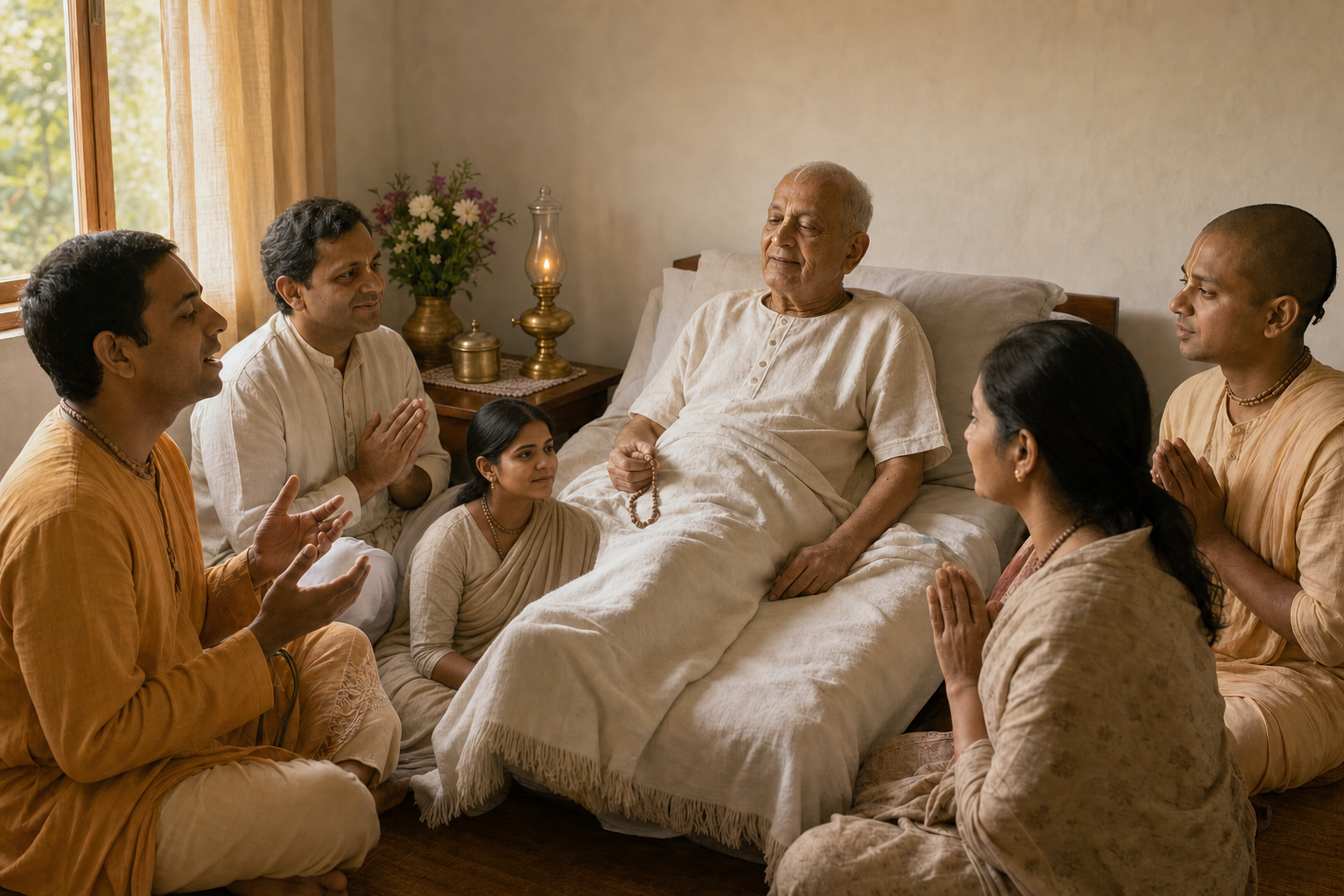
If someone you love is nearing the end of life, you may be wondering what a Gaudiya Vaishnava should actually do: keep chanting, invite more devotees, play a familiar recording, or simply sit nearby. Begin with one aim: help the person remember Krishna without making the final hours serve everyone else’s need for ceremony.
The same principle governs what comes afterward. Kirtan can accompany departure, carry grief, and preserve a life of seva. It does that work best when sacred sound remains an offering rather than a performance.
The Holy Name is a lifelong refuge, not a last-minute technique
Gaudiya Vaishnavism treats remembrance at life’s end, or anta-kala-smarana, as the culmination of cultivated bhakti. A departure surrounded by devotees and the Holy Name is therefore regarded as deeply auspicious within the tradition. The bedside kirtan matters, but it is not a mechanical device that cancels the life preceding it.
This distinction changes what you should do now. Do not wait for a medical crisis to decide which sacred sound is familiar, consoling, and central to your practice. Build a manageable relationship with nama through ordinary days. Then the mantra heard during illness is not an unfamiliar ritual imposed by anxious relatives. It is the sound in which the devotee has already learned to seek refuge.
The maha-mantra gives the bedside a clear center: Hare Krishna Hare Krishna, Krishna Krishna Hare Hare, Hare Rama Hare Rama, Rama Rama Hare Hare. The invocation beginning with Sri Krishna Chaitanya Prabhu can likewise orient those present toward mercy, humility, and dependence on grace. Whichever form is used, intelligible sacred words matter more than musical elaboration.
Sacred sound in this setting is not merely background music or a relaxation technique. In the devotional understanding of shabda-brahman, sound can shape consciousness and direct attention toward the Divine. Its steady cadence may also give the room a common focus when ordinary conversation has become difficult. That practical effect should support the spiritual purpose, not replace it.
Place carries meaning as well. Vrindavan is understood in Gaudiya theology not simply as a geographic town but as a sacred dhama, a living setting of Krishna’s presence and mercy. Yet reverence for the dhama is not permission to move a medically fragile person against their wishes or to compromise necessary care. If travel is being considered near the end of life, the person’s stated desire, clinical condition, and the judgment of the medical or palliative team must govern what is physically safe.
Nor should anyone turn an auspicious setting into a verdict on the departed. You cannot measure another person’s remembrance from their ability to sing, move, speak, or display emotion. The Holy Name should be offered with faith; the person’s inner relationship with Krishna should be approached with humility.
How to create a compassionate bedside kirtan
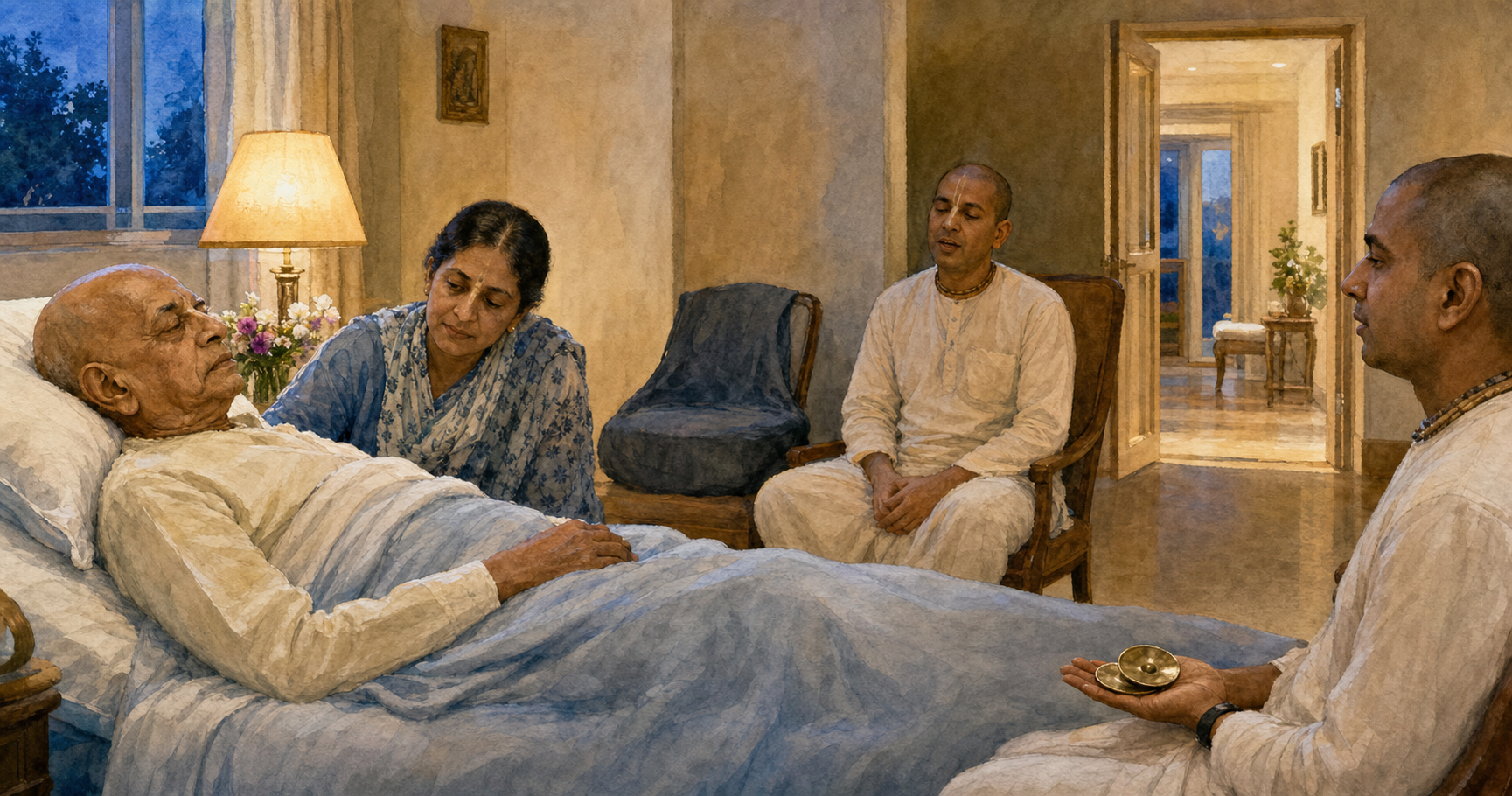
A crowded room and a loud kirtan are not automatically more devotional. A useful bedside arrangement protects the person’s comfort, preserves the clarity of the mantra, and keeps competing activity under control. Work through these decisions before the situation becomes urgent:
- Establish the devotee’s wishes. Ask whether they want live chanting, a familiar recording, scriptural recitation, silence between chants, or only certain people present. Record those wishes and identify one person who can communicate them when the devotee no longer wishes to manage visitors.
- Coordinate with the care team. Tell medical or palliative staff what the chanting means and ask what volume, number of visitors, and timing are compatible with care. Kirtan complements medication, nursing, symptom management, and palliative support; it does not replace any of them.
- Remove competing sound. Silence notifications, move side conversations outside, and avoid having several people lead at once. The aim is a coherent devotional atmosphere, not maximum activity.
- Choose a familiar anchor. Begin with the maha-mantra or another chant the devotee has actually practiced. Familiarity is more valuable here than novelty. Keep the words clear enough to hear without asking the person to respond.
- Keep the music congregational. Gaudiya kirtan is built around call-and-response, a stable rhythmic cycle, and collective remembrance. Use a pace that others can follow. A soft, steady lead is usually more serviceable at a bedside than ornamental singing or sudden changes in tempo.
- Let the room become smaller when necessary. Continuous spiritual support need not mean relentless volume. Reduce the number of voices, use a recording, chant softly, or allow quiet when the devotee needs rest. Availability of the Holy Name is the principle; pressure to perform devotion is not.
If distant devotees want to participate, a simple remote connection or a clean recording can bring familiar voices into the room. Assign someone other than the primary caregiver to manage the device. The person receiving care should not be surrounded by troubleshooting, repeated microphone checks, or requests to acknowledge people on a screen.
A mixed Dharmic family may recognize the intention even when practices differ. Sikh simran and kirtan, Buddhist chanting and mindful awareness, and Jain practices such as samayik and pratikraman also give importance to remembrance, equanimity, and compassionate presence at life’s threshold. This common ground can help relatives participate respectfully without pretending that all traditions make identical theological claims.
Turn mourning into remembrance without erasing sorrow
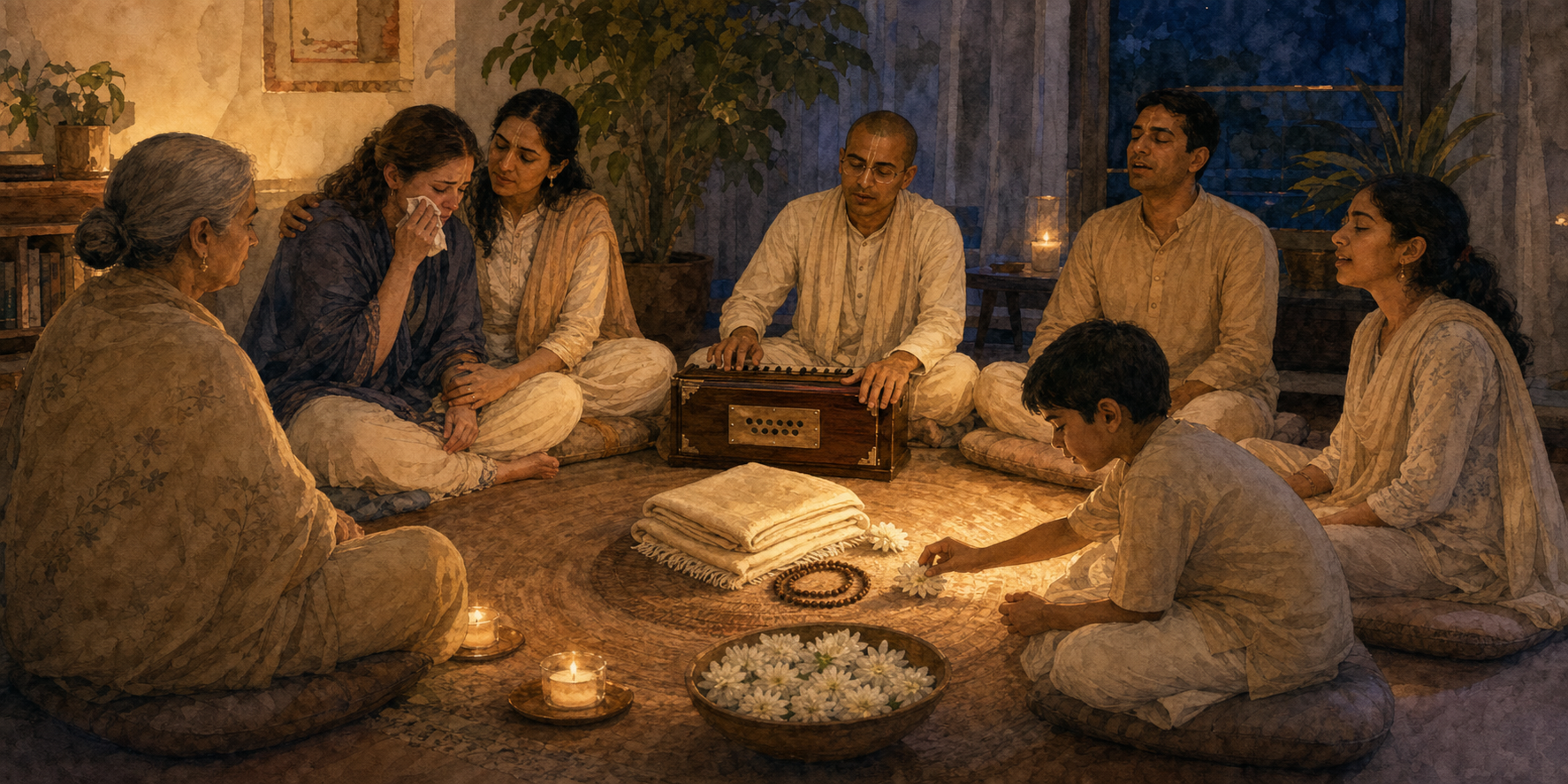
Grief does not show a failure of faith. A Gaudiya memorial can hold sorrow and gratitude together: sorrow because a relationship in this world has changed, and gratitude for the teachings, friendship, and service that remain active in other lives. Kirtan gives both responses a devotional form without requiring mourners to deny either one.
When you organize a remembrance gathering, give it a simple spiritual arc:
- Open with refuge. Begin with the Holy Name or an invocation centered on mercy so that the gathering is oriented toward Krishna before memories and emotions fill the room.
- Name relationships accurately. Terms such as guru, disciple, and Godbrother describe real bonds within guru-shishya parampara. Use them carefully rather than as ceremonial honors detached from the relationship they signify.
- Ask for concrete remembrance. Invite people to describe a teaching received, a service witnessed, or a quality they intend to carry forward. Specific memories reveal a devotional life more faithfully than exaggerated praise.
- Make the refrain accessible. Choose a call-and-response melody the assembly can actually sing. The congregation should not become an audience for specialists.
- End with continuing seva. Decide what the community will do with its gratitude: maintain an existing service, care for people the devotee served, preserve teachings, or strengthen the devotional relationships that the departed person cultivated.
Avoid making claims about the departed person’s spiritual destination merely to relieve the discomfort of those present. Gaudiya confidence in Krishna’s mercy can be expressed without pretending that another soul’s inner state is available for public inspection. Prayer, gratitude, and continuation of seva are strong enough; they do not need speculative certainty.
Community language should also leave room for people who grieve differently. One person may want to sing vigorously, another may sit silently, and another may be able to help only through practical service. Keep the Holy Name central while refusing to turn a particular outward emotional response into a test of devotion.
Preserve devotional recordings as service, not memorabilia

A recording can become more than a keepsake. A departed kirtaniya’s voice may continue to gather devotees across countries and generations, especially when illness, distance, or disruption makes physical assembly impossible. Lockdown-era collaboration in Mayapur demonstrated how carefully preserved kirtan can sustain shared remembrance across separation.
If you hold recordings of a departed devotee, do not leave the only copy on a phone, messaging thread, or streaming platform. Build a small archive while contributors, dates, and circumstances can still be identified:
- Retain a lossless master. Keep WAV or FLAC files rather than relying only on compressed social-media copies.
- Attach accurate metadata. Record the lead and response singers, location, date, instruments, lyrical source, engineer or editor, and relevant circumstances of the session.
- Preserve technical consistency. For new multitrack work, 44.1 or 48 kHz at 24-bit depth provides a disciplined production basis. Label versions clearly so that takes and stems are not confused.
- Protect integrity. Generate checksums for archival masters and keep verified copies in more than one managed location.
- Obtain permission and give transparent credit. Consult the family and contributors before public release. State clearly who performed, recorded, edited, and authorized the material.
- Master with restraint. Keep the sacred words intelligible, preserve the natural rise and fall of the response, and avoid limiting so aggressive that the kirtan becomes tiring to hear.
Editing should clarify the offering rather than manufacture a devotional moment that did not occur. Reasonable noise control, gentle vocal shaping, and balanced percussion can make the chant easier to follow. Excessive correction, dramatic effects, or the removal of every trace of the original room can separate the recording from the congregation it was meant to serve.
Context belongs in the archive too. A short factual note about where the kirtan occurred, why it mattered, and how the devotee served will help a future listener understand what the audio file alone cannot convey. Keep that account sober and verifiable. An honest record honors a Vaishnava more reliably than devotional exaggeration.
Key takeaways
- The purpose of bedside kirtan is to make remembrance of Krishna available, not to produce a perfect final scene.
- Ask about the devotee’s wishes early, appoint one coordinator, and align chanting with medical and palliative care.
- Use familiar, intelligible sacred sound at a volume and pace that serve the person receiving care.
- Treat the Holy Name and holy dhama as gifts of grace, not as a scorecard for judging another soul’s departure.
- Shape memorials around honest remembrance, congregational chanting, and a specific continuation of seva.
- Preserve important recordings with lossless masters, metadata, checksums, permission, and complete credits.
Your next step can be modest and immediate. Write one page of spiritual-care wishes naming the mantra or recording you want, the people to contact, the kind of room you prefer, and the person authorized to coordinate with caregivers. If a departure has already occurred, choose one act of seva that will keep the devotee’s gift moving through the community, and let the next kirtan begin there.
References
- Dandavats – From Mayapur Lockdown to Immortal Kirtan: A Powerful Tribute to Agnideva Das
- Dandavats – Remembering HG Kratu Prabhu: A Luminous Life of Bhakti, Departed in Vrindavan Dham
