
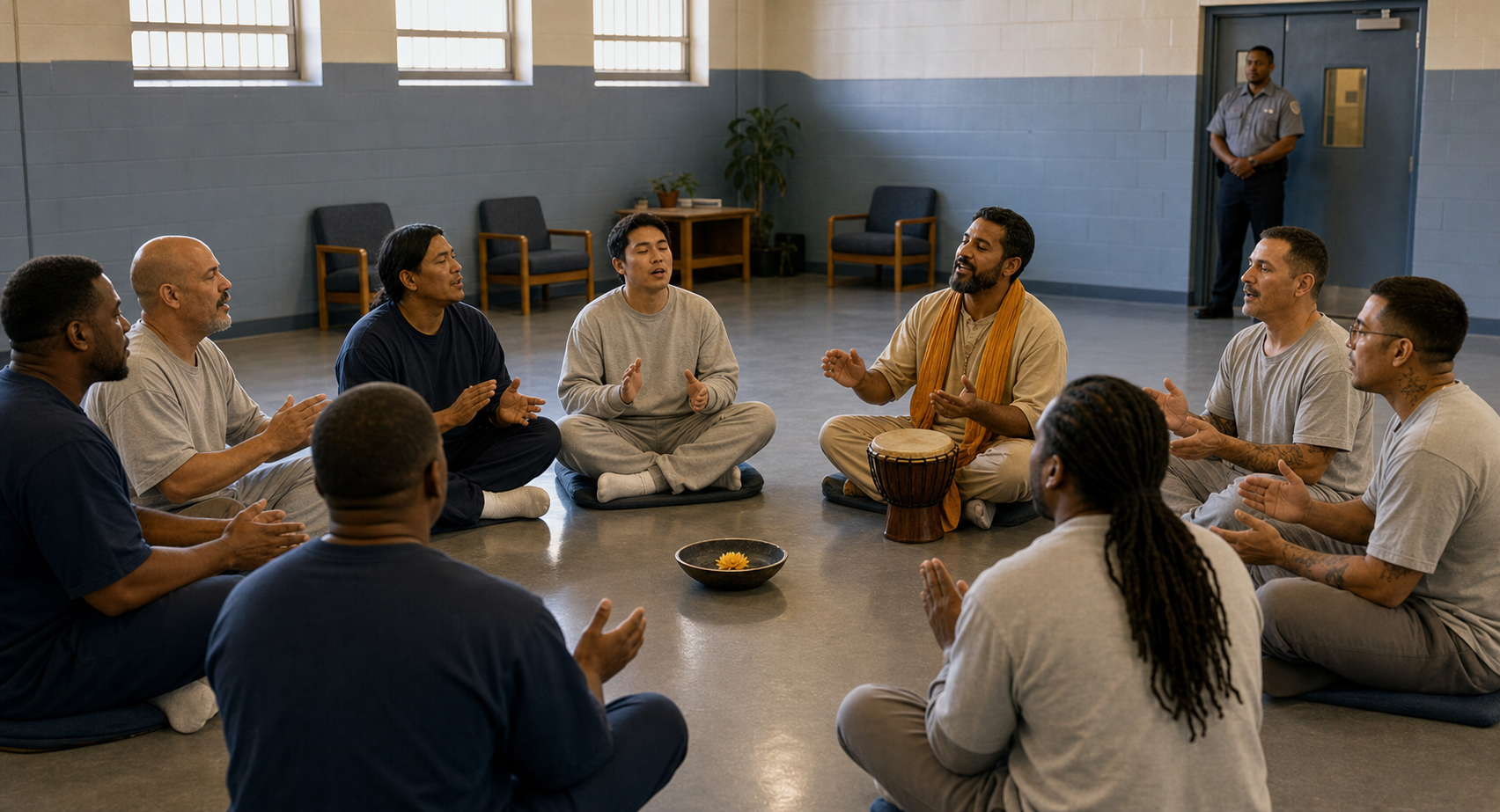
If you are trying to bring bhakti into a prison—or deciding whether a proposal deserves institutional support—the central question is not whether chanting is spiritually meaningful. It is whether devotional practice can become safe, voluntary, observable change in the difficult conditions of confinement.
Bhakti becomes rehabilitative when it gives a person something concrete to do before the next argument, during a sleepless night, after an angry impulse, or while facing the harm caused by past choices. Remembrance of the Divine then becomes more than consolation. It becomes a discipline of attention, nonviolence, accountability, service, and renewed agency.
Begin with the choices a participant can make today

Prison often compresses life into the next count, meal, threat, delay, or conflict. In that persistent survival mindset, an appeal to “change your whole life” can sound remote. A useful program starts with a smaller question: what can you notice and choose in the few seconds between provocation and response?
That question gives bhakti-based rehabilitation four practical aims:
- Steadier attention: returning the mind to a mantra or paced breath instead of following every anxious or hostile thought.
- Ethical discrimination: identifying what non-harm, restraint, truthfulness, and responsibility require in a specific situation.
- A responsible identity: understanding the self as more than a prison number or past offence without using spirituality to deny the consequences of that offence.
- Prosocial connection: learning to participate in a group without domination, intimidation, ridicule, or factional loyalty.
The Bhagavad Gita’s language of atma, manas, and the three gunas can support this work when it is used as a tool for observation rather than a system for labelling people. Tamas may be noticed as heaviness, avoidance, or confusion; rajas as agitation, craving, or impulsive activity; sattva as clarity, proportion, and steadiness. These are changing qualities of experience, not permanent identities and not clinical diagnoses.
A facilitator can turn that framework into a brief reflection:
- Name one difficult episode from the week without retelling unnecessary details of the underlying offence.
- Identify the first mental or bodily sign that the situation was escalating.
- Describe which quality was dominant: confused withdrawal, restless reaction, or clear restraint.
- Choose one lawful, non-harming response for the next occurrence, such as stepping away, seeking staff assistance, slowing the breath, or returning attention to the mantra.
- At the next meeting, report what was actually attempted and what happened. The aim is honest practice, not an impressive testimony.
This pairing matters: “You are more than your worst action” must remain beside “You are responsible for what you do next.” Remove either half and the program loses its rehabilitative integrity.
Use a repeatable 60–90 minute practice sequence

Consistency is more useful than novelty in a restrictive environment. A participant should know the rhythm of the gathering and be able to carry its simplest practices back to a cell, dormitory, or recreation area without needing special equipment.
A workable 60–90 minute session can follow this sequence:
- Five minutes of centering breath: use gentle diaphragmatic breathing or an unforced, evenly paced breath while seated. Participants should be free to keep their eyes open or opt out.
- Ten minutes of mantra practice: chant silently, softly, or in a quiet group according to facility policy.
- A short reading: select a passage from the Bhagavad Gita or a permitted parallel Dharmic text dealing with equanimity, duty, compassion, restraint, remembrance, or self-mastery.
- Guided application: connect the teaching to one recurring prison situation, such as verbal provocation, waiting, disappointment, cleanliness, keeping a commitment, or asking for help before anger becomes violence.
- Optional kirtan: use call-and-response chanting only in the form the institution has approved. A cappella chanting or simple hand-clapping can preserve the communal practice where instruments are prohibited.
- A closing intention: ask each participant to state privately or aloud one commitment involving non-harm, responsibility, or service before the next gathering.
The maha-mantra—Hare Krishna Hare Krishna, Krishna Krishna Hare Hare / Hare Rama Hare Rama, Rama Rama Hare Hare—works well in this setting because it is portable and repeatable. No altar, instrument, bead bag, or electronic device is required. If a facility permits a soft counting aid, it must enter through the approved property process; a volunteer should never improvise around a restriction.
A simple personal practice can use three elements: a stable cue, a short practice, and a written reflection. The cue might be waking, settling for the night, or another permitted point in the institutional routine. The practice might be quiet mantra repetition followed by several gently paced breaths. The reflection can answer three questions: What triggered me? What did I do? What will I try next time?
That log should remain a practice aid, not a surveillance device or a demand for intimate disclosure. Participants need to know who may read it, what confidentiality rules apply, and whether keeping written material is permitted in their housing unit.
Breath regulation and mantra can help a person settle attention, but they are not substitutes for clinical care. Acute psychological distress, trauma symptoms, substance withdrawal, or risk of self-harm must be referred through the facility’s qualified health and mental-health channels. A volunteer’s role is to recognise the boundary and make the proper referral, not to diagnose or promise that spiritual practice will cure the condition.
When in-person access is interrupted, the same structure can continue through approved correspondence: a short reading, a practice instruction, a weekly ethical question, and a practice log. Letters and study materials must still pass institutional screening. Families and community members should never send beads, food, books, or devotional objects outside the facility’s stated procedure, even when the intention is compassionate.
Make consent and security part of the sadhana

Respect for correctional rules is not a dilution of bhakti. In this setting, disciplined respect for another person’s conscience, bodily safety, and institutional boundaries is itself an expression of seva and ahimsa. A program that bypasses those duties may look devotional while undermining Dharma in practice.
Protect spiritual freedom
Participation must be voluntary from beginning to end. A participant should be able to attend, decline a chant, use an alternative contemplative practice, or leave the program without spiritual shaming or an implied institutional penalty. Access to literature, respectful conversation, or reentry help must never depend on a promise to convert.
A Dharmic approach can be inclusive without pretending that all traditions teach the same doctrine. Hindu participants may engage mantra, atma, and guna-based reflection. Buddhist participants may work through mindfulness and compassion; Jain participants through ahimsa and restraint; Sikh participants through simran and seva. These shared ethical practices can support collaboration while their theological distinctions remain respected.
Sattvic food principles should likewise be educational and optional. Volunteers can discuss moderation, cleanliness, compassion, and vegetarian practice, but they should not interfere with the meal system or make participants feel spiritually inferior for eating what is available. Requests for a religious diet belong in the facility’s formal accommodation process.
Protect institutional trust
Before the first gathering, the chaplaincy, custody staff, and volunteer team should agree on the schedule, room, attendance procedure, permitted texts, sound level, physical practices, property rules, documentation, referral channels, and emergency response. Ambiguity in any of these areas creates avoidable friction later.
- Complete the required background checks and institutional orientation before making direct contact with participants.
- Train every volunteer in Prison Rape Elimination Act standards, personal boundaries, mandated reporting, accurate records, and the facility’s confidentiality rules.
- Screen books, worksheets, envelopes, counting aids, musical instruments, food, and other materials through the authorised process.
- Do not carry private messages, money, goods, or favours between a participant and the outside community.
- Do not promise release benefits, special treatment, secrecy beyond policy, or outcomes the spiritual program cannot control.
- Record attendance, the general theme covered, approved material requests, and necessary referrals without collecting sensational or irrelevant personal details.
Satsanga also needs boundaries. It should not become an unstructured confession circle, an arena for debating offences, or a place where a charismatic participant acquires informal authority over others. Keep discussion anchored to present conduct: anger triggers, truthful speech, keeping one’s space orderly, resolving disputes without violence, and repairing trust through consistent action.
Peer encouragement can be valuable, but peers are not therapists, custody staff, or gurus by default. Facilitators should interrupt intimidation, theological one-upmanship, recruitment into factions, and advice that conflicts with institutional or clinical directions. The same standard applies to volunteers: warmth is appropriate; dependency, secrecy, and blurred relationships are not.
Measure conduct without pretending that attendance proves change

Religious and spiritual participation in correctional settings has been associated with reduced misconduct, stronger program engagement, and, in some settings, less justice-system contact after release. Meditation and breath-centred practices have also been linked with lower perceived stress and better emotional regulation. But results vary with program quality and participant motivation, and association alone does not establish that the program caused an outcome.
A credible evaluation therefore tracks the whole chain from resources to behaviour:
| Stage | What to track | What it can tell you |
|---|---|---|
| Inputs | Cleared volunteers, approved literature, scheduled space, correspondence capacity | Whether the program was equipped and delivered as intended |
| Activities | Mantra practice, facilitated reading, ethical dialogue, kirtan where approved, practice logs | What participants were actually offered, rather than what the program was advertised to provide |
| Outputs | Sessions and hours delivered, attendance, retention, completed study units, requested follow-up | Reach and continuity, but not transformation by themselves |
| Near-term outcomes | Participant reports of calm, sleep quality, rumination, conflict responses, and ability to use the practice under stress | Whether participants perceive usable changes that warrant further observation |
| Institutional outcomes | Rule compliance, disciplinary incidents, negative interactions, program retention, step-down progress | Whether behavioural patterns are moving in a constructive direction, while recognising other influences |
| Reentry outcomes | Consented community connections, continued practice, mentorship engagement, practical referrals, later justice-system contact where lawfully tracked | Whether continuity survived the transition out of custody |
Define these measures before using success stories to promote the program. Attendance shows exposure, not rehabilitation. A report of calm is meaningful but does not prove lasting conduct change. A reduction in disciplinary reports deserves attention but may also reflect housing changes, staff practices, other programs, or differences among the people who chose to participate.
Use numbers and narratives together. Attendance, retention, rule compliance, and approved institutional records show patterns. Participant reflections and chaplain observations can reveal the mechanism: whether someone remembered to pause, used a nonviolent response, kept a commitment, or sought help before a conflict escalated. Any vignette used outside the immediate program should be anonymised, recorded with permission, and stripped of details that could identify the participant or another person.
Treat release as the next stage, not graduation day
Inner discipline is easier to sustain when it has somewhere to land. Reentry planning should therefore begin while the participant is still practising inside. With explicit consent, the program can connect a person to a temple, gurdwara, Buddhist sangha, Jain community, or other suitable congregation able to offer mentorship, spiritual continuity, sober social connection, and practical support.
A useful handoff answers four questions before release:
- Who is responsible? Name the approved community contact rather than giving the participant only a general address.
- What practice will continue? Write down a realistic routine for mantra, meditation, study, satsanga, and service.
- What boundaries apply? Clarify communication, transportation, money, housing, confidentiality, and safeguarding expectations.
- What practical obstacle comes first? Where feasible, coordinate help with identification documents, employment preparation, stable routine, or another immediate reentry need instead of assuming spiritual enthusiasm will solve it.
A list of congregations is not yet continuity of care. Confirm that the receiving community knows the person is coming, understands the scope of its role, and can offer support without coercion. If that confirmation cannot be made, say so plainly and help the participant form a practice plan that does not depend on an unavailable mentor.
Key takeaways for your first program decision
- Judge a bhakti program by the choices it helps participants make under pressure, not by the volume of chanting or the number of religious labels adopted.
- Use a stable sequence: centering breath, mantra, permitted reading, ethical application, optional kirtan, and a concrete commitment.
- Pair spiritual dignity with accountability. A deeper identity must never become an excuse for denying harm.
- Make voluntary participation, interfaith respect, staff coordination, material screening, reporting duties, and clinical referrals part of the design before the first session.
- Track inputs, delivery, participant experience, institutional conduct, and reentry continuity. Do not treat attendance or testimony as proof of causation.
- Plan the community handoff early and obtain consent. Release should change the setting of the practice, not end the support around it.
If you are reviewing or proposing a program, start with a one-page operating covenant. Put voluntariness, the session sequence, allowed materials, volunteer boundaries, referral and reporting channels, outcome measures, and the reentry handoff on that page. Once the chaplaincy, custody team, volunteers, and community partners can agree on those terms, bhakti has a sound institutional vessel in which to do its quiet work.
References
