
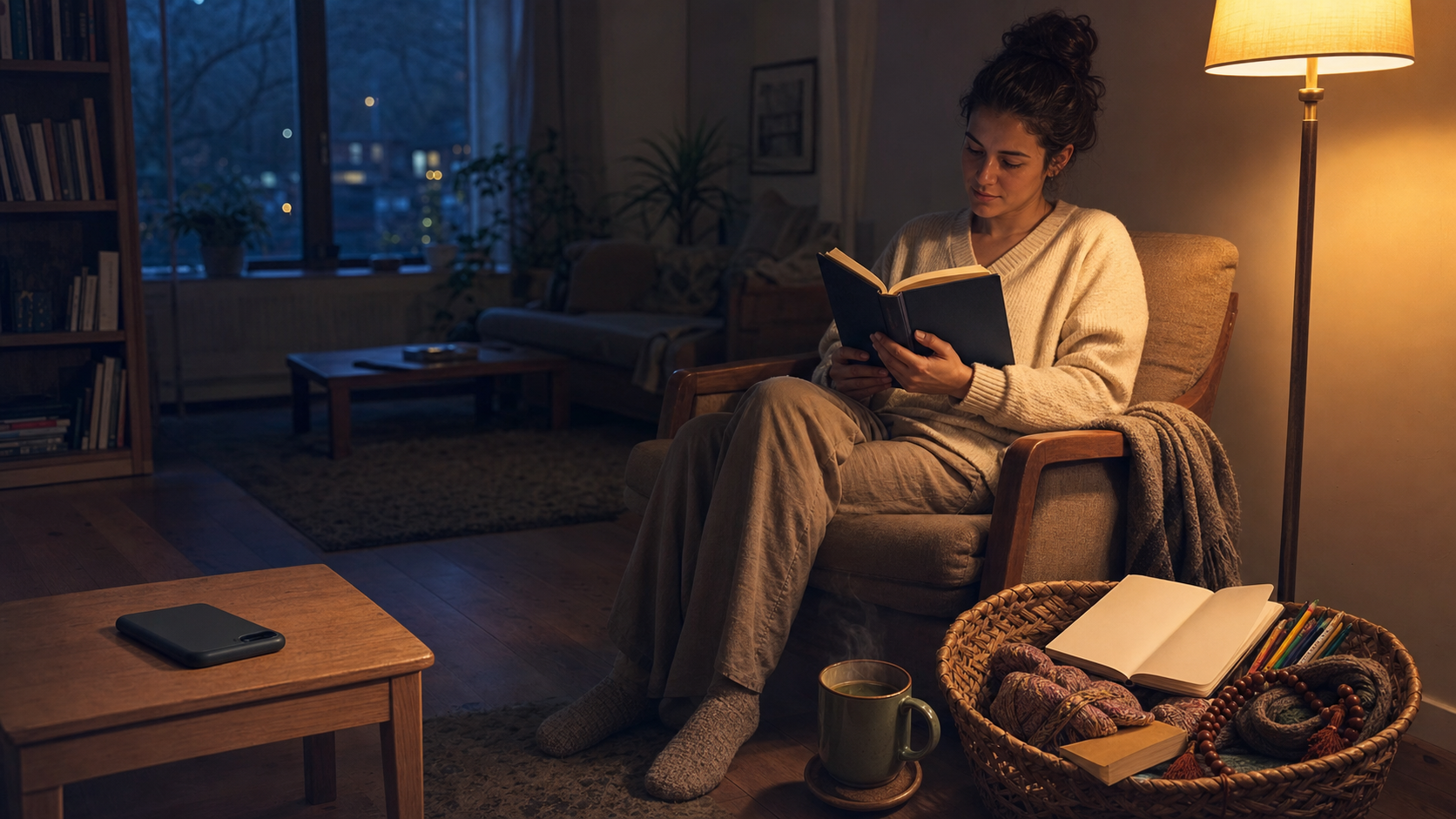
You sit down after dinner intending to rest. A quick check becomes a procession of alarming headlines, arguments, and short videos. By the time you put the phone down, the evening is gone, but the agitation is still in your body.
You do not need a heroic digital detox. You need an evening option that is close at hand, gentle enough for a tired mind, and more restorative than the feed. A small analog kit, paired with one repeatable cue, can give you that option.
Why the phone wins when you are already tired
Doomscrolling often begins as an attempt to come down from the day. The couch, television, and phone promise immediate relief without asking you to plan, prepare, or concentrate. That matters after work, commuting, caregiving, or a day of constant decisions.
The feed is unusually difficult to leave because it combines unpredictable novelty, heightened attention to threatening information, and almost frictionless access. Each swipe might reveal something amusing, urgent, enraging, or personally relevant. The uncertainty keeps the hand moving even after enjoyment has disappeared.
This is why a rule such as use the phone less usually fails in the evening. It leaves a vacuum. When your energy is low, the brain does not calmly compare five wholesome alternatives; it reaches for the action requiring the fewest steps.
The first distinction to notice is the difference between numbing and recovery. Numbing suppresses awareness for a while. Recovery leaves you more settled afterward. If twenty minutes of an activity makes it harder to stop, delays bedtime, or leaves your attention scattered, it may be entertaining without being restful. Late-night screen exposure can also delay melatonin onset and reduce subjective sleep quality.
Treat the problem as one of environment design, not moral weakness. Your task is to make a restorative action visible and immediate before decision fatigue takes over. If loss of sleep, anxiety, or compulsive online behaviour is seriously impairing your daily life, however, an analog routine is not a substitute for help from a qualified medical or mental-health professional.
Build an analog basket for the energy you actually have
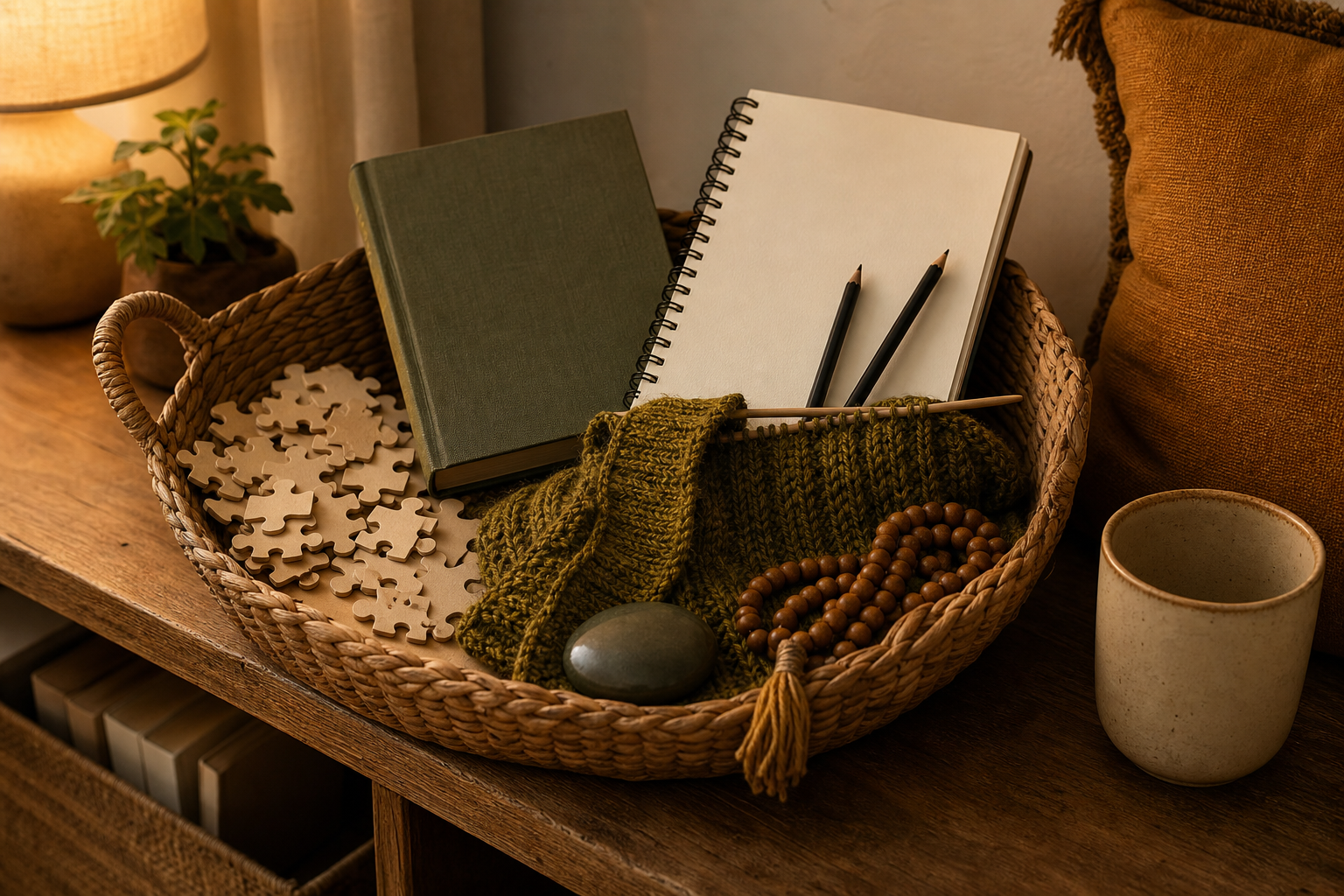
Put a basket, tray, or small box beside the chair, couch, or nightstand where scrolling normally begins. Its location is more important than its appearance. If it lives in a cupboard, it becomes another task. If it is within reach, it becomes a genuine competitor to the phone.
The basket should be a short menu, not a storage bin. Too many worthy choices recreate the decision problem you are trying to solve. Start with one item from each of these functions:
- Something to read: keep a demanding book, a practical book, and deliberately light reading ready. The light option is essential; an exhausted mind will not reliably choose a difficult text just because it is improving.
- Something for the hands: use a colouring book, small sketchbook, coloured pencils, oil pastels, watercolours, a manual puzzle, or materials for a simple collage.
- Something for reflection: keep a lined notebook for gratitude and a blank notebook for drawing, quotations, recipes, or observations.
- Something contemplative: add a mala, a printed verse, a short mettā or maitri prompt, one of the Jain bhavana, or a line selected for simran-inspired remembrance.
- Something to hear: keep wired or over-ear headphones with calming music, gentle kirtan, shabad kirtan, or a contemplative recording already selected. Queue it before the wind-down period so choosing audio does not reopen the feed.
Match the choices to the amount of attention you have left. Energy matching removes the hidden demand to perform wellness correctly.
| Evening state | Best-fit alternatives | Small starting action |
|---|---|---|
| Very low energy | Light fiction, colouring, tracing, gentle preselected audio | Read one page or colour one small area |
| Steady but tired | Practical reading, a commonplace notebook, collage, manual puzzle | Set a ten-minute timer and stop without judging the result |
| Clear and interested | Literary reading, watercolour, free sketching, longer reflection | Choose one chapter, image, or question rather than an open-ended project |
Low-pressure creativity is especially useful because it occupies the hands while gathering attention around colour, texture, and movement. The standard is participation, not quality. In Yogic language, this is abhyasa without clinging to the product: practise steadily, then release the demand that the page prove anything about you.
Prepare the physical details in advance. Sharpen the pencils. Put a bookmark at the next page. Write a prompt on the first blank sheet. Place a simple kitchen timer nearby if you need one. Each unfinished setup step gives the phone another advantage.
Use a 25-minute landing sequence
An open-ended ban makes the evening feel like deprivation. A short landing sequence gives it a shape. Attach the sequence to something that already happens: finishing the dishes, changing out of work clothes, making tea, or sitting in your usual chair.
Write the cue as an if-then instruction: If I sit down after dinner, then I touch the basket before I touch the phone or remote. This wording matters because it settles the first action before the tired version of you has to negotiate.
- Five minutes of breathing: sit comfortably and breathe through the nose without strain. Try a relaxed count of four on the inhalation and six on the exhalation. The counts are guides, not targets; return to normal breathing if the pattern feels uncomfortable.
- Ten minutes of reading or making: choose the item that matches your present energy. Read, colour, sketch, solve, or assemble. Keep the task small enough to finish or leave without frustration.
- Ten minutes of closing reflection: write three brief observations: one effort you made, one kindness you received, and one element of nature you noticed. If words feel burdensome, sketch three simple images instead.
A comfortable, longer exhalation can support the shift from vigilant arousal toward parasympathetic recovery. You are not trying to manufacture a special state. You are giving the body a quieter rhythm while attention disengages from rapid novelty.
On a depleted evening, preserve the cue even if you shorten the activity. Open the basket, breathe comfortably for five minutes, and read one page or colour one shape. A small completed ritual protects the association between the evening cue and the analog response. Trying to compensate with an ambitious session usually turns restoration into another obligation.
Let one Dharmic practice give the evening a centre
An analog evening does not have to be merely screen-free. It can become a modest practice of directing attention. The Dharmic traditions offer distinct disciplines for doing this, and their shared practical value does not make their teachings interchangeable.
Choose one practice that belongs to your path or that you can approach respectfully. Repeat it for several evenings instead of assembling a different spiritual sampler every night. Repetition reduces decisions and allows meaning to deepen.
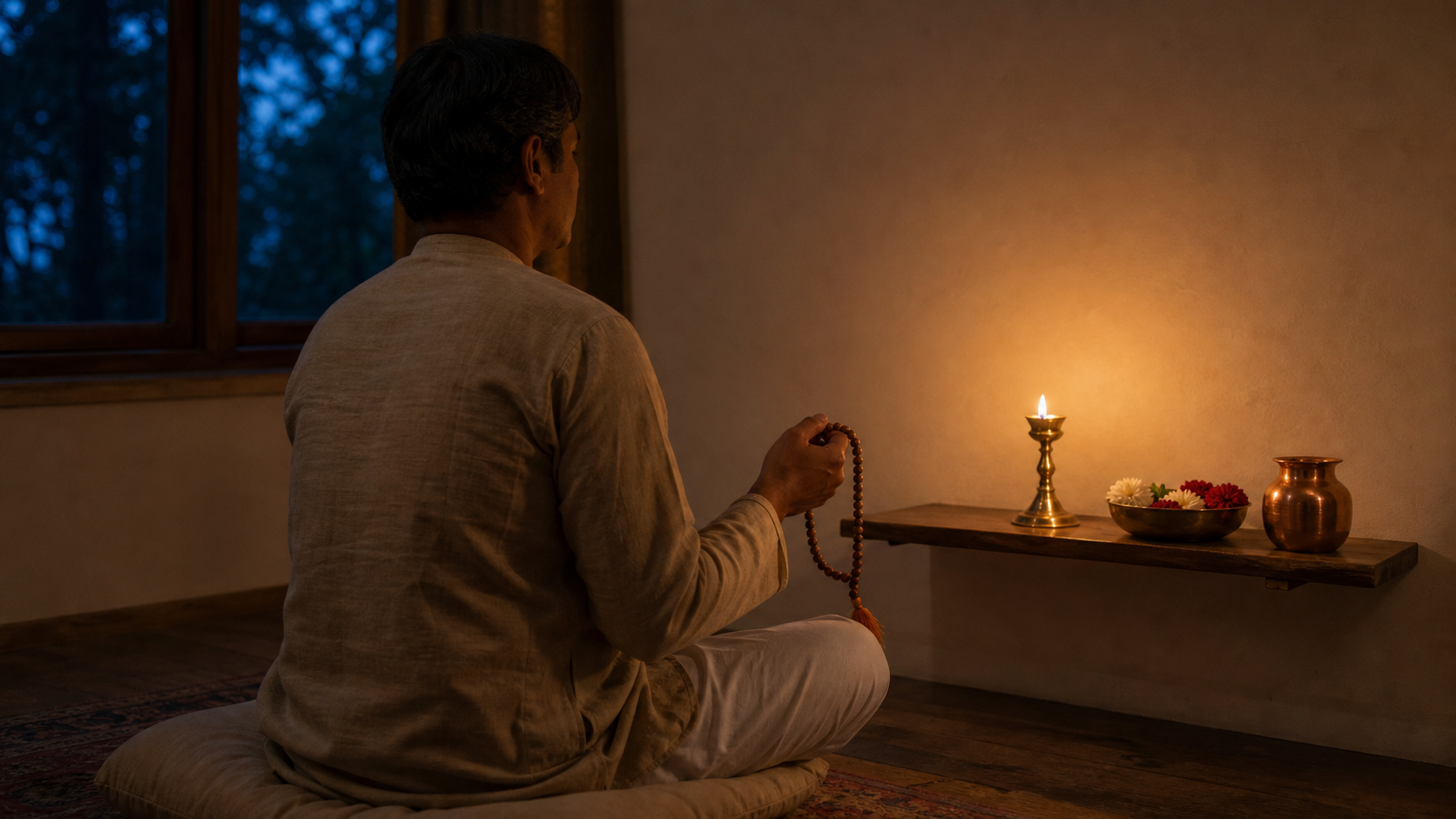
- Within Hindu and Yogic practice: treat the first minutes away from the feed as pratyahara, a deliberate withdrawal from competing sensory claims. Follow it with gentle pranayama, japa on a mala, or quiet attention to a selected verse from the Bhagavad Gita. Dhyana begins here as sustained attention, not as a performance of perfect silence.
- Within Buddhist practice: use anapanasati by staying with the ordinary breath, then close with a brief mettā or maitri reflection. When agitation appears, notice it without converting it into another reason to reach for stimulation.
- Within Jain practice: set aside a quiet interval in the spirit of samayik, or place one of the 12 bhavana beside the notebook. Aparigraha can become a concrete evening question: What was sufficient today, before the feed persuaded me that I needed more information, reaction, or possession?
- Within Sikh practice: use simran or gentle shabad kirtan to move from scattered repetition supplied by an algorithm toward chosen remembrance. Keep one line for contemplation beside the notebook rather than searching for a new selection at bedtime.
The common movement is from involuntary capture to voluntary attention. The purpose is not to declare technology impure. It is to recover the ability to decide what enters the mind and what receives remembrance. That is a more durable form of restraint than fighting the phone while leaving it in your hand.
Keep the spiritual element proportionate. One verse, one mala round, one bhavana, or a few minutes with the breath is enough for an evening transition. If you turn the ritual into a test of devotion, fatigue and self-criticism will soon make the feed look easier again.
Make the new default easier to repeat
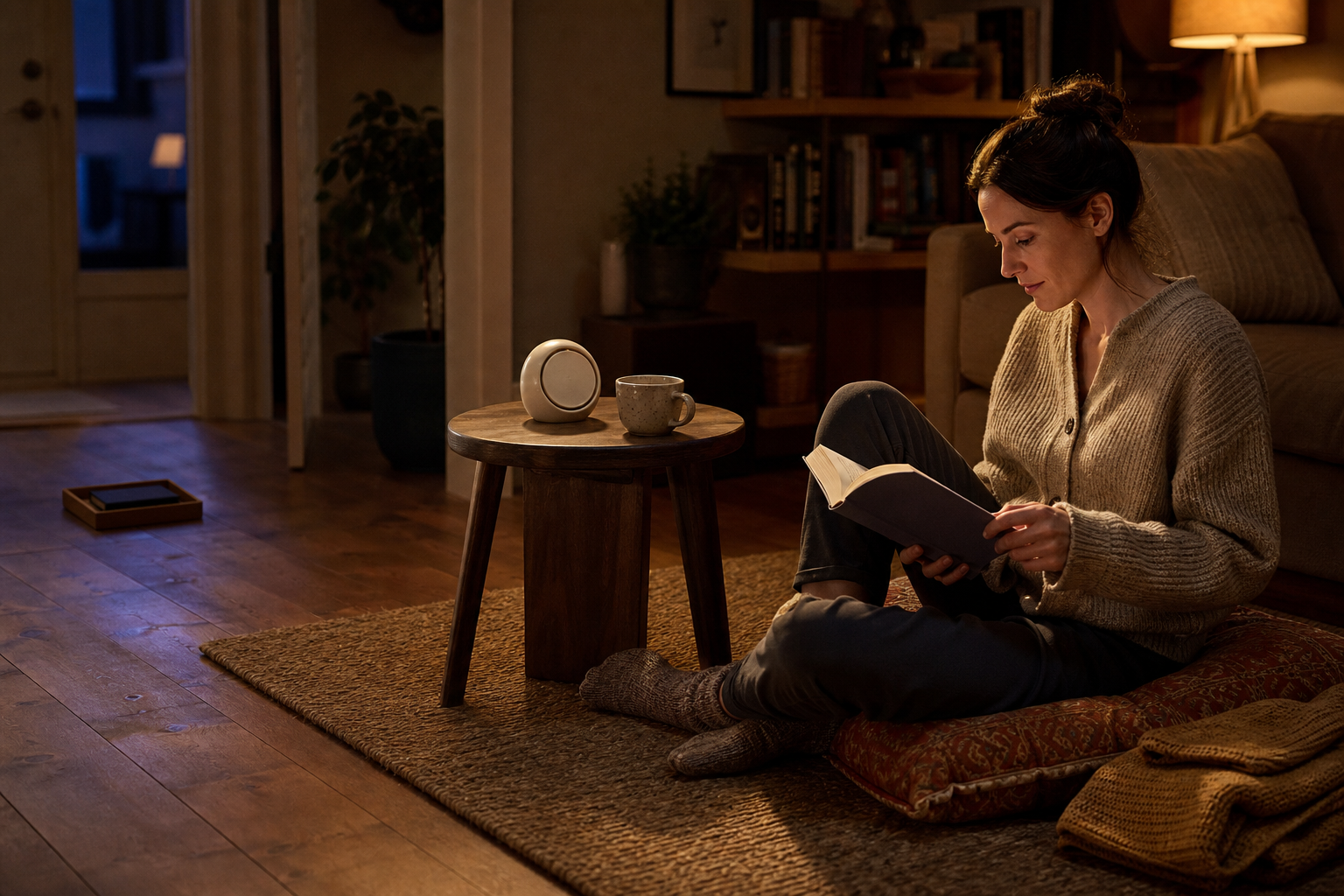
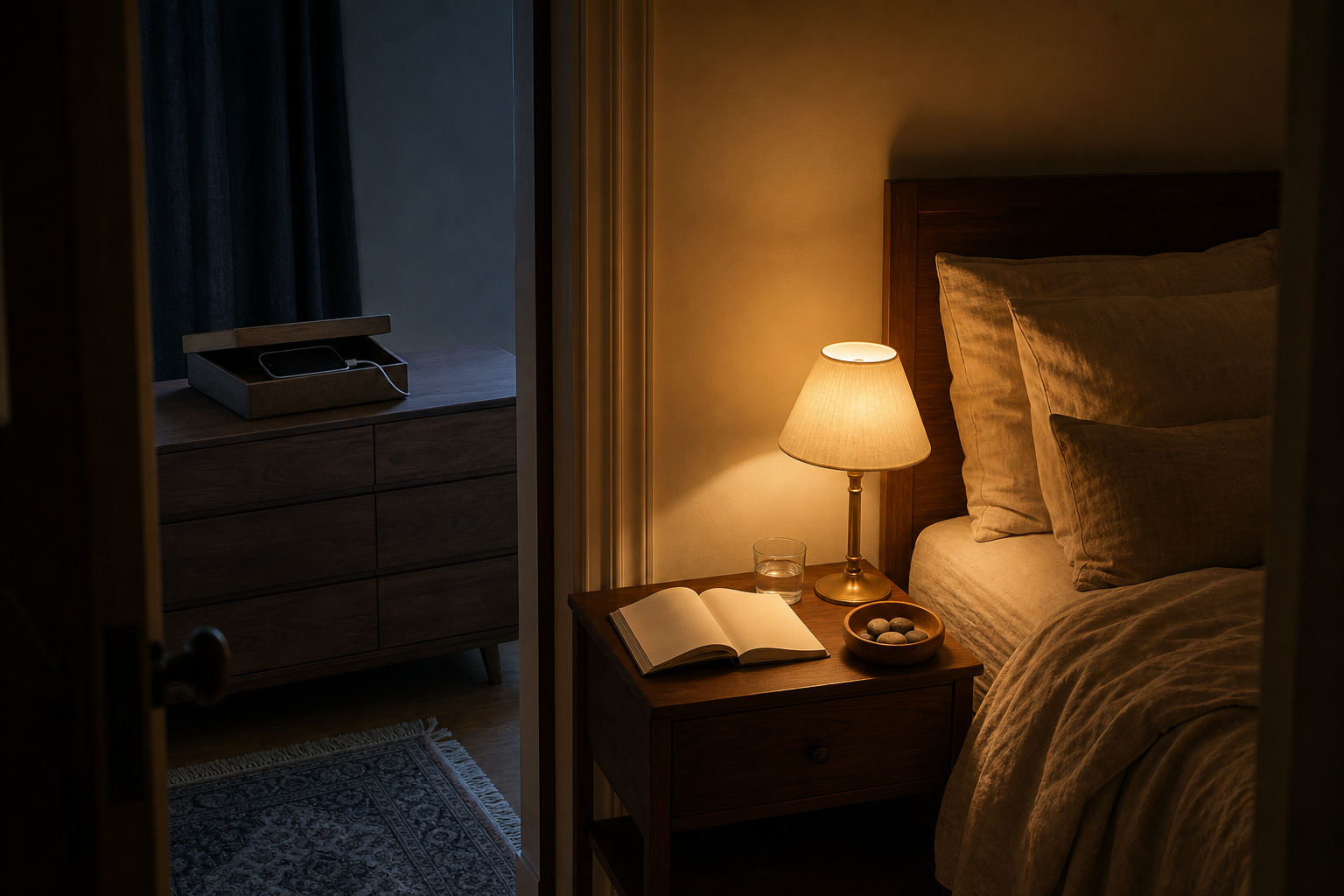
The basket cannot become the default while the phone remains the brightest, closest object in the room. During the first thirty minutes of your wind-down, charge the phone in another room. If you must remain reachable for caregiving or urgent calls, keep it beyond arm’s reach and restrict interruptions to genuinely necessary ones.
Put the television remote beneath the basket. This tiny rearrangement forces a pause before screen use and makes the analog choice visible at the exact decision point. The aim is not to prohibit television forever; it is to stop the screen from winning before you have consciously chosen it.
Expect some resistance from the activities themselves. Hand fatigue is a reason to use small paper and a ten-minute limit, not to abandon the kit. If you do not know what to draw, trace an outline or copy a familiar illustration. If an inner critic compares tonight’s page with work you once made, return to colour, pressure, and movement. The page does not need to be shown to anyone.
Track only enough to learn whether the change is helping. Draw three columns in the notebook: evening stress, ease of falling asleep, and morning clarity. Score each from 1 to 10. Complete the morning score after waking, not from memory the following night. Review the rows after one to three weeks for direction rather than perfection. These are personal observations, not clinical measurements.
Look for a practical pattern: whether the wind-down starts earlier, rumination occupies less of the evening, or mornings feel clearer. If nothing changes, inspect the design before blaming discipline. The basket may be out of reach, its choices may demand too much energy, the phone may still be beside you, or the cue may be too vague.
Key takeaways
- Doomscrolling is easiest to interrupt before the first swipe, so place an analog option at the point where scrolling normally begins.
- Stock for low, medium, and higher-energy evenings; light reading and tracing are legitimate recovery choices.
- Use one fixed cue and a 25-minute sequence: five minutes of breathing, ten minutes of reading or making, and ten minutes of reflection.
- Choose one Dharmic practice and repeat it. Depth requires less evening decision-making than constant novelty.
- Move the phone for the first thirty minutes and track stress, sleep-onset ease, and morning clarity for one to three weeks.
Tonight, do not redesign your whole relationship with technology. Put one book, one pencil, one notebook, and one contemplative prompt beside the place where you usually scroll. Move the charger, write your if-then cue, and complete the first five minutes. Make the next wholesome action close enough for a tired hand to find.
References
