

If Kratu Prabhu’s departure has left you wondering how to honor him, the most faithful answer is not a larger vocabulary of praise. It is a more deliberate life of bhakti. Remembrance becomes meaningful when it changes how you chant, study, serve, lead, and treat the people entrusted to your care.
His devotional legacy gives you a practical test: does remembering him strengthen your fidelity to Srila Prabhupada’s mission and make your service more dependable? If the answer is unclear, begin with the part of your devotional life that has become irregular, vague, or driven by status. That is where remembrance can become practice.
Begin with vani-seva, not memorial sentiment

Physical association ends, but service to a Vaishnava’s teachings need not end with it. In the Gaudiya Vaishnava understanding reflected in Kratu Prabhu’s life, vani-seva keeps spiritual association active through obedience to instruction. It turns separation into responsibility rather than allowing remembrance to settle into nostalgia.
Vani-seva is more exacting than admiration. Admiration can remain private and cost you nothing. Instruction enters your schedule, affects your choices, and may require you to correct a habit. If you honor a teacher for steadiness in sadhana while repeatedly treating your own practice as optional, the tribute has not yet reached the point where it can transform you.
Use the following sequence whenever you want to convert remembrance into service:
- Locate the neglected responsibility. It may be hurried japa, disconnected scriptural reading, unreliable seva, poor volunteer care, or a community decision that no one can clearly explain.
- Connect that weakness to a preserved principle: attentive chanting, coherent study, accountable service, humility, compassion, or transparent stewardship.
- Give the principle an observable form. Protect japa in your routine, accept a defined service responsibility, document a decision, or change the way affected devotees are heard.
- Examine the motive. Ask whether the action serves Krishna and the community or merely strengthens your position within it.
There is also a necessary boundary. Do not invoke Kratu Prabhu’s name to settle matters for which you do not have a preserved instruction. Affection does not authorize us to manufacture his opinion. Where his teachings supply a principle but not a detailed answer, state the principle honestly, use scriptural discernment, and remain accountable for your own judgement.
Make hearing, chanting, and service mutually reinforcing

Kratu Prabhu’s practical center was not an obscure technique. It was the disciplined relationship among shravana, kirtana, and seva: hearing about Krishna, chanting the holy name, and acting in devotional service. His example placed attentive japa, congregational kirtan, scriptural reflection, and regulated service within one coherent path.
Srimad-Bhagavatam 7.5.23 names nine expressions of devotion: hearing, chanting, remembering Vishnu, serving His feet, worship, prayer, servitude, friendship, and full self-surrender. The list is not a menu for collecting spiritual experiences. It shows that bhakti engages attention, speech, memory, ritual, relationship, and action. Hearing gives chanting content; chanting keeps remembrance alive; remembrance directs service; service tests whether what you heard has entered your conduct.
If your practice feels scattered, rebuild that connection in ordinary life:
- For japa: decide in advance where it belongs in your daily routine. Remove predictable distractions before you begin. When attention wanders, return it to the maha-mantra without turning the lapse into an excuse to abandon the practice.
- For study: read the Bhagavad Gita and Srimad-Bhagavatam as coherent pathways, not as collections of isolated quotations. After reading, identify the duty, misconception, or habit the passage places before you.
- For seva: accept work whose purpose and responsibility are clear. Finish unglamorous duties with the same care you would bring to visible service. Reliability is part of the offering.
- For congregational life: participate steadily enough to know what the community needs. Kirtan can create belonging, but belonging matures when participants also carry responsibility for one another.
This prevents a common imbalance. Chanting without reflection can become mechanical. Study without service can become an identity built around knowing. Service without sadhana can become exhausted activism or a search for recognition. Kratu Prabhu’s devotional method joined them so that understanding, remembrance, and responsibility could correct one another.
Acintya-bhedabheda, the Gaudiya teaching of inconceivable unity and distinction between the Divine and the living being, belongs in this practical architecture. It is not merely a doctrine to repeat. It places the practitioner in a real relationship with Krishna while refusing to collapse the servant into the object of service. When ego enters a devotional task, return to that orientation: the service matters, but it is not your possession; your contribution matters, but you are not its ultimate center.
Let humility govern power, resources, and responsibility
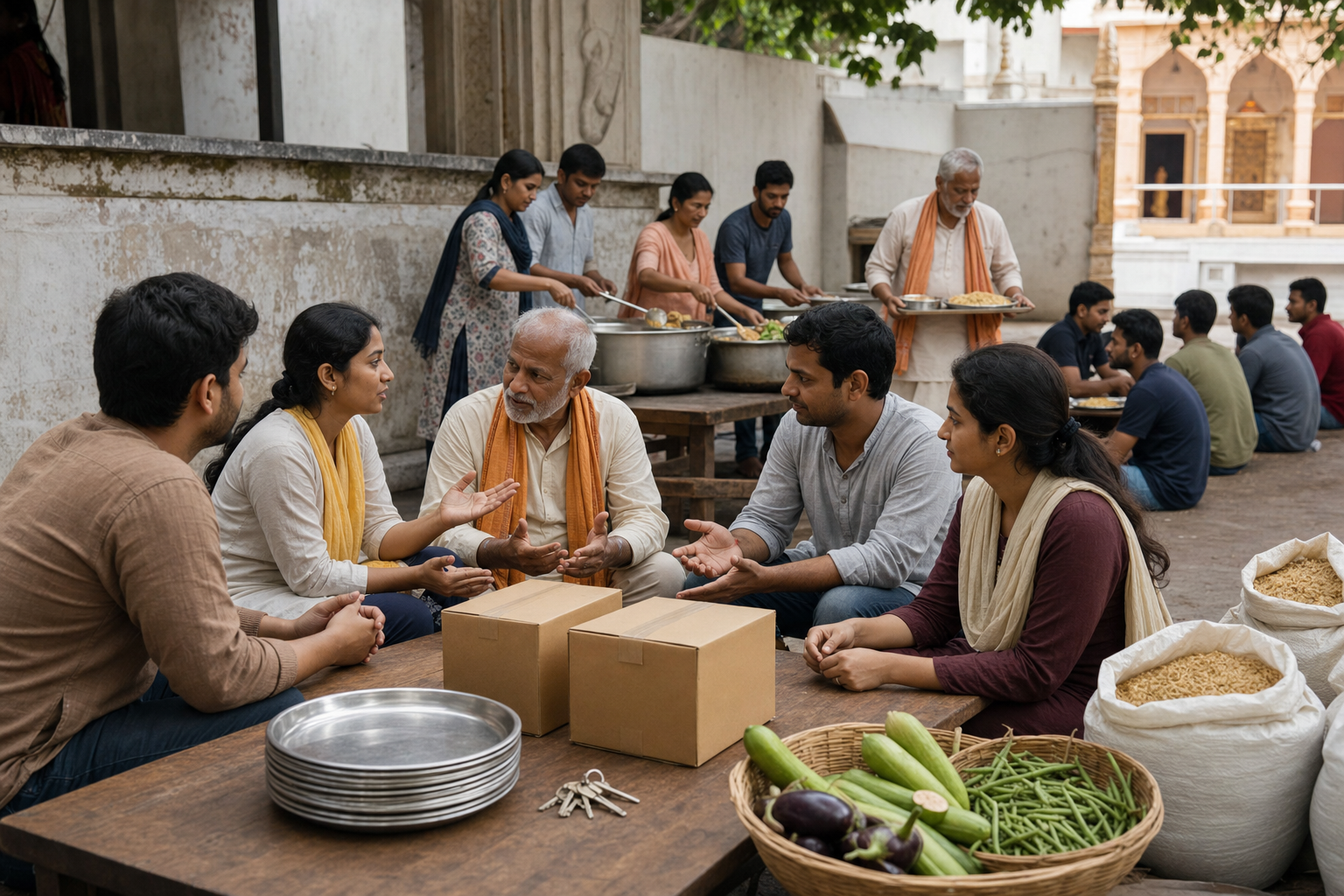
The Vaishnava instruction to be humbler than grass, more tolerant than a tree, ready to respect others, and free from demands for personal honor is often treated as advice for private character. Kratu Prabhu’s leadership shows why it must also shape institutions. Humility expressed through transparent decisions, responsible stewardship, volunteer care, and accountability becomes a form of governance.
Humility does not mean avoiding decisions or pretending that authority does not exist. It means refusing to use spiritual position as insulation from questions. A leader who speaks gently but leaves responsibilities vague, resources unexplained, or volunteers unsupported has preserved the appearance of humility while losing its function.
Before a temple or community decision becomes final, make sure the responsible people can answer these questions plainly:
- Which scriptural principle and part of the community’s mission govern this decision?
- Who will carry its burden, and have those people been heard before the commitment is made?
- Can the use of money, time, facilities, and volunteer labor be explained without evasiveness?
- Who owns the follow-through, and how will the community know whether the commitment was fulfilled?
- What will younger devotees and newcomers learn from the process as well as from the outcome?
These questions matter especially in diaspora congregations. Cultural diversity, demanding schedules, and intergenerational differences can make silent assumptions expensive. Long-time members may understand unwritten expectations that newcomers cannot see. Parents, youth, volunteers, and temple leaders may each hear the same announcement differently. Clear roles, structured mentorship, documented decisions, and patient explanation are therefore not bureaucratic intrusions into spiritual life. They are ways of caring for the people through whom service is performed.
Kratu Prabhu’s example also gives mentors a useful standard. Scriptural fidelity and compassion should appear together. Compassion without principle can leave a seeker without direction; principle delivered without attention to the person can turn guidance into control. State the teaching clearly, listen for the actual obstacle, and give the learner a practicable next duty. The purpose of correction is renewed service, not the mentor’s victory.
Build dharmic unity without erasing real distinctions

Kratu Prabhu’s legacy reaches beyond the internal life of an ISKCON congregation. Vaishnava commitments to daya, ahimsa, and seva can meet Buddhism’s emphasis on karuna, Jainism’s disciplined ahimsa, and Sikhism’s seva in a shared field of ethical action. This dharmic convergence is strongest when cooperation preserves each tradition’s distinct spiritual commitments.
Unity is not the claim that every doctrine, practice, or goal is interchangeable. That claim produces vagueness rather than respect. A Vaishnava should not have to mute devotion to Krishna to participate in a common initiative, just as Buddhist, Jain, or Sikh participants should not be asked to describe their paths in borrowed theological language. Honest friendship allows shared virtues to support cooperation without forcing false equivalence.
When you help organize a dharmic gathering, study circle, or service initiative, use a clear structure:
- State the shared ethical purpose in language every participant can recognize, such as compassion, non-harming, service, or responsible care for a common space.
- Invite each tradition to explain its own reason for pursuing that purpose. Do not compress different teachings into a synthetic doctrine no participant actually holds.
- Choose a cooperative activity with defined responsibilities so that unity becomes service rather than ceremonial goodwill.
- Protect devotional and ritual boundaries. Participation should not depend on concealing conviction or imitating a practice one does not accept.
- Judge the result by whether participants can describe one another more accurately, work together more reliably, and return to their own disciplines with greater seriousness.
This approach fits Kratu Prabhu’s wider devotional vision because it holds conviction and generosity together. Bhakti remains centered on Krishna and the guru-shishya parampara. At the same time, genuine devotion enlarges care, improves conduct, and makes cooperation across the dharmic family possible. Distinct roots do not prevent shared service; they give it honesty.
Key takeaways for carrying the legacy forward
- When choosing a tribute, prefer a change in devotional conduct or community practice over praise that asks nothing of you.
- When sadhana becomes fragmented, reconnect hearing, chanting, remembrance, and seva so that each discipline strengthens the others.
- When teaching, combine fidelity to shastra with careful attention to the seeker’s actual obstacle and next responsibility.
- When leading, make humility visible through explainable decisions, responsible resource use, volunteer care, mentorship, and follow-through.
- When pursuing dharmic unity, cooperate through compassion, ahimsa, and seva while allowing each tradition to retain its own language and commitments.
The next time you remember Kratu Prabhu, pause before offering praise alone. Identify the instruction closest to your present responsibility and place it into your routine, service role, or community agenda. Let the people affected by it see the follow-through. That is how gratitude becomes vani-seva and how a devotional legacy continues to act in the world.
References
- Dandavats – HG Kratu Prabhu’s Enduring Legacy: Devotional Leadership, Dharmic Unity, and Bhakti-Yoga
