
When something precious is threatened – your family, a temple, an institution, or the truth itself – you can feel trapped between two bad choices. Remain gentle and permit harm, or become so hard that winning changes you. Dharmic thought offers a more demanding path: protect without worshipping aggression, and seek prosperity without treating success as proof of righteousness.
Lakshmi-Narasimha and Lankini illuminate different parts of that path. They do not belong to the same episode, and they should not be collapsed into a single theological identity. Yet they confront the same practical question. Lakshmi seated upon Narasimha’s lap shows fierce power returning to refuge after defeating tyranny. Lankini yielding at the gate of Lanka shows a guardian recognizing that fortune and allegiance must turn away from adharma. One teaches power when to become peaceful. The other teaches loyalty when to step aside.
Fierceness becomes dharmic only when it knows where to stop

In the Bhagavata Purana’s account, Narasimha does not emerge because ordinary disagreement has become inconvenient. He appears in response to Hiranyakashipu’s tyranny and to protect Prahlada, whose devotion survives coercion and mortal danger. The avatar’s ferocity therefore has a defined object: the force of adharma that has made protection necessary. It is not generalized rage, and it is not destruction for its own sake.
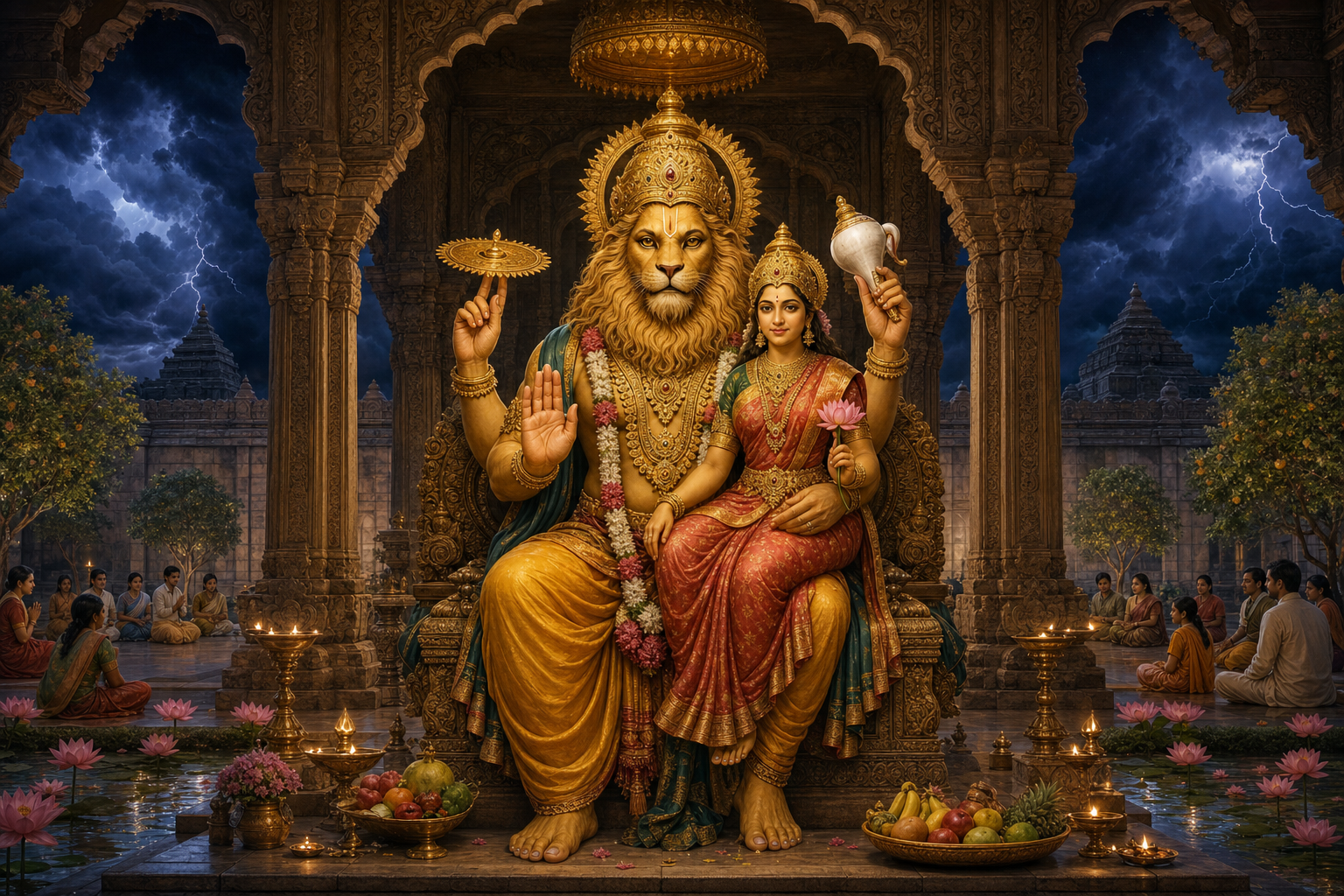
The sequence after the confrontation is as important as the confrontation itself. The devas hesitate before the blazing form, while Prahlada approaches in surrender. Wrath then gives way to grace. The settled icon of Lakshmi-Narasimha preserves that transition: Sri rests upon the Lord’s left lap while Abhaya and Varada promise fearlessness and generosity. The chakra still signifies protective power, but power is no longer surging outward without rest. It has reached its purpose.
The lap matters because it signifies accepted nearness. A frightened devotee is not left standing forever before an unapproachable weapon. Lakshmi makes visible the destination of righteous protection: intimacy can return, fear can subside, and life can become fruitful again. The movement from raudra to shanta is not a retreat from justice. It is evidence that justice has not become addicted to fury.
Before you call a forceful response dharmic, state four things plainly:
- The protected good: Name the person, duty, truth, or boundary you are defending. “Our side” is not precise enough.
- The concrete threat: Describe the conduct that must stop. Do not substitute labels about a person’s entire character for observable actions.
- The stopping condition: Decide what will tell you that the protective action has done its work. If nothing could make you stop, the response is being governed by anger rather than guardianship.
- The work of restoration: Identify what must follow the confrontation so that dignity, trust, safety, and ordinary life can return.
This is a moral test, not permission for vigilantism. Sacred accounts of divine force do not authorize private violence whenever someone feels offended. If a person faces an immediate real-world threat, the first duty is safety through lawful emergency, community, and professional channels. The icon helps you examine the purpose and limits of strength; it does not place you above law or accountability.
Sri is not a divine endorsement of whoever is winning

Lakshmi is often reduced to money, but Sri is a larger civilizational idea. She signifies auspiciousness, order, beauty, legitimacy, and the conditions in which life can flourish. Material resources may express that flourishing, but possession alone cannot prove it. A wealthy household can be disordered. A powerful state can be morally unstable. A successful institution can protect its prestige while betraying its purpose.
Lankini makes that distinction impossible to avoid. In the Sundara Kanda, she stands at the fortified threshold of golden Lanka as its fierce guardian and civic fortune, hence the name Lankalakshmi. She challenges Hanuman as he enters in search of Sita. After he subdues her, she remembers the prophecy that defeat by a vanara signals Lanka’s approaching fall. She then permits his passage and blesses the mission she had tried to obstruct.
Her change is not simple cowardice, and it is not mindless disloyalty. Lankini finally performs the deepest duty of a guardian: she discerns whether the power behind the gate still deserves protection. Ravana possesses Lanka, but possession does not make his cause dharmic. Hanuman arrives as an outsider, but his external position does not make his purpose hostile to truth. A guardian who can only defend the incumbent is a servant of control, not a servant of dharma.
The implication is uncomfortable but practical. Visible wealth can remain for a time even after auspicious order has begun to withdraw. Do not use a person’s comfort, an organization’s growth, or a ruler’s power as a shortcut for judging righteousness. Prahlada suffers while remaining aligned with dharma; golden Lanka appears formidable while its moral foundations are failing. Conduct must judge success, not the other way around.
If you are responsible for a household, association, temple, business, or public institution, ask:
- What purpose existed before the present office-holder, and will remain after that person leaves?
- Would we enforce this rule in the same way against an ally, donor, elder, or leader?
- What evidence would make us admit that the person inside the gate is wrong?
- Do our procedures allow a truthful but inconvenient messenger to be heard?
- Are we protecting the institution’s dharmic purpose, or merely shielding its reputation?
Lankini’s threshold is therefore not merely an architectural detail. A threshold is where intention is tested. The gate should deny predation, deceit, and desecration, but it must not exclude correction simply because correction is uncomfortable. Right guardianship combines firmness with the capacity to recognize a rightful passage.
A four-part test for protection in ordinary life

You will rarely face a mythic tyrant or stand watch over an epic city. You will face conversations, policies, loyalties, access decisions, and moments when anger feels morally clean. The following sequence translates the symbolism without pretending that human beings possess divine omniscience.
- Discern the threshold. Identify the boundary that has actually been crossed. In a family, it may be abusive speech or repeated deception. In an institution, it may be misuse of authority or disregard for a sacred rule. A clear boundary keeps your response attached to conduct rather than dislike.
- Separate the protected good from its present possessor. A leader, committee, family elder, or office-holder may be entrusted with a valuable institution without becoming identical to it. Protecting dharma can sometimes require challenging the person who claims to embody it.
- Choose the least forceful response that can genuinely stop the harm. Firm speech, refusal, restricted access, documented procedure, mediation, or lawful intervention may all be forms of protection. The purpose is to interrupt wrongdoing, not to maximize humiliation. Set the stopping condition before anger begins negotiating on your behalf.
- Restore the conditions of Sri. Once the violation stops, move deliberately toward safety, truthful order, material care, dignity, and renewed participation where appropriate. Abhaya without Varada would leave people merely unafraid; Varada without protection would leave generosity exposed to predation. Flourishing requires both.
At home, this can mean ending a degrading conversation while naming what respectful re-entry requires. In a temple or community body, it can mean applying admission, discipline, and financial rules consistently rather than bending them for status. In public leadership, it means refusing to treat wealth or spectacle as sufficient evidence of legitimacy. In personal discipline, it means asking whether an inner resistance protects a real value or merely guards your ego from correction.
The same balance appears through distinct, non-identical forms across the wider dharmic family. Buddhist wrathful guardians serve the path of compassion, Jain Abhaya joins fearlessness to ahimsa, and Sikh Miri-Piri holds spiritual responsibility beside temporal courage. These are not interchangeable doctrines. They do, however, reject the lazy idea that compassion must be helpless or that strength must be cruel.
Use Lakshmi-Narasimha as a reset before you act
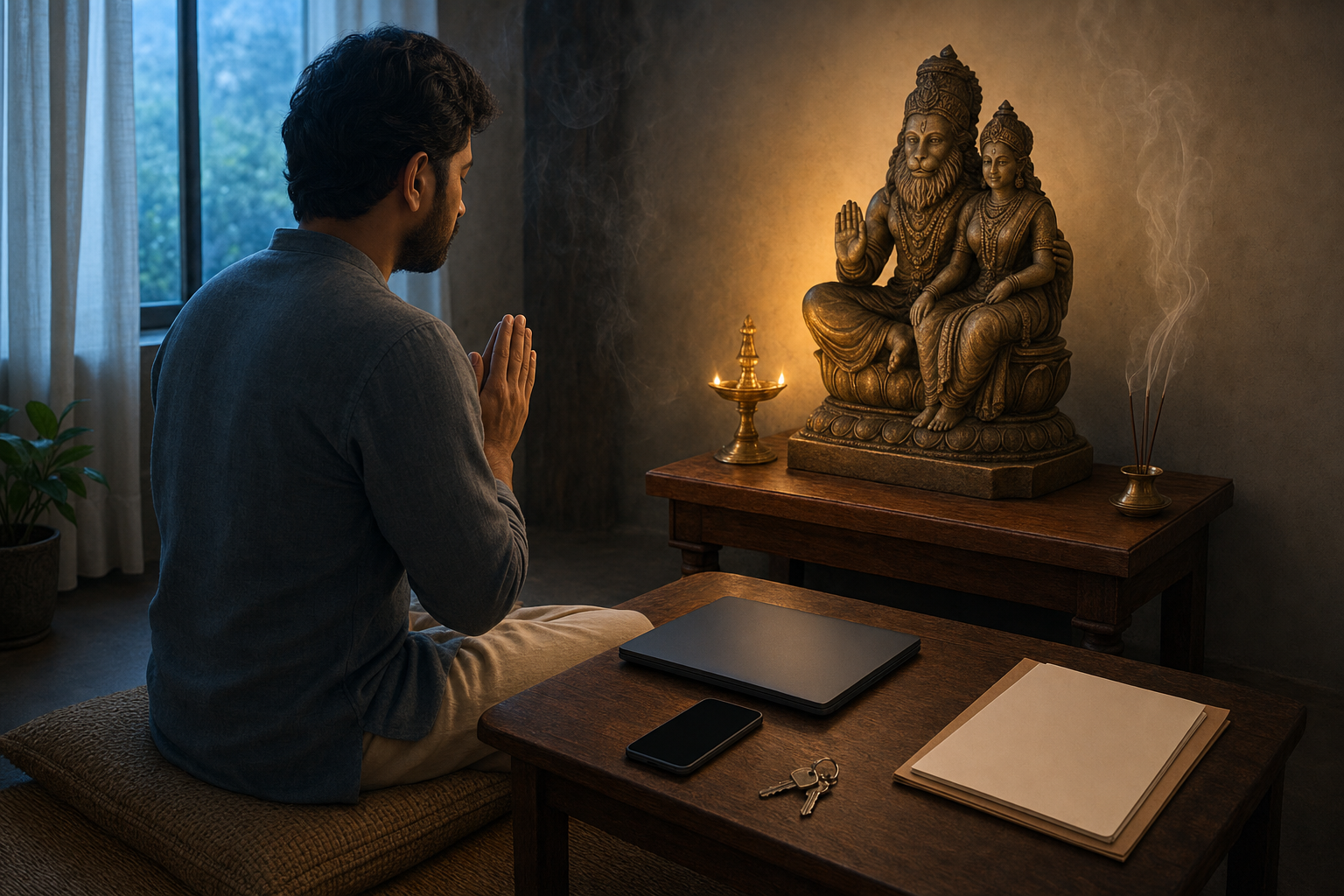
A devotional practice is especially useful in the interval between feeling anger and choosing a response. Its purpose is not to prove that your anger is righteous. It is to bring fierceness, discernment, and benevolence back into the same field of attention.
- Bring to mind Lakshmi-Narasimha seated after the defeat of tyranny. Notice the lion face and protective chakra, but also Lakshmi’s serene nearness, the open hand of Abhaya, and the boon-bestowing Varada.
- Let your breathing become steady enough that you can describe the situation without exaggeration. Do not suppress the signal carried by anger; separate that signal from the urge to punish.
- Recite “Om Nrisimhaya Namah” or the plea “Lakshmi Nrisimha mam dehi karavalambam”. Hear it as a request for a rescuing hand, not as a magical weapon against someone you dislike.
- Ask two paired questions: “What must be protected now?” and “What must be able to flourish afterward?” If you can answer only the first, your plan may be too punitive. If you can answer only the second, it may be too weak to stop the harm.
- Write down one bounded protective act and one restorative act. The first addresses the violation. The second prevents the conflict from becoming your permanent emotional home.
You can add Lankini’s question when loyalty is involved: “Am I guarding dharma, or only the person who currently occupies the citadel?” Then name the evidence that would make you revise your judgment. A conclusion that cannot be corrected by any evidence is not discernment; it is attachment wearing sacred language.
The Pancharatra and Vaikhanasa traditions preserve Lakshmi-Narasimha as an auspiciously pacified form suited to worship. That ritual setting matters. The devotee does not contemplate endless combat, but power cooled and ordered through Sri. If a conflict involves abuse, immediate danger, legal rights, or serious psychological distress, use appropriate qualified help as well. Contemplation can steady moral attention, but it cannot replace protection, due process, or professional care.
Questions readers often ask
Does reverence for a fierce deity justify aggression?
No. Narasimha’s fierceness is directed against a defined tyranny and culminates in protection, refuge, and peace. The form supplies a moral pattern – purpose, limit, and restoration – rather than a personal license to attack opponents. Human beings remain accountable to facts, proportion, law, and the welfare of those affected.
Does Lakshmi’s presence guarantee financial success?
No. Sri includes prosperity, but she cannot be reduced to accumulated money. Lakshmi-Narasimha joins flourishing to protective order, while Lankalakshmi shows fortune withdrawing its allegiance from an adharmic polity despite Lanka’s outward splendor. Material success may be useful, but it is not a self-authenticating sign of divine approval.
When has a protective response done enough?
It has done enough when the defined violation has stopped, the protected person or principle is secure, and continued force would serve retaliation rather than safety. That is the point to shift from interruption to repair. The Abhaya hand gives you the practical measure: protection should reduce rightful fear, not keep everyone permanently afraid of the protector.
Was Lankini wrong to stop defending Lanka?
Her office was deeper than obedience to Ravana. Once she recognized the prophesied sign and the dharmic purpose of Hanuman’s entry, permitting passage fulfilled guardianship more truthfully than continued resistance would have. Loyalty to a sacred trust can require refusing the authority that has corrupted it.
At the next difficult threshold, do not ask only whether you are strong enough to win. Write down what you are protecting, what would make you stop, and what act will restore Sri when the danger passes. Fierce protection becomes dharmic when those three answers remain bound together.
References
- DharmaRenaissance Blog – Lakshmi on Narasimha’s Lap: Fierce Grace, Fearless Protection, and the Devotee’s Ascent
- DharmaRenaissance Blog – Unveiling Lankini (Lankalakshmi): Lanka’s Fierce Guardian – Iconography, Myth, and Spiritual Power
