

You may already know what matters to you, yet your calendar tells a different story. Important work stays vague, urgent work multiplies, and attention is consumed before you decide where it should go. The difficulty is often not a lack of purpose. It is the missing bridge between purpose and the next action.
A Dharmic life does not demand maximum output at any cost. It asks you to choose a worthy aim, work with full attention, reject corrupt means, and loosen your claim on the reward. That is how the purpose of human birth becomes visible in ordinary duties, and how disciplined completion becomes sadhana rather than mere busyness.
Choose a goal that Dharma can defend
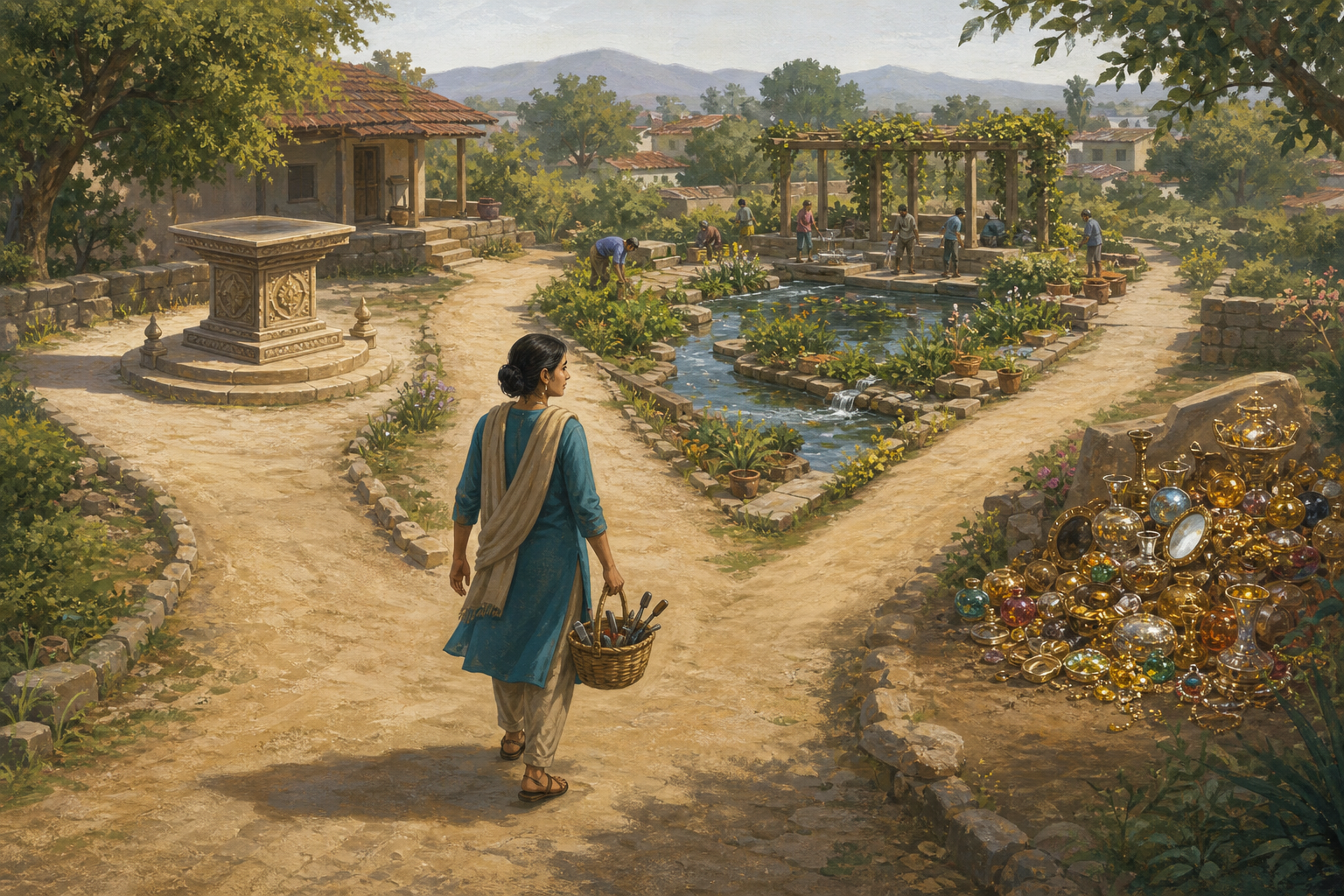
Productivity asks how quickly something can be done. Dharma first asks whether it should be done, why it should be done, and what you must refuse to do while pursuing it. If you skip those questions, discipline can make you more efficient at serving vanity, resentment, greed, or somebody else’s agenda.
The Purusharthas offer a practical order for making that decision. Dharma guides Artha and Kama, while Moksha supplies the horizon of inner freedom. Earning, building, enjoying, competing, and achieving are not rejected. They are placed under ethical governance so that worldly success does not become another form of bondage.
Run an important goal through four gates before committing your time to it:
- Duty: Which real responsibility does this goal fulfill? Name the person, relationship, institution, craft, or community that will be better served.
- Means: Can you pursue it truthfully, fairly, and without avoidable harm? If the plan depends on deception or exploitation, a desirable result does not purify it.
- Freedom: Will the pursuit train steadiness and discernment, or deepen compulsion, comparison, and fear? An ambition that owns your identity is already charging too high a price.
- Contribution: What will exist when the work is finished? Look for a completed duty, a useful skill, a repaired relationship, a reliable service, or knowledge that can be shared. This is the practical spirit of loka-sangraha, holding the world together through responsible action.
Then write a sankalpa that can govern a real day: “I will finish [observable result] by [real boundary] because it serves [duty, person, or value]. I will not cross [ethical line] to obtain it.” If you cannot complete those four blanks, the aim is not ready for disciplined pursuit.
Notice the difference between an aspiration and a finish line. “Advance my career” is an aspiration. Completing an accurate application that represents your skills without exaggeration is a finish line. “Become spiritual” is an aspiration. Beginning the day with your chosen remembrance and then completing a neglected duty is a finish line. Purpose becomes credible when another person could identify what reached completion.
A goal that fails the Dharmic test should be changed, even if you have already invested effort in it. Perseverance belongs to conscience before it belongs to a project. Stopping an adharmic course is not weakness; it is awakened discrimination.
Build your day around one completed loop

The Katha Upanishad 1.3.14 calls the seeker to rise, awaken, approach the wise, and learn. Swami Vivekananda gave that counsel modern force by emphasizing sustained movement toward the goal. As a daily discipline, the sequence becomes initiation, lucid attention, and completion.
Use the following protocol for study, professional work, household duty, community service, or spiritual practice:
- Define one result that will be complete. Write “draft and check the first section,” not “work on the report.” Write “solve and verify the assigned problems,” not “study mathematics.” The verb must produce evidence of completion.
- Name the first visible action. Open the required page, place the materials on the desk, create the file, or make the necessary call. Procrastination feeds on an undefined beginning; a physical first move leaves less room for negotiation.
- Protect one focus interval. A practical structure is 25 to 50 minutes of monotasking followed by a 5 to 10 minute mindful break. Choose the duration that lets you return steadily rather than proving how long you can endure.
- Limit work in progress. Keep no more than two active tasks. Everything else belongs on a waiting list. This forces you to finish or consciously suspend something before adding another open loop.
- Attach the start to a dependable cue. For example: when your morning drink is put down, the document opens and the first heading is written. The cue should trigger behavior, not another decision about whether you feel ready.
- Close deliberately. Check the work, name or file the output, record it in a short Done log, and write the next action if more remains. “Done” should mean that the result is usable, submitted, stored, communicated, or otherwise placed where it belongs.
Design the environment before testing your willpower. Silence the phone and place it beyond reach. Keep one book, file, or browser tab in front of you. Lay out the materials before the focus period begins. If online access is unnecessary, disconnect for the interval. These small barriers reclaim the attentional sovereignty that Dharmic practice requires in a distraction-heavy environment.
Do not make the sankalpa grand merely to make it feel spiritual. It should be small enough to complete and substantial enough to matter. Clearing trivial items while avoiding the difficult duty is still avoidance. Ask whether today’s finish line creates a useful result or merely produces the sensation of being occupied.
Interruptions will still occur. When one arrives, decide explicitly whether it is urgent enough to replace the present commitment. If it is, rewrite the finish line. If it is not, record it and return. The damaging habit is not changing a plan; it is allowing every new demand to change it without a conscious decision.
Work intensely without making the result your identity

Nishkama karma is sometimes misread as indifference to quality or outcome. Karma Yoga asks for the opposite: careful action without the demand that reality reward you exactly as expected. Bhagavad Gita 2.47-2.50 joins disciplined work to equanimity. The result matters, but it cannot become the sole measure of your worth or the excuse for compromised conduct.
Before beginning, divide the situation into two lines. Under “Mine,” write the actions you can govern: preparation, truthfulness, concentration, revision, communication, and follow-through. Under “Not mine alone,” write the variables that depend on others or on conditions beyond you: approval, applause, market response, another person’s decision, and exact timing.
This division changes how you respond to success and failure. You still study why the result occurred. You correct weak preparation, seek instruction, and change a faulty method. You do not pretend that effort guarantees a preferred outcome, and you do not use uncertainty as an excuse for passivity.
The Hindu analysis of karma makes the same distinction at a larger scale. Sanchita names accumulated potential, prarabdha the momentum presently unfolding, and agami the causes being created now. Whatever conditions have arrived, your present intention and conduct are still setting something in motion. That rejects both total control and fatalism.
Review a completed task in three stages. First, inspect intention: was the aim worthy? Second, inspect method: were attention, truthfulness, competence, and restraint present? Third, inspect consequence: what happened, what can be repaired, and what should change in the next attempt? This converts disappointment into instruction without turning every setback into a judgment on the self.
Detachment also allows intelligent course correction. Continuing after the facts, ethical boundaries, or genuine purpose have changed is not spiritual grit. Fidelity to Dharma may require reformulating the goal, seeking wise counsel, or ending the project. “Stop not” applies to the worthy purpose, not to every plan you happened to make.
Sustainable rhythm is part of the method. Yoga Sutra 1.14 grounds practice in long, continuous, respectful cultivation, while Bhagavad Gita 6.17 places nourishment, rest, activity, and recreation within disciplined living. A routine that repeatedly sacrifices basic duties, relationships, nourishment, or rest has failed its own Dharmic test. Stamina is built through return, not through occasional punishment.
Use one path deeply while honoring the shared grammar

Hinduism, Buddhism, Jainism, and Sikhism should not be flattened into one metaphysics. Their accounts of self, liberation, karma, and ultimate reality retain real distinctions. Yet each gives you a disciplined way to test whether spiritual purpose is changing conduct rather than decorating it.
| Tradition | Discipline for action | A question to ask today |
|---|---|---|
| Hindu traditions | Dharma, Karma Yoga, abhyasa, vairagya, bhakti, and jnana | Am I performing the duty well without turning its fruit into my identity? |
| Buddhism | Sila, samadhi, and prajna within the Noble Eightfold Path | Does this action reduce harm, heedlessness, craving, aversion, and confusion? |
| Jainism | Right vision, right knowledge, right conduct, ahimsa, aparigraha, and anekantavada | Am I causing avoidable harm, grasping at more than I need, or treating my partial view as the whole truth? |
| Sikhism | Naam Japo, Kirat Karo, Vand Chhako, seva, and sarbat da bhala | Does my day join remembrance, honest work, generous sharing, and concern for all? |
Choose the vocabulary and principal practice that belong to your actual tradition, temperament, and instruction. Do not collect sacred terms as a substitute for repetition. A modest practice performed faithfully will shape attention more deeply than a crowded routine that changes whenever novelty fades.
The shared daily architecture is simple. Begin with remembrance and a clear intention. Carry an ethical restraint into your work. Return attention when it wanders. Complete an honest duty. End with reflection, gratitude, service, or sharing. Support the cycle through svadhyaya and a real community of practice, whether you call it satsanga or sangha. Plurality of valid methods does not remove the need for disciplined continuity.
This is also where purpose expands beyond private self-improvement. Meditation that never improves speech, devotion that never touches duty, and activism that never examines anger have become disconnected from their ethical test. Inner practice and service correct each other: contemplation exposes your motives, while responsibility reveals whether the insight survives contact with other people.
Key takeaways for your next work cycle
- Put the goal under Dharma before putting it on a schedule. A harmful end or corrupt method is not redeemed by persistence.
- Translate purpose into one observable completion. If you cannot define what “done” looks like, you cannot direct attention toward it.
- Engineer the beginning. Specify the first physical action, remove distractions, and attach the start to a dependable cue.
- Give full effort to what you can govern, while refusing to make approval, applause, or another person’s decision the measure of your worth.
- Use a steady rhythm of work, rest, study, remembrance, community, and service. Discipline should make duty more reliable, not make the rest of life collapse.
- Measure progress through everyday character: less reactivity and grasping, more truthfulness, patience, compassion, equanimity, and completed responsibility.
Do not judge the practice by a dramatic meditation, a burst of motivation, or one unusually productive day. The more useful signs are qualitative and repeatable: sattva increasingly guiding energy and inertia, greater equanimity in gain and loss, reduced craving and aversion, and a wider field of patience and empathy. The test is the reliability of ordinary goodness.
At the end of a work cycle, ask whether you finished what you deliberately named, whether the means remained truthful and non-harming, whether the result served someone beyond your ego, and whether you can release the outcome cleanly. Where the answer is no, change the environment or the method before making a harsher promise. Abhyasa means returning intelligently.
Your next move can be made today. Choose one honorable completion. Write why it matters and the line you will not cross. Remove the most obvious distraction, finish the first visible action, and return until the loop is closed. Then offer the result, record what you learned, and let tomorrow’s sankalpa begin from truth rather than fantasy.
References
- DharmaRenaissance Blog – Manava Janma Uddeshya: A Transformative Dharmic Guide to the Purpose of Human Life
- DharmaRenaissance Blog – Arise, Awake: Swami Vivekananda’s Call to Relentless Focus, Dharmic Grit, and Goal Mastery
