

You may study the Bhagavad Gita carefully yet feel that your prayer lacks warmth. You may love kirtana and puja yet wonder whether emotion alone can carry you through a difficult decision. Or you may be told to surrender when what you actually need is to know what surrender requires of you.
You do not have to choose between knowledge, devotion, and surrender. Each addresses a different weakness in practice. Knowledge clarifies what is true and dharmic. Devotion keeps the heart and attention turned toward the Divine. Surrender releases the demand that reality obey your preferences. The practical task is to give each its proper place.
The three practices solve different spiritual problems
Jnana is not the accumulation of religious information. It is disciplined discernment: learning to distinguish the enduring from the transient, dharma from rationalization, and the Self from the identities to which ahankara clings. It corrects confusion.
Bhakti is not a passing devotional mood. It is the repeated orientation of thought, affection, speech, and action toward Ishvara. It corrects indifference and distraction. A person may understand a teaching and still fail to live it because the mind loves something else more intensely. Devotion gives knowledge emotional force.
Sharanagati, or prapatti, is the entrustment of oneself to the Divine. It corrects the ego’s claim to complete authorship and control. It does not mean abandoning judgement, duty, or effort. It means acting conscientiously without treating the desired result as a personal possession.
The Bhagavad Gita therefore presents a graded movement from absorption to practice, disciplined action, and relinquishment of the fruits of action. This is not a ranking of superior and inferior people. It is a diagnostic sequence. When direct absorption is not stable, you practise. When the mind still wanders, you dedicate action. When anxiety fastens onto the result, you offer the fruit.
The relation among these disciplines is understood differently across Hindu sampradayas. Advaita Vedanta treats devotion to Ishvara as a purifying discipline that matures into Self-knowledge, with knowledge and surrender ultimately converging in nondual clarity. Vishishtadvaita preserves the asymmetry between the finite self and the infinite Lord and gives prapatti a central place as reliance upon divine grace. Dvaita maintains the eternal distinction between devotee and Lord, so knowledge flowers as love, service, and dependence upon God. Shaiva, Shakta, Smarta, and Yoga traditions arrange the emphases in their own ways.
You need not erase those differences to build a coherent practice. If you belong to a sampradaya, let its understanding of the self, Ishvara, grace, mantra, and liberation provide the grammar. Borrowing an auxiliary practice can be fruitful; casually mixing incompatible conclusions usually creates confusion. The goal is integration, not a private system assembled from attractive fragments.
Key takeaways
- Use knowledge when you are unclear about truth, duty, or the meaning of a practice.
- Strengthen devotion when you understand the teaching but do not remember or love it enough to live by it.
- Practise surrender when you have acted responsibly but remain consumed by control, recognition, or fear of the result.
- Judge all three by their fruits: clearer conduct, steadier attention, less self-importance, and greater capacity to serve.
- Follow the doctrinal frame of your sampradaya rather than pretending that every Hindu school makes identical metaphysical claims.
Turn sacred study into knowledge that changes conduct

The most common failure of jnana-oriented practice is stopping at recognition. A sentence sounds profound, you agree with it, and the mind moves on unchanged. Real assimilation asks what the teaching exposes in your own perception and what you will do differently because of it.
A classical sequence moves through shravana, manana, and nididhyasana. Shravana is receptive encounter with the teaching. Manana tests and digests it through reasoned reflection. Nididhyasana is sustained contemplation until the truth is no longer merely an idea you can repeat.
You can apply that sequence to a short passage rather than racing through a large quantity of scripture:
- Read or hear one manageable passage. Use a trusted translation and a commentary rooted in the tradition you are following. Do not begin by collecting several interpretations that rest on incompatible assumptions.
- Restate the teaching in plain language. If you cannot explain it without repeating Sanskrit terms, you may recognize the vocabulary without yet grasping the claim.
- Name your resistance. Write the assumption that the teaching challenges. It may be the belief that success proves your worth, that discomfort always signals a wrong choice, or that spiritual knowledge entitles you to judge another person.
- Identify one consequence for conduct. Decide how the teaching changes a conversation, obligation, purchase, apology, or act of service already in front of you.
- Sit with the teaching without adding more material. When attention wanders, return to its central meaning. This is where an understood proposition begins to reorganize perception.
A simple notebook can keep this honest. Divide an entry into three lines: teaching, resistance, action. Under teaching, paraphrase the passage. Under resistance, record where your habits disagree with it. Under action, name the next observable response. This prevents svadhyaya from becoming a collection of quotations that never reaches speech, money, family life, or work.
Buddhi is functioning well when it makes you more exact and less arrogant. You become harder to manipulate because you can distinguish faith from credulity, but you also become less eager to dismiss what you have not understood. If study mainly supplies labels for other people’s supposed ignorance, ahankara has recruited the teaching.
Give devotion a form the mind can actually return to
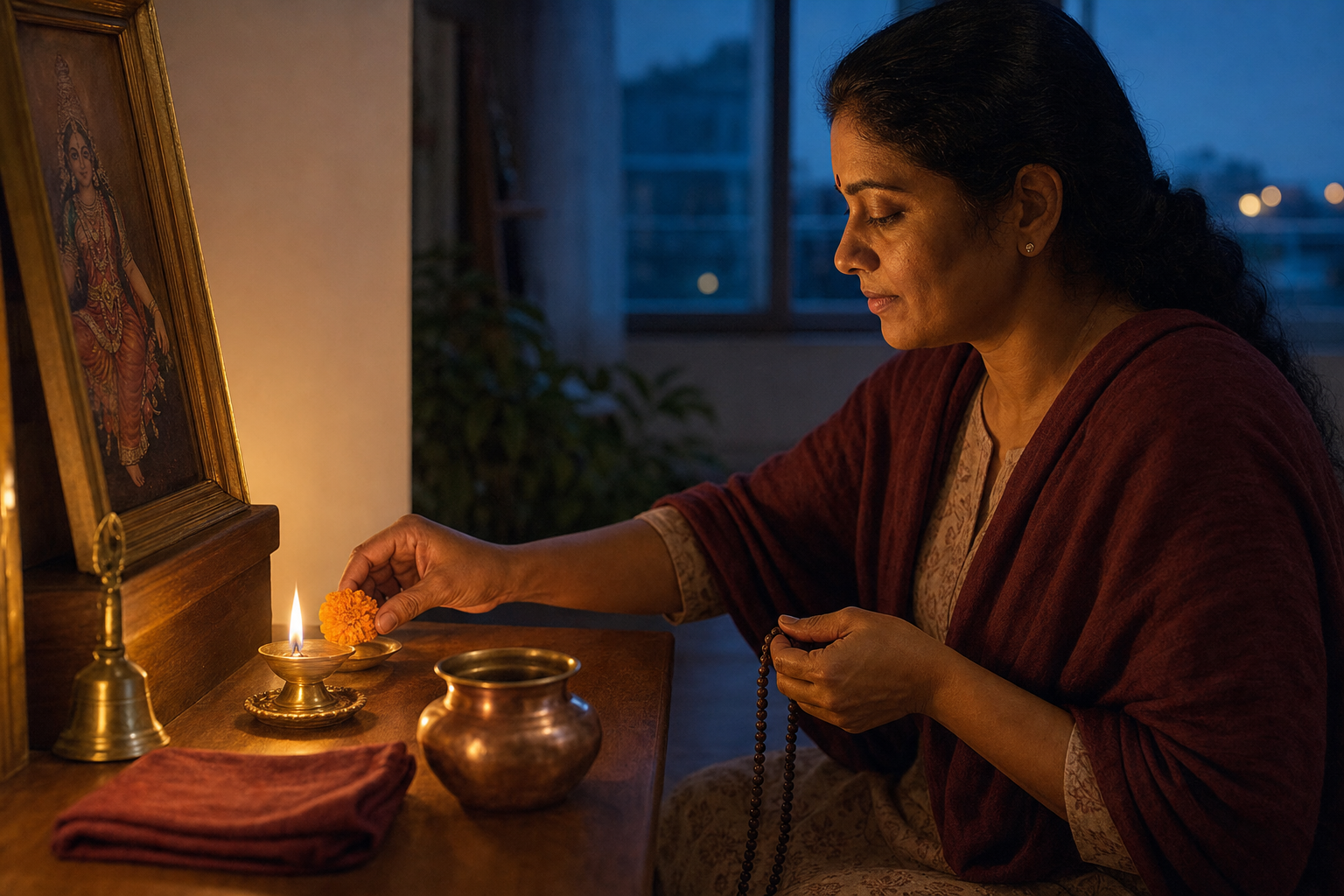
Devotion becomes stable through relationship and repetition. Choose an ishta-devata, divine name, mantra, stotra, or form of worship that your lineage authorizes and that you can approach consistently. The ishta principle gives the heart a definite centre without requiring contempt for another devotee’s chosen form.
You do not have to manufacture an intense emotion before beginning. The Bhagavata Purana’s nine modes of bhakti include listening, singing, remembrance, service at the divine feet, worship, salutation, servitude, friendship, and complete self-offering. If singing does not come naturally, listen or serve. If elaborate ritual is not available, remember the Name. If emotion feels inaccessible, begin with dependable action offered in a devotional spirit.
For japa or stotra, bring word, meaning, and intention together:
- Learn the basic meaning of what you recite.
- Pronounce it as carefully as your instruction and ability allow.
- Keep attention on the deity or truth invoked rather than on completing a quota.
- Pause after recitation so the mind can remain with the remembered presence.
- Carry that remembrance into the next ordinary task instead of treating worship and daily conduct as separate worlds.
Sri Sadasiva Brahmendra’s well-known refrains show how knowledge can be carried by devotion. Sarvam Brahma-mayam, Manasa sancharare Brahmani, and Pibare Rama-rasam can be approached as three linked instructions within an Advaita practice. See all as pervaded by Brahman. Return the wandering mind to Brahman. Let remembrance of Rama give that contemplation sweetness and intimacy. Philosophy supplies the vision; song trains attention to inhabit it.
The test of bhakti is not how dramatic you feel during worship. Look at what happens when you are interrupted, contradicted, or denied recognition. Devotion is maturing when remembrance makes speech gentler without making judgement weak, when seva produces less resentment, and when another person’s form of worship no longer threatens your own.
If recitation has become mechanical, do not automatically add more. Reduce the amount, recover the meaning, and give full attention to what remains. If devotion is emotionally intense but leaves your decisions impulsive, add svadhyaya and a deliberate review of dharma. If it produces sectarian pride, add anonymous service and examine who is seeking status through the sacred identity.
Practise surrender without turning it into passivity

Surrender is easiest to misunderstand when you are frightened. The desire for relief can disguise avoidance as faith. You may say that the result is in divine hands before doing the preparation, telling the truth, setting a boundary, making restitution, or completing the duty that is actually in your hands.
The Gita’s culmination in sharanagati does not cancel its sustained demand for disciplined action. Surrender changes the claim you make over action; it does not make adharma harmless or responsibility optional. You still use buddhi, consult rightful guidance, choose the dharmic course, and act with care. What you relinquish is the insistence that effort must purchase the outcome you prefer.
A traditional account of prapatti gives it six mutually supporting features:
- Anukulya-sankalpa: resolve to do what is favourable to divine alignment.
- Pratikulya-varjana: refuse what obstructs that alignment.
- Rakshishyatiti-vishvasa: trust in divine protection without dictating the form that protection must take.
- Goptritva-varana: consciously accept the Divine as guardian.
- Atma-nikshepa: offer the whole self rather than reserving ego’s preferred territory.
- Karpanya: recognize your dependence with humility, not self-contempt.
These features reveal why surrender requires intelligence. You must discern what is favourable and unfavourable. You must distinguish trust from a guarantee that no painful event will occur. You must offer the self without pretending that your capacities, relationships, and duties have ceased to matter.
Use this sequence when a decision has a real outcome attached to it:
- Name the duty. Ask what role and obligation are actually yours, not what would protect your image.
- Separate action from outcome. Preparation, honesty, effort, and correction may be yours. Another person’s response, public recognition, and the final result may not be.
- Test the proposed action against dharma. Surrender to a preference, charismatic personality, or group demand is not automatically surrender to the Divine.
- Pray before acting. Offer your intention and ask that self-interest not disguise itself as righteousness.
- Act completely. Do not perform a half-hearted effort and call the shortfall detachment.
- Offer the fruit. Receive success without self-deification and failure without treating yourself as spiritually abandoned.
- Review and correct. Offering the result does not prevent you from learning, apologizing, repairing harm, or improving the next action.
Pseudo-surrender can usually be recognized by the responsibilities it makes disappear. It excuses missed obligations, silences legitimate questions, or asks the vulnerable to tolerate adharma. Genuine surrender makes a person more available for dharmic action because less energy is spent defending status and controlling every response.
Build one daily rhythm instead of three competing routines

You do not need separate spiritual lives for jnana, bhakti, and sharanagati. Arrange one routine so that understanding leads into remembrance, remembrance informs action, and action ends in offering.
- At the beginning of the day: bow or offer a short prayer, read one passage, state its meaning in your own words, and perform your chosen japa or stotra with attention.
- Before ordinary work: make a sankalpa that names the quality required of you, such as truthfulness, patience, courage, or care. Dedicate the work rather than waiting for a formally religious activity.
- At transition points: remember the divine Name before opening a difficult message, entering a meeting, beginning a journey, serving a meal, or responding in conflict. These small returns train smarana under real conditions.
- At a difficult decision: identify the duty, consult the teaching, notice the ego’s preferred story, act on the clearest dharmic judgement available, and offer the result.
- At the end of the day: ask where knowledge affected conduct, where remembrance disappeared, and where attachment to an outcome took over. Choose one correction for the next day.
- In community: make room for satsanga, collective singing, scriptural study, or seva. Private practice reveals some tendencies; service and relationship expose others that solitude can conceal.
Adjust the balance according to the problem you can observe. If study has become dry, let the same teaching enter through song, puja, or the Name. If strong feeling is outrunning judgement, slow down and return to svadhyaya and counsel. If anxiety remains after responsible effort, practise a more explicit offering of the fruit. If surrender has made you passive, restore karma-yoga, deadlines, and accountability. If religious accomplishment is feeding pride, choose seva that offers little visibility.
Do not measure the routine by how elevated it feels on a good morning. Measure it at the point of friction. Can you remember the teaching before speaking harshly? Can you invoke the Name without using it to escape a decision? Can you accept an unwanted result and still make the next responsible effort? That is where the three disciplines begin to function as one sadhana.
Begin with the next ordinary responsibility. Take one teaching into it, remember one divine Name while doing it, and offer one result when it is complete. Keep returning to that sequence until knowledge guides what you love, devotion sustains what you know, and surrender frees you to act without being owned by the outcome.
References
- DharmaRenaissance Blog — Unveiling the Golden Wisdom of Sri Sadasiva Brahmendra: Advaita Quotes, Music, and Practice
- DharmaRenaissance Blog — Devotion Through Buddhi and Grace: Mastering Hindu Bhakti via Consciousness and Surrender
