
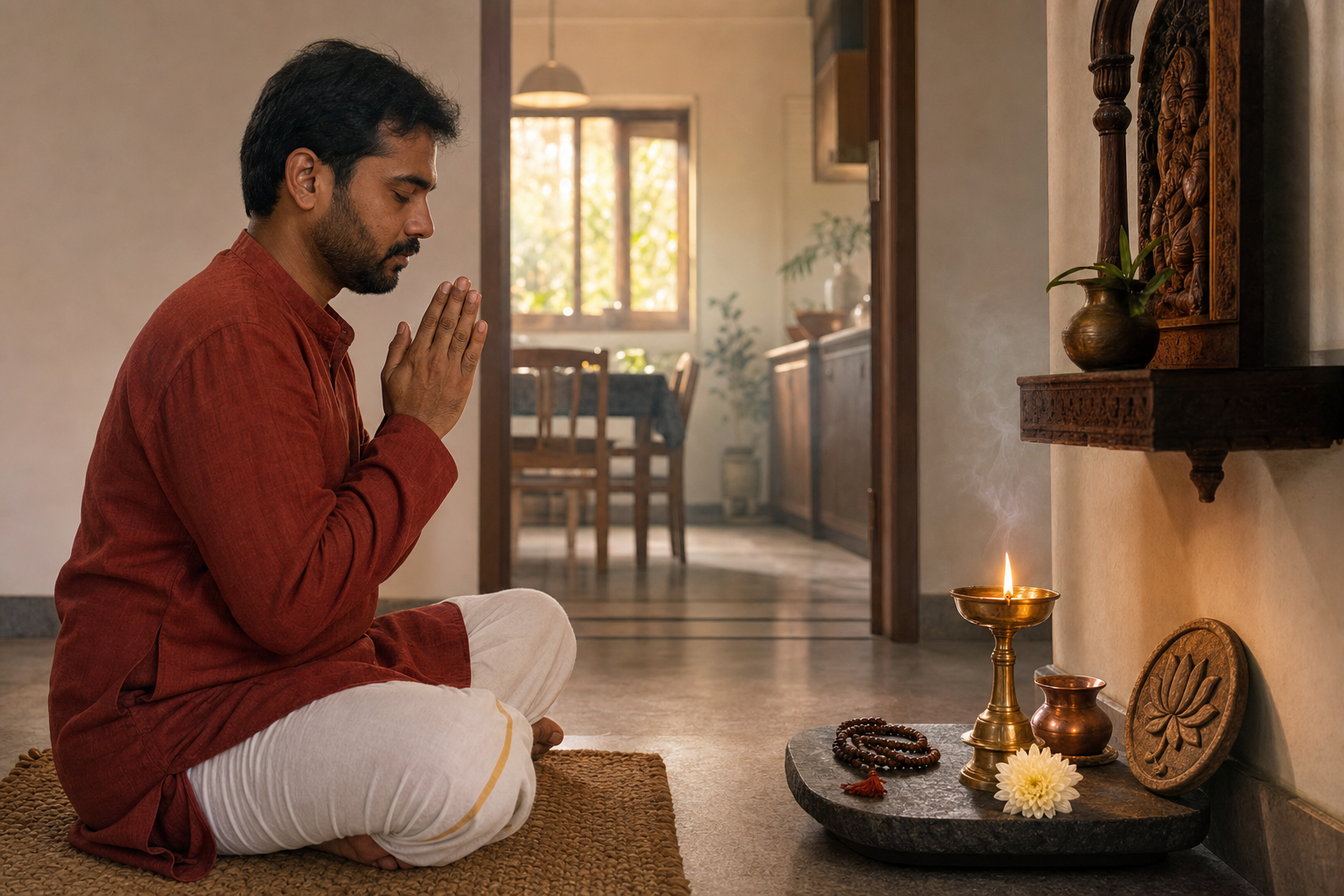
You finish pūjā, fold your hands, and realize that your mind was elsewhere for most of it. The lamp was lit, the mantra was recited, and every familiar gesture was performed. Yet the practice felt more like completing a duty than meeting the Divine. Should you add another mantra, find a more powerful image, or wait for devotional feeling to appear?
Before changing the form, change the test. Ritual gives devotion a repeatable structure. A sacred symbol gives attention a precise object. Bhāva gives the act a devotional relationship. Conduct reveals whether any of it entered you. When those parts remain connected, even a modest daily practice can become spiritually serious without becoming elaborate or dramatic.
Use the aftertaste, not intensity, as your test

Devotional experience is larger than emotion. It can appear as recollection that survives distraction, restraint at the moment of anger, tenderness toward another being, or the willingness to correct a wrong. Tears and exhilaration may occur, but their absence does not prove that your practice is empty. A quiet mind that becomes more truthful is a more dependable sign than a thrilling experience that leaves your habits untouched.
Gaudiya Vaishnava theology gives extraordinary bodily manifestations a precise but deliberately secondary place. The eight sāttvika-bhāvas include tears, trembling, horripilation, changes in the voice or complexion, stunned stillness, sweating, and fainting. They are understood as involuntary expressions of concentrated devotion, not techniques to imitate and not ranks on a spiritual scoreboard.
During a temple discourse, Srila Prabhupada once stopped speaking and entered an unusual stillness that quieted the whole assembly. He resumed without turning the moment into a performance. That combination matters: absorption arose on its own, while humility prevented it from becoming spectacle. The practical lesson is not that you should seek the same outward symptom. It is that authentic experience deepens remembrance, modesty, service, and attentiveness.
Other Dharmic paths maintain their own vocabularies and theological boundaries. Buddhist samādhi may be accompanied by pīti and sukha; Jain samayika trains steadiness and ethical self-observation; Sikh Nāam Simran can flower as anand. These should not be treated as interchangeable states. Their useful common warning is narrower: experience belongs inside discipline, ethics, and humility rather than above them.
Key takeaways
- Do not judge a ritual by whether it produces a powerful sensation. Ask whether it improves recollection, restraint, honesty, and care.
- When attention wanders, the meaningful act is returning it. That return is part of sādhana, not evidence that sādhana failed.
- Treat unusual tears, trembling, stillness, or bliss with humility. Do not manufacture them, advertise them, or demand them from yourself.
- Give every offering an ethical destination: a repair, a restraint, an act of generosity, or protection for someone vulnerable.
- If practice increases vanity, aggression, or contempt for another path, its devotional meaning has been displaced by ego.
Read a sacred symbol as a set of instructions
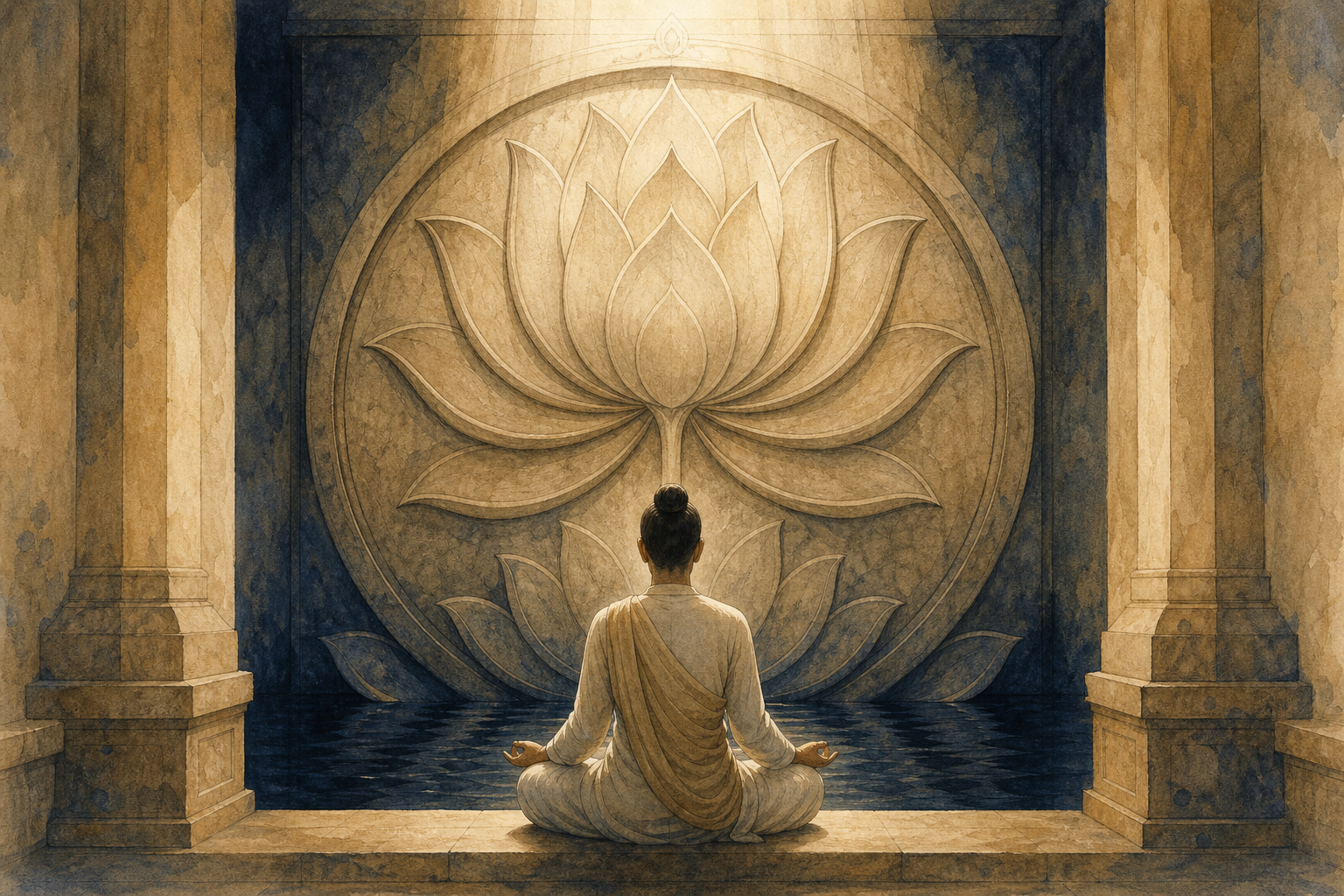
A sacred image is neither ordinary decoration nor a puzzle whose meanings must be memorized before worship can begin. It makes invisible principles available to sight, posture, memory, and relationship. You begin by recognizing whose form you are approaching within a particular lineage. You then ask what its features teach and what response those teachings require from you.
Panchavaktra Bhairava offers a particularly clear example. His five faces gather multiple directions and cosmic activities into one form. A practical household contemplation can approach Tatpuruṣa in the east as honest seeing, Vāmadeva in the north as steady care, Aghora in the south as courageous release, Sadyojāta in the west as reverence before mystery, and Īśāna above as silent grace. You do not need to contemplate every face during every sitting. Choose the teaching that addresses the dharmic demand immediately before you.
- If you are avoiding an uncomfortable truth, remain with the face of honest seeing and name the fact without excuse.
- If another person depends on you, contemplate steady care and identify the responsibility that must be completed.
- If resentment or attachment is keeping an old conflict alive, contemplate courageous release without pretending that injustice did not occur.
- If you are forcing certainty where you do not possess it, allow reverent unknowing to interrupt pride.
- If effort has become control, end with silent receptivity rather than adding more activity.
The attributes sharpen the same method. The triśūla penetrates ignorance; the ḍamaru evokes the rhythm of manifestation; the kapāla confronts mortality and transformation; the pāśa and aṅkuśa represent restraint and guidance; the sword and vajra express decisive clarity; and the bell awakens attention. Bhairava’s dog embodies loyalty, guardianship, and life at the threshold. Because details vary across Agamas and regional forms, use these meanings as contemplative guidance rather than as a rigid test of whether an image is correct.
To work with any symbol, look before you interpret. Notice one face, hand, object, posture, vehicle, sound, or direction. Name its traditional function as accurately as you can. Then translate that function into one behavior you can complete. A bell that awakens awareness may mean putting the phone away during a family conversation. A noose representing restraint may mean refusing to forward an inflammatory message. A guardian at the threshold may mean protecting the dignity of a person who is being excluded.
Fierce iconography requires a firm ethical boundary. It never licenses cruelty. Its weapons turn spiritual force against delusion, cowardice, harmful impulse, and adharma; its guardianship directs power toward protection. If contemplating a fierce form makes you more eager to humiliate an opponent, you have reversed the symbol’s purpose.
Inter-Dharmic comparison needs the same discipline. Mahākāla serves as a fierce protector in Vajrayāna Buddhism, some Jain sacred landscapes recognize Kṣetrapāla figures in local boundary practice, and Sikh cultivation of nirbhau gives fearlessness an ethical and devotional setting. These resonances can illuminate shared concerns with vigilance and courage, but they do not make the figures or doctrines identical. Learn a symbol within its own tradition first; compare functions only after preserving the identities on both sides.
Build a home ritual that can carry devotion
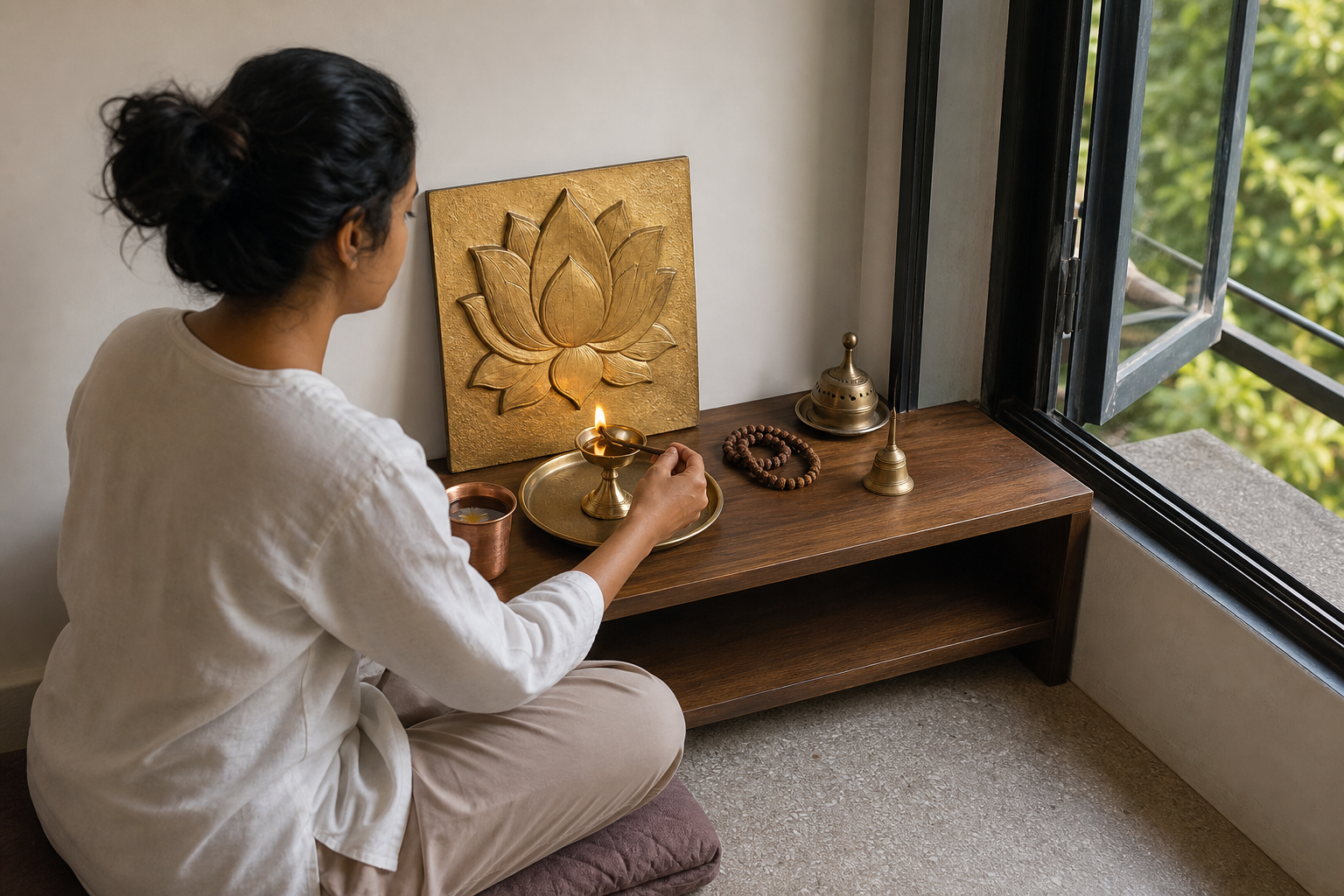
A sustainable home practice should be simple enough for you to remain present from beginning to end. Complexity is useful only when you understand what each added action contributes. The following sequence can be adapted to your iṣṭa-devatā, lineage, and household responsibilities without pretending that every Dharmic tradition uses the same liturgy.
- Prepare the threshold. Clean the worship surface, silence notifications, and place only what you will actually use. If you light a dīya, set it on a stable, nonflammable surface and do not leave it unattended. Water, a flower, fruit, or an unlit lamp can serve where flame is unsafe.
- State a concrete saṅkalpa. Do not settle for a vague wish to be spiritual. Name a quality and its setting: patience during a difficult conversation, truthfulness in a decision, steadiness in caregiving, or courage to make amends.
- Establish relationship. Look at the sacred form, invoke the Divine through a name or prayer recognized in your practice, and remember why you have come. If you do not understand a mantra, learn its setting and meaning instead of assuming that sound alone excuses inattention.
- Bring body, speech, and mind together. Dharmic ritual can operate as kāyika, vācika, and mānasika practice: bodily action, spoken recitation, and mental participation. Let posture support attention, let the voice be audible enough to follow, and keep returning the mind to the meaning.
- Offer rather than display. Bhagavad Gita 9.26 deliberately names modest offerings – a leaf, flower, fruit, or water – to show that devotion is not measured by expense. Present what is clean, appropriate, and honestly available. Let the gesture include relinquishing possessiveness, not merely moving an object.
- Leave room for silence. After recitation, remain still long enough to notice what the ritual has brought into awareness. Do not search your body for signs of ecstasy. If a neglected duty or concealed resentment appears, receive that recognition as material for practice.
- Complete the offering in conduct. Dedicate the benefit beyond yourself and choose a corresponding act. Bhairava devotion can extend into feeding and caring responsibly for dogs. Other fitting expressions include dāna, preparing food for others, participating in langar, repairing a relationship, or quietly protecting someone at risk.
This sequence works on more than one level. Repeated posture and gesture give the body reliable cues for attention. Rhythmic japa joined to smooth, unforced breathing can support calm and concentration. Dawn and dusk provide natural transitions at which remembrance can interrupt automatic behavior. A dusk dīya, quiet japa, or explained family pūjā can therefore join sensory attention, contemplative meaning, and cultural transmission without requiring a large ceremony.
Community practice adds synchrony. Kīrtan, congregational worship, and shared service coordinate attention and reinforce belonging. When a teacher or devotee enters unmistakable deep absorption, protect the moment instead of converting it into content: become quiet, steady your own breath, continue mental remembrance, and avoid crowding or unnecessary documentation. Reverence is something the assembly does, not merely something it feels.
Troubleshoot what makes a practice go hollow
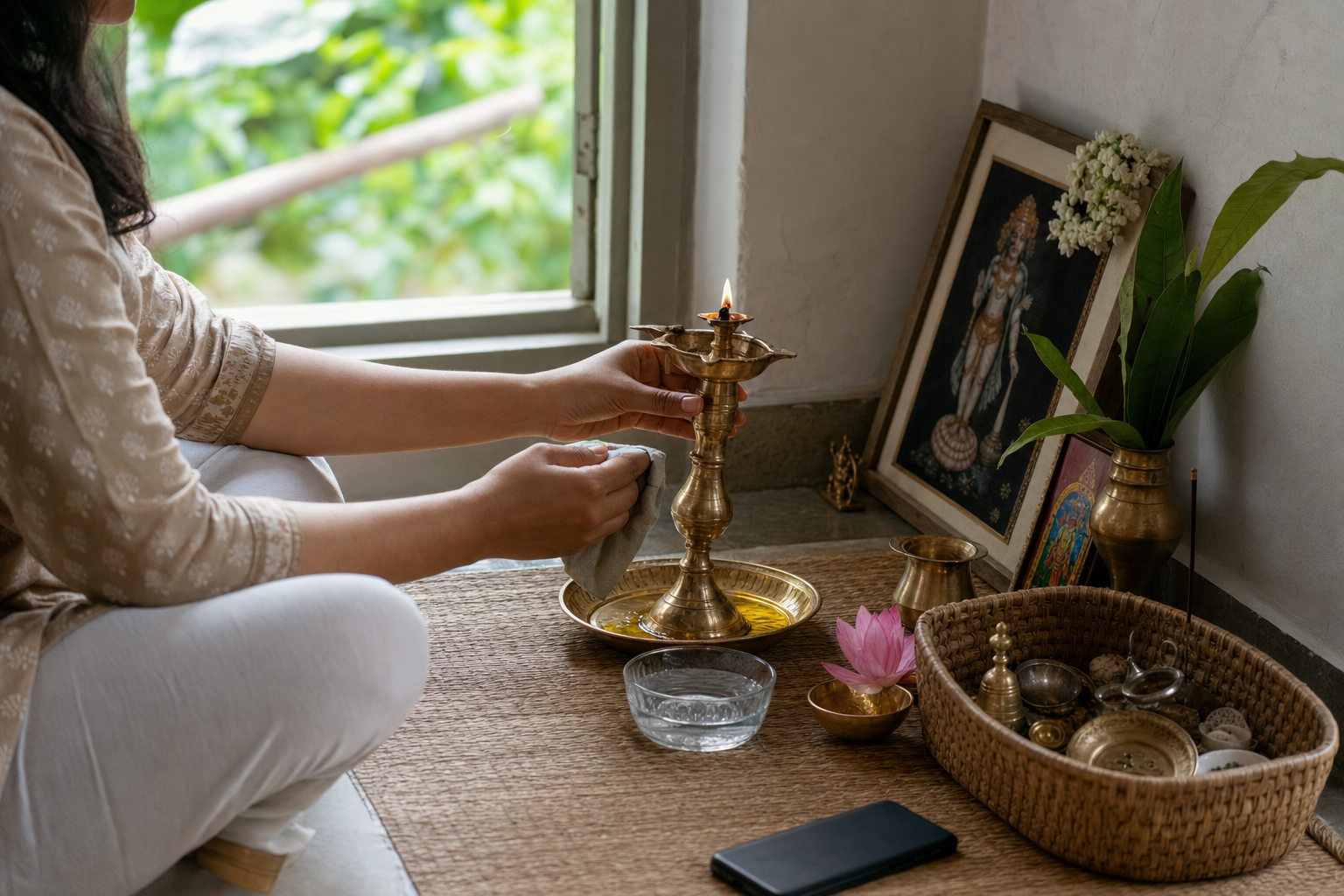
You keep adding steps because the old ones feel dull
More procedure often gives a distracted mind more places to hide. Remove any optional step whose meaning you cannot explain. Keep a clear opening, one central act of remembrance or offering, a period of stillness, and a closing dedication. Study one retained gesture before expanding the sequence again. Fewer actions performed with attention are more useful than a crowded rite conducted on autopilot.
You feel nothing and assume the Divine is absent
Stop using mood as the only instrument of measurement. Notice whether you returned attention when it wandered, remembered the mantra later in the day, or paused before a harmful reaction. Devotion may initially become visible as fidelity rather than sweetness. Continue the form consistently enough to observe its effect on conduct, but change an obviously confusing or unsustainable arrangement instead of defending it merely because it is familiar.
Devotional feeling has become public proof of status
Once emotion becomes evidence that one devotee is higher than another, performance can replace surrender. Conceal more of your practice. Give anonymously. Accept ordinary service that brings no recognition. If tears or stillness arise, let them pass without staging, photographing, exaggerating, or using them to claim authority. Steady sevā and humility remain safer measures than a memorable display.
Fierce or esoteric practice is tempting you to improvise
Do not copy advanced Tantric procedures, transgressive offerings, nyāsa sequences, or restricted mantras simply because instructions circulate publicly. Such practices depend on initiation, context, competence, and guidance. Household Bhairava worship can remain grounded in ethical intention, disciplined behavior, water, flowers, black sesame, sweets, lamps, and established recitations. Complexity is not evidence of authenticity, and danger is not evidence of spiritual power.
The shrine is clean, but the ritual harms its surroundings
Śauca cannot stop at the edge of the altar. Avoid plastic offerings and materials that produce needless waste. Use fire with care, keep sound at a level that respects neighbors, and consider animals and local ecology when disposing of flowers or food. Choose biodegradable materials and responsible disposal rather than treating immersion or abandonment as automatically sacred. A rite invoking ahiṁsā while creating preventable harm contradicts itself.
End each practice with a direct question: what did this ask me to become, and what will I do before the day closes? Tonight, keep the rite you already know, choose one symbol within it, make your saṅkalpa concrete, and carry its meaning into one act of service or repair. Let conduct decide when the practice is ready to grow more elaborate.
References
- DharmaRenaissance Blog – Panchavaktra Bhairava Decoded: Five Faces of Fierce Compassion, Iconography, Mantra, Rituals
- Dandavats – A Temple Room Stilled: Srila Prabhupada’s Ecstatic Symptoms, Scripture, Science, and Practice
- Dandavats – Beyond Empty Envelopes: The Inner Science and Living Purpose of Vedic and Dharmic Rituals
