
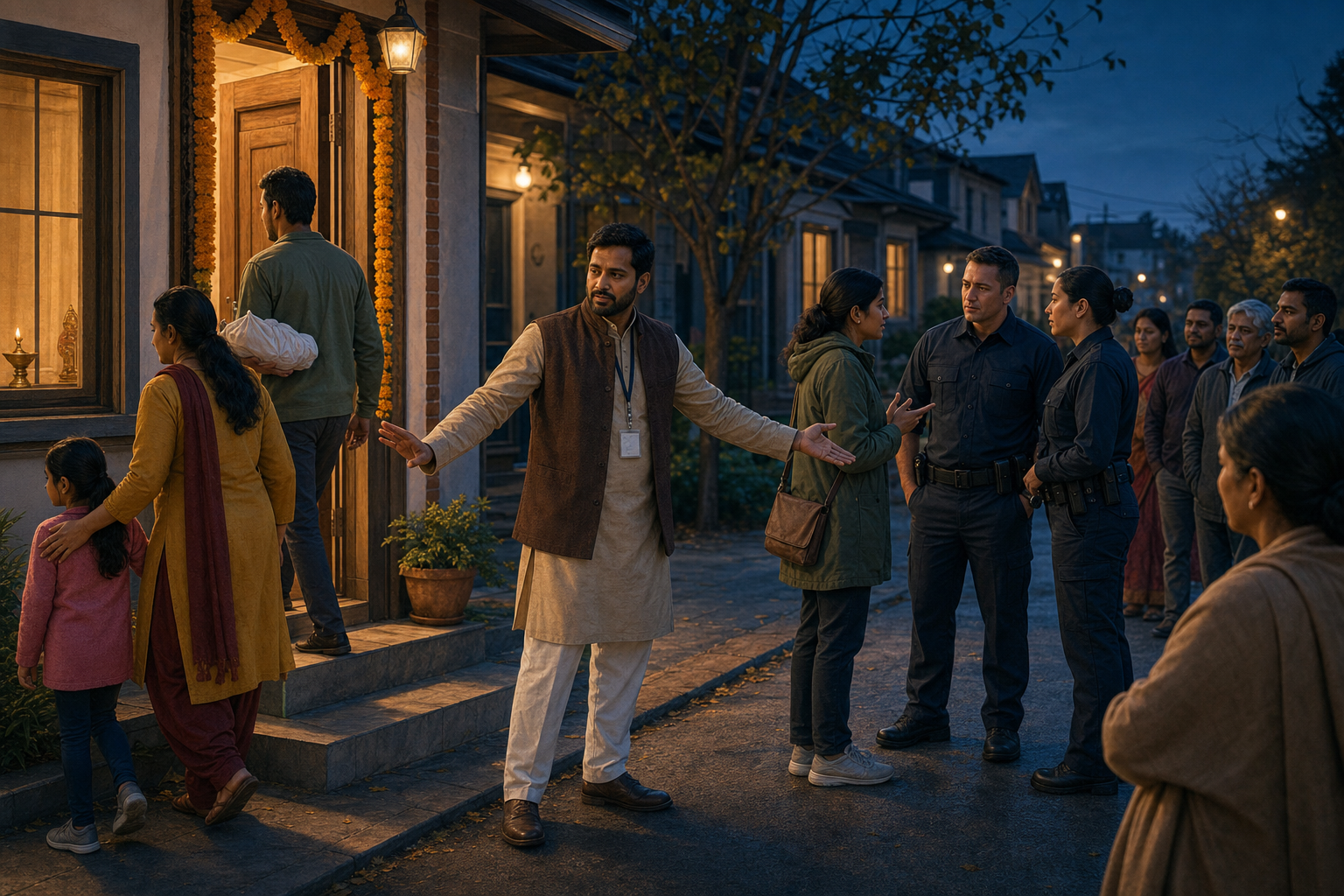
A troubling message lands in your neighbourhood group: there has been an assault, a threat, or an objection involving a sacred symbol. Within minutes, identities are being named, motives are being declared, and people are being urged to gather. You may need to protect your family, support a victim, preserve evidence, and speak to police at the same time.
The right response is neither passive nor inflammatory. It is disciplined: stop immediate harm, distinguish facts from claims, give police a usable record, protect Hindu and other Dharmic religious rights, and leave the neighbourhood with a settlement it can actually uphold. Social cohesion does not require silence in the face of wrongdoing. It requires a form of strength that makes lawful accountability more likely.
Key takeaways
- Treat violence, a credible threat, a non-violent religious-space dispute, and an online rumour as different problems. They require different first responses.
- Protect life before protecting the narrative. Arrange medical help, move vulnerable people away, contact police, and do not summon a counter-crowd.
- Record what happened in three columns: verified facts, attributed allegations, and unanswered questions. Never promote an allegation into a fact because it fits a familiar pattern.
- Ask police for a specific outcome: emergency protection, registration of a complaint, preservation of evidence, separation of opposing groups, or a time-bound mediation.
- Do not confuse communal harmony with impunity. A negotiated placement dispute may end through voluntary relocation; violence and intimidation still require evidence-led legal action.
- After calm returns, document the agreement, assign responsibility for follow-up, and create a standing local protocol before the next festival or dispute.
Triage the danger before you name the conflict
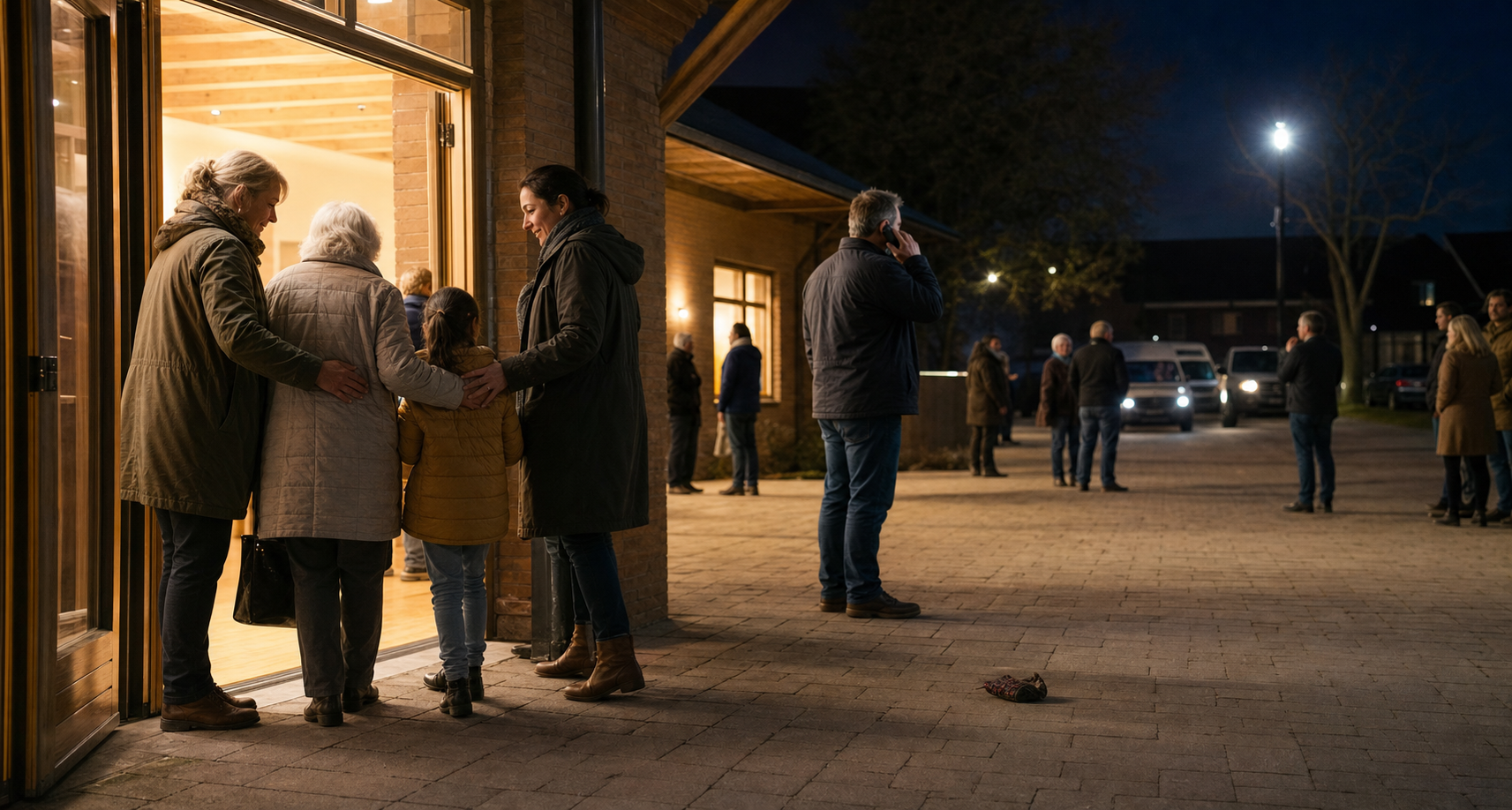
Your first task is classification, not commentary. Ask what is happening now, who is exposed to harm, and which intervention can reduce that harm without destroying evidence or escalating the crowd.
| What you can verify | Your first move | What to avoid |
|---|---|---|
| Violence is occurring or someone is injured | Move people to safety, seek medical help, contact police, and preserve the scene | Counter-mobilisation, retaliation, touching a weapon, or circulating graphic images |
| A specific and credible threat has been made | Save the original message, record its context, alert the threatened person, and report it | Replying with threats, publicly exposing a home address, or arranging a confrontation |
| The dispute concerns a wall, flag, procession route, loudspeaker, or sacred image | Prevent crowd formation and request a neutral, police-facilitated discussion | Damaging, covering, or removing another person’s property without consent |
| Only an online claim is circulating | Locate the earliest available claim and check for a police statement or direct evidence | Adding communal labels, forwarding names of minors, or treating silence as confirmation |
If someone is injured, assistance comes first. Bystanders should not let fear of procedural inconvenience prevent them from helping an injured person reach medical care; Good Samaritan protections support prompt assistance. Keep the route clear, nominate one person to communicate with police, and ask spectators to step back. A crowd gathered in sympathy can still obstruct an ambulance, contaminate a scene, frighten witnesses, or produce a second confrontation.
Next, separate the act from the motive. When a student is allegedly lured to a meeting and fatally attacked over an older dispute, arrests and an open investigation justify evidence-led vigilance, but the festival date or identities of the accused do not by themselves establish a communal motive. Motive may eventually be proved through messages, prior threats, witness testimony, planning, or other evidence. Until then, say what is known and identify what remains unproved.
This restraint is not indifference to anti-Hindu violence. It protects the credibility of a genuine complaint. An exaggerated claim gives opponents an easy way to dismiss verified harm, while a precise account keeps attention on the victim, the evidence, and the conduct that must be answered.
Give police a clean record and a workable request

Police cannot act efficiently on a neighbourhood argument presented as a stream of forwarded messages. Give them a compact incident record. It should distinguish direct observation from information received from someone else.
- Write the date, place, sequence of events, and the time at which each major development occurred.
- Record exact threatening words where they matter. Do not improve, translate loosely, or intensify them.
- List injuries and property damage without speculating about their legal classification.
- Keep the names and contact details of willing witnesses separately from any public statement.
- Preserve original photographs, videos, voice notes, and messages. Keep an unedited copy and note who supplied it.
- Identify nearby CCTV systems quickly so the lawful custodian and police can preserve relevant footage before routine overwriting.
- Record the complaint or acknowledgement number, the officer contacted, and any promised next step.
Do not publish the evidence packet to prove that you possess it. Public circulation can expose witnesses, reveal investigative details, spread the identity of a minor, or strip a recording of the context needed to assess it. Share copies through the lawful channel while retaining the originals securely.
Ask for the intervention the situation requires
A vague demand to do something invites a vague answer. State the immediate risk and make a bounded request. For an active threat, ask for protection and separation of the groups. For an alleged offence, ask how the complaint will be formally recorded and how evidence should be supplied. For a dispute over shared space, ask for a neutral venue, one representative from each side, a clear agenda, and a written outcome.
Mediation works best when it gives every participant a face-saving path without hiding the substance of the disagreement. Police or another neutral facilitator should hear the parties separately if a joint meeting would become performative. The final note should state each side’s position, the agreed action, who will carry it out, and when follow-up will occur. It should not declare that a coerced concession was voluntary.
Keep the civil-dispute and criminal-accountability tracks distinct. An informal settlement can resolve placement, access, maintenance, or procession logistics. It cannot safely substitute for investigation of an assault, weapon use, serious intimidation, or destruction of property. Do not sign an unread statement, promise to suppress evidence, or waive legal options under crowd pressure. If arrest, serious injury, or a consequential undertaking is involved, obtain advice from a qualified lawyer. A victim or family seeking compensation, legal assistance, or protection from intimidation can also approach the relevant District Legal Services Authority.
Handle sacred symbols with reverence and foresight
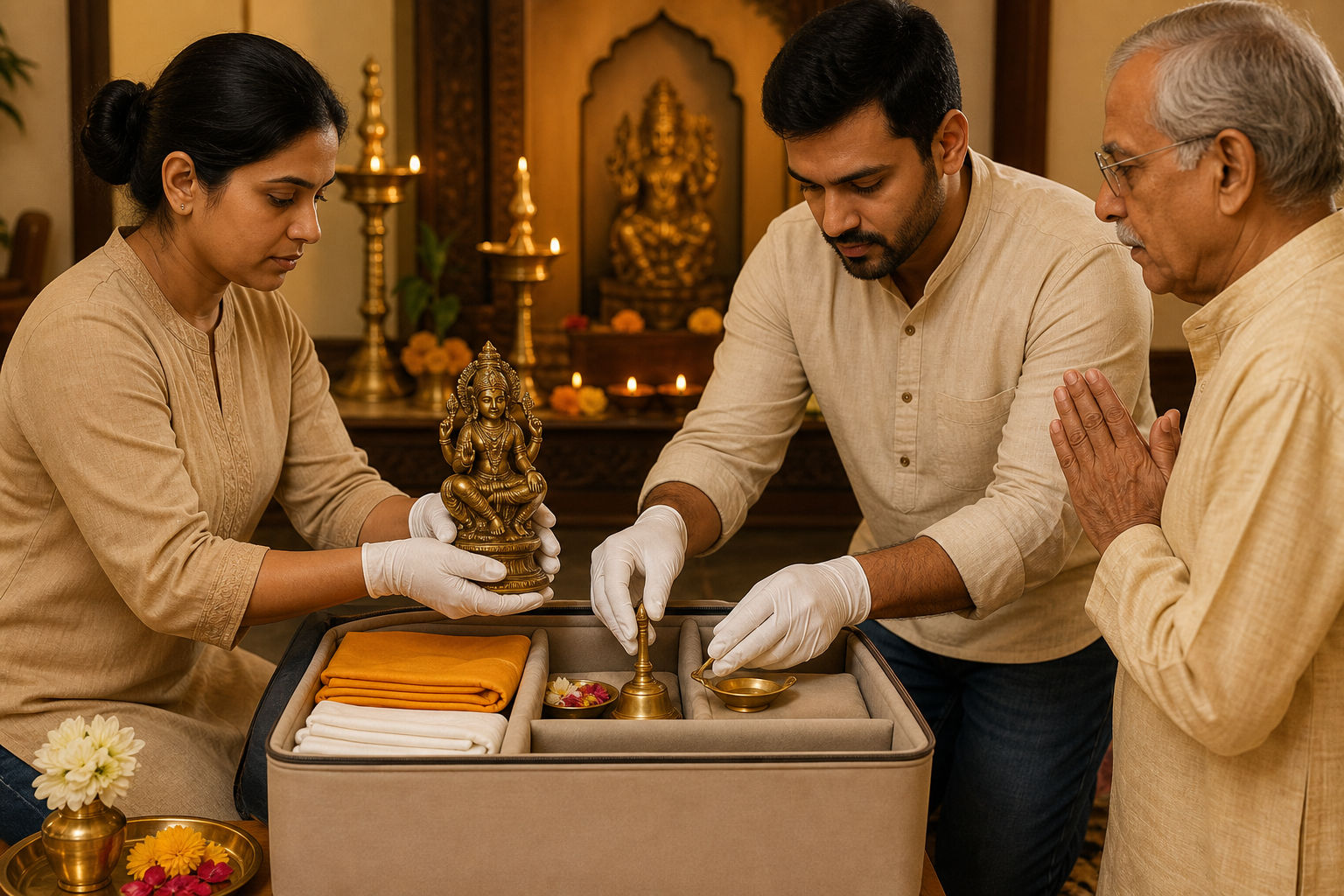
A boundary wall is private property, but its outer face also meets a shared lane. Dust, monsoon splash, litter, pedestrian contact, vehicles, festival decorations, and municipal work can all affect what is placed there. The practical question is therefore larger than whether a resident’s intention was devotional. It is whether the chosen location permits the image to be tended with the dignity the deity deserves.
Before installing a Hindu deity image on a street-facing surface, answer these questions:
- Will the image remain above routine contact, splash, refuse, animals, and vehicle movement?
- Is it protected from weather, or would a canopy or sheltered niche be needed?
- Who will clean and maintain it after the initial installation?
- Does the location obstruct pedestrians, sanitation work, drainage access, or another established civic use?
- Is the image being installed for worship and reverence, or mainly as a device to deter littering or vandalism?
- If the household moves or can no longer maintain it, what is the respectful removal plan?
A sacred image should not become a substitute for a no-littering sign, a camera, lighting, or a municipal complaint. Instrumental use creates a predictable problem: the symbol is expected to control public behaviour, yet no one accepts continuing responsibility for its care. Use ordinary civic tools for the civic problem and reserve sacred imagery for a setting in which it can be honoured.
If an objection arises, begin with intent and impact. The household may have acted from bhakti; the objector may fear exposure or inadvertent disrespect. Those positions are not automatically irreconcilable. A disagreement over deity images on a boundary wall was settled through police-facilitated voluntary removal, showing how relocation can protect sanctity without accusing the family of hostility to Dharma.
The same reasoning can build Dharmic solidarity. Sikh flags and sacred emblems, Jain Tirthankara images, and Buddhist icons also call for attentive placement and care. A common neighbourhood standard should focus on protection, maintenance, access, and consent rather than ranking whose sacred symbol deserves respect.
Constitutional rights remain part of the boundary. Article 25 protects freedom of conscience and religious practice subject to public order, morality, and health. Expression is protected by Article 19(1)(a), while Article 19(2) permits reasonable restrictions. Those principles do not give a crowd authority to impose its own punishment, nor do they make every placement immune from legitimate public-order or municipal concerns. Police mediation should seek the narrowest practical measure that restores safety and preserves dignity.
For a Hindu household, voluntary relocation should be documented as a practical accommodation, not an admission that devotion was wrongful. Agree on who will remove the image, how it will be handled, where it may be placed respectfully, and whether the wall needs an ordinary civic solution afterward. Consent about each of those points prevents the settlement itself from becoming the next grievance.
Stop rumour from becoming the second incident
The first incident may involve only a few people. The second begins when an unverified caption converts it into a conflict between entire communities. By then, people far from the location are pressuring residents to take positions before witnesses have even been heard.
Use a three-part information ledger:
- Verified: facts directly observed, formally acknowledged by police, or supported by preserved evidence.
- Alleged: claims attributed to a named complainant, witness, accused person, or representative, without presenting them as findings.
- Unknown: motive, disputed sequence, weapon linkage, group involvement, or any other point still being investigated.
This ledger should govern every public update. A useful message is short: what happened, what authorities have done, what remains unverified, what residents should avoid, and where reliable updates will appear. Do not add adjectives that perform outrage but contribute no fact.
Identity and motive must remain separate. The religion of a victim or accused may be a verified biographical fact and may still be relevant to community concern. It is not, on its own, proof that the act was religiously motivated. The date of a Hindu, Muslim, Sikh, Buddhist, or Jain festival is also context, not a finding about motive. If later evidence establishes targeted hatred, say so with the same precision.
Apply a simple sharing discipline:
- Open the material rather than forwarding its caption.
- Check whether it shows the event claimed, at the place and time claimed.
- Look for an official police update and compare it with more than one credible account where available.
- Remove phone numbers, home addresses, medical images, and identifying details of minors from anything shared publicly.
- If you previously circulated a false claim, correct it in the same groups instead of quietly deleting it.
- Do not publish a witness’s identity merely to answer sceptics. Give the information to investigators.
Community leaders have a special responsibility here. They can demand a thorough investigation, organise lawful support for the victim, and condemn an offence without assigning hereditary guilt to neighbours who had no part in it. Dharma does not demand naivety about organised hostility. It demands that judgement follow truth, that punishment follow lawful responsibility, and that anger not be redirected toward the uninvolved.
Turn a temporary calm into a local cohesion system

A police vehicle leaving the lane is not proof that the conflict has ended. Rumours may remain active, young people may continue a personal feud, and one side may believe it conceded under pressure. Follow-up must begin after the immediate danger has passed but before memories fragment and competing versions harden.
Hold a small after-action meeting with people who have an operational role: affected residents, a temple or other Dharmic institution representative where relevant, a neighbourhood elder trusted across factions, youth or school representatives if students are involved, and the police community liaison. Do not recreate the crowd indoors.
The meeting should produce a brief written record covering:
- The facts accepted by all parties and the questions still reserved for investigation.
- Any agreed relocation, repair, access arrangement, route, timing, or maintenance duty.
- A named point of contact for each party and for police.
- A method for reporting a breach without mobilising supporters.
- A follow-up date and the condition that will allow the matter to be considered closed.
Then convert the lesson into a standing protocol. Temple committees, gurdwara sewa teams, Jain sanghs, Buddhist vihara associations, resident groups, and local administrators can agree in advance on respectful placement standards, festival-route coordination, complaint channels, rumour verification, and access to mediation. A protocol written during calm is easier to follow than an improvised rule announced in front of an angry crowd.
Youth safety needs its own track. An older personal dispute can become lethal when threats are normalised, peers arrange confrontational meetings, or carrying a weapon is treated as status. Schools, parent groups, youth clubs, and police outreach teams should make early reporting, peer de-escalation, and safe bystander action ordinary. A young person who receives a threat should know which adult will take it seriously and how to report it without being sent back into a face-to-face settlement with the aggressor.
The Dharmic synthesis is practical. Ahimsa governs the means: do not retaliate against the uninvolved, manufacture allegations, or turn sacred symbols into instruments of provocation. Karuna directs attention to the injured, bereaved, frightened, and displaced. Accountability ensures that compassion is not twisted into impunity. These duties reinforce one another when police work is evidence-led and community leadership is disciplined.
Choose the people and channel for this work before the next crisis. Name a police liaison, a documentation lead, a medical-contact volunteer, and two mediators trusted for their restraint. That small act of preparation gives your community something more useful than another angry message: a lawful path from danger to protection, from grievance to remedy, and from temporary quiet to durable trust.
References
- Hindu Existence – Gaighata Wall Dispute Resolved: Decisive Police Mediation Restores Calm After Deity-Image Row
- Hindu Janajagruti Samiti – Ghaziabad Class 11 student killed on Eid: verified facts, arrests, and a path to community unity
