
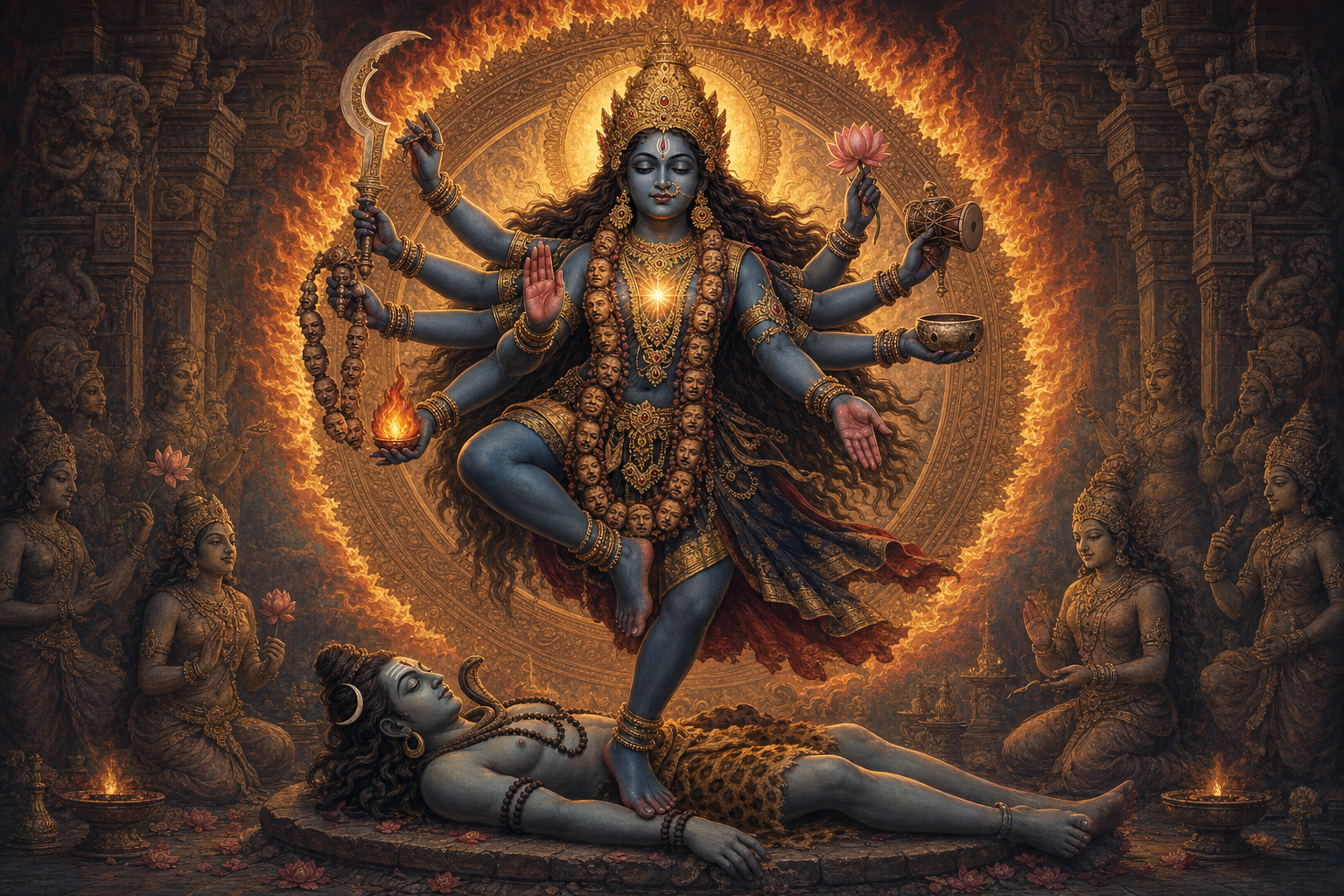
You may be standing before a goddess enthroned on skulls, a fanged Bhairava carrying a skull-bowl, or a dancing deity surrounded by weapons and severed heads. If you read the image as a collection of horrors, its meaning closes. If you read it as a sequence of spiritual operations, a precise teaching about power and liberation begins to appear.
You don’t need to identify every implement before the image can speak to you. Start with four questions: What is inert? What animates it? What binds the being represented? What in the composition cuts, redirects, or releases that bondage? Those questions turn unfamiliar Tantric imagery into a grammar you can actually use.
Read the relationship before you decode the objects
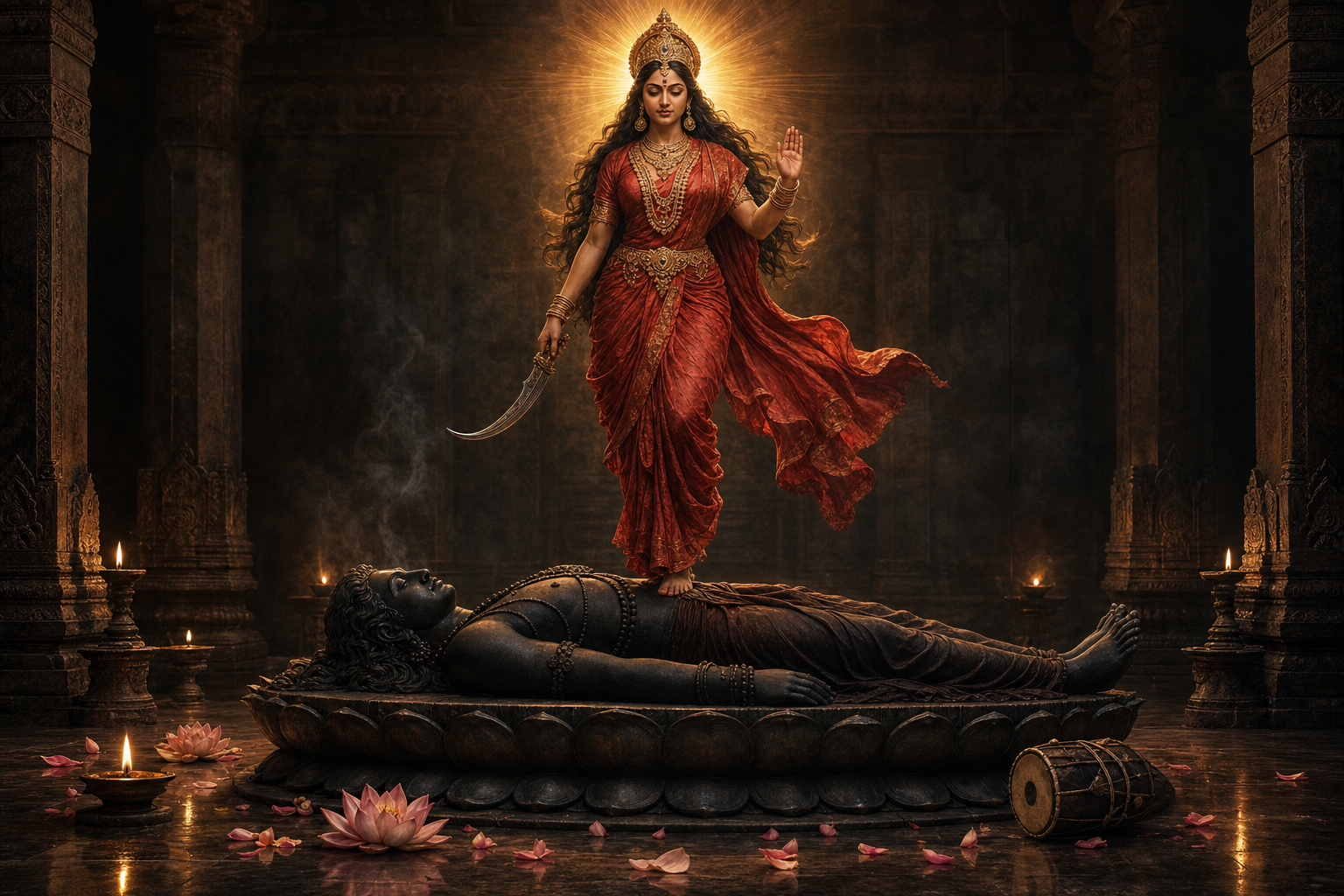
The first mistake is to isolate the central deity from the figure, throne, animal, or field beneath it. In Tantric iconography, contact is often the teaching. A goddess seated on apparently lifeless divine supports is not simply displaying rank. Her position shows the relationship between structure and the power that makes structure function.
Within many Shakta and nondual Shaiva frameworks, Shiva represents pure consciousness while Shakti is that consciousness as freedom, manifestation, cognition, and action. They aren’t two competing substances. They are distinguishable aspects of one reality. The familiar comparison of Shiva without Shakti to a śava, or corpse, is therefore a technical metaphor for quiescence, not an insult to Shiva and not a claim that consciousness is literally dead.
The pañca-mahāpreta teaching makes this relationship visible. Here, preta means an inert or inactive support rather than a wandering ghost. The five great supports are commonly identified with Brahma, Vishnu, Rudra, Īśvara, and Sadāśiva. Shakti enthroned upon them communicates that even the loftiest cosmic functions remain potential until divine power activates them.
| Divine support | Cosmic act | Question to ask while viewing |
|---|---|---|
| Brahma | Sṛṣṭi, emanation or creation | What is being brought into manifestation? |
| Vishnu | Sthiti, maintenance or continuity | What is being sustained? |
| Rudra | Saṃhāra, dissolution or reabsorption | What must be returned to its source? |
| Īśvara | Tirobhāva, concealment or veiling | What makes reality appear limited or hidden? |
| Sadāśiva | Anugraha, grace | What makes recognition and release possible? |
This mapping gives you a disciplined way to approach a five-skull crown or fivefold throne, but it isn’t a universal decoding key. Depending on the lineage, five skulls may also organize the five elements, senses, vital winds, or bodily sheaths. The point isn’t to choose the most esoteric answer. It is to determine which fivefold structure the surrounding iconography and ritual context make plausible.
Begin, then, at the point of contact. Is the deity seated on a throne, standing on a recumbent form, dancing above a figure, or accompanied by a consort? Ask what the supporting form contributes and what the active form supplies. This is usually more revealing than beginning with the most dramatic weapon.
Decode a fierce image from its center outward
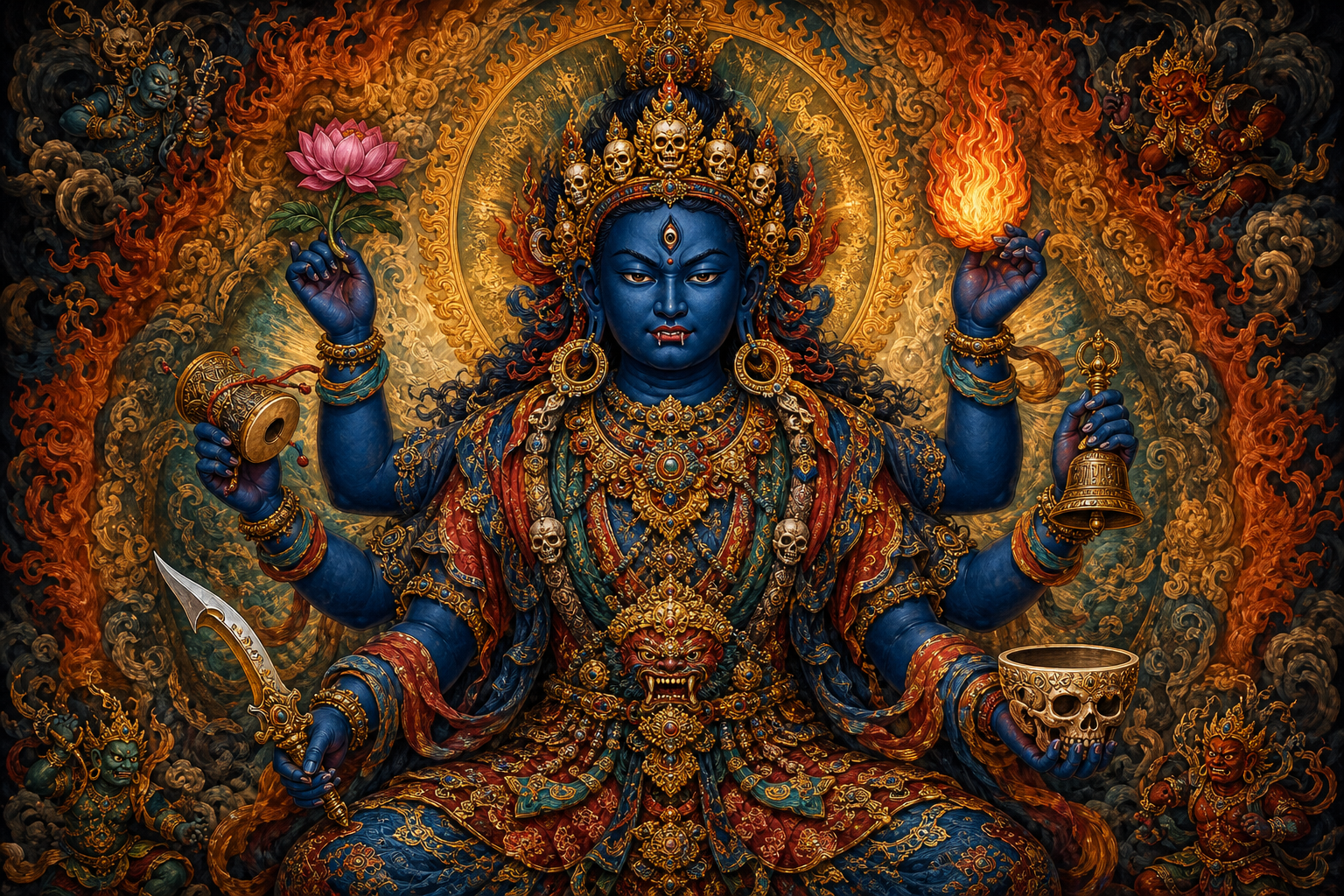
Tantric deities share attributes, and regional workshops don’t always follow one textual prescription. A skull-bowl alone doesn’t identify Bhairava; a trident alone doesn’t identify a particular form of Shiva. Read clusters of evidence in a fixed order so that one striking detail doesn’t control your conclusion.
- Establish the central presence. Notice whether the figure is masculine, feminine, paired, solitary, peaceful, fierce, seated, standing, or dancing. Count faces, eyes, and arms, while allowing for damage or later repairs.
- Read the face and hair. A third eye widens the field of awareness beyond ordinary sight. Fangs, flared nostrils, arched brows, and radiating matted hair intensify the fierce mode. A crescent moon, serpents, skulls, or a small head in the crown may narrow the identification.
- Separate gestures from implements. An open palm in abhaya offers fearlessness; a lowered boon-giving hand offers grace. These gestures can change the meaning of every weapon around them.
- Read paired implements as a sentence. A noose and goad, for example, describe gathering and directing. A sword beside a protective gesture joins discernment to reassurance. Don’t treat each hand as an unrelated emblem.
- Finish with the base and surroundings. Look for a vāhana, subsidiary deities, flames, corpses, guardians, architectural placement, and the direction the figure faces. These details often distinguish a generic fierce deity from a specific guardian form.
Hands show what divine power does
A weapon in a Tantric hand is usually an instrument of consciousness before it is an instrument of physical violence. Its meaning lies in the operation it performs:
- Triśūla, the trident: penetration of threefold limitation or bondage. The exact triad can differ by doctrinal setting, so don’t assign one automatically.
- Ḍamaru, the hourglass drum: pulsation, manifestation, and the ordering power of sacred sound.
- Khaṭvāṅga, the skull-topped staff: mastery of liminal wisdom and the capacity to remain conscious where ordinary identity loses its footing.
- Kapāla, the skull-bowl: reception and transformation. Nectar or blood within it can signify that intense energies aren’t merely suppressed; they are consecrated and redirected.
- Pāśa, the noose: gathering what wanders, including scattered attention.
- Aṅkuśa, the goad: directing energy once it has been gathered.
- Sword and shield: discriminating insight joined to protection.
- Abhaya and varada mudrās: fearlessness and grace, which prevent a fierce array from being mistaken for aggression without purpose.
That last pairing matters. If you notice the fangs but miss the abhaya hand, you have read only half the sentence. Fierceness identifies the force required to confront bondage; the gesture discloses the compassionate end of that force.
Body, ornament, and posture show what power has mastered
Ash-covered skin places impermanence directly on the divine body: every formed thing returns to essence. A sky-clad or lightly draped body can indicate freedom from social covering and dependence. Tiger or elephant hide, bone ornaments, serpents, and the cremation-ground aesthetic place the deity where ordinary categories of purity, status, and safety no longer provide protection.
A skull-garland can represent mortality, but it may carry a more exact linguistic meaning. When the number is given as fifty, the heads can correspond to the Sanskrit varṇamālā, making the garland a sign of sovereignty over sound and meaning. A garland or belt of severed hands can point toward the cessation of compulsive karma: action is no longer driven blindly by attachment.
Posture supplies the verb. A figure standing in alīḍha or pratyālīḍha projects force through a deliberate stride. A vigorous dance releases energy through the entire body. A firmly seated goddess expresses concentrated sovereignty. In ecstatic forms such as Unmatta Bhairava, flying hair, asymmetrical alignment, an intense gaze, and a forward-driving posture may communicate awareness that has exceeded ordinary mental constraint without falling into disorder.
The dog at Bhairava’s feet is equally instructive. Its loyalty, vigilance, night vision, and boundary-keeping fit Bhairava’s role as kṣetrapāla, guardian of a sacred precinct. A small animal at the edge of the pedestal can therefore settle an identification that the weapons alone leave uncertain.
Let the fierce imagery trace a path to liberation
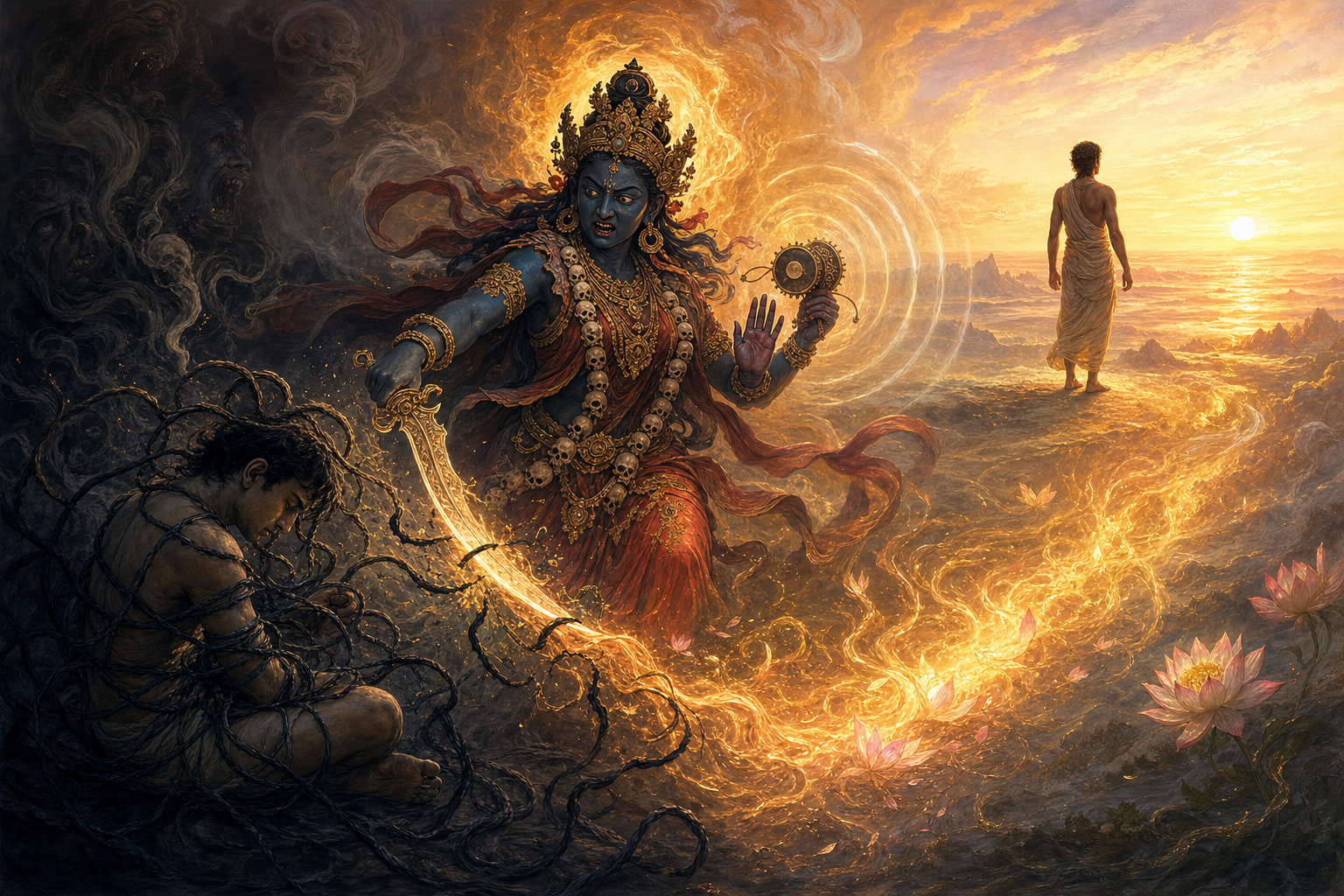
The macabre reading stops at death, blood, bone, and weapons. The liberative reading asks what happens to fear, desire, action, and identity in their presence. Tantric imagery doesn’t always remove the difficult object. It frequently changes the relation between awareness and that object.
A useful way to follow that movement is as a five-part sequence:
- Confrontation: skulls, ashes, corpses, fangs, and cremation-ground signs place mortality and fear where you can’t politely ignore them.
- Discrimination: the third eye, sword, or trident breaks the assumption that your habitual interpretation is the only reality.
- Collection: the noose draws scattered attention and compulsive movement back toward a center.
- Redirection: the goad, drum, dance, or dynamic posture turns arrested energy toward awakened action rather than repression.
- Reassurance: abhaya, varada, a stable throne, or an attentive vāhana reveals protection and grace within the terrifying form.
This sequence also explains why fierce and peaceful meanings can inhabit one image. The aesthetic mood may begin in raudra, the fierce rasa, become intelligible as compassion, and settle into śānta, peace. The deity doesn’t terrorize for its own sake. The terrible aspect is a threshold: what frightened the contracted self becomes a disclosure of what awareness can contain.
Unmatta deserves special care here. The word can carry senses such as ecstatic, intoxicated, or mad in the sacred sense of rapture beyond ordinary discursive thought. It doesn’t make confusion inherently holy, and it shouldn’t be used to romanticize mania, psychological distress, or loss of judgment. A theological image of transrational clarity is not a medical diagnosis or a substitute for care.
You can contemplate the icon safely without imitating esoteric ritual. Choose one figure and first describe only what is visibly present. Then identify the symbol of confrontation, the instrument of transformation, and the sign of grace. Complete one sentence: “This image places ___ before awareness, redirects it through ___, and resolves it in ___.” If your interpretation can’t account for both the fierce and gracious elements, keep looking.
Ritual use demands a different standard. Mantras, yantras, midnight worship, and offerings associated with fierce deities belong to specific liturgical systems. Viewing an icon isn’t initiation into those systems. Where skull-seat symbolism is adapted for contemplative use, carved wood, clay, or drawn diagrams can preserve the teaching without violating ahiṃsā. Don’t treat dramatic imagery as permission to collect human remains, invent offerings, or improvise transgressive rites.
Use temple context and lineage to prevent false certainty
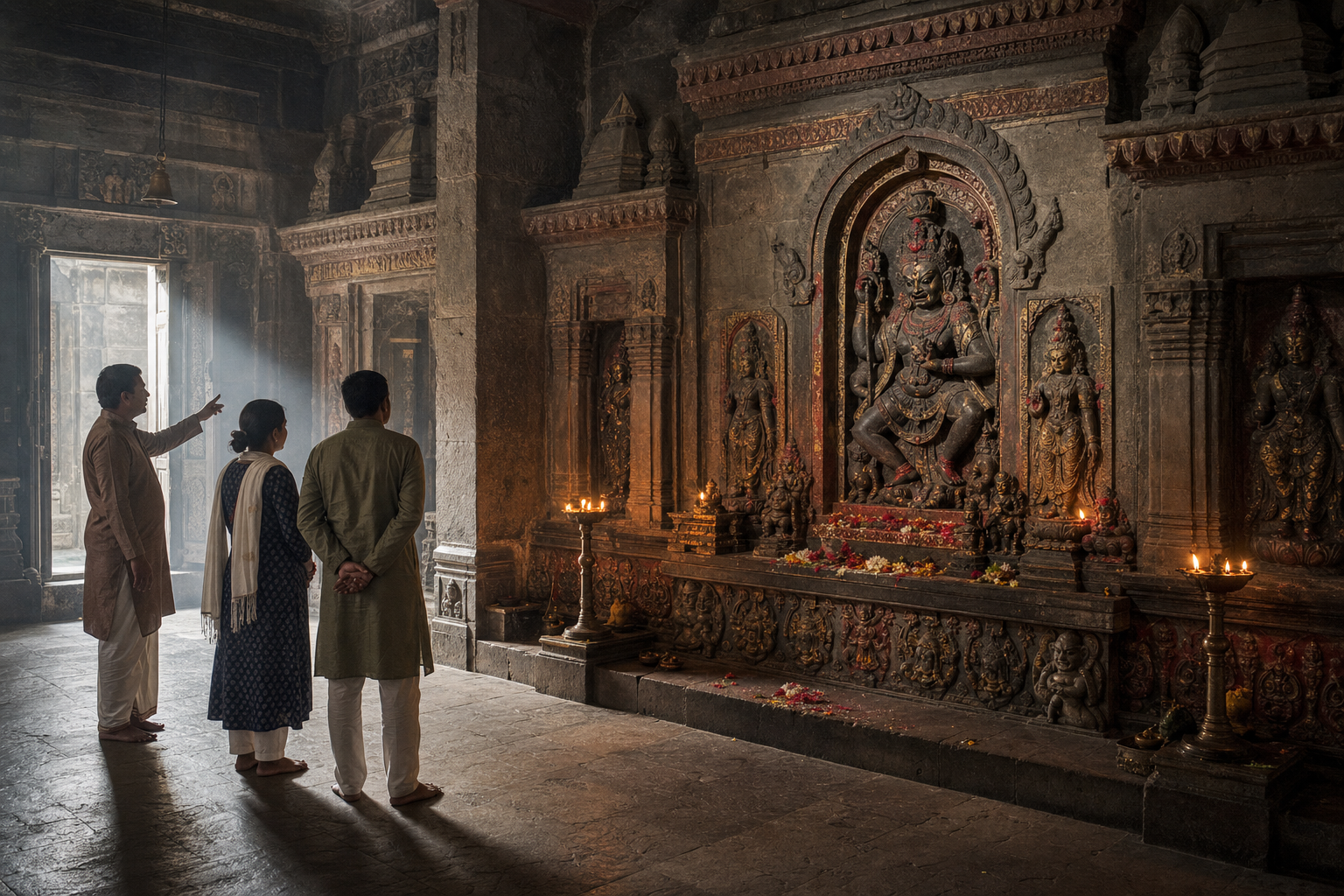
Iconographic identification is cumulative. Arm count, color, direction, and individual attributes can vary across texts, regions, sculptural schools, and ritual lineages. Unmatta Bhairava, for example, may have four, six, or eight arms, and directional assignments aren’t identical everywhere. “Fierce figure with trident” is therefore an observation, not a complete identification.
Use four layers of context before naming a specific form:
- The icon itself: face, crown, arms, gestures, implements, posture, ornaments, vāhana, and consort.
- The group: whether the figure belongs to an eightfold or sixty-fourfold Bhairava arrangement, a goddess retinue, or a processional sequence.
- The architecture: whether the shrine stands at a gateway, enclosure corner, outer boundary, or other threshold suited to a guardian.
- The living identity: the temple’s name for the deity, the ritual calendar, customary offerings, procession order, and explanations preserved by its practitioners.
Placement is functional evidence. Bhairava at a gate or perimeter is doing the work of a guardian even before you identify his precise form. A dog near the pedestal strengthens that reading. A five-skull motif beneath a sovereign goddess points toward a different theological emphasis. Context doesn’t merely decorate an icon; it tells you what the icon is there to do.
Recognize dharmic resonances without erasing differences
Fierce guardians and fivefold symbolic systems move across the Indic civilizational field, but resemblance isn’t identity. Vajrayāna forms such as Vajrabhairava or Yamāntaka, Heruka, and Cakrasaṃvara use terrifying forms, skull ornaments, and corpse imagery within Buddhist teachings on emptiness, awakened knowledge, and transformed mental energies. The five Tathāgatas, five wisdoms, and five aggregates form a Buddhist fivefold grammar; they shouldn’t simply be relabeled as the five Brahmas.
Newar traditions in Nepal make the shared cultural field especially visible because Shaiva, Shakta, and Buddhist communities participate in overlapping ritual ecologies. Bhairava masks, drums, processions, and festival forms can operate at a civic level while retaining lineage-specific meanings.
Jain traditions offer another carefully bounded resonance. Regional Kṣetrapāl and Nakoda Bhairav traditions preserve guardian motifs, while Jain philosophy understands the jīva’s infinite knowledge and perception as obscured by karmic accumulation rather than activated by a creator’s Shakti. The shared question concerns obscured capacity and release; the metaphysical answers remain distinct.
Sikh remembrance of Bhagautī as divine power or the sword of discernment, along with the discipline of fearless chardi kalā, can resonate ethically with Bhairava’s courage and protection. That resonance doesn’t turn Sikh practice into Tantra. The honest comparison identifies a shared concern—fearless defense of dharma—while preserving each tradition’s scripture, theology, and discipline. This is how guardian imagery can illuminate the wider dharmic family without forcing every tradition into one system.
Key takeaways for your next encounter
- Read the relationship between the central deity and the supporting figure before interpreting isolated objects.
- Treat preta as “inert support” when reading the pañca-mahāpreta throne; don’t import the ordinary ghost meaning into a technical Tantric context.
- Pair each fierce sign with its counterweight: weapon with mudrā, skull with awareness, dynamic posture with stable purpose.
- Read implements as operations. The noose gathers, the goad redirects, the sword discriminates, the skull-bowl transforms, and the drum sets power in motion.
- Don’t force one meaning onto a fivefold motif. Test five Brahmas, cosmic acts, elements, senses, vital winds, or sheaths against the rest of the composition.
- Use the vāhana, shrine position, deity group, local name, and ritual role to confirm an identification.
- Compare Hindu, Buddhist, Jain, and Sikh motifs at the level of the question they address, then preserve the distinct answer each tradition gives.
On your next temple or museum visit, give one Tantric image five undistracted minutes. Record what you see before naming it. Locate the support, the active power, the instrument of transformation, and the sign of grace. Then check the local identity and context. That small discipline lets the icon remain more than an exotic object: it becomes a coherent map of how awareness meets bondage and turns power toward freedom.
References
- DharmaRenaissance Blog — Unmatta Bhairava Iconography: Fierce Guardian of Shiva and Ecstatic Freedom
- DharmaRenaissance Blog — Pancha Mahapretas: Why Even Gods Are Inert Without Shakti (Tantric Hinduism Explained)
