
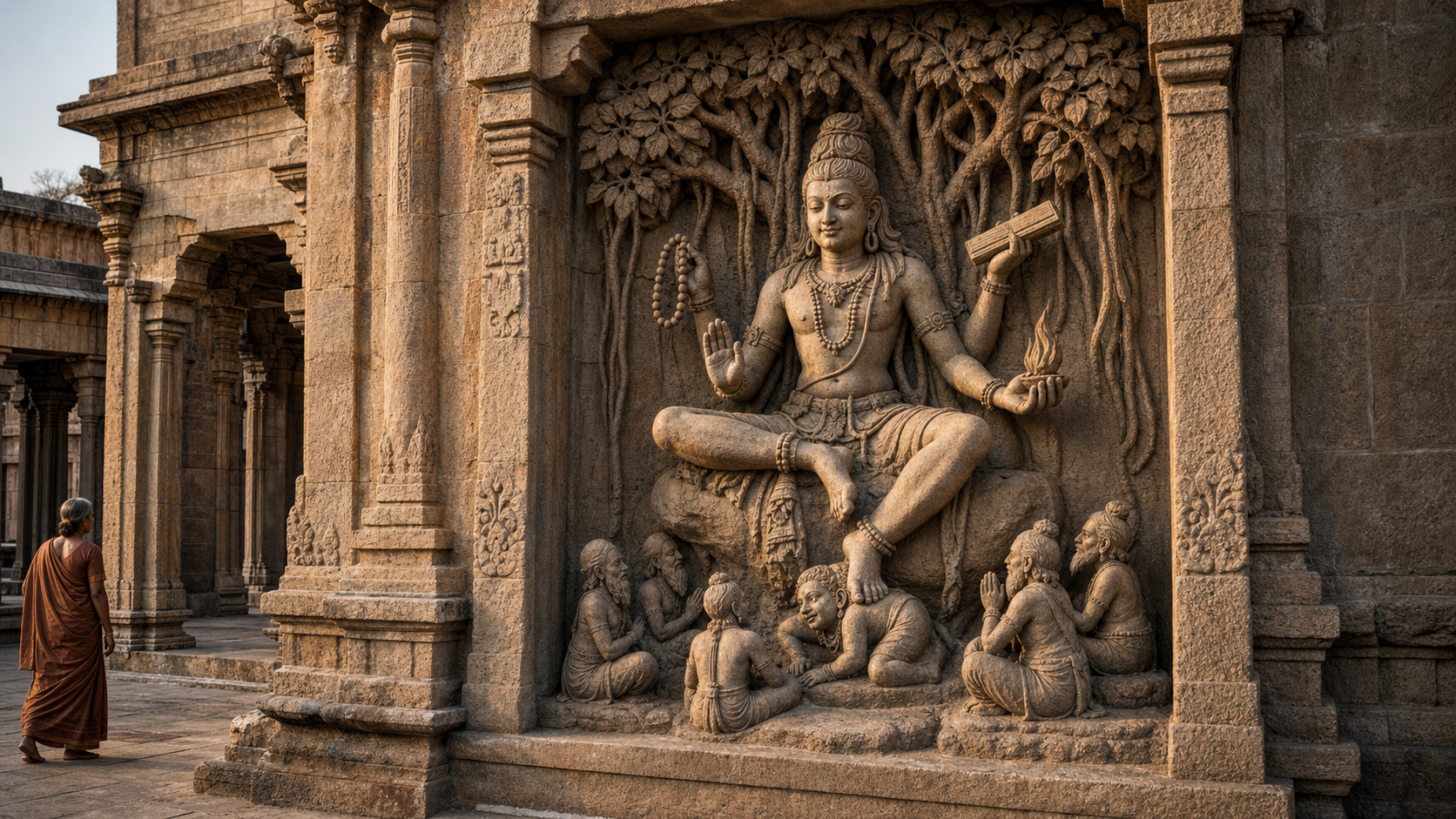
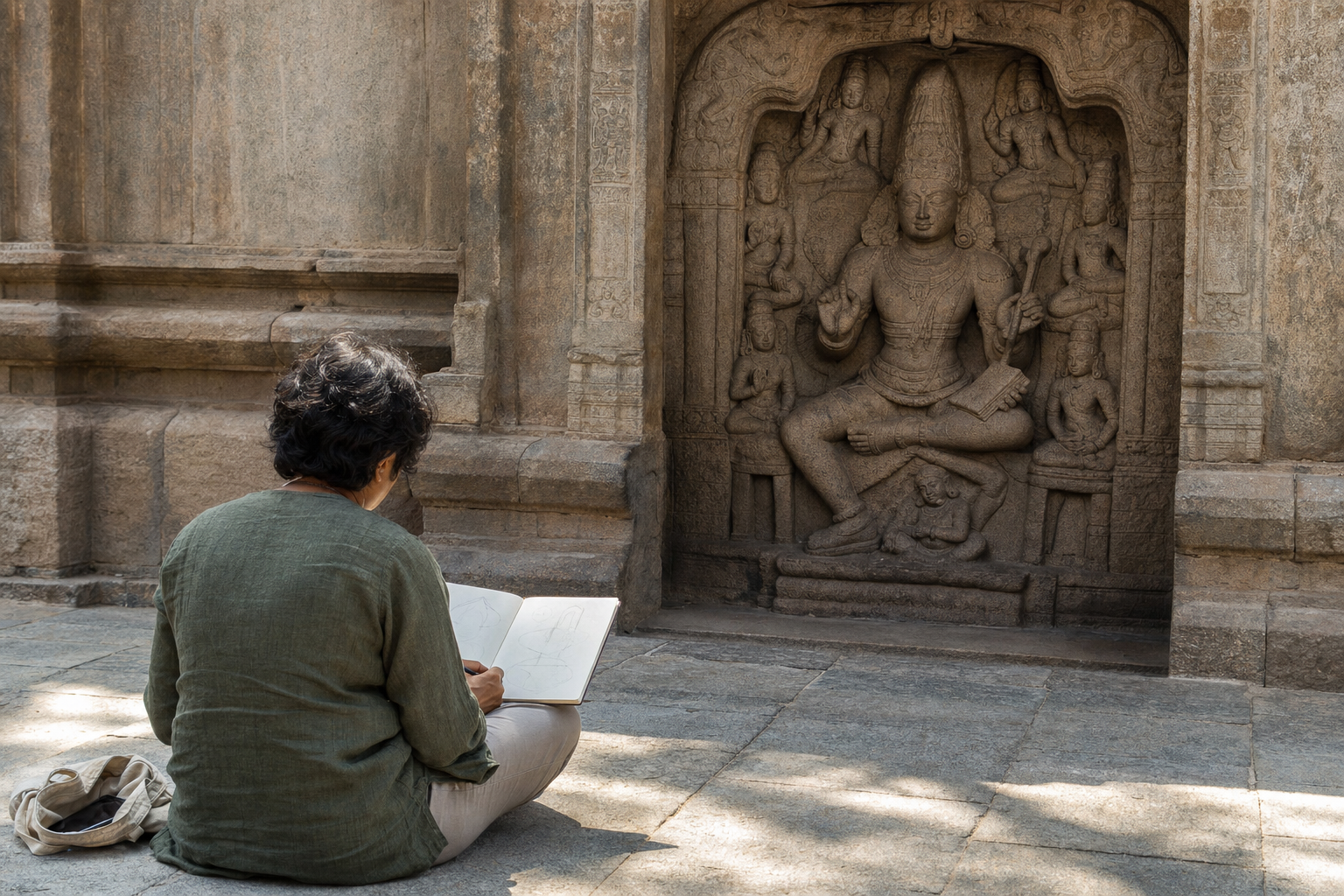
You are walking around a Shiva sanctum when you reach the southern wall. In a niche sits a youthful, composed Shiva. One foot presses down a small figure; a manuscript and rosary appear among his hands; sages gather below a spreading tree. Is this Medha Dakshinamurti, and what exactly are you meant to notice?
Do not identify him from one object alone. Read the image as a coordinated teaching: location establishes the role, posture shows mastery, the hands describe a method of learning, and the surrounding figures reveal what kind of relationship the deity offers you.
Find the teacher on the southern wall
Dakshinamurti means Shiva in his south-facing manifestation. Medha sharpens that identity: it refers not merely to collecting information, but to an intelligence capable of retaining, penetrating, connecting, and rightly applying what has been learned. The form therefore concerns the passage from instruction to understanding.
In the customary arrangement of many South Indian Dravida temples, look for Dakshinamurti in the southern koshta of the garbhagriha’s outer wall. A koshta is an architectural niche. Because this niche opens outward from the southern side, the deity faces south. That placement is one of your strongest clues, although local temple plans and later renovations can introduce variations.
South is associated with Yama and the certainty of death. Shiva does not face that direction because knowledge belongs to a gloomy quarter. He faces it because discriminating wisdom meets finitude without evasion. The spatial lesson is immediate: fear loses authority when reality is seen clearly.
Use this recognition sequence when no label is available:
- Establish the location. Check whether you are at the outer southern wall of the main Shiva sanctum, not merely beside a south-facing subsidiary shrine.
- Confirm that the figure is Shiva. Look for the matted crown, crescent, Ganga, third eye, serpents, rudraksha ornaments, or tiger skin. Wear, repainting, and regional style may obscure some of them.
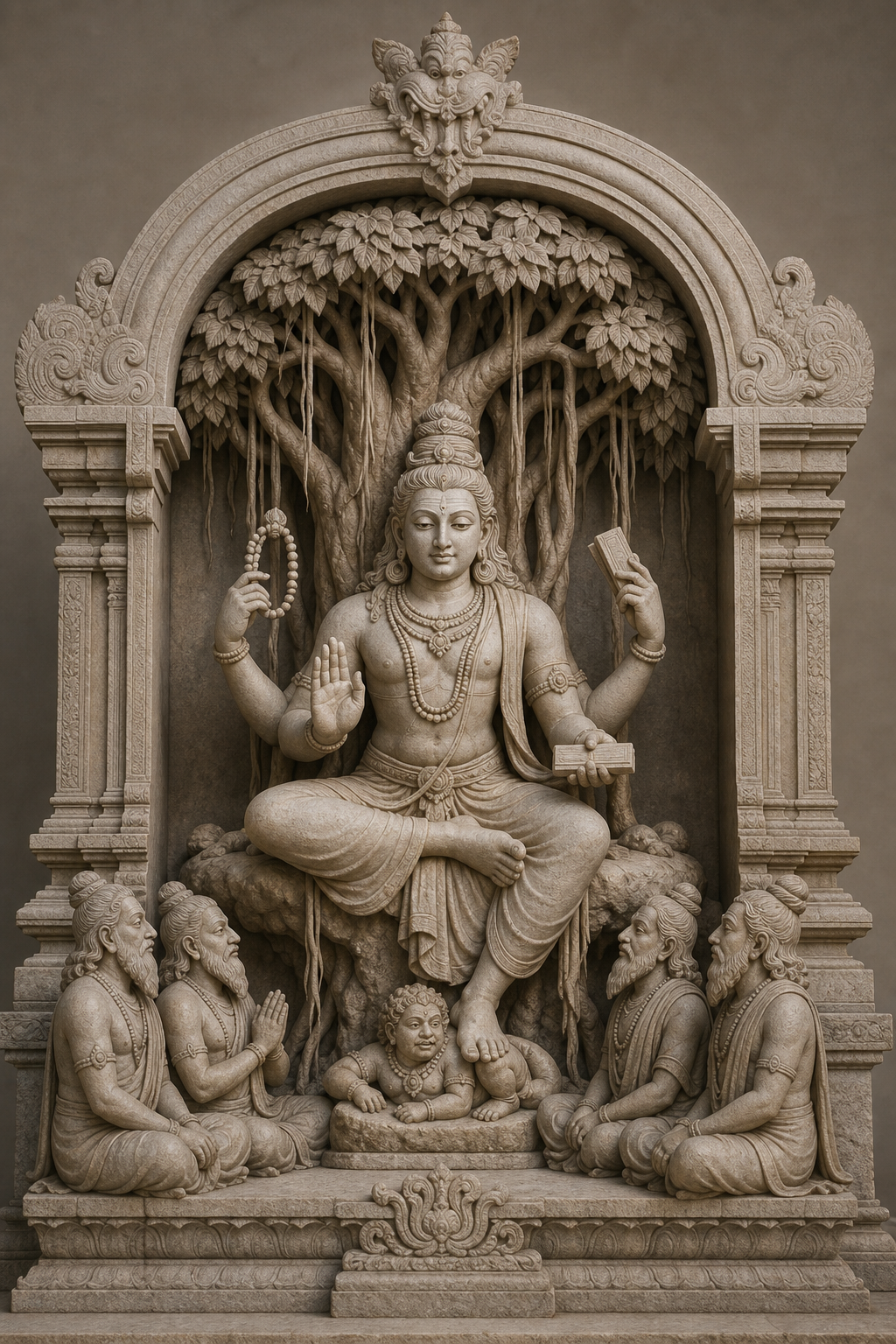
- Look for a teaching composition. The calm seated deity, banyan canopy, listening sages, and expository hand gesture collectively mark the guru form.
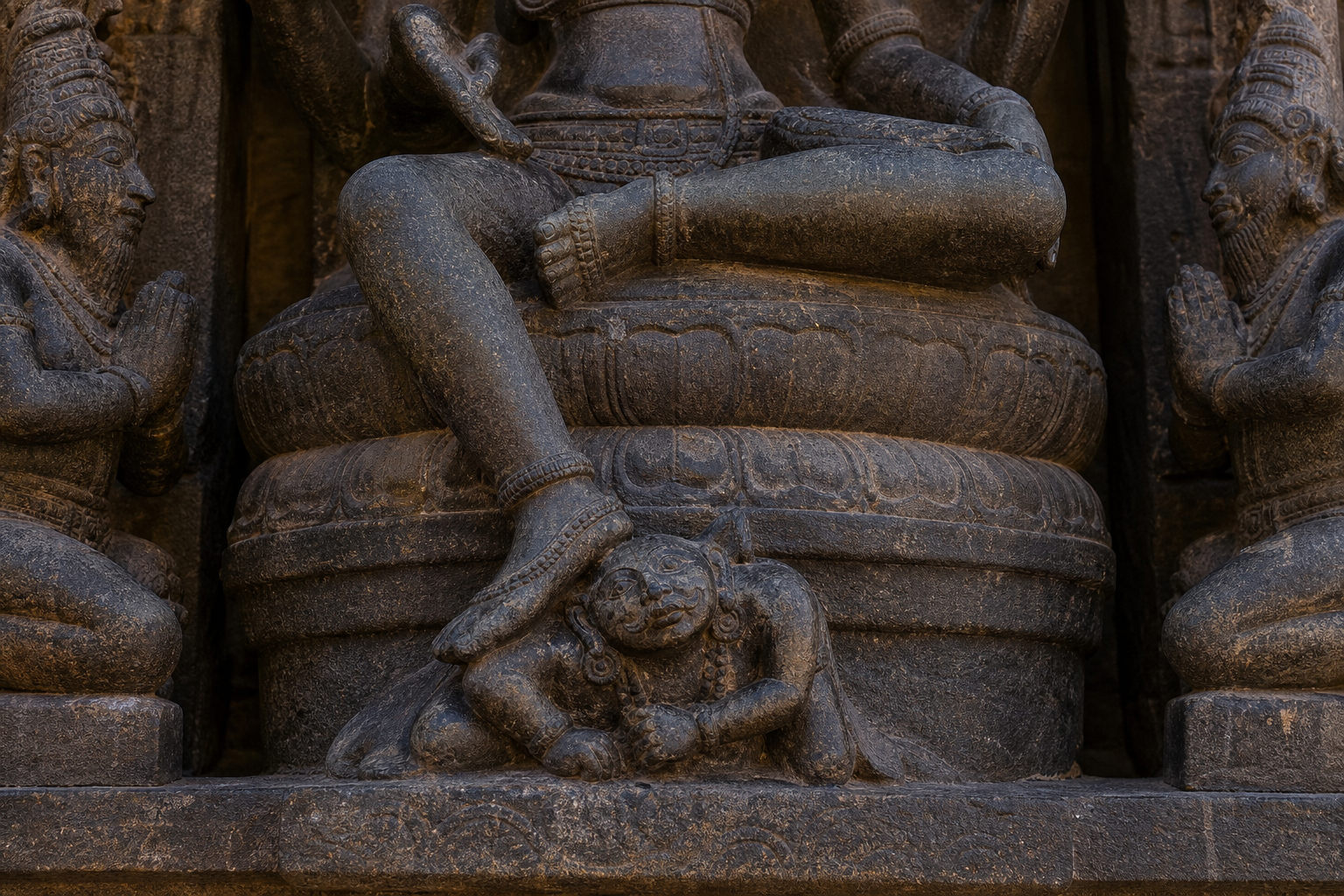
- Inspect the ground. A small figure beneath Shiva’s right foot is usually Apasmara, the embodiment of unstable attention and mistaken knowing.
- Weight the manuscript and rosary. When these are deliberately prominent, a Medha or Jnana emphasis becomes especially plausible.
The last step is important. A teaching mudra can identify Dakshinamurti generally, but it does not by itself settle the subtype. Temple inscriptions, shrine labels, local paddhatis, and the complete set of attributes deserve more weight than a single hand.
Read the body from the face down to Apasmara
Begin with Shiva’s face. It is commonly youthful, balanced, and tranquil, even though the deity is the primordial teacher of ancient sages. The apparent paradox is intentional. Wisdom is older than any lineage, yet it does not decay. Half-closed eyes hold inward absorption and outward awareness together. Relaxed shoulders, an open chest, and a soft abdomen communicate composure without lifelessness.
Now follow the body downward. The left leg is usually folded into the seat, establishing contemplative stability. The right leg extends toward Apasmara. This figure is often called a demon, but that loose label can hide the icon’s precision. Apasmara gathers several related failures into one form: forgetfulness, distraction, inertia, misapprehension, and the mind’s tendency to lose what it has genuinely seen.
Shiva’s foot holds Apasmara under disciplined control. The point is not the destruction of thought or embodiment. It is the removal of distraction from the seat of command. Medha can develop only when the mind’s interruptions no longer decide what you remember, believe, or do.
This also explains why Apasmara appears beneath both Dakshinamurti and Nataraja. Nataraja answers ignorance through cosmic movement; Dakshinamurti answers it through concentrated stillness. The rhetoric changes, but Shiva’s mastery over confused awareness remains.
The exact seat may vary without changing the central identity:
- Virasana stresses command over the senses and the steadiness of a sovereign teacher.
- Padmasana places greater visual weight on inward absorption.
- A yogapatta, the band supporting the legs in meditation, makes sustained concentration physically visible.
- A simhasana, or lion throne, represents the authority of insight rather than political rule over other people.
Above the seat spreads the banyan, or vata-vriksha. Its longevity suits perennial knowledge; its descending aerial roots resemble teachings becoming new lineages without leaving their origin. Read the tree as part of the lesson, not as decorative scenery. Knowledge shelters a community, grows through transmission, and requires patient cultivation.
This use of sacred space has resonances across the Dharmic family without making the traditions interchangeable. The Bodhi tree frames awakening in Buddhism. The Jain samavasarana frames the Tirthankara’s teaching assembly. The Shaiva banyan frames the bond between silent guru and receptive student. In each case, wisdom is presented as an environment one enters, not merely a statement one memorizes.
Let the four hands show you how knowledge matures
When recording the attributes, call each hand right or left from the deity’s body, not from your position as the viewer. This small discipline prevents reversed descriptions and makes comparison with temple labels or iconographic catalogues much easier.
A common four-armed Medha or Jnana arrangement includes the following elements, though their exact positions can vary:
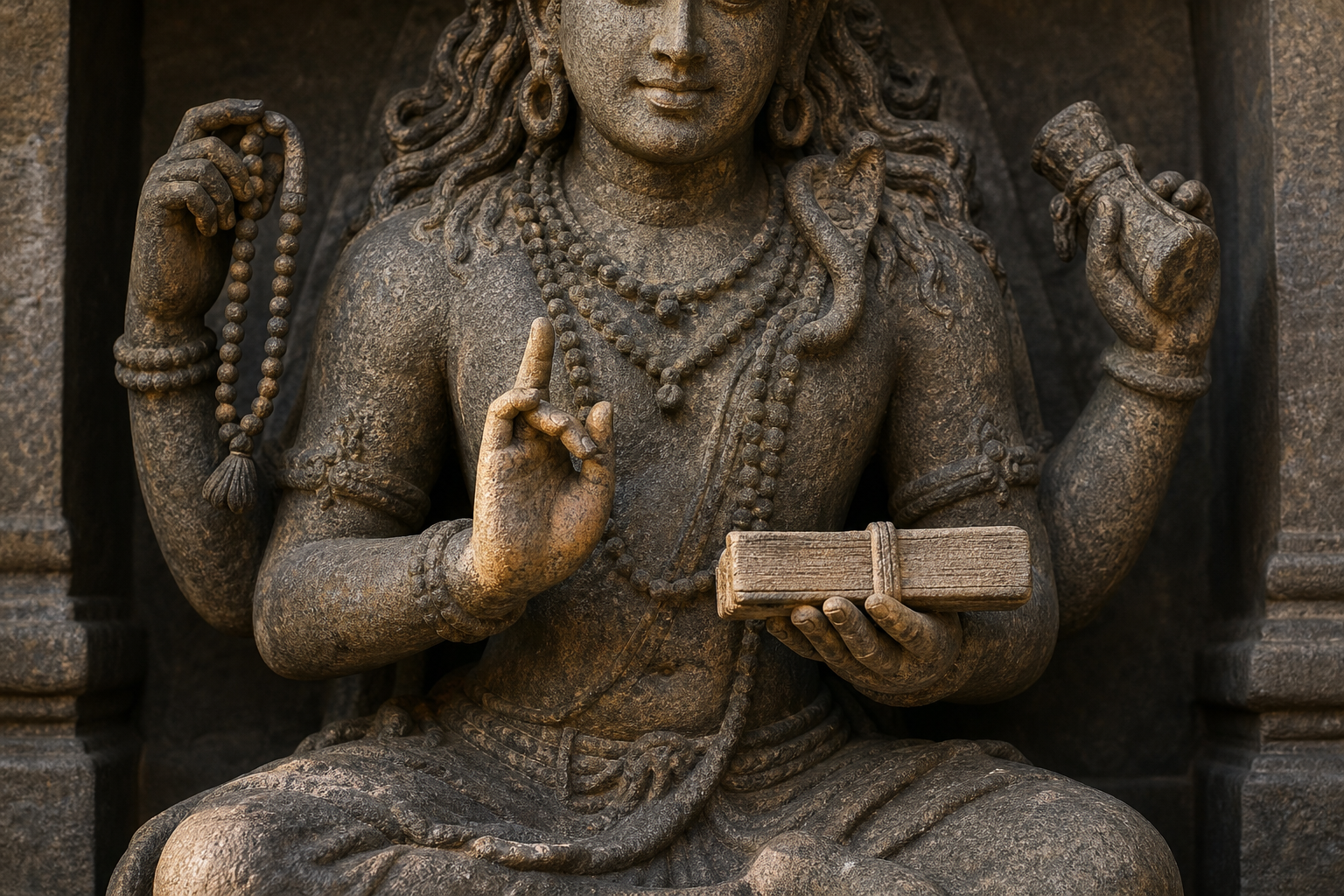
- Jnana, chin, or vyakhyana mudra: the lower right hand commonly forms a gesture of knowledge or exposition. It marks Shiva as one who reveals rather than merely commands.
- Akshamala: a rosary often appears in an upper hand. Its recurring beads signify sustained recollection, contemplation, and abhyasa – disciplined repetition.
- Pustaka: the manuscript, commonly associated with a left hand, represents transmitted learning. In more detailed sculpture it may resemble a bound palm-leaf text.
- Open hand: another hand may offer varada, the granting of a boon, or abhaya, reassurance and freedom from fear. Read the actual pose rather than assuming that every open palm has the same function.
The contact between thumb and index finger in the knowledge gesture is often read as the relation, and ultimate unity, of Paramatman and jivatman. The remaining three fingers may be interpreted through the three gunas or through past, present, and future held in equilibrium. These are complementary symbolic readings, not a reason to treat every finger as though it had only one permissible gloss.
For identifying the Medha emphasis, the important relationship is between the pustaka and akshamala. The manuscript gives you received knowledge. The rosary gives you repetition and recollection. The teaching gesture points toward insight that has become direct rather than second-hand. Together they describe a demanding sequence: encounter the teaching, return to it, digest it, and allow it to correct your judgement.
That is why Medha should not be reduced to cleverness, examination success, or a supernatural memory aid. It is retentive and discriminating intelligence brought into right action. Remembering words while repeatedly choosing badly would leave the icon’s central promise unfulfilled.
Distinguish Medha from the other Dakshinamurti forms
All Dakshinamurti images share teacherhood, stillness, and the overcoming of ignorance. The subtype tells you where the sculptor and ritual tradition have placed the accent. Use the dominant cluster of attributes, not the presence or absence of one damaged object.
| Form | Dominant visual clues | Primary accent | Identification caution |
|---|---|---|---|
| Medha or Jnana Dakshinamurti | Prominent manuscript, rosary, and teaching gesture | Learning retained, examined, and transformed into insight | Do not call every seated Dakshinamurti Medha solely because one hand forms a mudra |
| Yoga Dakshinamurti | Meditative equipment, ascetic restraint, and sometimes a yogapatta | Concentration and inward absorption | The absence of a conspicuous manuscript need not indicate damage or an incomplete image |
| Vina Dakshinamurti | A vina or an unmistakable musical configuration | Nada, with sound serving as a path toward knowledge | Do not dismiss the instrument as a decorative accessory |
The four sages reinforce the identification. Sanaka, Sanandana, Sanatana, and Sanatkumara are shown as attentive students near the teacher. Their presence turns the entire niche into a classroom: Shiva teaches, the sages receive, the manuscript preserves, the rosary rehearses, and the banyan shelters the transmission. Their smaller scale indicates compositional hierarchy, not lesser spiritual seriousness.
Adornment supplies another layer of confirmation. The jata-mukuta may carry the crescent moon and Ganga, joining time and purification to Shiva’s stillness. The third eye indicates perception beyond surface appearance. Serpents can appear as ornaments or as a sacred thread, suggesting mastered energy. Rudraksha beads mark ascetic discipline, while the tiger skin presents instinct as something transmuted rather than denied.
Material changes the visual effect, not the theological core. Granite images in Tamil Nadu and Karnataka often communicate the form through firm contours and architectural gravity. Panchaloha bronzes permit a more supple body and luminous surface, especially in an utsava image intended for procession. The lost-wax method associated with the great Chola bronze tradition models each casting individually.
Proportion is also meaningful. Shilpa traditions use tala-based modules to relate the head, torso, limbs, and hands to the whole. A balanced face, measured gestures, relaxed shoulders, and controlled posture produce the visual authority of someone who has nothing to prove. If age or damage has erased a finger gesture, recover the identity from location, posture, attendants, tree, attributes, and Shaiva marks together.
Turn recognition into a practice of learning
Once you have identified Medha Dakshinamurti, resist the urge to treat recognition as the finish line. The icon is built around a method you can use. It joins textual learning, repeated recollection, undistracted reflection, and conduct.
You can translate that method into an ordinary study session without pretending that it is a formal temple rite:
- Begin with the pustaka. Choose one bounded passage or question. Do not confuse opening many texts with learning deeply from one.
- Apply the discipline of the akshamala. Close the text and state its central claim from memory. Reopen it, find what you omitted or distorted, and repeat the correction.
- Make room for the teaching mudra. Stop adding information long enough to ask what the passage changes in your understanding. Silence here is examination, not vacancy.
- Identify your Apasmara. Name the distraction, assumption, or habitual error that keeps displacing the lesson. Remove its authority for the duration of the work.
- Complete the movement into action. Decide what judgement, conversation, or conduct should differ if you have actually understood what you studied.
Temple worship gives this same aspiration a ritual setting. Thursdays, because of their association with the guru, and Guru Purnima are important occasions at many Dakshinamurti shrines. Practices can include abhisheka with water, milk, or vibhuti; a lamp or banyan leaves; recitation of the Medha Suktam; and the Dakshinamurti Stotra traditionally attributed to Adi Sankara. Dakshinamurti may also be invoked at vidyarambha, the ceremonial beginning of learning.
These observances are governed by the temple’s own paddhati and practical rules. Do not place offerings on an image, cross a barrier, or begin an abhisheka simply because you have seen the practice elsewhere. Ask the priest or temple staff what is appropriate at that shrine. If no offering is possible, attentive darshan does not become inferior.
Key takeaways
- Start with the southern exterior niche of the main Shiva sanctum, then confirm the identity through a cluster of visual clues.
- A prominent pustaka and akshamala give the strongest Medha or Jnana emphasis: received teaching must be retained, revisited, and understood.
- Apasmara represents distracted and mistaken awareness losing its rule over the mind, not the destruction of thought itself.
- The banyan, sages, posture, ornaments, and hand gestures are parts of one teaching composition; none is expendable scenery.
- Yoga and Vina Dakshinamurti retain the same guru identity while shifting the emphasis toward meditation or nada.
- Local labels and paddhatis should settle uncertainty when a damaged or regionally distinctive image does not match a standard diagram.
On your next pradakshina, pause at the southern niche before reaching for a camera. Find the manuscript, follow the rosary, notice what lies beneath Shiva’s foot, and give the silent teacher one undistracted minute. The image becomes intelligible when you practice the quality of attention it depicts.
References
