
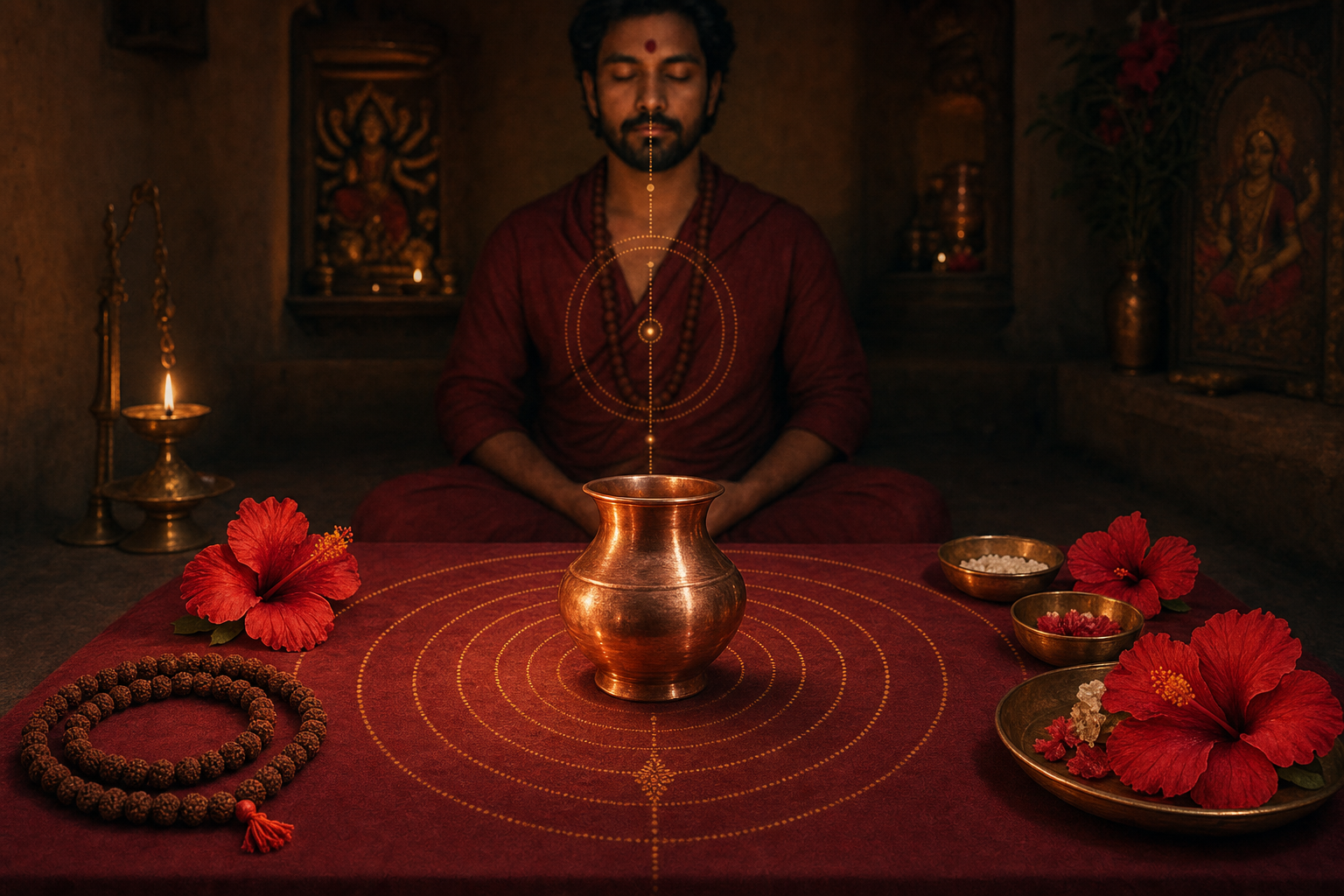
You may have encountered Patra Puja through the detail most easily sensationalized: a sacred vessel that may contain alcohol. If that has left you wondering whether the rite is profound, dangerous, or incompatible with your vows, do not begin with the liquid. Begin with authority, intention, and result.
A genuine Patra Puja is neither a devotional excuse for intoxication nor a claim that matter becomes chemically magical. It is a Shakta discipline in which a vessel, an offering, mantra, breath, and attention are brought into one field of worship. Understanding that structure will help you distinguish lineage practice from imitation, choose an appropriate non-intoxicating form when necessary, and recognize whether the practice is producing clarity or merely acquiring exotic decoration.
Ask what the vessel is meant to transform
The literal starting point is simple: patra means a vessel or receptacle, while puja means reverential worship. In a Shakta setting, however, the patra is not treated as neutral crockery. It is prepared as a temporary seat of Devi. The practitioner simultaneously learns to see the body, senses, and mind as vessels capable of receiving Shakti.
This is why sacred vessel alchemy is primarily an alchemy of relationship. The physical substance remains a substance with ordinary material effects. What changes is the way it is approached: possession becomes offering, appetite becomes attention, and habitual consumption becomes a deliberate encounter with presence. Amrita, in this context, names the nectar-like recognition of the offering as Devi’s grace. It does not mean that an intoxicant ceases to intoxicate or that consecration cancels the need for restraint.
The traditional map for this transformation uses the three gunas. You can apply it as a practical diagnostic rather than an abstract philosophy:
- Tamas is given a container. Unexamined tamas appears as lethargy, avoidance, denial, or fear. Ritual containment can redirect that heaviness into stillness, patience, and the ability to remain present.
- Rajas is given one direction. Restless desire normally jumps from object to object. Sankalpa, mantra, mudra, and a steady gaze gather that movement into focused effort.
- Sattva becomes perceptible. When inertia is held and agitation is concentrated, clearer perception can emerge. Its signs are not spectacle but reduced reactivity, honest attention, and greater care toward other beings.
Before any ritual action, name the actual condition you are bringing to the vessel. It might be fatigue, avoidance, agitation, resentment, or fear. A vague wish to become spiritual gives the mind room to perform. A truthful sankalpa gives the rite something definite to transform.
The decisive question comes after worship: are you more capable of clear action, restraint, gratitude, and non-harm? If the answer is no, unusual sensations and elaborate implements do not prove that alchemy occurred.
Read the rite as a disciplined sequence
Patra Puja belongs to a wider Shakta and Kaula ritual world, including traditions that work with the pañcamakara, or five offerings associated with transgressive practice. The point of such discipline is to transform energies that ordinarily bind consciousness, not to indulge them under sacred vocabulary. That distinction is maintained by initiation, vows, mantra, exact ritual boundaries, and the oversight of guru-parampara.
You can understand the architecture without pretending that a general explanation transmits lineage-specific instructions. Although details differ among sampradayas, the rite commonly follows this movement:
- Sankalpa establishes direction. The practitioner states the intention of the worship and places personal desire inside a larger devotional purpose.
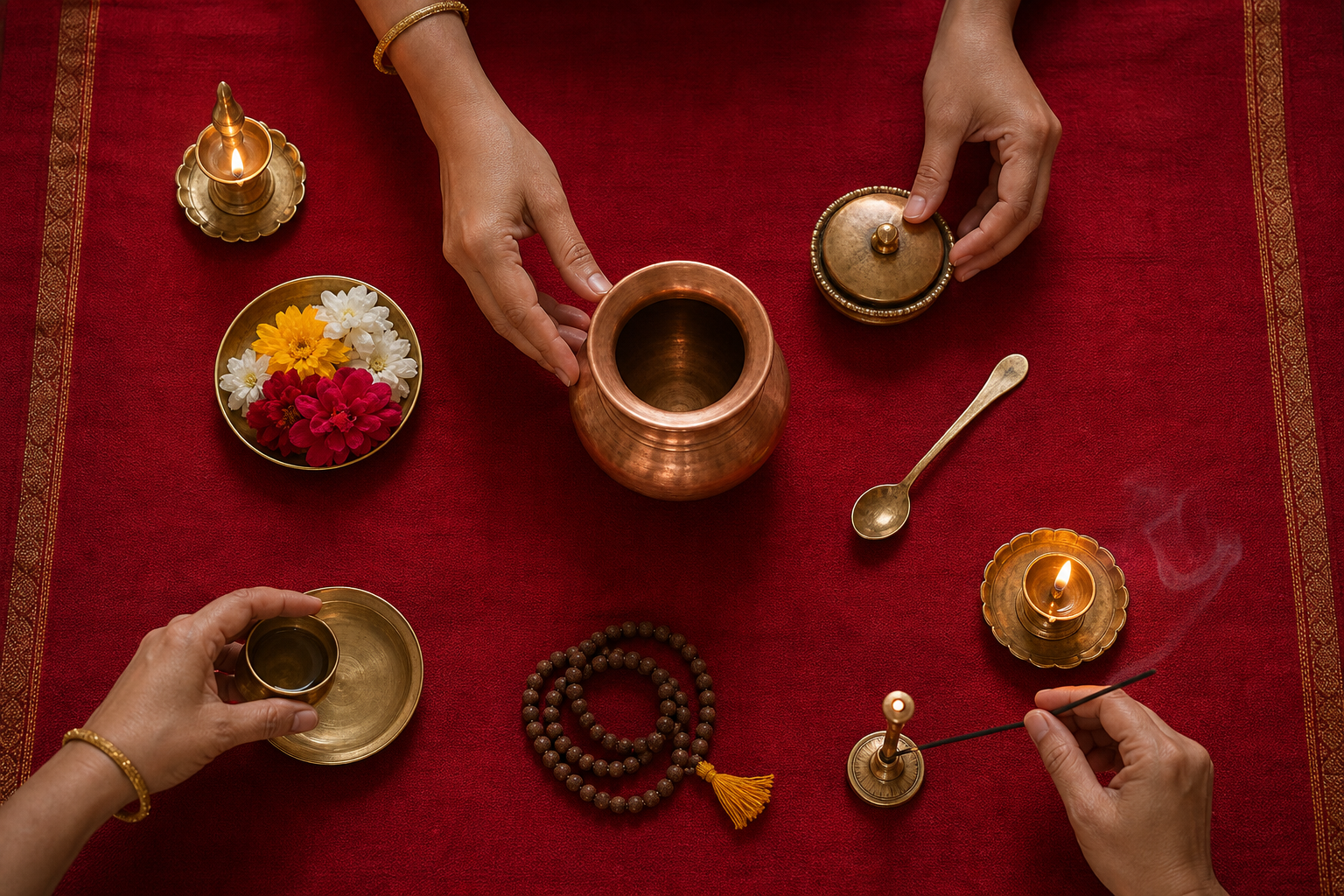
- Purification prepares both vessel and practitioner. The patra is cleaned, perfumed, and marked according to the ritual system. Bhuta-shuddhi purifies the elemental field, while nyasa places mantra-consciousness upon the hands and body.
- Attention is bounded. Regulated breathing, a protective mandala, and a settled posture prevent the rite from becoming scattered performance.
- Avahana changes the vessel’s ritual status. Shakti is invited to abide in the patra. From this point, the vessel and its contents are approached as a consecrated presence rather than an object available for casual use.
- Mantra-samskara consecrates the offering. The appropriate bija and mula-mantra are recited while breath, sound, gaze, and mudra are coordinated. Mantra is the operative sacred speech of the rite, not background music.
- The familiar forms of puja engage the senses. Fragrance, flowers, incense, lamp, and food offering bring smell, sight, touch, and taste into devotional order.
- Atma-samarpana completes the inward movement. The practitioner offers the contracted sense of self, then receives or distributes the consecrated substance as prasada with gratitude and restraint.
The sequence explains why copying only the final act is a serious misreading. Taking a liquid from a decorated cup is not Patra Puja when sankalpa, purification, invocation, mantra, ethical discipline, and self-offering have disappeared. The container exists to discipline desire before anything is received from it.
The material of the vessel also belongs to its ritual grammar. Clay, copper, silver, the domestic kalasha, and the kapala used in fierce Bhairava-oriented settings carry different associations. A kalasha can express purity and abundance in household worship. A skull-cup confronts impermanence and attachment to identity in a very different ritual environment. Choosing the most dramatic object because it looks powerful reverses the logic of tantra. Use what your authorized practice prescribes; for ordinary household worship, a clean and suitable vessel is more truthful than borrowed fierceness.
The same restraint applies to mantra. If you have not received the rite, do not assemble bija syllables, mudras, and visualizations from unrelated traditions. Study the sequence as theology and ritual philosophy, then ask a qualified teacher what belongs to your sampradaya. Mantra becomes meaningful through correct relationship and disciplined repetition, not through obscurity alone.
Choose the contents by lineage, safety, and clarity
Not every Patra Puja uses alcohol. Shakta traditions distinguish outward or transgressive forms often associated with vamachara, conservative right-hand approaches associated with dakshinachara, and strongly internalized contemplative approaches associated with samaya. The boundaries and usage of these terms vary by lineage, but the practical lesson is stable: no single liquid or external form defines the spiritual purpose.
Some lineages consecrate madya under tightly defined sacramental conditions. Others prohibit intoxicants and use a substitute. Established alternatives include water, fresh juice, herbal infusions, sweet spiced panaka, and panchamrita made from milk, curd, ghee, honey, and sugar. Substitution is not a modern embarrassment or a spiritually inferior compromise. It makes the amrita principle visible without requiring alcohol to carry it.
Use this decision order:
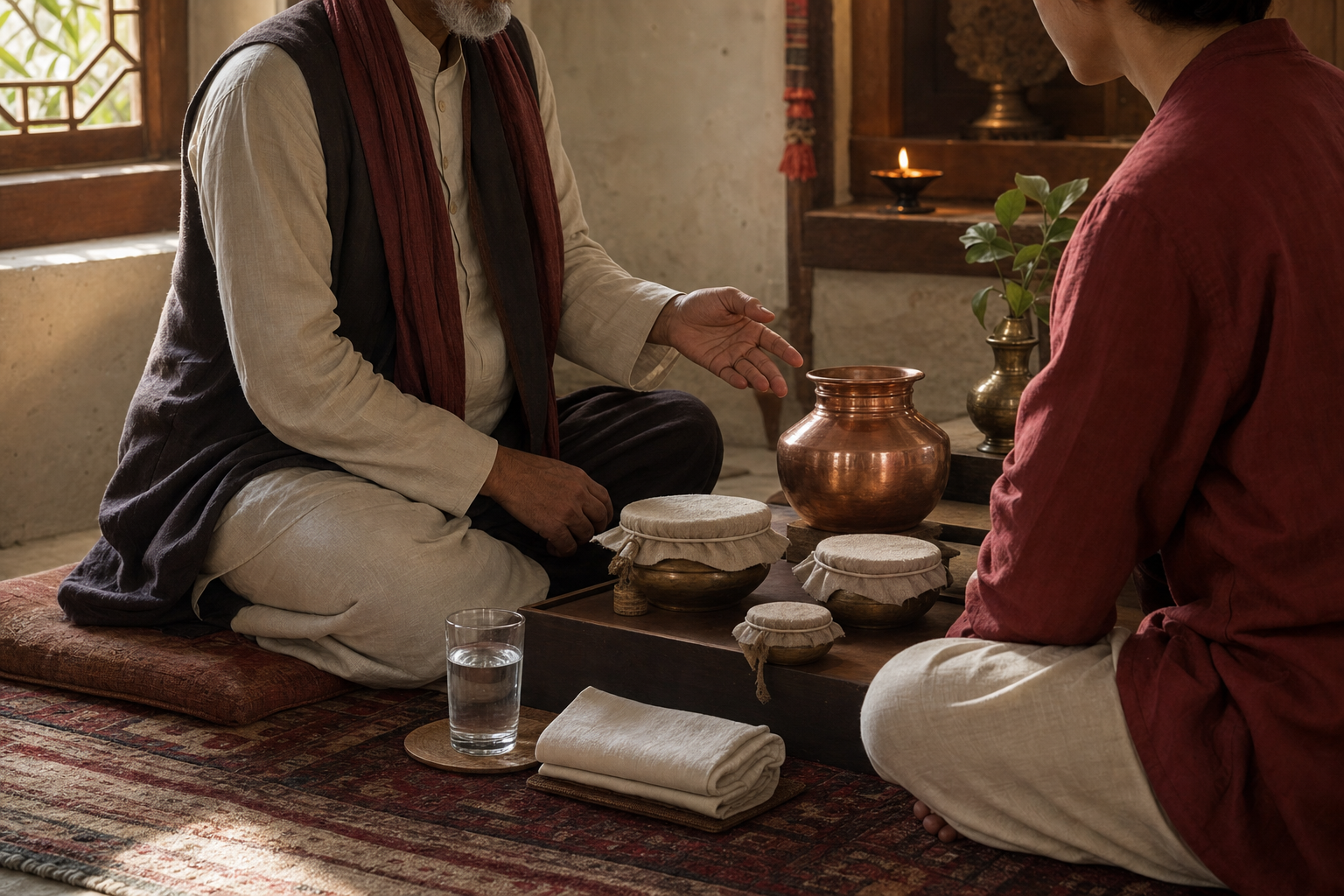
- If you belong to an initiated lineage, follow its actual instruction. Do not alter the substance, quantity, mantra, participants, or mode of distribution merely because another sampradaya does something different. Ask your guru or authorized teacher whether substitution is required or permitted.
- If you are exploring Patra Puja without initiation, alcohol is not the default. Learn the symbolism and use a non-intoxicating household form only within the worship you already know. Do not recreate a transgressive rite from descriptions.
- If your vows or religious discipline prohibit intoxicants, abstain without apology. A practice that requires you to violate a sincerely held dharmic commitment is not producing integration.
- If alcohol is connected with compulsion, impaired judgment, or danger in your life, do not expose yourself to it in the name of sadhana. Choose a non-alcoholic offering. Patra Puja is not treatment for alcohol dependence or anxiety; when either affects safety or daily functioning, seek qualified clinical support.
- If panchamrita ingredients are unsuitable for you or the participants, use an appropriate alternative. The ritual principle does not depend upon consuming a particular dairy or sweet mixture. In a domestic setting, clean water can bear the symbolism plainly.
Consecration changes ritual meaning; it does not erase material consequence. This distinction is especially important when someone uses tantric language to pressure another person into consuming something unwanted. Consent, clarity, and non-harm are not obstacles to Shakti worship. They are part of the vessel that makes worship possible.
Prasada should therefore be received in a manner consistent with the rite’s purpose. More is not more sacred. If receiving the contents produces dullness, excess, concealment, or loss of discernment, the practice has moved away from amrita and back toward unexamined tamas.
Judge the alchemy by its dharmic fruit
Breath regulation, nyasa, repeated mantra, steady gazing, and attention to bodily sensation can gather a scattered mind. Traditional descriptions and practitioner accounts include an arc from restlessness toward stillness, subtler breathing, brighter attention, and spontaneous gratitude. These experiences may be meaningful, but they are not a clinical claim and should not be sold as nervous-system treatment.
Do not turn the Kundalini map into an achievement chart
Within yogic anatomy, changes during worship may be interpreted as Kundalini moving through the sushumna and centers such as muladhara, svadhishthana, manipura, and anahata. That map belongs to a contemplative tradition; it is not a scoreboard. Heat, tingling, emotion, or altered perception does not by itself establish realization. Chasing a sensation can simply give rajas a new spiritual object.
Instead, examine what survives after the altar is cleared. A practice aligned with its stated purpose should make ordinary conduct more lucid. You should be better able to keep a commitment, speak truthfully, refrain from harm, and meet discomfort without immediately escaping it.
- Signs of alignment: steadier attention, proportionate emotion, gratitude without display, restraint around the offering, clearer responsibility, and increased concern for the well-being of others.
- Reasons to pause: impairment, compulsive repetition, escalating quantity, agitation presented as spiritual intensity, neglect of ordinary duties, pressure placed on other participants, or the use of secrecy to excuse harm.
If warning signs appear, stop the intoxicating or destabilizing element and speak with a trustworthy teacher who is capable of setting limits. Where the problem includes dependence, unsafe behavior, or serious psychological distress, use appropriate professional care rather than treating ritual guidance as a substitute.
Shared dharmic values do not make every method interchangeable
Other dharmic traditions illuminate the ethical test without becoming alternate names for Patra Puja. Vajrayana Buddhist ganacakra also works with consecrated offerings to transform fixation and aversion within a disciplined ritual setting. Jain practice places radical ahimsa and abstinence at the center of purification. Sikh discipline rejects intoxicants while understanding Amrit through initiation and Naam through remembrance. These resonances show a shared concern with purification, self-mastery, and nectar-like awareness; they do not make the rites identical.
If you are Jain or Sikh, honoring the shared dharmic aspiration does not require borrowing a Shakta vessel rite that conflicts with your discipline. If you are Buddhist, superficial resemblance does not turn a Hindu puja into ganacakra. If you are a Shakta practitioner, references to other traditions do not relax the demands of your own parampara. Dharma is strengthened when we recognize kinship without dissolving real differences.
Key takeaways for approaching Patra Puja
- Patra Puja transforms the practitioner’s relationship to substance and desire; it is not defined by alcohol.
- The complete ritual movement matters: sankalpa, purification, nyasa, invocation, mantra-consecration, sensory offerings, self-offering, and restrained reception.
- Do not improvise an esoteric form. Learn lineage-specific mantras, mudras, substances, and permissions from an authorized teacher.
- Water, panchamrita, herbal preparations, juice, and panaka can express the amrita principle where non-intoxicating worship is appropriate.
- Abstinence is not a lesser attainment. It is the correct choice whenever intoxicants violate your vows, weaken clarity, or create risk.
- Evaluate the rite by what follows it: clearer attention, restraint, truthfulness, gratitude, compassion, and non-harm.
- Somatic or Kundalini-related sensations may belong to the practitioner’s interpretive map, but they do not outweigh ethical conduct.
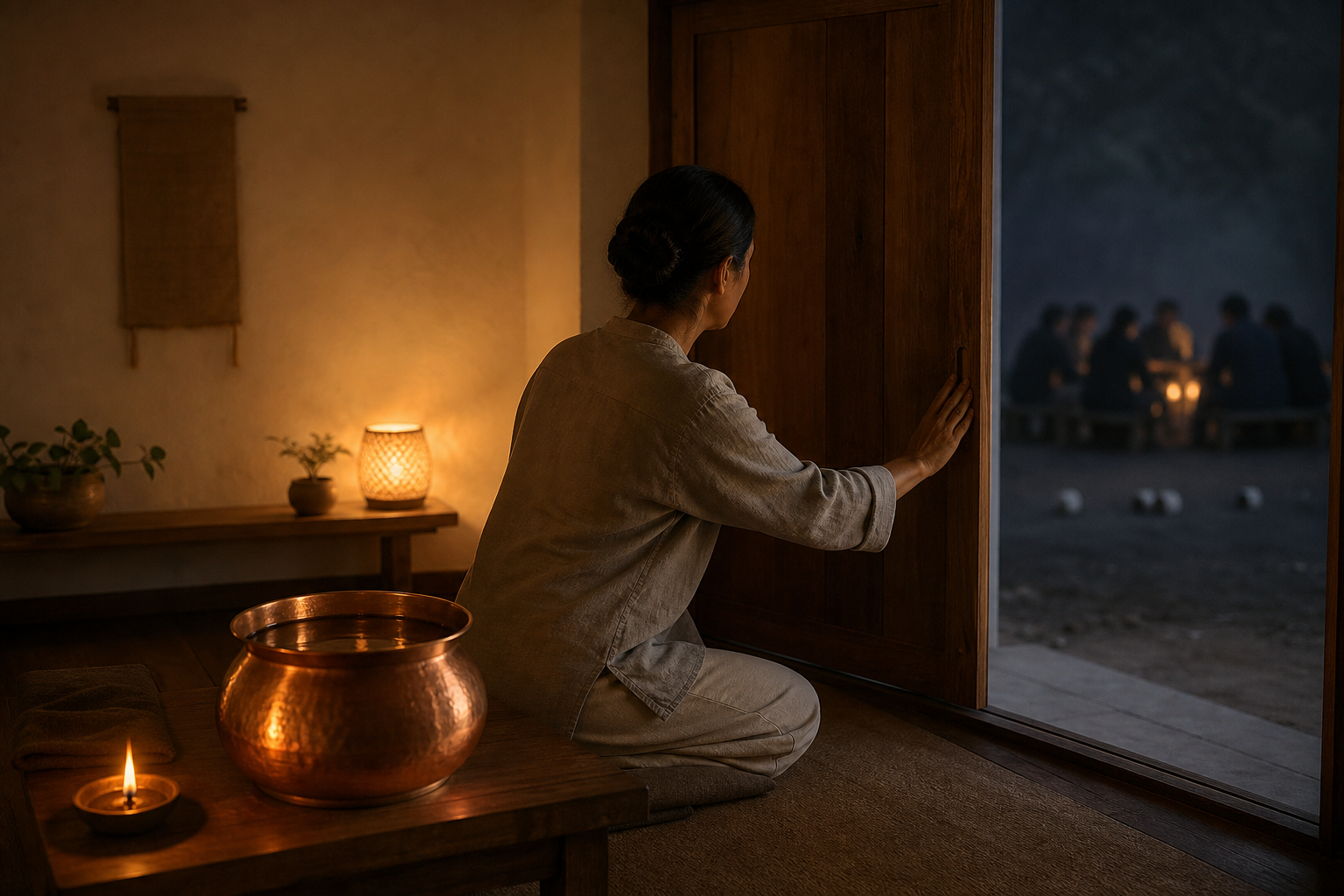
If you want to approach the symbolism at home without claiming an initiation you have not received, begin modestly. Place clean water in a clean kalasha or other suitable vessel on your altar. Make a truthful sankalpa. Recite a mantra already established in your regular worship, offer a flower or lamp if that is customary for you, sit until attention settles, and receive the water reverently as tirtha. This is a domestic reflection of sacred vessel worship, not a reconstruction of a restricted Kaula rite.
When a fuller Patra Puja is offered to you, ask four concrete questions before participating: Which sampradaya authorizes it? Who transmitted the method? What exactly is in the vessel? What conduct and result are expected afterward? A trustworthy answer will make the boundaries clearer, not use mystery to erase them.
Let your next step be small enough to remain honest. Clean the vessel, clarify the intention, choose what protects awareness, and watch what kind of person rises from the altar. That is where sacred vessel alchemy becomes more than an image.

References
