
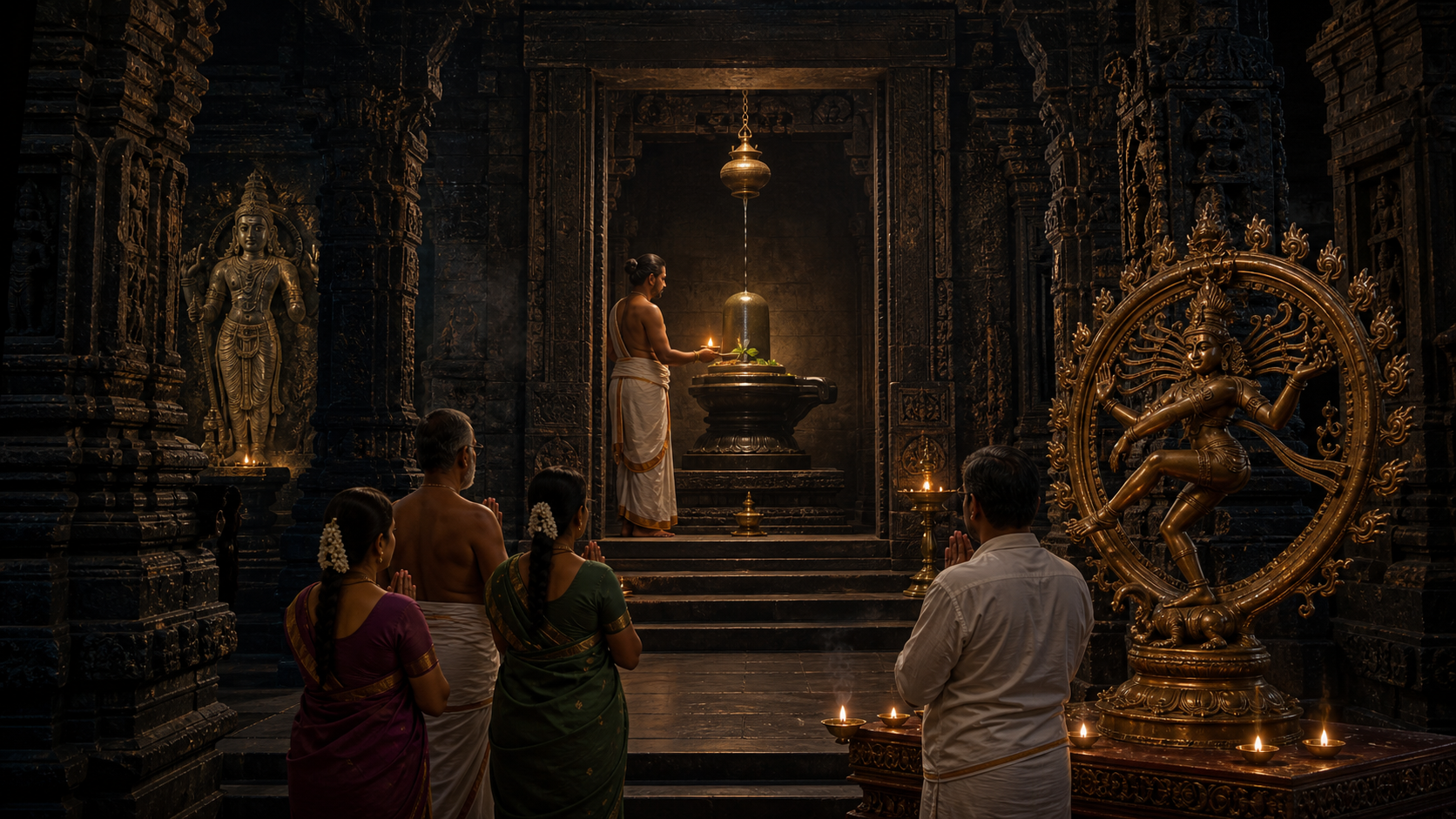
You enter a Shiva temple and meet what looks like a contradiction. The quiet linga in the dark sanctum receives water, flowers, food, lamps, and mantra every day, while a magnificent Nataraja or a fierce image of Shiva receives only a bow. If visual splendour determined ritual importance, the temple would make little sense.
The missing distinction is ritual office. A Shiva image can be sacred without being the temple’s principal object of daily puja. Once you learn to distinguish a primary icon, a processional murti, a niche deity, and a narrative relief, you can read the temple more clearly and offer devotion without crossing its ritual boundaries.
Begin with ritual office, not outward appearance
Shiva’s anthropomorphic forms make particular acts, qualities, and moods visible. Nataraja presents Shiva in cosmic dance. Tripurantaka shows him releasing the decisive arrow. Gajasura-samhara presents the subduing of the elephant-demon. Other images show Ravana attempting to lift Kailasa or Shiva sharing an intimate familial scene with Parvati. These are often called lilamurtis because they reveal divine lila, or action and play, through a recognizable episode.
The Shiva-linga works differently. It does not freeze one episode of the divine life into stone. It signifies Shiva as the unbounded axis, the brahmastambha, and therefore uses a concentrated form to point beyond any single body, mood, or story. This is why the usual Shaiva temple hierarchy places the linga at the centre of daily worship, even when more visually elaborate images surround it.
Consecration turns this theological distinction into a ritual one. Through prana-pratishtha, particular icons are installed for particular forms of service. The principal icon may receive the complete daily sequence of upacharas, while another image is assigned to festivals, processions, periodic honour, contemplation, or visual instruction. Two images of Shiva can therefore look equally sacred yet have different ritual rights.
| What you encounter | Its usual ritual office | How you should approach it |
|---|---|---|
| Mula-bhera or mulavar | The fixed principal icon, commonly a Shiva-linga, receiving regular temple worship | Receive the central darshana and follow the priest’s directions for offerings |
| Utsava-bhera | A consecrated processional icon, often made for festival worship and public procession | Venerate it during its appointed seva, festival, or procession |
| Parivara or koshta deity | An attendant or prescribed niche deity receiving a more limited or periodic protocol | Bow, circumambulate, and offer only what local custom permits |
| Narrative relief or sacred sculpture | Visual theology that teaches through posture, story, gesture, and mood | Take darshana, study the form, and protect it from touching or unsolicited offerings |
This is a working pattern, not permission to assume the status of an unfamiliar image. A niche figure may have been consecrated, and an anthropomorphic form may be the presiding deity of a particular temple. Ritual status belongs to the installed tradition of that shrine. When you are unsure, ask which icon is the mulavar and where personal offerings are accepted.
Darshana and formal puja must also be kept distinct. Darshana is reverential seeing: you place yourself before the deity and allow the sacred form to shape your attention. Puja is an organized act of service involving designated offerings and procedures. Bowing before a narrative panel does not make it insignificant. It means its primary gift may be vision and instruction rather than daily abhishekam.
Read the temple from its still centre outward
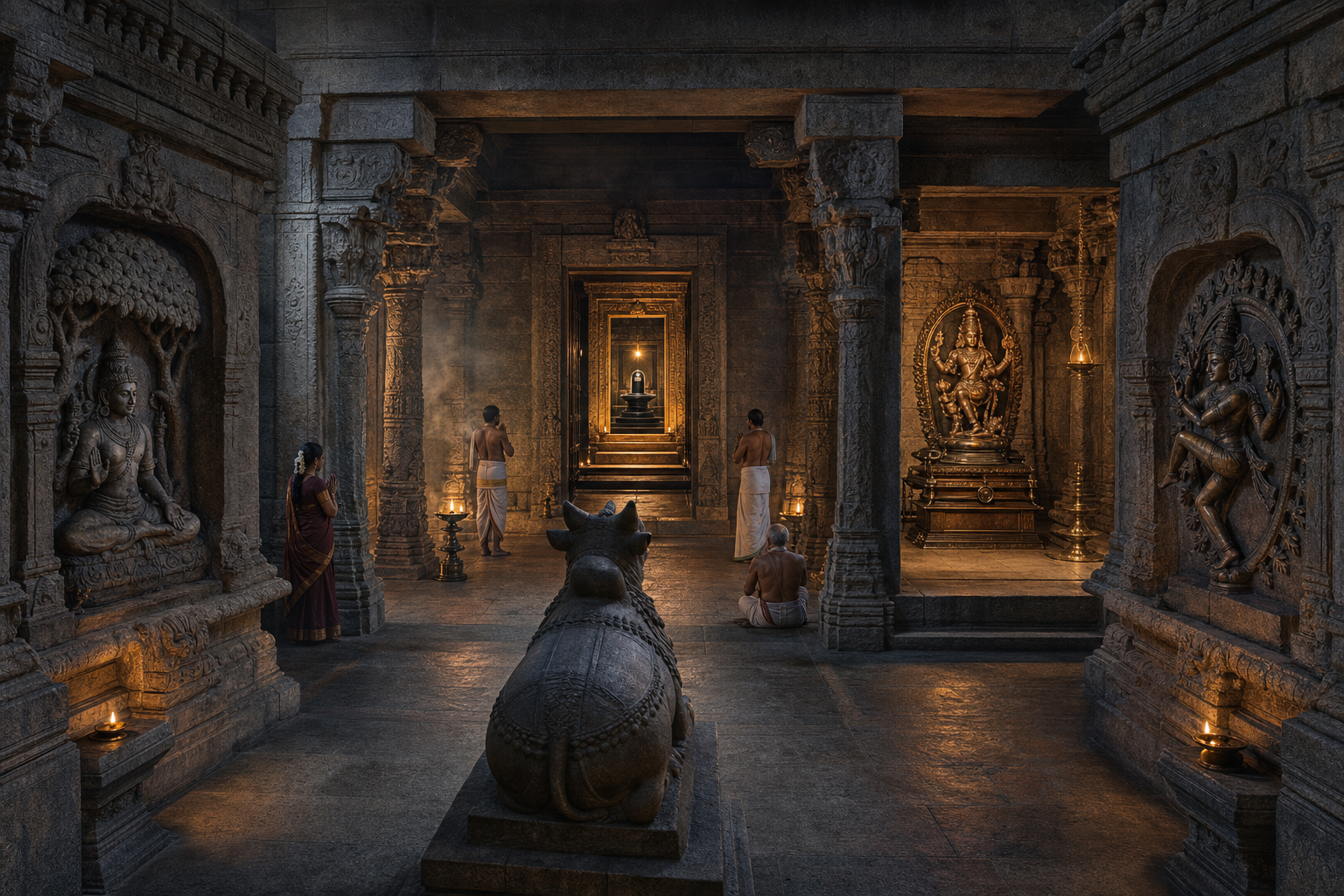
The linga establishes the contemplative centre
The garbhagriha is usually dark, compressed, and quiet. Its atmosphere supports shanta rasa, the mood of tranquillity. At its centre, the linga gives the mind little narrative detail to chase. You are invited to become still before a form that refuses to confine Shiva to one event or personality.
Lingodbhava makes that meaning visible in narrative form. Shiva appears as a column of light whose beginning and end cannot be found by Brahma and Vishnu. The image often occupies the western niche in a Dravida temple, while the linga inside the sanctum embodies the limitless axis without narrating the whole episode. One teaches through story; the other gathers the teaching into ritual stillness.
Do not interpret an aniconic emblem as an absence of divine personality. The linga and the lilamurti are not rivals. The first prevents you from reducing Shiva to one pictured event; the second prevents transcendence from becoming a remote abstraction. Each corrects a possible excess in how you see the other.
The surrounding forms unfold Shiva’s activity
As you leave the sanctum and walk around the prakara, stillness opens into divine action. In a common Dravida arrangement, Dakshinamurti appears on the south, Lingodbhava on the west, and Durga on the north. Mandapas, pillars, and outer walls give more room to movement, narrative, relationship, and dramatic rasa. Temple architecture thus becomes a spiritual itinerary: concentration at the centre, interpretation along the path.
Use four questions when you meet a Shiva image:
- What is Shiva doing? Dance, combat, instruction, repose, and family presence disclose different dimensions of divine action.
- What mood does the form establish? A tranquil image prepares a different response from a fierce or intensely energetic one.
- Where has the image been placed? Sanctum, niche, wall, mandapa, and processional chamber are ritual clues, not incidental locations.
- What signs of active service surround it? A permanent altar, fresh alankara, lamps, vessels, barriers, and a priestly sequence may indicate an installed worship protocol. Their absence is a reason to observe before acting.
Fierce forms require particular care in interpretation. An image of Shiva defeating a destructive force can radiate intense tejas. Placing such a form away from the innermost sanctum can preserve the sanctum’s tranquil mood; it does not imply embarrassment about Shiva’s power or a lower theological rank. Where Bhairava or another fierce form presides, a specialized ritual order governs the shrine.
Somaskanda offers another kind of lesson. In a number of Chola-era temples, the image of Shiva, Parvati, and Skanda appears behind the sanctum linga. The familial scene lends tenderness and social intimacy to the sacred space without replacing the linga as its central ritual focus. When you notice two forms placed in deliberate relation, read the relationship before trying to rank them.
Follow the temple’s protocol without overlooking its art
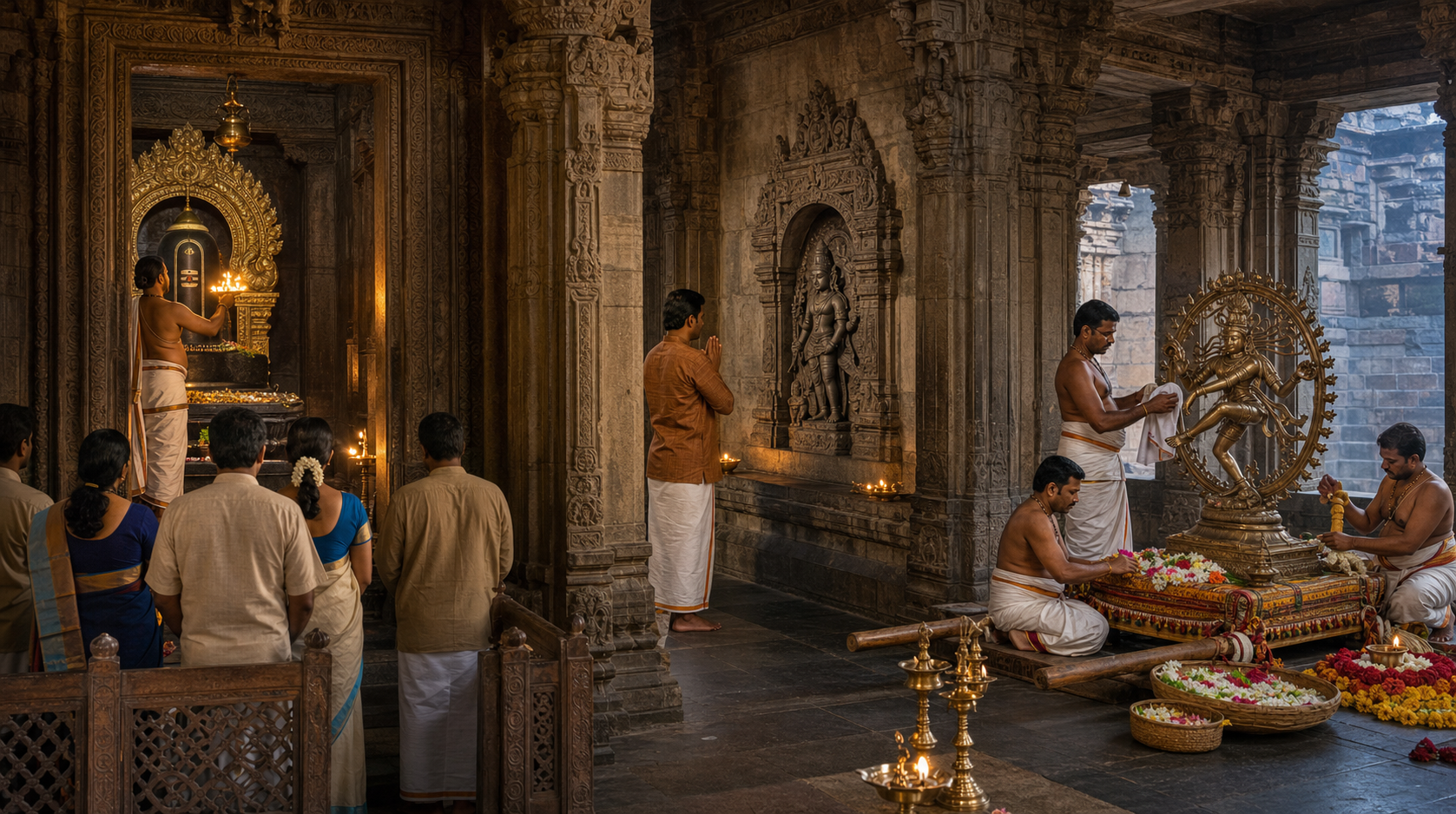
A good temple visit joins devotion to attentiveness. You do not need specialist knowledge before entering, but you should resist treating every sculpture as an open altar. The following sequence works well when the temple has not posted different instructions.
- Pause before making an offering. Notice the route devotees follow, the location of the principal sanctum, and any signs restricting entry, photography, touching, or liquids.
- Identify the presiding icon. The mula-bhera anchors the temple’s regular worship. If you cannot tell which form holds that office, ask rather than infer it from size or ornament.
- Receive darshana before requesting anything. Let seeing and attention come first. This keeps puja from becoming a hurried transaction.
- Give offerings through the authorized channel. Place flowers, bilva leaves, naivedya, or abhishekam materials where the priest or temple arrangement directs. Do not apply substances directly to an icon unless that practice is clearly permitted.
- Circumambulate with attention to the niches. Observe posture, direction, accompanying figures, weapons, gestures, and mood. A brief bow is an appropriate default where no separate service is taking place.
- Ask about the utsava-murti. If a Nataraja, Somaskanda, or Chandrasekhara appears in a processional setting, find out when that icon receives festival worship or leaves the temple.
- Leave ancient surfaces untouched. Oils, water, powders, repeated handling, and improvised abhishekam can damage stone, pigments, and inscriptions. Reverence includes vigraha-rakshana, the care of the sacred form.
The safest assumption is not that a wall image is merely decorative. It is sacred art performing a different duty. Treating it respectfully while withholding unsolicited ritual substances honours both its theology and its material survival.
Recognize the exceptions without losing the principle
Chidambaram places Nataraja, the dancing anthropomorphic form, at the centre of its daily sequence. Tiruvarur gives exceptional liturgical prominence to Tyagaraja, while celebrated Nataraja icons elsewhere can receive rigorous worship. These cases show that shape alone never determines ritual status. A lilamurti installed as the presiding or festival deity can receive full worship by the authority of that temple’s tradition.
Festival time can also change which icon comes to the foreground. During Arudra Darshanam, a consecrated Nataraja may receive elaborate abhishekam and procession. Music, dance, lamps, vehicles, and public darshana allow Shiva’s presence to move from the temple’s still centre into communal space. The icon has not suddenly become sacred; its appointed liturgical time has arrived.
So avoid the loose claim that narrative images are seen but never worshipped. A more accurate rule is this: every sacred image deserves reverence, while formal services follow consecration, ritual office, festival calendar, and local parampara.
Build a simple home puja around steadiness and suitability
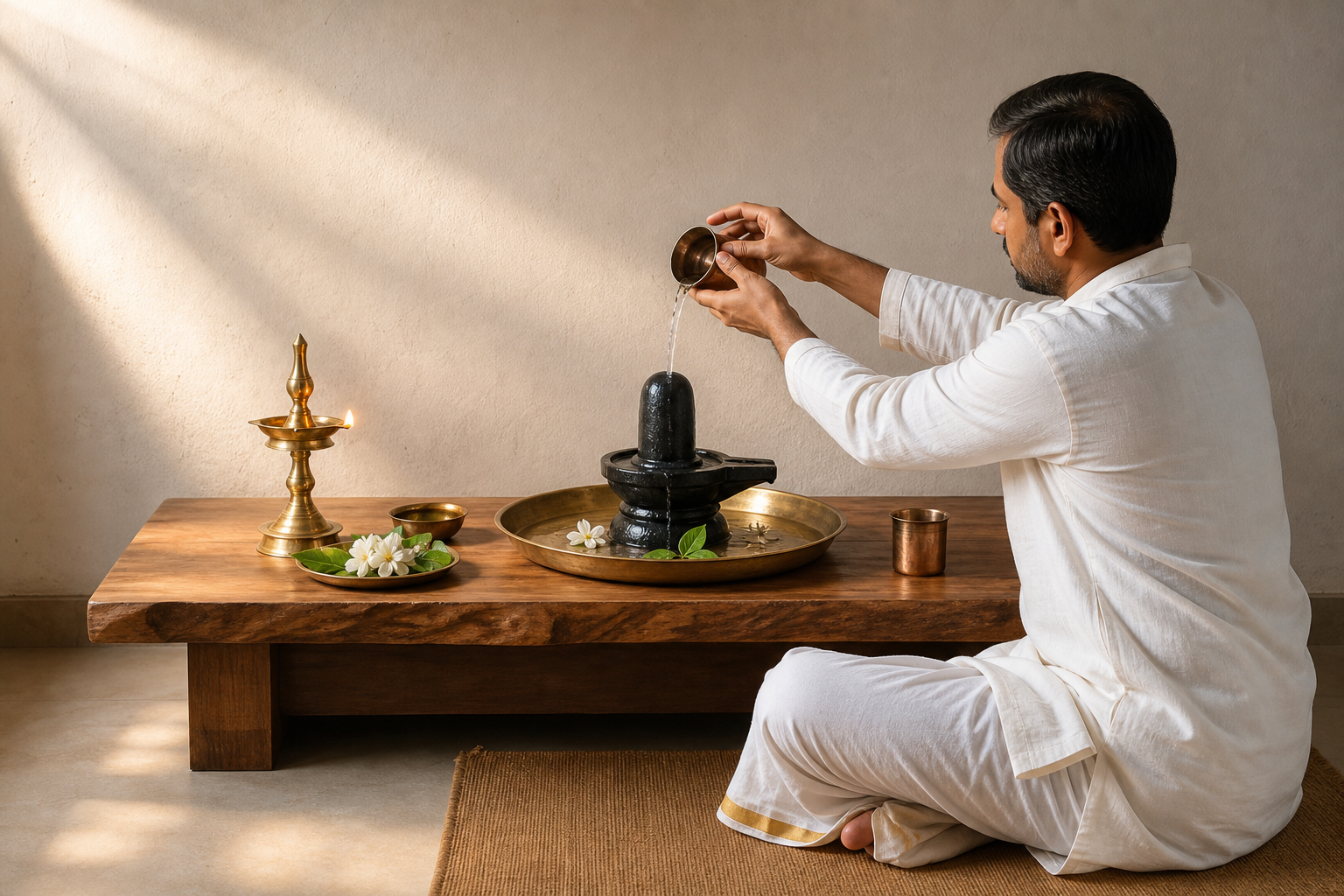
Your home shrine does not need to reproduce a large temple’s hierarchy. It does need a stable devotional focus and a form of worship suited to the object in front of you. An inherited or formally installed linga or murti should be served according to the family’s instructions. If a consecrated installation carries obligations you do not understand, seek guidance from the temple or acharya connected with that tradition.
For a modest household practice, simplicity is an advantage. A clean, repeatable sequence is more useful than copying an elaborate festival ritual once and abandoning it.
- Choose the focus deliberately. Use the Shiva-linga or image already accepted in your household practice. Do not turn an antique, painted relief, porous sculpture, or decorative wall image into an abhishekam object.
- Prepare before lighting the lamp. Clean the worship area and arrange a diya, clean water, a suitable vessel, and bilva leaves where they are customary and available. This prevents you from leaving the ritual midway to find materials.
- Make a clear sankalpa. State the purpose of the worship plainly: devotion to Shiva, observance of a vrata, remembrance of a family intention, or cultivation of inner steadiness.
- Offer water with restraint. Perform a simple water abhishekam only on a linga or murti suitable for liquids and placed in a receptacle that can contain them. Panchamrita belongs only where your practice permits it and the icon can be cleaned without damage.
- Offer bilva and mantra. Place the leaves respectfully and repeat Om Namah Shivaya at a pace that keeps the mind with the sound. Do not let counting replace attention.
- End in stillness. Sit quietly after the visible offerings. The transition from action to silence allows the home ritual to express the same movement held by the temple: Shiva manifest in form and Shiva beyond any single depiction.
- Restore the space. Clean the vessel and worship area promptly, and handle offerings according to your family or local custom.
If your chosen focus is a printed Nataraja, a framed image, or a material that should remain dry, offer light, flowers, mantra, and attention instead of liquid. Abhishekam is not a test of devotional seriousness. An unsuitable offering that damages the image defeats the care that puja is meant to express.
Use the correct lunar window for a named observance
Ordinary devotion and a formally named vrata are not the same decision. For Pradosh observance, Trayodashi must prevail during the evening twilight known as Pradosh Kaal. For Masik Shivaratri, Krishna Paksha Chaturdashi should prevail in the relevant evening and night period. Those conditions must be checked for your location; a date or clock time copied from another city may not match your sky.
Tithi is determined by the changing angular separation of the Sun and Moon, and sunrise and sunset vary with place. Drik and Vakyam computational traditions can also produce slightly different transition times. Use the panchang followed by your family, a trusted location-aware almanac, or the schedule of the temple where you observe the vrata.
Month labels can differ as well. Northern Purnimanta and southern Amanta conventions may attach different month names to the same lunar day. Do not abandon your parampara because another calendar labels the date differently. Verify the operative tithi and its timing, then follow the customary system of your family or locale.
If you cannot verify the required lunar window, perform your ordinary Shiva devotion without claiming the named vrata. A diya at dusk, a suitable water offering, bilva, mantra-japa, and quiet meditation can be scaled to your circumstances while preserving the essential movement from intention to offering and then to stillness.
Key takeaways for worshipping Shiva’s forms well
- The most dramatic image is not automatically the principal object of daily worship; identify its ritual office first.
- The Shiva-linga expresses the unbounded centre, while lilamurtis make Shiva’s actions, relationships, and moods visible.
- Darshana is a complete devotional act. An image does not need to receive your personal abhishekam in order to be sacred.
- Sanctum, niche, wall, processional chamber, and festival route each provide clues about how an icon functions.
- Never pour liquids, apply powders, or touch an unfamiliar image without permission, especially when it is an ancient relief.
- At home, match the offering to the material: use water only for a suitable worship icon, and use light, flowers, mantra, and contemplation for images that must remain dry.
- For Pradosh or Masik Shivaratri, verify the qualifying tithi in a location-aware panchang rather than relying on a fixed date or clock time.
On your next temple visit, identify three things before making an offering: the fixed presiding icon, the processional icon, and the forms that teach through story. That small act of attention will turn a collection of beautiful objects into an intelligible sacred order.
At home, choose the simplest observance you can sustain with care. Let the icon give devotion a form, and let the silence after puja keep that form open to the immeasurable Shiva it reveals.
References
- DharmaRenaissance Blog — Unveiling the Sacred Logic: Why Shiva’s Lilamurtis Adorn Temples Yet Rarely Receive Puja
- DharmaRenaissance Blog — June 13, 2026 Panchang: Krishna Trayodashi to Chaturdashi, Shubh Muhurat and Ritual Wisdom
