

You may have opened a list of Shakti Peethas and immediately met a problem: the names, body parts and even the number of sites can change from one tradition to another. If you treat sacred geography as a directory that must have one final, error-free edition, those variations look like contradictions.
Ask a better question: what does each place teach about Shakti? That shift turns a pilgrimage map into a metaphysical map. It also gives you a practical way to approach a shrine, interpret its physical features and carry its teaching home without flattening distinct regional traditions into one generic Goddess cult.
A Peetha is a seat, not merely a pin on a map
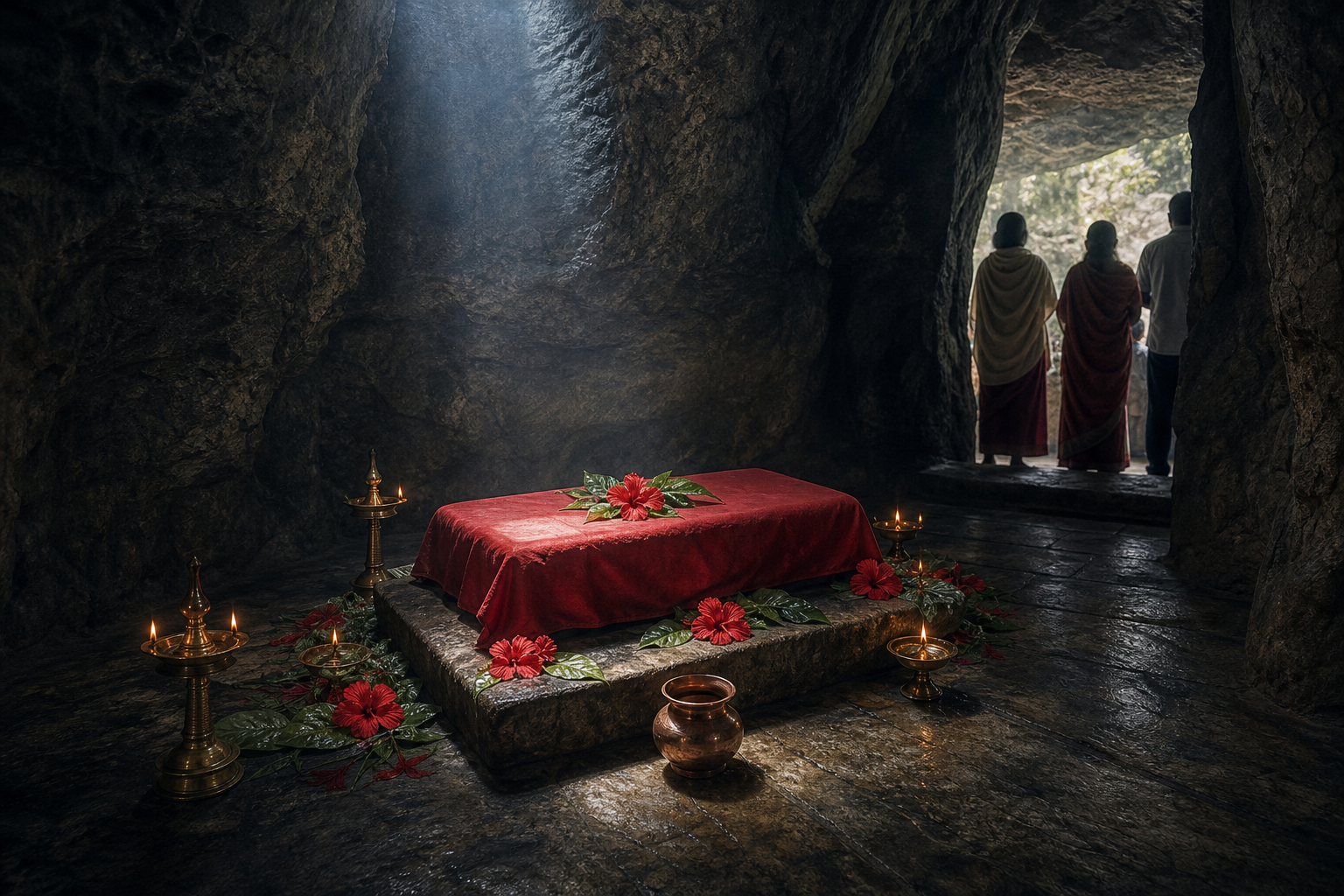
Peetha means a seat: a place where power is established, encountered and transmitted. In Shakta usage, the word therefore carries more weight than “temple.” A temple can be understood as a structure erected around a deity, but a Shakti Peetha often asks you to recognize the terrain itself as the Goddess’s form. A hill, cave, riverbank, spring, fissure or womb-like chamber may be central to the encounter rather than incidental scenery.
Kamakhya makes this principle unusually clear. Its sanctum on Nilachal Hill contains a natural rock fissure continuously bathed by an underground spring. There is no anthropomorphic murti at the center. You do not stand before a representation of the Goddess so much as descend toward living geology received as her yoni, her generative presence.
This changes how you should look at sacred space. The material feature is not a primitive substitute for a more sophisticated image. It is the theology. Rock conveys stability and depth; water conveys movement, renewal and inexhaustible emergence; descent into a cave reverses the ordinary outward movement of the senses. The pilgrim’s body learns through direction, texture, darkness, sound and proximity before the intellect formulates a doctrine.
The lists of Peethas preserved in Puranic, tantric and regional traditions do vary. Their differences need not be forced into a single modern inventory. A regional enumeration may express a particular lineage, ritual circuit or memory of the land. Another may associate a site with a different part of Sati’s body or a different form of the Goddess. The stable principle is not uniform cataloguing but the distribution of sacred presence across many centers.
When you encounter a Peetha, use four questions instead of asking only where it ranks on a list:
- What form or function of Shakti is emphasized here?
- Which physical feature of the place carries that teaching?
- How do the route, thresholds and sanctum train the pilgrim’s attention?
- What ritual or ethical response is expected after the encounter?
Those questions work whether you are standing at a famous pilgrimage center, visiting a regional shrine or studying a sacred map from home. They keep the place specific while revealing the metaphysics within it.
A dispersed divine body becomes a geography of wholeness

The narrative of Sati’s bodily dissolution explains why Shakti is encountered through a network rather than at only one central sanctuary. As parts of her body descend upon the land, each location becomes a Peetha. What begins as rupture is answered by consecration: no fragment is spiritually abandoned, and no single center exhausts the whole.
This is why the story should not be reduced to an ancient travel legend. It makes three claims you can use when reading Shakta geography.
- The body is not outside sacred reality. Embodiment, fertility, mortality and transformation can disclose the Divine rather than obstruct it.
- Difference need not mean separation. Many Goddess forms, local names and ritual cultures can belong to one field of Shakti without becoming interchangeable.
- There can be many centers. A mandala is organized through relationship, not through the exclusion of every center except one.
The third point is especially important. Modern habits tempt us to search for the “main” site and demote the rest to copies. Shakta geography resists that reflex. Each Peetha can be complete as a manifestation while remaining relational as part of a larger body. The whole is present through the network, yet every node has its own theological accent.
That principle also explains why local tradition matters. A pan-Indian name does not cancel the memory of a village, dynasty, river community or tantric lineage that has cared for a shrine. Kamakhya’s surviving structure reflects a reconstruction under Koch rulers in the 16th century, while a major restoration of Guhyeshwari is associated with King Pratap Malla in the 17th century. These layers do not manufacture the sanctity of the sites; they show how communities repeatedly accepted responsibility for maintaining sacred presence in public life.
There is an ethical consequence here. If terrain participates in the Goddess’s body, care for water, hills, access routes and surrounding communities is not an optional environmental addition to pilgrimage. It belongs to the logic of reverence. Leaving waste near a sacred spring while offering flowers inside the sanctum divides worship from conduct in precisely the way Shakta metaphysics refuses to divide spirit from manifestation.
Four correspondences turn geography into metaphysics
The easiest way to understand a Shakta site is to notice four correspondences operating at once. They should not be collapsed into a crude code in which every hill equals one organ or every shrine equals one chakra. They are contemplative relationships: each level helps you perceive the others more clearly.
1. Consciousness and power
Shakta thought begins with the inseparability of consciousness and its power. Shiva names consciousness in repose; Shakti names its capacity to know, will and act. The opening verse of Saundarya Lahari states the point sharply: without union with Shakti, Shiva cannot bring forth even the slightest movement. This does not subordinate one deity to another. It says that being and efficacy, awareness and expression, are distinguishable but never finally divided.
The three modalities of Shakti make the principle practical: iccha is will, jnana is knowledge and kriya is action. A pilgrimage that stirs emotion but changes none of these remains incomplete. Before visiting, clarify your intention. At the site, learn what the tradition is actually teaching. Afterward, turn the encounter into an appropriate action. Will without knowledge becomes impulse; knowledge without action becomes display; action without clear intention becomes restlessness.
Shakti also operates through five cosmic acts: emanation, maintenance, reabsorption, concealment and grace. A shrine may give one of these acts unusual prominence. A fertility rite foregrounds emergence; an ancestral observance may bring maintenance and continuity into view; a cremation-ground form confronts dissolution; an esoteric sanctum uses concealment as spiritual discipline; a protective Goddess embodies grace. Ask which movement of reality the place is teaching you to recognize.
2. Yoni and garbha
Yoni and garbha provide a second correspondence. Yoni is origin and threshold: the point at which the unmanifest enters form. Garbha is womb, interior and gestation: the protected space in which transformation becomes possible. They are related but not identical. One emphasizes emergence; the other emphasizes formation within a hidden center.
This language is embodied, but it should not be reduced to reproductive anatomy alone. It describes how anything comes into being. An intention crosses a threshold, enters a period of formation and eventually becomes action. Insight does the same. So does a civilization: memory is received, cultivated within communities and expressed in renewed forms.
The garbhagriha, literally the womb-chamber of a temple, makes the same movement architectural. You pass from a more public exterior through increasingly concentrated thresholds toward a dark, restricted center. The journey teaches that sacred knowledge is not consumed at a glance. Attention must be gathered before presence can be received.
The downward-pointing triangle and central bindu of the Sri Chakra express this generative concentration diagrammatically. The triangle directs attention to Shakti’s power of manifestation; the bindu holds multiplicity in a concentrated center. Temple, terrain and yantra are therefore not three unrelated religious objects. They are different instruments for training perception toward origin, manifestation and return.
3. Outer terrain and the pilgrim’s body
Shakta practice frequently reads the human body as a field of sacred power. Kundalini language describes Shakti as grounded at muladhara, disciplined and intensified at manipura, refined toward compassion at anahata and concentrated as insight at ajna. The point is not to assign every Peetha a universally fixed chakra. It is to recognize that the outward journey through sacred terrain is meant to awaken an inward journey through habit, emotion, attention and discernment.
Notice what a site makes your body do. Do you climb, descend, circumambulate, bow, wait or enter silence? Does water touch the body? Does the sanctum constrict your field of vision? These actions are not logistical interruptions before the spiritual experience. They are part of the instruction. A descent may cultivate interiority; circumambulation may displace the ego from the center; waiting may expose impatience more honestly than a lecture could.
4. Liminal places and unexamined fear
Fierce forms such as Chamunda prevent sacred geography from becoming a collection of pleasant landscapes. Her cremation-ground setting brings the pilgrim to a boundary where social identity, bodily permanence and ordinary control cannot be maintained. Her skull imagery points beyond limited cognition, while the surrounding signs of death and wildness reclaim regions of experience that respectable consciousness would prefer to avoid.
The appropriate response is neither sensationalism nor imitation. Fierce iconography is a discipline of interpretation. Ask what fear the image refuses to conceal, which attachment has been mistaken for identity and what kind of courage would serve dharma rather than ego. Chamunda’s destruction of Chanda and Munda can be read inwardly as the mastery of aggressive and cunning impulses, not as permission to glorify aggression.
This gives you a reliable test for any interpretation of divine power: does it deepen discernment, restraint and compassionate action? Shakti separated from viveka and karuna becomes mere force. A genuine encounter with a fierce shrine should make conduct more disciplined, not the personality more domineering.
Kamakhya and Guhyeshwari reveal two movements of one power
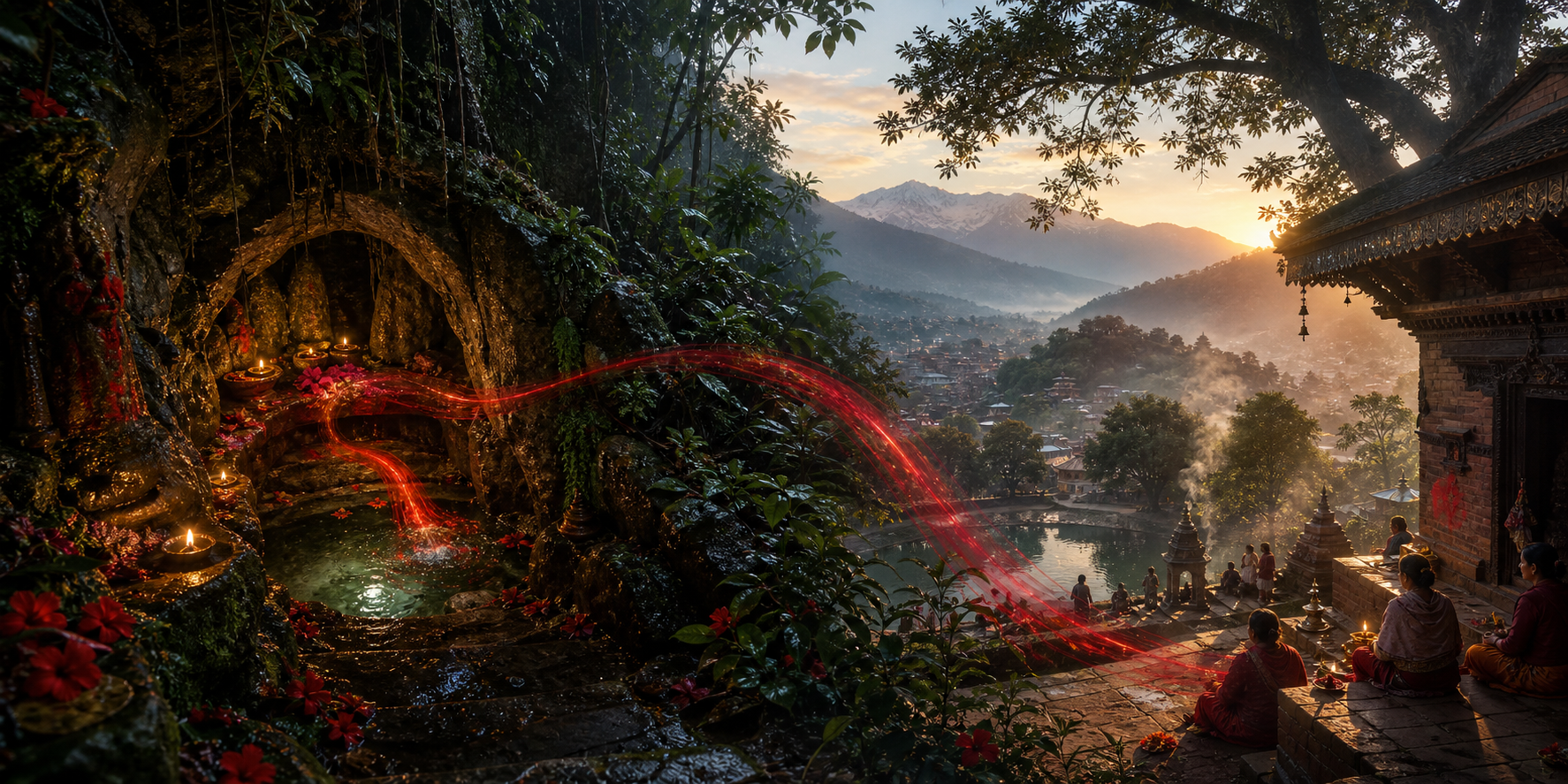
Kamakhya in Assam and Guhyeshwari in the Kathmandu Valley offer a particularly useful way to see Shakta geography working across terrain, architecture and civilizational space. They should not be treated as identical shrines, and the yoni-garbha relationship is best used as an interpretive lens rather than imposed as the only authorized classification. Their differences are what make the relationship illuminating.
| Site | Material and ritual focus | Metaphysical emphasis | What to notice |
|---|---|---|---|
| Kamakhya | Natural rock fissure, subterranean spring, cave-like sanctum and the Ambubachi cycle | Yoni as origin, threshold, fertility and emergence | Descent, water, living geology and the integration of bodily and cosmic cycles |
| Guhyeshwari | Sacred yoni within an intimate, womb-like chamber near Pashupatinath | Garbha as hidden interior, gestation and transformation | Concentration, restricted access, stillness and the relation between Shakti and the Shaiva axis |
Kamakhya’s annual Ambubachi observance makes the Goddess’s menstrual cycle ritually visible. The temple closes for several days before reopening to pilgrims. The practice joins body, earth and cosmic rhythm without treating menstruation as an embarrassment that must be excluded from sacred language. It asks you to see fertility as cyclical power rather than uninterrupted production.
The surrounding shrines of the Dasha Mahavidyas broaden that lesson. Shakti is not confined to one mood. She appears as beauty and terror, abundance and renunciation, speech and silence, worldly engagement and radical transcendence. Moving through the complex can therefore function as a pedagogy of plurality: apparently opposed forms belong to a more comprehensive unity.
Guhyeshwari places greater emphasis on hiddenness. Its name evokes the Goddess as sovereign of the secret or interior domain. The shrine’s proximity to Pashupatinath also makes the Shiva-Shakti relationship spatially legible. Visiting the two in relation can teach more than treating each as an isolated attraction: consciousness and power, repose and manifestation, are contemplated through a paired sacred landscape.
The Kathmandu setting also carries a lesson in Dharmic coexistence. Newar Hindu and Vajrayana Buddhist communities have participated in a shared tantric topography while retaining distinct lineages and disciplines. Shared vocabulary does not require the claim that every doctrine is the same. It shows how proximity, reciprocal recognition and disciplined difference can sustain a plural sacred culture.
Read together, the Brahmaputra valley and the Bagmati basin also correct a narrowly national reading of Dharma. Contemporary borders matter politically, but they do not contain the older circulation of pilgrims, ritual specialists, artistic forms and tantric vocabularies. Shakta geography records a civilizational field extending across regions without erasing their particular histories.
Do not demand a prescribed emotion from either shrine. Some devotees describe Kamakhya through vitality and earthy immediacy and Guhyeshwari through stillness and contemplative spaciousness. Such descriptions can prepare your attention, but they are not a test of spiritual success. Your task is to observe the site carefully, not manufacture the feeling you think a serious pilgrim ought to report.
Turn a visit from religious tourism into disciplined pilgrimage
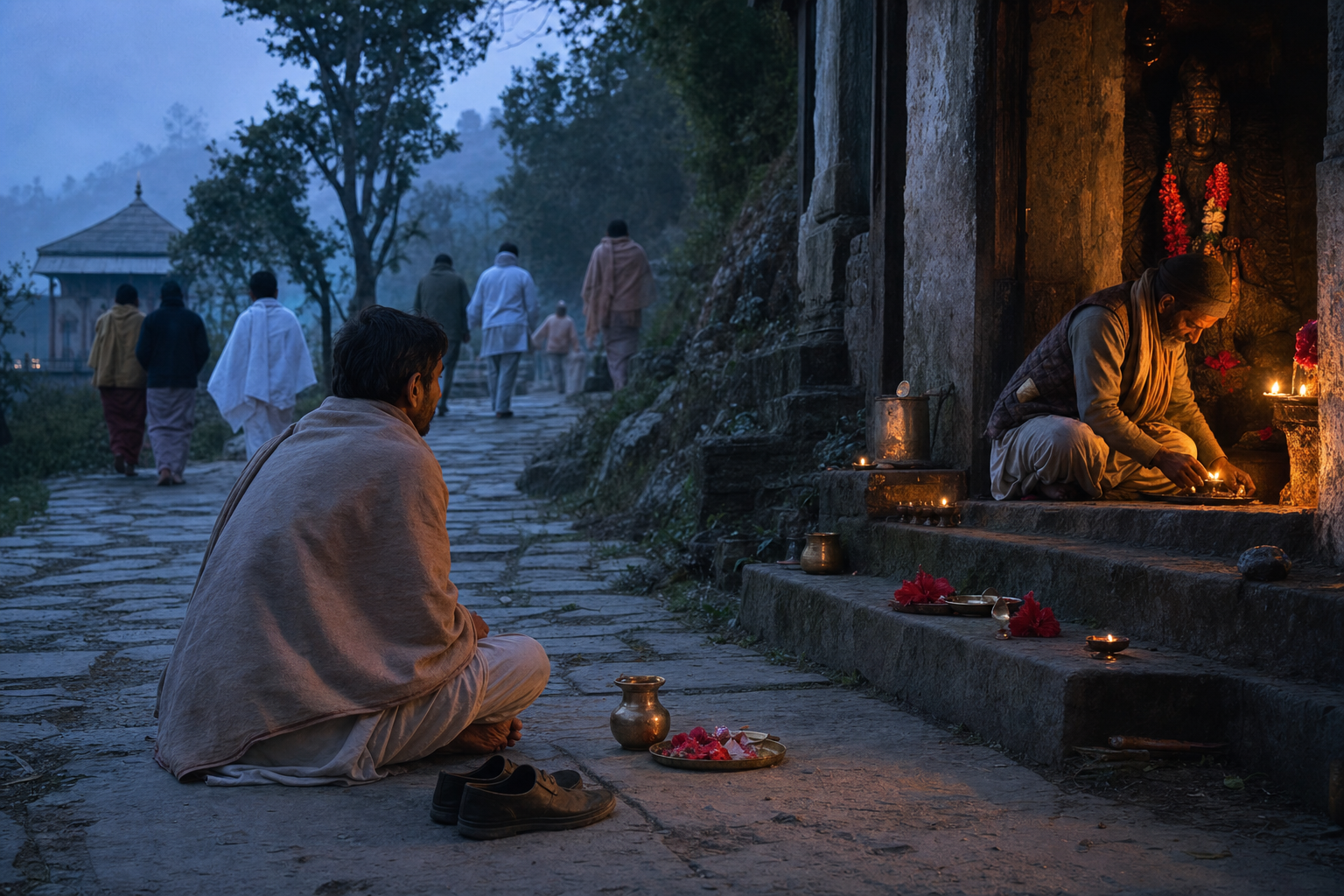
You do not need esoteric initiation to approach a public shrine respectfully. You do need to distinguish public devotion from restricted tantric practice. A sacred place is not made more authentic by crossing a boundary that its custodians have asked you to honor.
- Choose the site by its teaching, not only its fame. If you are studying manifestation and embodied sacredness, Kamakhya offers a clear focus. If you are contemplating interiority and the Shiva-Shakti relationship, Guhyeshwari offers another. If fear, impermanence or misused power is your concern, a fierce form such as Chamunda may be the more honest doorway. These are orientations, not promises of a particular result.
- Learn one local account before you arrive. Identify the presiding form, the central physical feature and the behavior expected near the sanctum. Do not assume that rules learned at one Peetha apply at another.
- Set one intention in the language of iccha, jnana and kriya. Write down what you seek, what you need to understand and what action may follow. One sentence for each is enough. This prevents the visit from dissolving into impressions and photographs.
- Read the approach as part of the shrine. Notice direction, elevation, water, sound, thresholds, waiting and changes in light. Ask what each transition does to your attention before deciding what it symbolizes.
- Accept limits without resentment. Observe silence and modesty, follow local rules for offerings and photography, and keep respectful distance from rites restricted to initiates. Access is not the measure of grace.
- Complete the pilgrimage through conduct. Within a day of leaving, return to your three sentences. Refine the intention, record one thing learned and choose one proportionate act of seva, restraint, repair or disciplined practice.
If travel is not possible, you can still work with the same structure at home. At dawn or twilight, prepare a clean place with a lamp, water, flowers, scent and a food offering. Recite a stotra belonging to a tradition you understand, then sit quietly with the three powers of will, knowledge and action. Keep the practice simple. Its credibility lies in regularity and dharmic conduct, not in borrowing advanced mantras or private rites without initiation.
A useful home contemplation begins with a single physical feature. Visualize Kamakhya’s spring and ask what in your life needs honest renewal. Contemplate Guhyeshwari’s inward chamber and ask what must mature before it is made public. Sit with Chamunda’s cremation ground and ask which temporary identity you are defending as though it were permanent. End by naming one action that answers the question.
Key takeaways
- A Shakti Peetha is a seat of power whose terrain, architecture, deity and ritual form one teaching.
- Variations among Peetha lists reflect multiple lineages and regional memories; they do not require you to dismiss the entire geography or force every account into one catalogue.
- Shiva and Shakti name consciousness and its inseparable power, while iccha, jnana and kriya give you a practical measure of whether pilgrimage has changed anything.
- Yoni emphasizes emergence; garbha emphasizes interior formation. Kamakhya and Guhyeshwari make those complementary movements tangible.
- Fierce imagery should produce discernment, restraint and fearlessness in service of dharma, not fascination with domination.
- The most faithful response to sacred land includes respect for local custodians, restricted rites, the surrounding environment and the communities that sustain the shrine.
Begin with one place rather than another long list. Learn its form of Shakti, identify the feature of the land that carries its teaching, and choose one action through which that teaching can enter your life. The sacred map becomes legible when you stop collecting its points and allow one of its centers to reorient you.
References
- DharmaRenaissance Blog — Sri Chamunda Stotra: Unveiling Shakti, the Primordial Force Animating All Gods and Cosmos
- DharmaRenaissance Blog — Kamakhya & Guhyeshwari: Unveiling the Yoni-Garbha Continuum of Shakti Across the Himalaya
