
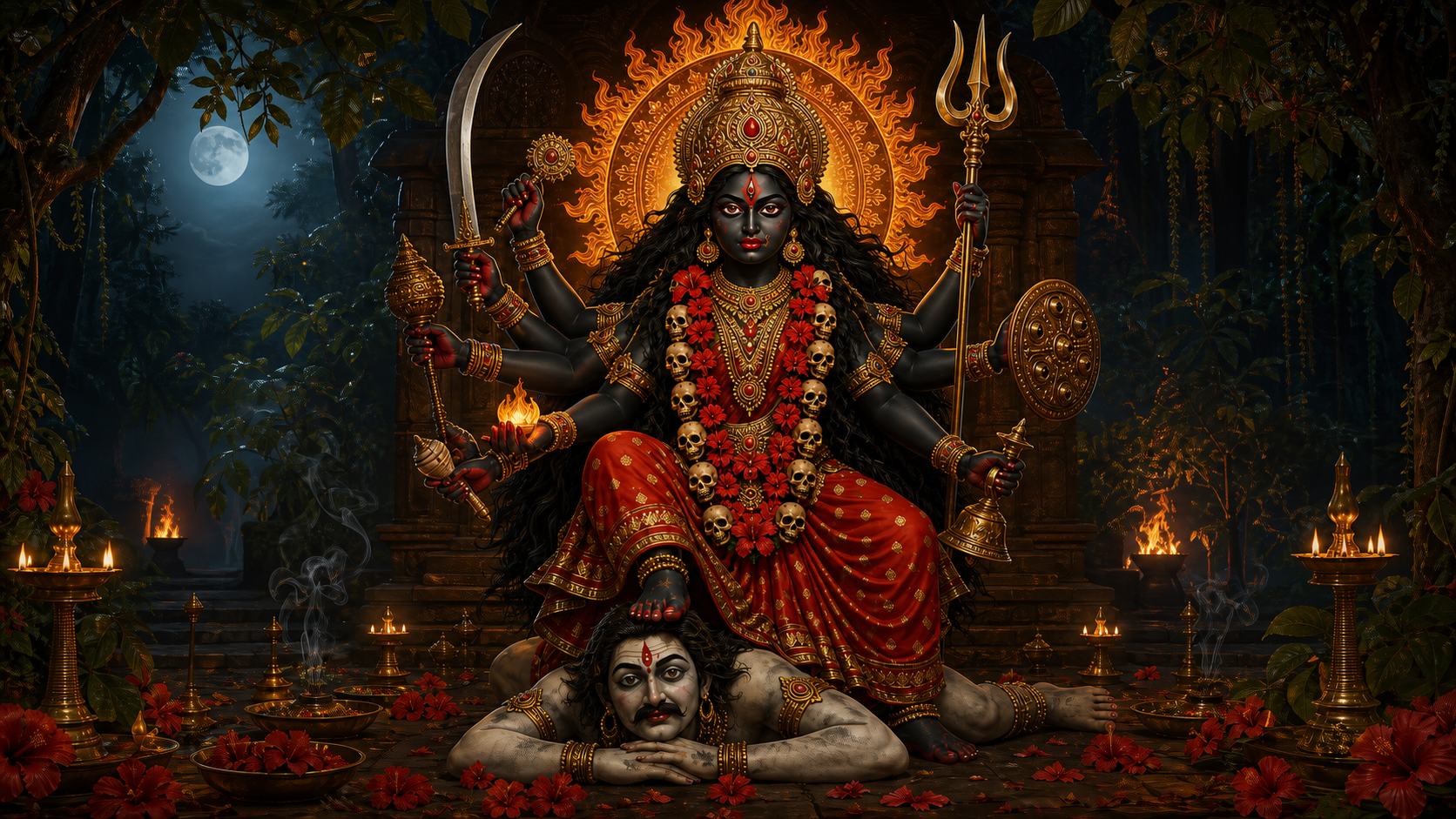
You may have seen a Kerala image of Bhadrakali, or watched a performance of her battle with Darika, and noticed a corpse-like being beneath the Devi. Is it an enemy, a throne, or her vehicle? Position alone does not settle the question.
Kerala’s Shakta tradition permits several related but distinct forms: a Vetala as vahana, a corpse serving as a pretasana, and a figure trampled as an embodiment of pride or adharma. Once you keep those forms separate, the scene becomes legible. It presents a theology of protection in which the Mother does not avoid death, disorder, and fear. She places them under dharmic command.
Begin with the relationship beneath the goddess
Your first task is not to name the creature. It is to identify the relationship between the lower figure and the goddess. The same area beneath Bhadrakali’s feet can carry more than one iconographic meaning, and treating every corpse-like form as a Vetala produces a confident but unreliable interpretation.
- Start with the local designation. Does a temple tradition, ritual litany, performer, or thottam pattu identify the being as a Vetala, bhuta, preta, adversary, or symbolic corpse? A local ritual name is stronger evidence than resemblance alone.
- Distinguish mounting from sitting and trampling. A figure functioning as a vehicle bears the Devi. A pretasana functions as her seat. A body under her foot may instead signify defeated pride, disorder, or adharma.
- Identify the narrative being enacted. If the setting is Darika-vadha, the composition belongs first to Bhadrakali’s victory over Darika. Do not add a Vetala merely because the performance uses cremation-ground imagery.
- Use the goddess’s attributes to identify her, not the lower figure. The trishula, kapala, sword, shield, unbound hair, and garland of heads establish a fierce Bhadrakali field, but they do not by themselves prove that the being below is her vahana.
This method matters because Kerala preserves regional forms in which a bhuta or Vetala may appear beneath the goddess, as her seat, or as her mount. Those positions share a language of mastery over death, but they are not interchangeable labels.
The safest reading is therefore layered. First establish what the local tradition calls the form. Then determine whether the relationship is vahana, seat, or subjugation. Only after that should you interpret its theology. A pan-Indian iconographic chart cannot replace those three steps.
A vahana reveals what the deity has placed under command
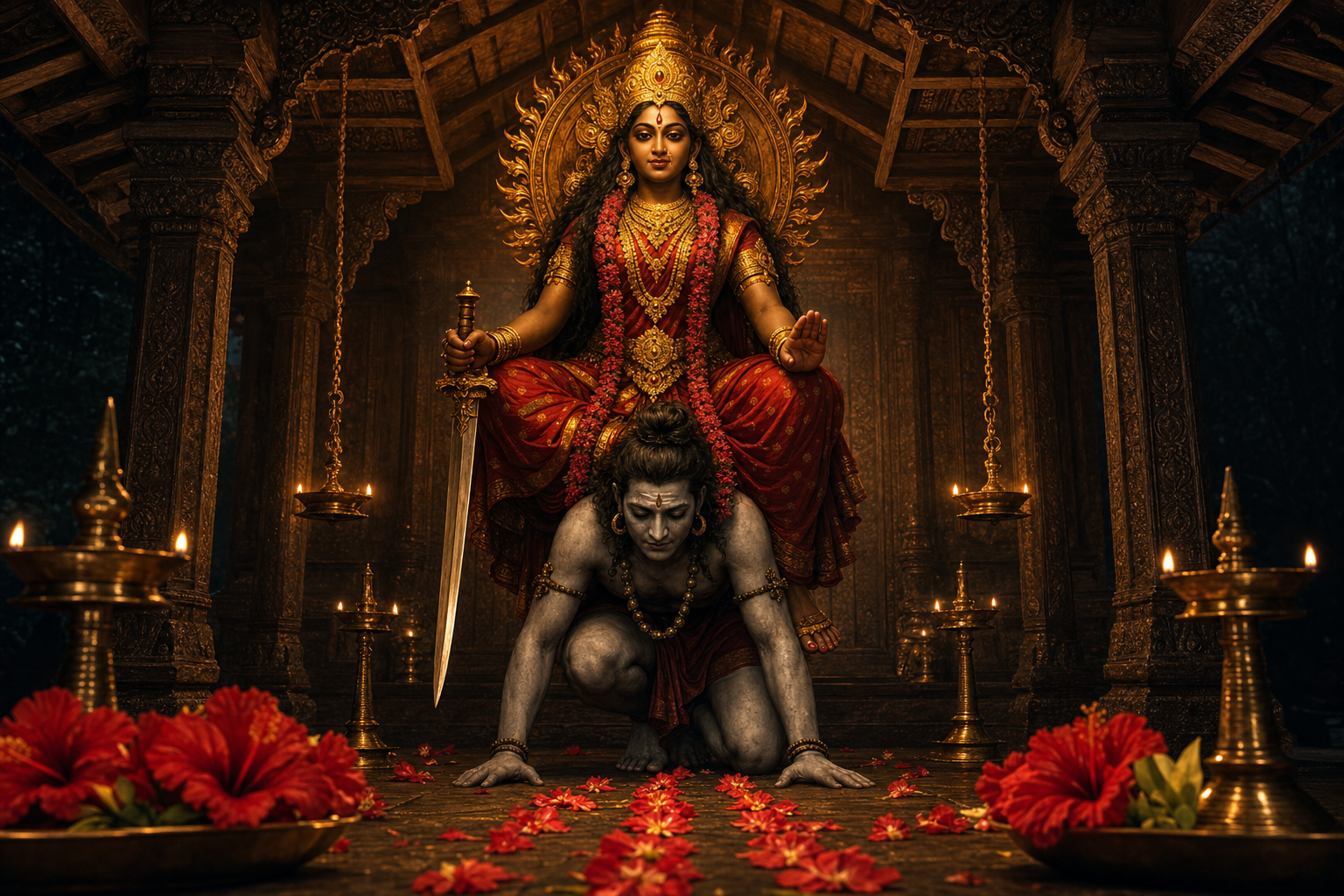
A vahana is more than divine transport. It expresses a relationship between the deity and a power active in the cosmos. Durga’s lion, Saraswati’s swan, and the terrifying companions of Chamunda make different qualities visible. The vehicle shows both the energy present and the authority directing it.
The Vetala belongs to the difficult end of this symbolic grammar. In Sanskrit narrative and tantric language, a vetala is associated with the restless dead, cremation grounds, and thresholds between living and dead. Bhutas, pretas, pishachas, and related beings can also appear in the wider retinues of Bhairava and the Goddess. They represent agencies that ordinary social order cannot comfortably accommodate.
If your main point of reference is the Baital Pachisi, retain the association with a clever and unsettling being of the threshold, but do not transfer that narrative character wholesale into Kerala temple imagery. The Vetala beneath Bhadrakali is interpreted through Shakta sovereignty. Its importance lies in what the Devi does with its liminal power.
When Bhadrakali rides the Vetala, restless force is no longer free to menace the community. It has become an instrument of the very protection it once seemed to threaten. The image neither celebrates the unquiet dead nor pretends that such fear does not exist. It redirects dangerous energy toward a dharmic purpose.
That is the principle to remember: ridden power is governed power. The Vetala remains recognizably fearsome, because transformation does not require pretending that destructive potential is harmless. Yet it stands below the Mother and moves according to her will. Fierceness has acquired direction, responsibility, and an ethical limit.
This is also why the motif should not be presented as the universal mount of Bhadrakali. The Devi Mahatmya establishes a broad theology of the Goddess’s protective ferocity, but it does not prescribe a Vetala vahana for Kali or Bhadrakali throughout Bharat. The Vetala belongs to a regional Kerala articulation of a much wider Shakta principle: the sacred can enter what society fears and return its energies to order.
Darika-vadha gives the fierce image its ethical test
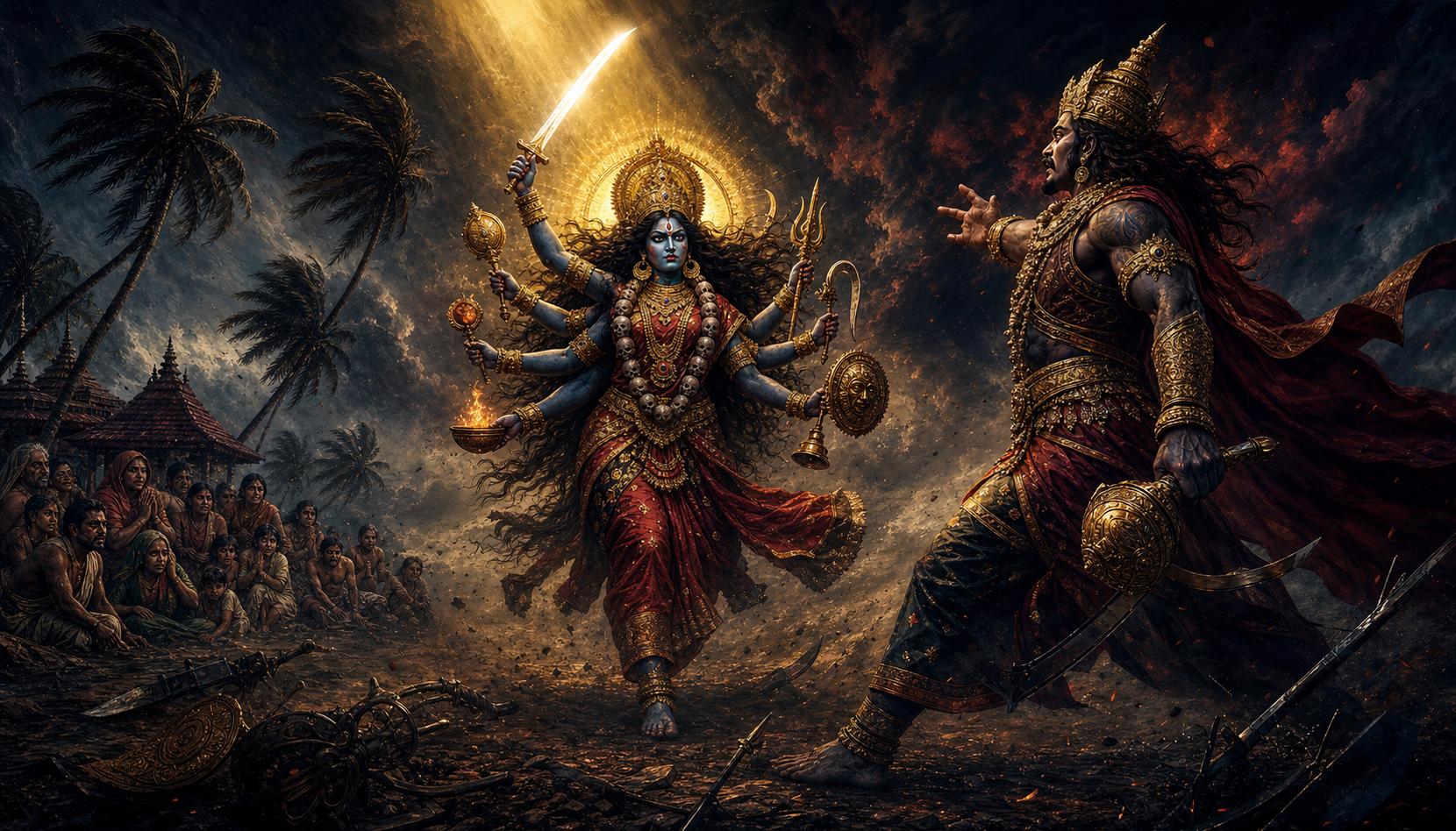
In a Kerala telling central to this ritual world, the Saptamatrikas cannot subdue the boon-protected asura Darika. Bhadrakali then emerges from Shiva’s fiery third eye and destroys him. Her appearance is not random rage. It is force made available when ordinary containment has failed and adharma has become resistant to lesser remedies.
The sequence matters. Darika’s disorder comes first. Bhadrakali’s force answers it. Restored balance is the intended end. Remove that order, and the myth can be misread as little more than sacred violence. Preserve it, and the battle becomes a demanding account of when fierce intervention serves dharma.
The Vetala vahana adds another stage to the victory. Bhadrakali does not merely eliminate a named adversary and depart. The wider forces associated with death, transgression, night, and social unease are brought into her protective order. What cannot safely roam is bound to service.
This gives you a practical test for interpreting any fierce image of the Devi. Ask what the force protects, what restrains it, and what condition it is meant to restore. If anger is celebrated for its own sake, the interpretation has lost the Darika-vadha structure. Bhadrakali’s wrath is sacred because it is directed against adharma and ends in protection, not because every eruption of wrath is sacred.
The distinction guards against two opposite mistakes. One is to soften Bhadrakali until her weapons, skulls, and untamed hair become embarrassing decorations. The other is to admire the terrifying surface without asking who is protected by her action. Kerala’s fierce Mother permits neither reading. Her severity is meaningful because the vulnerable need protection and destructive arrogance must meet a limit.
Kerala’s ritual landscape makes the symbol communal
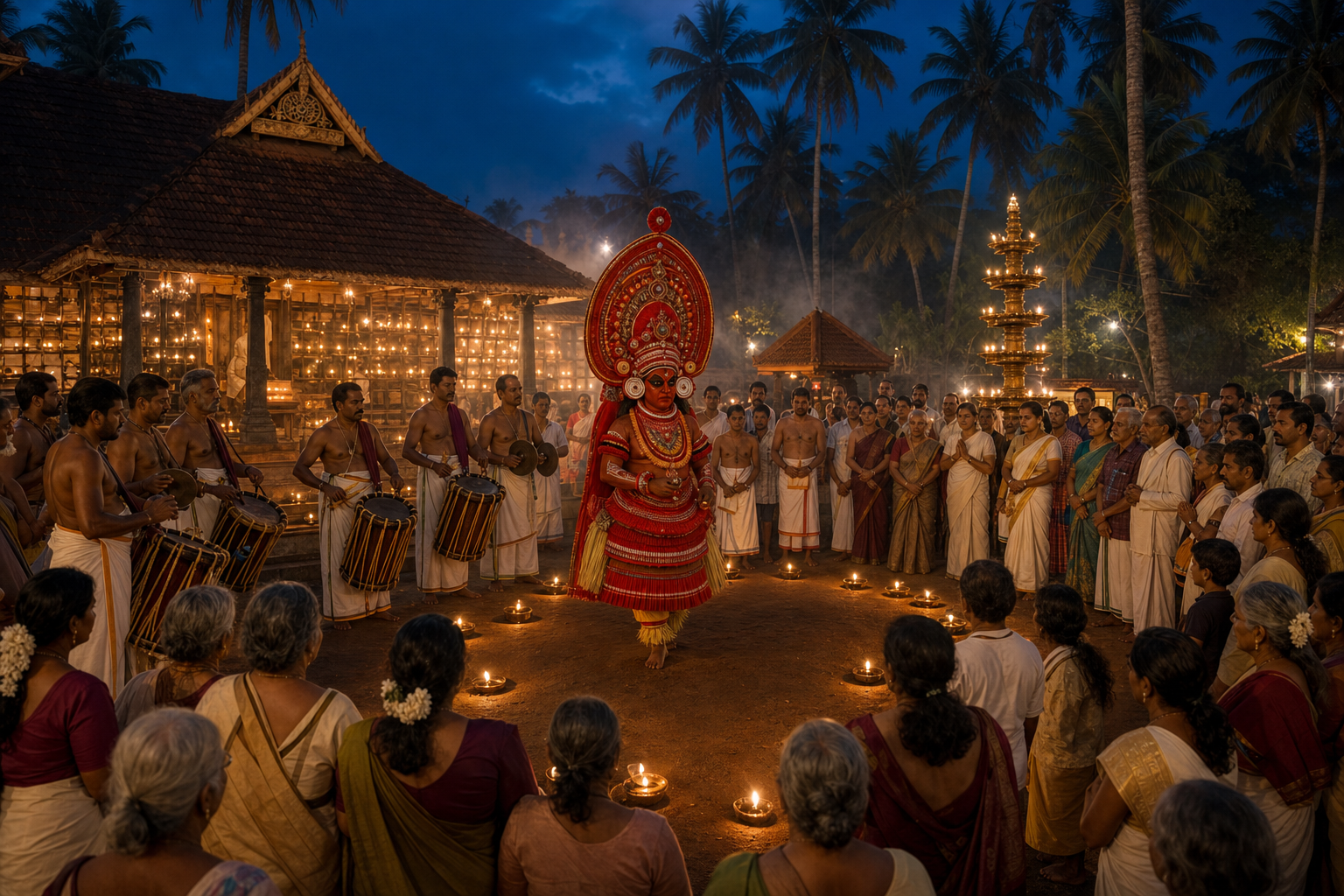
The Vetala motif becomes clearer when you move beyond an isolated icon and look at the world in which Bhadrakali is worshipped. Kerala’s kavus are grove-sanctuaries situated at ecological and social thresholds. Serpent presence, protected groves, water, village memory, local deities, and human settlement can meet within the same sacred geography.
That setting is not incidental. A threshold is where categories touch and where uncertainty becomes difficult to ignore: cultivated land and forest, settlement and night, health and affliction, living community and ancestral memory. Bhadrakali’s authority is especially intelligible there because she can cross boundaries without being overcome by them.
Daily worship may coexist with bhuta-preta-shanti, while a vellichappad speaks for the deity in matters of healing or communal dispute. Pacifying a disturbing presence does not grant it final authority. It acknowledges unease, gives it a ritual boundary, and places the community’s response beneath the Devi’s jurisdiction. The logic is close to that of the Vetala vahana: danger is faced, named, constrained, and redirected.
Performance makes this theology visible over time. Mudiyettu stages the Darika-vadha cycle as a movement from transgression through confrontation to restored order. Theyyam, Kaliyattam, Padayani, and thottam pattu inhabit a related ritual world of fierce deities, spectral attendants, boundary-crossing forms, and cremation-ground memory. The literal Vetala mount is not present in every performance, and you should not claim that it is. The shared grammar lies in the Devi entering a fearful terrain and returning its power to communal well-being.
When you attend such a performance, watch the transitions rather than collecting frightening visual details. Notice how disorder is introduced, when the Goddess becomes present, which beings surround or serve her, and how the movement returns toward protection. If the identity of a figure is unclear, ask for its local ritual name instead of supplying one from a different temple, text, or region.
Kodungallur Bharani can be approached through a related pattern of supervised ritual inversion: tensions and boundary-testing expression are admitted within the Goddess’s field before order is reconstituted. Yet this does not make every Kodungallur image evidence for a Vetala vahana. Nor does the prominence of sanctuaries such as Kodungallur Bhagavathy, Thirumandhamkunnu, or Attukal prove that the same lower figure appears in each place. A living theology can be shared even when local icons and liturgies differ.
From cremation-ground sovereignty to inner discipline
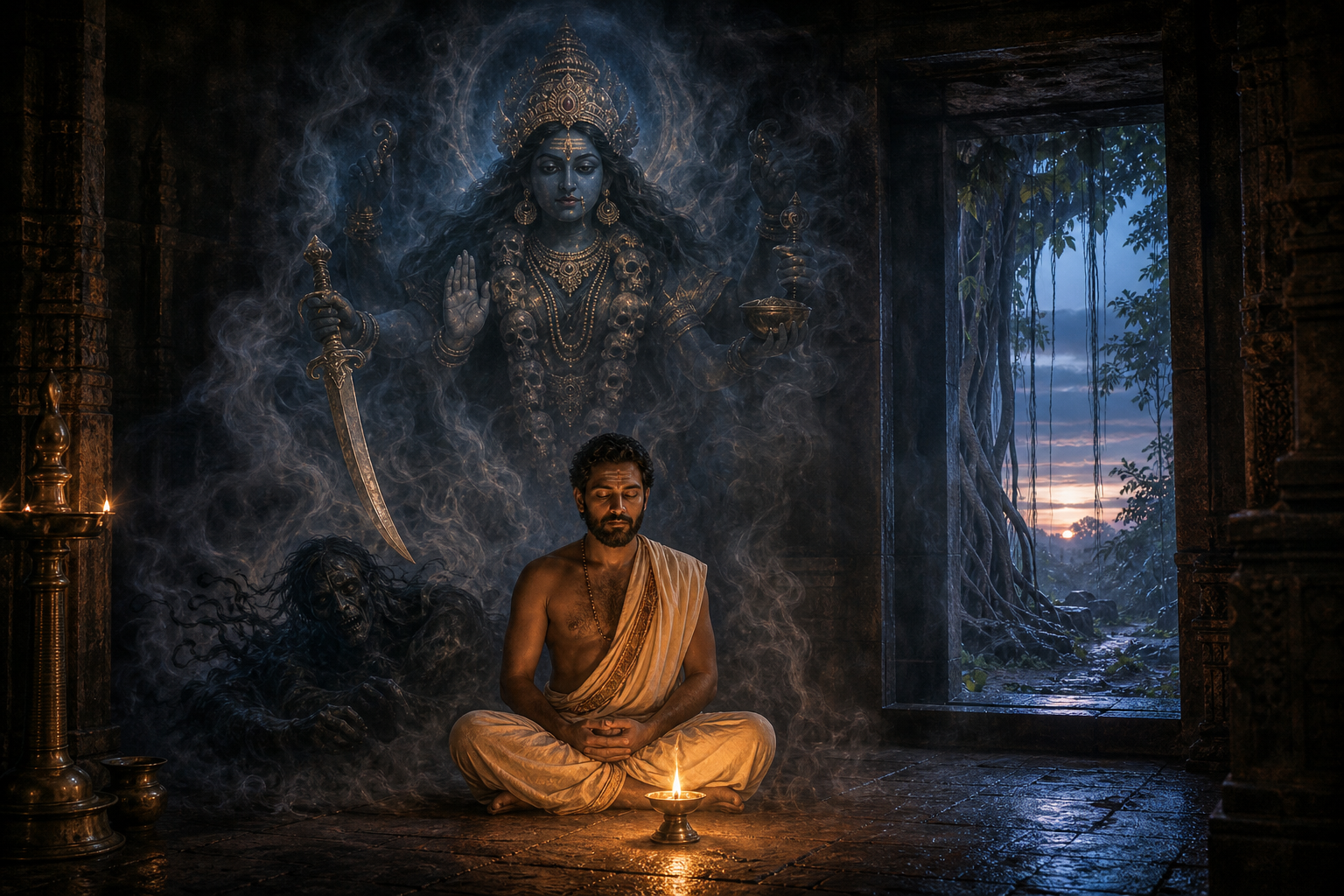
Bhadrakali’s skull-cup, garland of heads, dishevelled hair, corpse-seat, and spectral company do not amount to a celebration of death. They announce that death cannot expel the Goddess from any part of reality. The cremation ground is terrifying precisely because familiar identities and securities fail there. Shakta imagery places the Devi at that limit and shows that the limit is still within her sovereignty.
Pretasana and Vetala-vahana express related ideas but must remain distinct. In a pretasana, the inert corpse becomes the Goddess’s seat. In the vahana form, a restless being becomes her vehicle. One emphasizes sovereignty over inert mortality; the other emphasizes command over mobile, unsettled power. Both turn what appears threatening into a support for awakened authority.
Advanced tantric symbolism extends this grammar through practices associated with the cremation ground and the panchamundi asana, a seat of five skulls. The inner application is mastery of fear, aversion, and death-anxiety rather than denial of them. Nothing in a public image, however, is permission to improvise advanced rites. You can understand the ethical teaching without attempting a practice for which the image itself supplies neither method nor guidance.
For ordinary life, the useful lesson is disciplined redirection. Naming fear is better than letting it govern invisibly. Placing anger beneath a vow or duty is different from indulging it. Protective force must remain answerable to the good it claims to defend. Even a rejected or unruly energy may sometimes be put to service, but only after it has been brought under a clear ethical authority.
Key takeaways
- Before calling a lower figure a Vetala, look for a local ritual name and distinguish a mount from a corpse-seat or trampled embodiment of adharma.
- If the form is explicitly Vetala-vahana, read it as governed liminal power: the restless being has been placed in the service of the Goddess’s protection.
- Do not universalize the motif. It is a significant Kerala Shakta expression, not the standard vahana of Bhadrakali across every Hindu tradition.
- Use Darika-vadha as the ethical frame. Bhadrakali’s fierceness answers adharma, protects the vulnerable, and aims at restored balance.
- Read kavus, songs, oracles, and ritual performances as context. The image belongs to a living communal system, not merely to an illustrated catalogue of supernatural beings.
- Take the inner symbolism as a demand for disciplined mastery, not as an invitation to imitate cremation-ground or skull-seat practices without proper guidance.
The next time you encounter Bhadrakali above a corpse-like form, pause before naming what you see. Ask what role the local tradition assigns the figure, then follow the movement from danger to dharmic order. That sequence lets you meet the fierce Mother without taming her into harmlessness or mistaking disciplined protection for a fascination with death.
References
