

If you have heard that Indra gained a thousand eyes while watching Tilottamā, and also that his eyes emerged from a curse in the Ahalyā story, you are not facing a scriptural mistake that must be repaired. You are meeting two traditions that use the same divine epithet to examine different movements of desire, consequence, and awareness.
The useful question is not, “Which account cancels the other?” It is, “What does each account ask you to notice?” Once that distinction is clear, Indra’s thousand eyes become more than a curious bodily transformation. They become a compact lesson in how power sees, how desire narrows sight, and how disciplined attention can serve dharma.
The apparent contradiction is a clue, not a problem
Indra bears the names Sahasrākṣa and Sahasranetra, both expressing the idea of the “thousand-eyed” deity. These honorifics belong to the larger Vedic and epic memory of Indra as a sovereign guardian whose awareness extends in every direction. Different narratives then explain, dramatize, or morally reinterpret that familiar identity.
This is why the Tilottamā and Ahalyā traditions can coexist. An etiological story—one that explains why a being has a particular name, feature, custom, or symbol—does not always function like a modern biographical report. It can attach an established name to a theological question. One telling can make the eyes signify comprehensive vision; another can make them the transformed residue of wrongdoing.
Trying to splice the two accounts into a single compulsory timeline usually obscures what each one is doing. It is more faithful to preserve their distinct moral structures. Hindu sacred narrative is often polyvalent: a symbol can bear several meanings without becoming meaningless.
Key takeaways
- In the Tilottamā episode, the multiplication of Indra’s eyes accompanies an encounter with extraordinary beauty and belongs to a wider restoration of cosmic order.
- In Ahalyā traditions, the thousand eyes arise from the transformation of marks imposed after Indra’s sexual transgression.
- The accounts should not be collapsed into one event: one foregrounds expanded sight and divine strategy, while the other foregrounds misconduct, punishment, penance, and grace.
- The shared ethical question is whether perception becomes grasping possession or disciplined awareness.
This distinction also explains why an image of Indra need not display a thousand literal eyes. His vajra, Airāvata, royal posture, and textual epithets can communicate the same sovereign vigilance. Iconography condenses meaning; it does not have to illustrate every narrative detail anatomically.
Tilottama defeats the power that weapons cannot reach
The Tilottamā episode begins with a political and cosmic problem, not with a beauty contest. The asura brothers Sunda and Upasunda perform formidable tapas and obtain protections that make them extraordinarily difficult to defeat. Their unity is their strategic advantage. Conventional force cannot readily overcome two powerful beings whose loyalty makes each one an extension of the other.
As their power turns toward adharma, beings across the worlds suffer. The devas therefore need an upāya: a means suited to the actual structure of the danger. Brahmā directs Viśvakarma to fashion Tilottamā, an apsara of incomparable refinement. A traditional gloss connects her name with tila, the smallest grain or particle, and uttama, the finest or highest. She is imagined as beauty assembled from the most excellent subtleties of creation.
That name matters. Tilottamā is not merely “a beautiful woman” inserted into the plot. She represents precision. The response to Sunda and Upasunda is calibrated as carefully as she is composed. The devas do not attack the brothers where they are strongest. They expose the ungoverned desire hidden inside that strength.
When Tilottamā enters their presence, each brother wants exclusive possession of her. Kāma becomes moha: attraction passes into delusion, and delusion destroys judgment. Their supposedly invincible union cannot survive the demand that one brother surrender what the other claims as his own. They turn upon each other and bring about their mutual destruction.
The crucial fault is not Tilottamā’s beauty. It is the brothers’ inability to encounter beauty without converting it into ownership. Her presence does not create their moral weakness; it makes that weakness decisive. Their outer empire collapses because neither has established inner government over desire.
This also prevents a damaging modern misreading. The episode is not a licence to manipulate people through sexuality, nor does it make a woman’s beauty responsible for male violence. Sunda and Upasunda choose rivalry, possession, and aggression. Tilottamā is the agent through whom their hidden contradiction becomes visible. If you apply the story outside its mythic setting, apply its diagnostic principle: find the dependency that makes destructive power possible, and address that dependency instead of merely striking its surface.
That is the episode’s lesson in statecraft. A forceful response is not always the most intelligent response. Before reaching for the equivalent of the vajra, ask what actually holds the disorder together. A coalition may depend on shared ambition. An abusive system may depend on silence. A compulsive habit may depend on a predictable trigger. The appropriate upāya acts on the enabling condition while remaining answerable to a righteous end.
Why Indra’s sight multiplies
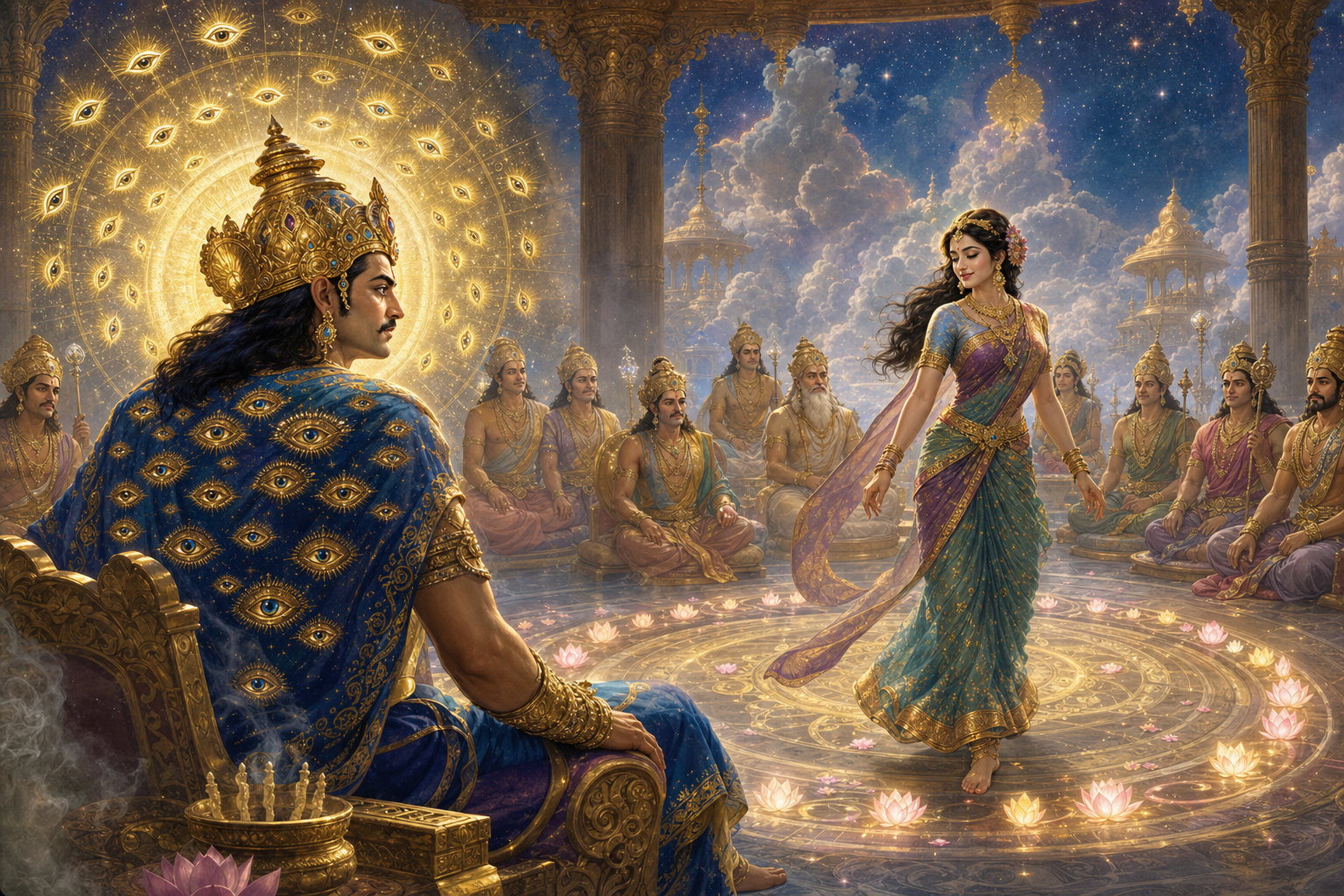
Tilottamā’s passage also affects the assembled devas. Śiva manifests faces so that he can behold her in every direction. Indra becomes thousand-eyed so that no aspect of her movement escapes his sight. The scene brings attraction and awareness unusually close together, and that closeness should not be simplified too quickly.
At one level, the gods acknowledge the overwhelming radiance of a being formed from the finest elements of creation. At another, their multiplied vision expresses a divine capacity to apprehend more than one fragment or angle. Śiva’s faces have therefore been read as omnidirectional witness-consciousness, while Indra’s eyes fit the vigilance expected of a celestial sovereign.
The symbol remains morally demanding because more sight does not automatically mean better sight. A thousand grasping glances would merely multiply distraction. A thousand eyes become worthy of Indra’s office only when they form one field of protective awareness. The transformation asks whether attention is being expanded in service of duty or scattered in pursuit of appetite.
Ahalya turns a mark of transgression into an organ of sight
The Ahalyā cycle gives Indra’s eyes a sharper penitential meaning. In widely preserved versions, Indra’s sexual transgression brings a curse that covers his body with a thousand yoni marks. Through penance, divine intervention, or grace, depending on the telling, those marks are changed into eyes.
The transformation does not require you to pretend that the offence never occurred. Its force comes from continuity: the signs of disgrace become instruments of perception. What once registered uncontrolled desire now signifies the possibility of seeing differently. Grace changes the form and future use of the mark without making moral responsibility irrelevant.
This account guards against an overly flattering interpretation of Sahasrākṣa. Indra is not only the vigilant king of the devas. He is also a powerful being whose position does not exempt him from consequence. Divine rank, martial ability, and ritual importance do not turn adharma into dharma.
Read beside Tilottamā, the contrast becomes precise. Sunda and Upasunda see beauty and attempt to possess it; their sight terminates in self-destruction. Indra beholds Tilottamā and receives expanded vision within a drama of restored order. In the Ahalyā tradition, however, Indra himself crosses the line from desire into violation and must bear the result. The same deity can therefore embody both the responsibility of watchful sovereignty and the danger of ungoverned appetite.
When you encounter a particular retelling, do not begin by importing details from every other version. First identify its sequence:
- What act causes Indra’s bodily marks or multiplied sight?
- Are the marks initially eyes, or do they become eyes only after a curse has done its work?
- What brings the transformation: penance, grace, another divine decision, or the sight of Tilottamā?
- Does the narrative emphasize kingship, shame, restraint, restoration, or comprehensive awareness?
Those questions let each telling speak in its own moral register. They are more useful than declaring one popular version “the real story” and dismissing the rest as corruption.
Three Dharmic tests keep the symbolism honest
A symbol as vivid as a thousand eyes invites interpretation, but not every interpretation is equally disciplined. Three tests keep the reading connected to the narrative rather than turning it into vague inspiration.
1. The restraint test: what happens after desire appears?
None of these stories depends on denying that attraction occurs. Their ethical pressure falls on what follows. Sunda and Upasunda move from attraction to exclusive claim and violence. Indra’s Ahalyā transgression shows power overriding rightful restraint. The Tilottamā scene, by contrast, can support a movement from arresting beauty toward enlarged awareness within a dharmic purpose.
For your own reading, locate the verb that follows desire. Does the character behold, honour, demand, deceive, possess, or attack? That verb usually reveals more than the mere presence of kāma. Dharmic restraint does not require blindness; it requires the ability to see without surrendering judgment.
2. The power test: is the chosen means proportionate to the disorder?
The devas cannot solve the Sunda-Upasunda crisis by repeating the brothers’ model of domination. They need insight into the boon, the bond, and the brothers’ psychology. Tilottamā functions as a subtle means where direct attack is constrained.
Yet “subtle” is not automatically synonymous with ethical. Any upāya must still be judged by its purpose, its target, and what it asks of other beings. The reusable principle is strategic discernment, not a blanket approval of deception. Ask whether the means interrupts adharma with proportionate harm, or merely disguises another form of exploitation.
3. The attention test: do many viewpoints become one responsibility?
Indra’s eyes suggest panoramic awareness only when they are coordinated by dharma. Without such coordination, multiplying inputs produces restlessness rather than wisdom. In contemporary terms, constant exposure to messages, images, opinions, and crises can resemble a thousand eyes while still leaving you unable to see what matters.
A responsible reading therefore joins breadth to integration. See the immediate desire, the other person’s dignity, the governing duty, and the likely consequence at the same time. If one of those directions disappears, attention has narrowed even if information has increased.
Related disciplines across Dharmic traditions sharpen this point without making all traditions identical:
- Buddhist indriya-saṃvara trains restraint at the sense doors so that seeing does not automatically become grasping. Indra also appears in Buddhist traditions as Śakra Devānām Indra, protector of the Trāyastriṃśa heaven.
- Jain saṃyama and aparigraha—self-restraint and non-possessiveness—name precisely what Sunda and Upasunda lack. In Jain cosmology, “Indra” is also a title for celestial lords who honour the Tirthankaras.
- Sikh teaching identifies kām as one of the five thieves that cloud discernment. The relevant connection is ethical, not a claim that Sikh scripture retells the Tilottamā episode.
- Hindu readings hold the elements together through dharma, mastery of the senses, responsible kingship, and the fitting use of upāya.
The traditions do not need to be blended into one doctrine to illuminate a shared civilizational concern: power becomes dangerous when the senses command the person who is supposed to govern them.
Use the thousand eyes as a discipline of attention
You can turn the symbol into a practical reading exercise without pretending that the exercise itself is an ancient rite. Before making a consequential decision, look in four directions:
- Intention: What do you actually want, beneath the respectable explanation you are giving yourself?
- Relationship: Are you treating another being as a person with agency, or as something to possess, deploy, or defeat?
- Dharma: What duty, boundary, promise, or legitimate restraint governs the situation?
- Consequence: What pattern will this action strengthen after the immediate desire or crisis has passed?
If one answer is missing, do not compensate by gathering more information. Pause at the missing direction. Sunda and Upasunda have immense power but cannot see beyond possession. The transgressive Indra of the Ahalyā cycle sees an opportunity but not the boundary. The sovereign meaning of Sahasrākṣa begins when sight includes the boundary, the other being, and the consequence.
The same discipline can guide your use of art and beauty. Ask what the aesthetic experience is doing to attention. Does it disclose a truth that argument could not reach? Does it restore proportion? Does it reveal hidden attachment? Or does it reduce someone to an object and make appetite harder to question? Tilottamā’s role belongs to the first set of possibilities because the narrative directs culpability toward possessiveness and uses beauty to expose adharma’s internal fracture.
It can also guide conflict. When direct confrontation repeatedly fails, identify what sustains the harmful arrangement: fear, mutual interest, secrecy, prestige, or dependency. Addressing that structure may be wiser than escalating force. But keep the ethical limit in view: another person’s body, vulnerability, or trust is not raw material for your strategy.
The next time someone asks why Indra has a thousand eyes, give both answers and keep their functions distinct. Then turn the question back toward practice: when desire appears, will your sight narrow into possession, or widen enough to include dignity, duty, and consequence? That is where an old epithet becomes a living demand of dharma.


References
