
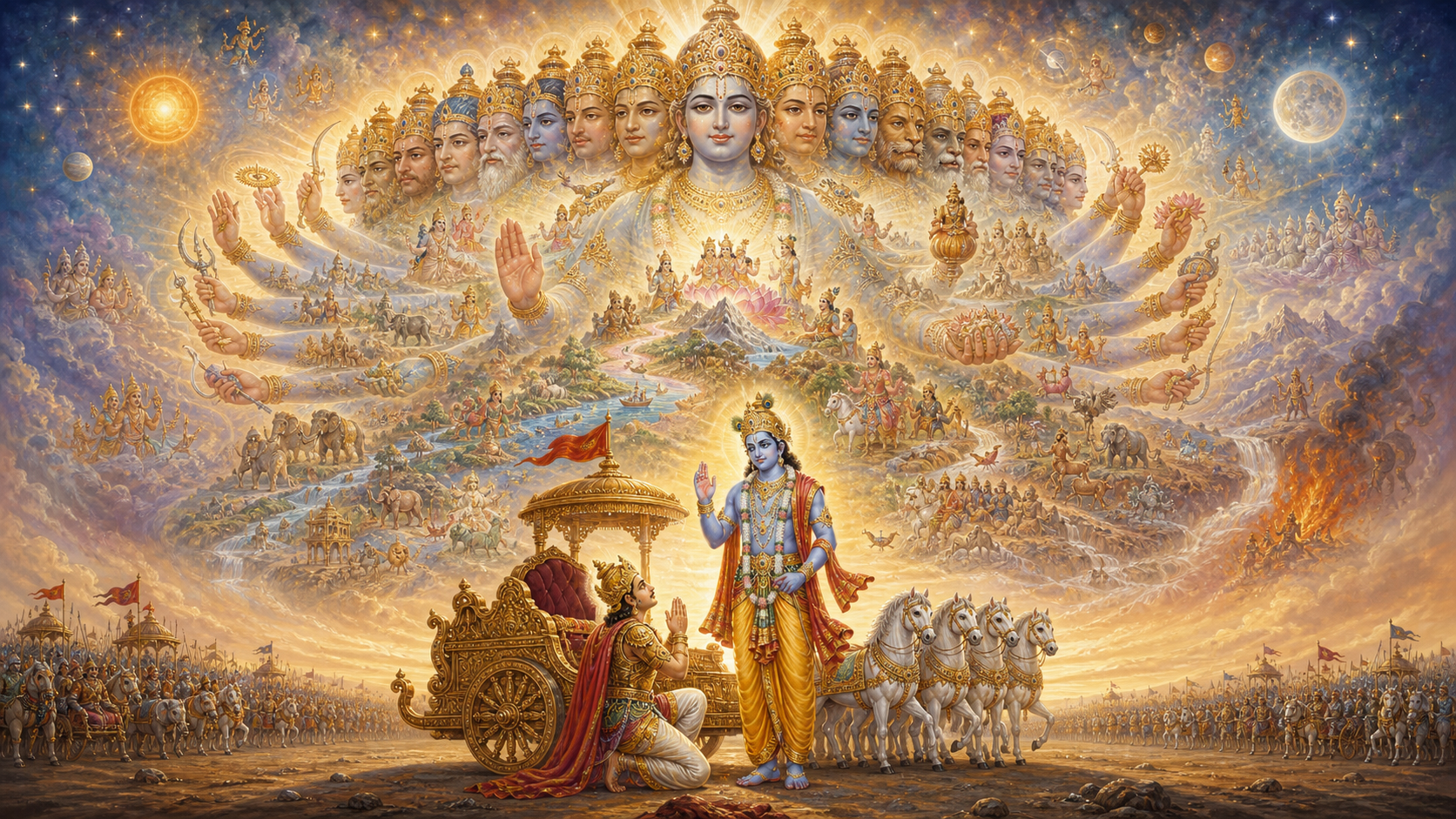
You may accept Krishna’s vishvarupa and still wonder what it actually explains. Did Bhagavan become the elements? Did prakriti make the universe? Is the cosmic form a literal picture, a theological symbol, or both?
The confusion usually comes from asking one teaching to perform several different jobs. Vaishnava cosmology becomes much clearer when you distinguish the vision of total dependence, the sequence of cosmic manifestation, the means by which that truth is known, and the action expected from the knower.
Ask what kind of causation a passage is explaining

When you ask what caused a clay pot, clay and the potter answer different parts of the question. Clay supplies the proximate material. The potter directs its transformation. Tools and conditions make the transformation possible. None of these answers becomes false merely because another level of explanation is added.
Vaishnava accounts of creation use a comparable distinction without reducing Bhagavan to a human craftsman. The Supreme is the independent origin, activator, regulator, and sustaining ground. Prakriti is the proximate material from which differentiated structures appear. Time, karma, inherent disposition, cosmic intelligence, individuating consciousness, the subtle qualities, the elements, the senses, and their presiding powers describe stages or conditions within that dependent manifestation.
This framework identifies Bhagavan as the nimitta-karana, the directing or efficient cause, while also locating the ultimate ground of the material cause in him. Prakriti functions as the proximate upadana-karana, the material available for formation, but it is never treated as a self-starting or self-sustaining reality.
That gives you three propositions to keep together:
- Immanence: Bhagavan is present through his energies and sustains every faculty and element.
- Transcendence: Bhagavan is not exhausted by the cosmos or confined within its measurable boundaries.
- Dependence: The world is real and consequential, but its reality is not independent reality.
For a Gaudiya Vaishnava reader, acintya-bheda-abheda provides the guardrail: the Lord and his energies are simultaneously one and different in a relation that cannot be flattened into ordinary identity or absolute separation. If you stress oneness alone, you risk making Bhagavan merely another name for the aggregate universe. If you stress difference alone, you risk imagining a distant deity who starts creation and then becomes unnecessary.
The vishvarupa addresses this relation more directly than it addresses manufacturing order. It discloses the many worlds, beings, powers, and processes as held within one divine reality. The causal sequence answers a different question: through which dependent principles does undifferentiated material potential become an ordered field of embodied experience?
Whenever you encounter a claim that Bhagavan created the universe, therefore ask three follow-up questions. What supplies the proximate material? What activates and orders its transformations? What keeps every effect dependent after it has appeared? Those questions prevent a vague use of the word cause from hiding the theology.
Follow the causal chain without turning it into modern physics

The Bhagavata’s Sankhya-informed sequence is a map of differentiation and dependence. Its categories organize material potential, experience, agency, perception, and moral consequence. They should not be treated as laboratory variables or forced into a timeline measured in seconds after a physical beginning.
- Pradhana holds material potential in equilibrium. The three gunas have not yet produced the differentiated structures of experience. This is potentiality, not an independently creative substance.
- The glance of the Purusha activates manifestation. Kala, karma, and svabhava mediate the transition from equilibrium to ordered change. Kala structures becoming; karma carries the accumulated momentum of prior actions; svabhava supplies inherent disposition. These factors operate under divine direction rather than alongside Bhagavan as rival first causes.
- Mahat-tattva manifests as cosmic intelligence. Order and intelligibility precede the fully separated objects and faculties of embodied experience. The universe is therefore not portrayed as an unintelligible accident assembled from completely unrelated parts.
- Ahankara introduces individuation. Here ahankara means more than boastfulness or personal vanity. It is the principle by which functions and identities become differentiated. Its sattvika, rajasika, and tamasika modalities support different branches of manifestation.
- The branches produce the equipment and field of experience. The tamasika modification yields the subtle qualities of sound, touch, form, taste, and smell, followed by ether, air, fire, water, and earth. The rajasika modification empowers the ten organs of perception and action. The sattvika modification is associated with the presiding devatas and refined mental functions, including mind and discernment.
This chain does not describe five unrelated factories. Each later category remains dependent on what makes its operation possible. A sense organ does not perceive merely because it has a physical structure. Perception also requires an object, a subtle quality, attention, mental coordination, and the wider order in which these can meet. The sequence makes embodied experience intelligible by refusing to isolate any one component.
The distinction between sarga and visarga then prevents another common confusion. Sarga is the primary manifestation of fundamental categories such as the elements, senses, and mind. Visarga is their subsequent organization, combination, and diversification, classically associated with Brahma acting under divine guidance. Secondary agency is real, but it does not become absolute agency.
Use four labels when you study any stage of this sequence:
- Source: What prior reality makes this category possible?
- Activator: What moves potential into operation?
- Product: What becomes differentiated at this stage?
- Function: What part of embodied or cosmic order can now operate?
This method is more reliable than memorizing a list of Sanskrit terms. It shows why the sequence matters: every apparent unit is a coordinated dependency, not a self-sufficient thing.
Let each witness reveal a different aspect of dependence
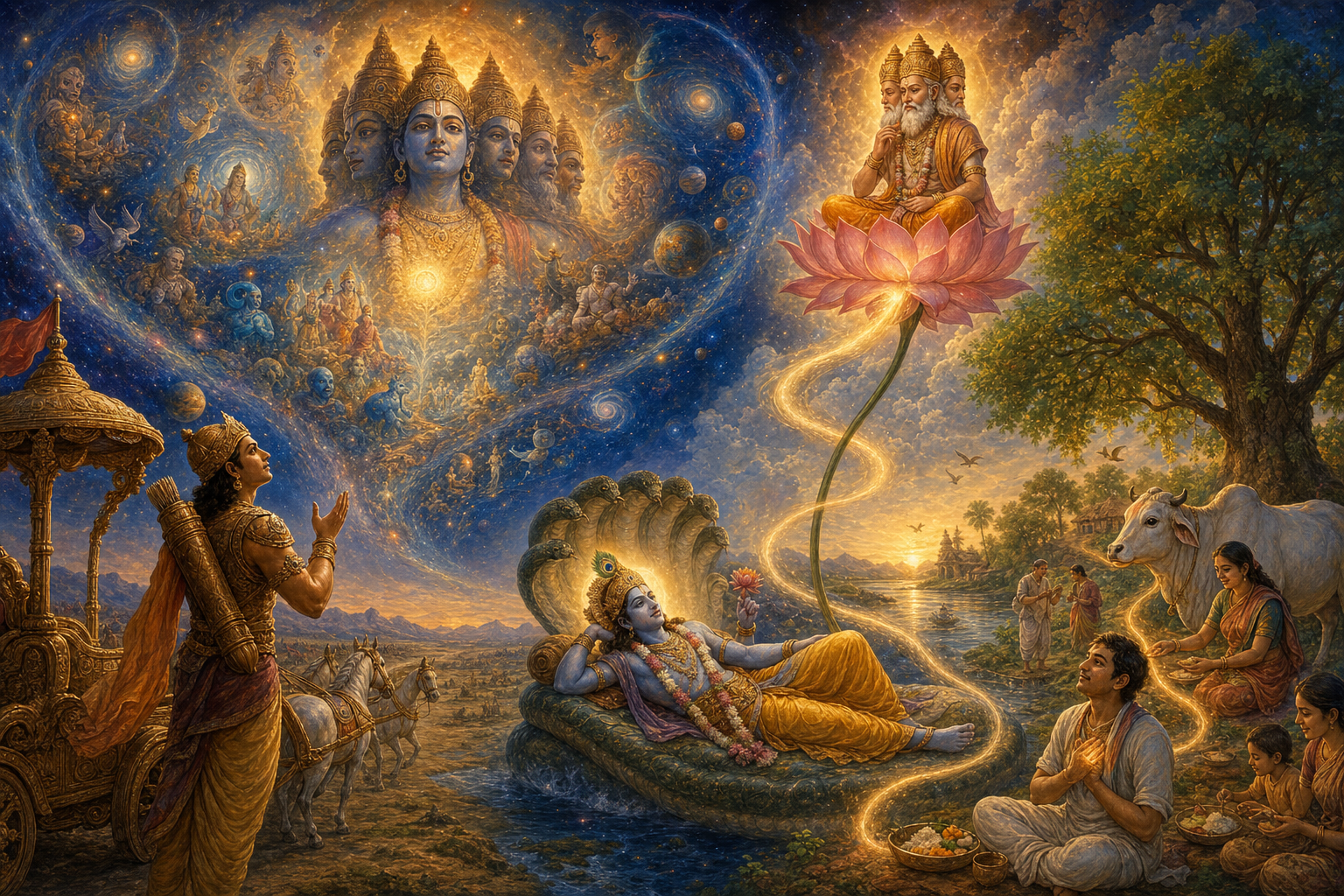
Cosmic visions should not be merged into one undifferentiated spectacle. Arjuna, Sanjaya, Akrura, Yashoda, and the witnesses in the Kaurava court occupy different situations, receive different kinds of access, and return from vision with different responsibilities. Those differences help you interpret what each episode is doing.
Arjuna sees totality and returns to duty
Arjuna asks to behold Krishna’s sovereign form in Bhagavad Gita 11.3-4. Krishna answers in 11.8 that Arjuna cannot see it with his ordinary eyes and grants divya cakshu, divine sight. The resulting vision gathers countless forms, powers, beings, and worlds into one immeasurable disclosure. Its radiance is compared in 11.12 to a thousand suns rising together.
The comparison communicates overwhelming brilliance; it is not a numerical luminosity reading. More importantly, the vision does not provide the staged causal sequence from pradhana to the elements. It reveals the dependence and destiny of the entire sequence at once. The many do not escape the source merely because they appear differentiated.
Arjuna responds with reverence, fear, and a transformed understanding of the friend beside him. Krishna eventually restores the gentle form through which intimacy can continue. The narrative movement matters: cosmic vision returns Arjuna to svadharma and responsible action. If your reading ends with visual grandeur but never reaches duty, it has stopped before the teaching reaches its practical result.
Sanjaya shows how vision becomes truthful transmission
Sanjaya does not stand beside Arjuna as a second battlefield disciple. Vyasa grants him divya drishti so that he can witness and report what occurs. Bhagavad Gita 18.75 attributes his hearing of the secret teaching to Vyasa’s grace, while 18.76-77 describes his repeated recollection of Krishna’s wondrous form with amazement and joy. Vaishnava commentarial memory therefore receives Sanjaya as a visionary witness as well as a narrator.
Sanjaya’s role keeps revelation from becoming private possession. Grace-enabled perception can be communicated through disciplined speech and received through shabda. The listener should still distinguish Arjuna’s direct participation from Sanjaya’s mediated witness, but mediation does not make the event spiritually empty. It creates an obligation to narrate without distortion.
For you, the practical test is accuracy. When recounting a sacred teaching, separate what the verse explicitly states, what a commentary infers, and what a later retelling adds. Sanjaya models faithful transmission, not imaginative embellishment.
Akrura sees local presence without cosmic absence
Akrura’s vision in Bhagavata Purana 10.39-10.40 occurs during the journey to Mathura. Krishna and Balarama remain upon the chariot, yet Akrura also beholds the divine reality within the Yamuna: cosmic Narayana upon Ananta Sesha, attended by the devas, with the principles and inhabitants of the worlds present in him. Vishnu Purana 5.17 preserves a parallel revelation.
This simultaneity corrects a spatial mistake. Krishna’s visible presence at one location does not mean that his cosmic sovereignty has been compressed into a small material container or withdrawn from everywhere else. The personal form and cosmic ground are not competing bodies that must displace one another.
Akrura also receives vision in a devotional pause rather than in the crisis of a battlefield. That difference tells you not to chase intensity as though terror were the mark of authenticity. Humble pilgrimage, bathing, prayer, and concentrated devotion can disclose the same relation of dependence in a gentler register.
Yashoda and the royal court teach interpretive restraint
When Yashoda looks into Krishna’s mouth in Bhagavata Purana 10.8.37-45, she sees the universe within the child she mothers. The episode communicates cosmic containment and divine immanence, but it is not presented with all the technical features of the Bhagavad Gita’s chapter 11 revelation. Calling every disclosure vishvarupa without qualification erases useful textual distinctions.
Krishna’s revelation in the Mahabharata’s Udyoga Parva occurs when Duryodhana attempts to bind him in the Kaurava assembly. The righteous perceive more than those dominated by hostility and delusion. Some recensions and retellings also give Dhritarashtra temporary sight, after which he asks to become blind again, but that detail does not have uniform textual standing. Sanjaya’s divya drishti remains the more secure link between the court and battlefield.
Use a four-question test for any cosmic-vision episode:
- Who is permitted to see?
- What faculty, grace, or preparation makes the seeing possible?
- Which relation between Bhagavan and the cosmos is disclosed?
- What action, service, or correction follows?
The fourth question is decisive. Arjuna resumes duty, Sanjaya narrates truthfully, Akrura continues his service, and Yashoda’s maternal relation survives an impossible vision. Darshana is transformative knowledge, not sacred entertainment.
Avoid six category errors that distort the teaching
- Do not read the vishvarupa as an astronomical atlas. It discloses the cosmos in relation to Bhagavan. Its many eyes, mouths, beings, weapons, and blazing forms communicate universality, power, plurality, and destiny rather than a scale drawing of physical space.
- Do not turn a metaphor into a measurement. The thousand-suns comparison conveys radiance beyond ordinary comparison. It does not supply an energy value or invite a calculation from Bhagavad Gita 11.12.
- Do not reduce immanence to identity without remainder. The cosmos exists through divine energies and within divine sovereignty, but Bhagavan exceeds the manifested totality. Containment does not mean exhaustion.
- Do not turn transcendence into deism. Divine agency is not limited to an initial push. The elements, faculties, laws, and transformations remain dependent upon continuing sustainment.
- Do not use divine causation to erase secondary responsibility. Brahma’s role in visarga, the activity of material nature, the consequences of karma, and the moral agency of embodied beings remain meaningful. Dependence on the Supreme is a reason for careful action, not an excuse for passivity.
- Do not use revelation to dismiss observation and reasoning. Pratyaksha, anumana, and shabda answer different ranges of questions. Ordinary perception and inference investigate proximate processes; shabda guides the knower where unaided senses cannot reach. Divya cakshu marks a limit of ordinary perception, not the uselessness of all perception.
The same discipline is needed when comparing dharmic traditions. Buddhist pratityasamutpada emphasizes conditioned co-arising and therefore offers a powerful language of interdependence, but its metaphysical commitments are not simply those of Vaishnava theism. Jain thought orders reality through jiva, pudgala, dharma-dravya, adharma-dravya, akasha, and kala while giving karma and responsibility a rigorous place. Sikh teaching on Ik Onkar and hukam affirms singular creative sovereignty and moral order.
The useful convergence lies in disciplined attention, humility, responsibility, non-violence, and resistance to the fantasy of an isolated self. It does not require claiming that every tradition teaches the same ultimate cause. In inter-dharmic conversation, name the shared ethical insight and the distinct metaphysical claim separately. Respect grows through precision, not through forced sameness.
Modern science also belongs at a different explanatory level. Physics and cosmology investigate measurable structures and regularities. The gunas, kala, karma, and divine agency function as metaphysical, phenomenological, and moral categories. Treating them as rival laboratory variables weakens both discussions. You can accept careful empirical investigation of proximate processes while asking the further Vaishnava question: why is there an intelligible, dependent order in which those processes and knowers exist?
Turn cosmic causation into a daily discipline

A cosmology of dependence should alter how you use the faculties it describes. If every sense, element, thought, and opportunity operates within a sustained order, humility is rational rather than decorative. Gratitude, restraint, truthfulness, stewardship, and ahimsa become responses to reality’s structure.
Use the read, map, and return method
- Read one precise passage. Begin with Bhagavad Gita 11.3-8 for the request and divine sight, 18.75-77 for Sanjaya’s reception, Bhagavata Purana 2.5.11 for causal dependence, or 10.39-10.40 for Akrura’s vision. Do not blend the passages before noticing what each one actually addresses.
- Name the question it answers. Mark it as a vision of total relation, a sequence of manifestation, an account of spiritual perception, or an ethical return. A passage may address more than one, but do not assume it addresses all four equally.
- Map three levels of cause. Identify the proximate instrument, the mediating conditions, and the ultimate dependence. In daily life, that might mean body and senses at the proximate level, time and acquired disposition among the conditions, and Bhagavan as the sustaining ground.
- Check the knower. Ask what humility, grace, instruction, or discipline corrects ordinary perception. This prevents you from treating a powerful private impression as self-authenticating revelation.
- Return to one action. Choose the duty made clearer by the reflection: truthful speech, restraint in conflict, attentive worship, less waste, better care of the body, or service to another being.
Apply the method to an ordinary moment for seven consecutive days. Before answering an irritating message, for example, notice the device, eyes, memory, mind, bodily tension, habits, timing, and consequences of earlier choices involved in the response. Remember that none of these faculties is self-created or absolutely independent. Then choose a truthful reply that does not add needless harm.
Do not pretend that this exercise reveals another person’s precise karma or a hidden past-life explanation for every event. Karma belongs in the causal framework as moral continuity, not as permission to diagnose suffering from a distance. The immediate use of the teaching is to govern your own intention and conduct.
The same method can organize the three practices of shravana, kirtana, and smarana. In shravana, hear how all categories depend on the Supreme. In kirtana, speak or chant the divine names as an acknowledgment of that dependence. In smarana, remember the sustaining presence before using a sense, making a decision, or claiming ownership of a result. Hearing gives the map, chanting aligns speech with it, and remembrance brings it into the next action.
Key takeaways
- The vishvarupa reveals the total dependence of worlds and beings; it is not a substitute for the staged account of manifestation.
- The causal sequence moves from pradhana through activation, mahat-tattva, ahankara, subtle qualities, senses, governing faculties, and gross elements.
- Prakriti is the proximate material of formation, while Bhagavan remains the independent origin, director, and sustaining ground.
- Divine sight means spiritual knowledge requires grace and prepared perception; it does not abolish scripture, reasoning, or ordinary observation within their proper range.
- A sound interpretation returns the knower to dharma. If cosmic teaching does not refine conduct, its practical purpose has not yet been reached.
Begin with one faculty today. Before you speak, eat, work, or worship, identify its immediate instruments, remember their deeper dependence, and choose the dharmic response that follows. Cosmic causation becomes living bhakti when it changes your next act.
References
- DharmaRenaissance Blog – Three Who Saw Krishna’s Infinite Vishvarupa: Arjuna, Sanjaya, Akrura: Evidence and Insights
- Dandavats – Unveiling the Cosmic Blueprint: Srimad Bhagavatam SB 2.5.11 with HG Mukunda Datta Prabhu
