
If illness or persistent pain has brought you to the Narayaneeyam, you may be carrying two questions at once: Can this prayer help me, and what does healing honestly mean here? The clearest answer is that the text can become a disciplined form of refuge, surrender, and inner reorientation. Its sacred tradition includes a bodily cure, but no one can promise you the same medical outcome.
You do not have to choose between dismissing the tradition and treating it as a guaranteed remedy. You can receive Bhattathiri’s story as testimony to grace, undertake parayana as a serious devotional practice, and continue appropriate medical care without confusing the roles of either.
What Bhattathiri’s healing story does and does not claim
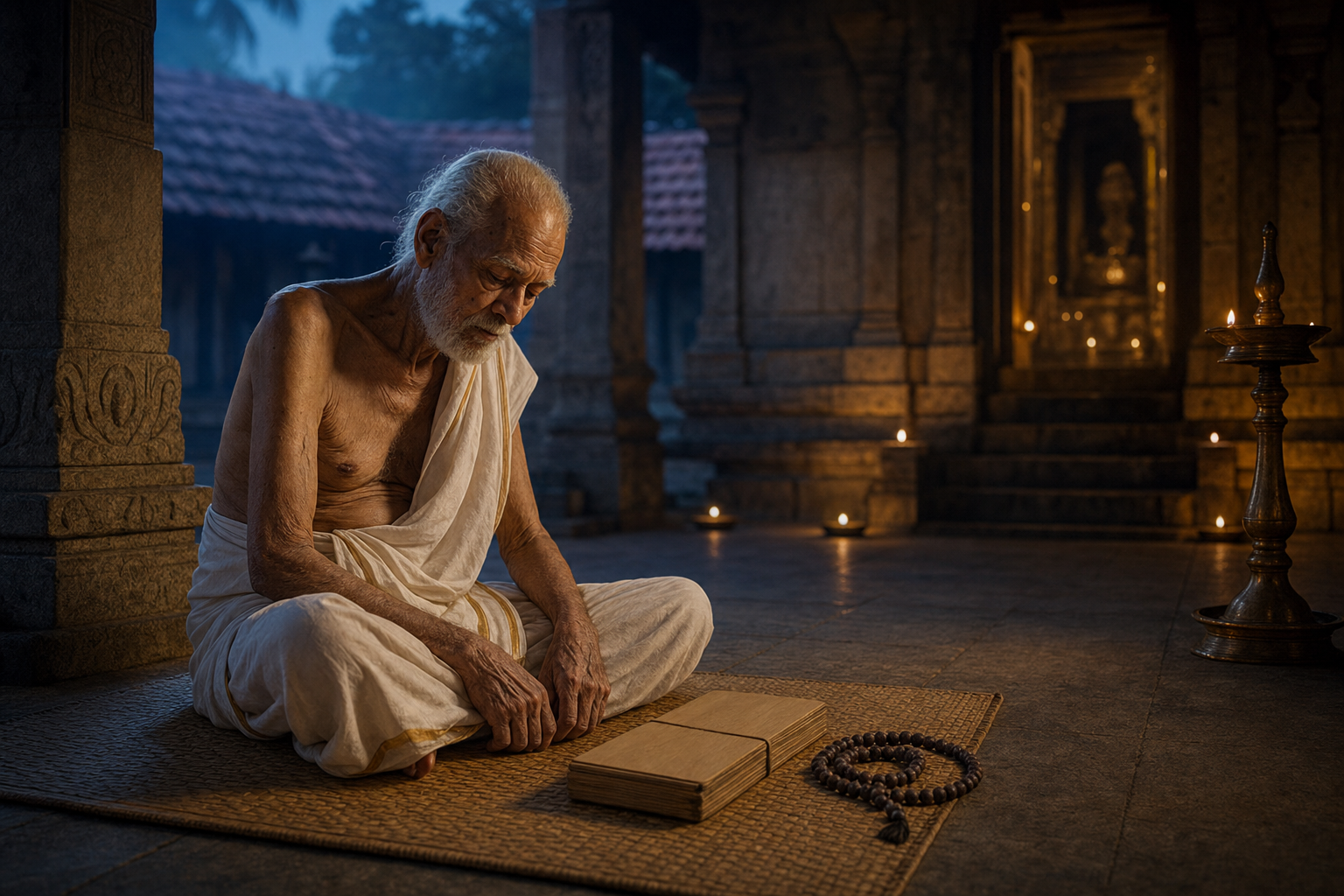
Melpathur Narayana Bhattathiri, who lived from approximately 1560 to 1646 CE, belonged to Kerala’s Namboothiri scholarly world. He was trained in Sanskrit grammar and poetics, and his devotional writing carries the compression and control of someone accustomed to examining every word.
The healing narrative begins with his teacher, Achyuta Pisharati. Kerala’s tradition relates that when Pisharati became gravely ill with vataroga, Bhattathiri prayed to take the affliction upon himself as an act of profound guru-bhakti. The disciple then manifested the illness. It is often described as paralytic, but the traditional Ayurvedic label does not provide enough clinical information to assign Bhattathiri a modern diagnosis retrospectively.
His response to suffering was composition, recitation, and surrender at Guruvayur. Bhattathiri is remembered as composing one dasaka each day for one hundred days before Guruvayurappan. The final day brought a vision of the Lord’s form and, in the devotional memory of Kerala, restoration of the poet’s health.
That is a sacred healing account, not a repeatable clinical protocol. It does not establish how a particular illness will progress, which treatment another person needs, or whether recitation will remove physical symptoms. Its religious claim is different: suffering can be brought into relationship with Narayana, and disciplined devotion can transform how a person inhabits that suffering.
Bhattathiri’s guru-bhakti should likewise be understood as radical compassion, not as an instruction to seek illness, refuse relief, or prove devotion through avoidable harm. For you, sharing another person’s burden may mean caregiving, arranging transport, preparing food, accompanying someone to an appointment, or praying without making promises about a cure.
Do not use Narayaneeyam recitation in place of medical assessment or treatment. New paralysis, sudden weakness, loss of speech, or severe or worsening symptoms require urgent medical attention. Do not stop prescribed treatment because symptoms briefly improve or because someone interprets continued illness as insufficient faith. Prayer can accompany responsible care; it should not obstruct it.
Fish first is a method, not a mysterious remedy

Kerala’s oral memory associates Bhattathiri’s undertaking with counsel from Tunchath Ezhuthachan: meen thudangi ezhuduka, or begin with fish. This was not dietary advice. It pointed Bhattathiri toward Matsya, the fish incarnation with which Vishnu’s Dashavatara sequence begins.
Matsya belongs to a story of rescue at the time of a flood and the recovery of submerged sacred knowledge. That makes fish first more than a clever literary hint. When illness floods your days with fear, appointments, fatigue, or uncertainty, the first task is to recover what must not be lost: truthful attention, dharmic responsibility, treatment, prayer, and your relationship with the Divine.
You can turn that principle into a brief preparation before every recitation:
- Name the flood. State the present difficulty in one plain sentence. Avoid explaining your entire life or predicting the outcome.
- Name what must be protected. It may be your trust in Narayana, adherence to treatment, patience with your family, or the ability to ask for help.
- Choose today’s first act. Complete the next dasaka, make the appointment you have postponed, take prescribed medicine as directed, or tell a trusted person what you need.
- Offer the result without bargaining. Ask for grace, clarity, courage, and relief, but do not make devotion conditional on receiving one predetermined outcome.
This approach also prevents a cruel misreading of illness. Pain is not evidence that you are spiritually defective, and persistent symptoms do not prove that your recitation has failed. Fish first means returning to refuge and right order. It does not mean inventing blame for what you cannot control.
Why this scholar’s poem is so well suited to repetition
Bhattathiri condensed the Bhagavata Purana, traditionally comprising approximately 18,000 verses, into 1,036 verses arranged in 100 dasakas. The movement is deliberate: creation and cosmic order lead through Vishnu’s incarnations and toward the intimacy of Krishna-lila. A person in distress is therefore not handed an isolated healing formula. You are led through a complete theological world in which fear, rescue, order, love, beauty, and surrender all have a place.
Bhattathiri’s formation in vyakarana, or grammar, helped give the work its syntactic economy. Its changing classical metres provide momentum or contemplative stillness as the subject requires, while the salutations at the end of each dasaka return attention to the Lord. The form gives a troubled mind a boundary: one section, one movement of meaning, one closing act of prayer.
You can work with that form through four complementary modes:
- Sound: Recite the Sanskrit aloud when you are able. Aim for steady, attentive pronunciation rather than speed. Let accuracy be something you patiently learn, not a reason never to begin.
- Meaning: Read a reliable translation or explanation so the syllables remain connected to the avatara, teaching, or lila being praised.
- Contemplation: After finishing, remain with one image, name, or movement from the dasaka instead of immediately reaching for another distraction.
- Community: If fatigue makes solo recitation difficult, listen attentively or ask family members or fellow devotees to participate. Receiving support is not a lesser form of practice.
Choose one primary mode and one supporting mode. A beginner might listen while following a translation. A Sanskrit student might recite and then check the meaning. Someone confined by illness might hear the dasaka and offer the closing prayer inwardly. The point is disciplined presence, not performance.
A sustainable 100-day Narayaneeyam practice

Bhattathiri’s one-dasaka-a-day pattern gives you a clear container: 100 sections over 100 days. It is demanding enough to establish continuity without requiring you to consume the entire text in one burst. If illness, disability, caregiving, or work makes that pace unrealistic, use a gentler schedule and name it honestly as an adaptation. You do not need to imitate another person’s physical capacity to demonstrate sincerity.
- Choose the rhythm before you start. For the traditional pattern, assign Dasakas 1 through 100 to 100 consecutive dates. For an adapted practice, decide how many days per week you can sustain and keep the dasakas in sequence.
- Prepare one usable text. Keep the numbered Sanskrit text and a translation or explanation together. Constantly changing editions, recordings, or routines can turn preparation into avoidance.
- Attach recitation to a stable daily cue. Use a time already present in your day, while allowing clinical appointments, sleep, and necessary care to take priority when they conflict.
- Make a truthful sankalpa. A sound intention is: May this practice deepen devotion and help me meet illness truthfully. Avoid vows that demand a particular cure by a particular date.
- Complete only the day’s portion. Recite, read, or listen to the assigned dasaka. Do not rush several sections merely to manufacture a sense of achievement.
- Pause at the final salutation. Name what you are surrendering and one responsible action still required from you. Surrender is not passivity.
- Keep a minimal record. Note the date, dasaka number, one word for your state before and after, and the next practical duty. This tracks attention and fidelity; it is not evidence that the practice has medically treated a disease.
- Finish with Dasaka 100 attentively. Its contemplation of the Lord’s form belongs to the climax of Bhattathiri’s journey. Afterward, decide which smaller rhythm of study or recitation you can carry forward.
Measure fidelity, not a promised miracle
Symptom relief is welcome, but it cannot be the only measure of a devotional practice. Ask whether the discipline helps you tell the truth about your condition, keep appointments, accept assistance, pray without panic, speak more patiently, and remember that your identity is larger than an illness. Those are meaningful changes even when a disease follows its own course.
Watch for the opposite pattern as well. The practice needs correction if you are hiding symptoms, abandoning treatment, exhausting yourself to preserve a schedule, treating illness as punishment, or assuring other patients that they will be cured. If recitation repeatedly increases guilt or fear, adjust the pace and seek appropriate guidance from a trusted spiritual teacher and a qualified health professional.
Rhythmic recitation, contemplative attention, and a dependable daily structure can help some people reframe pain and cultivate resilience. That is a modest and valuable possibility. It is different from claiming that a sacred text has been clinically shown to cure paralysis or any other condition.
Key takeaways
- Bhattathiri’s recovery belongs to Kerala’s sacred memory. Honor it as testimony to grace without turning it into a guaranteed medical result.
- Fish first points to Matsya, the beginning of Vishnu’s avatara sequence. In practice, it means recovering refuge, truth, and right order when suffering has overwhelmed your life.
- The Narayaneeyam contains 1,036 verses in 100 dasakas, making one dasaka per day a clear 100-day discipline.
- Combine sound with meaning: recite or listen, understand the day’s movement, and pause at its closing salutation.
- Keep devotional and medical care in their proper relationship. Prayer can sustain treatment, but it must never replace necessary assessment or become a reason to stop prescribed care.
- Judge the practice by fidelity, truthful action, steadier attention, and deepening surrender, not by whether you can force a miracle on a schedule.
If you want to begin, put Dasaka 1 on tomorrow’s calendar and prepare the text today. If illness is part of your reason for starting, place your next responsible medical step beside it. That pairing captures Bhattathiri’s enduring lesson: begin at the source, proceed steadily, and bring the whole truth of your condition before Narayana.
References
