
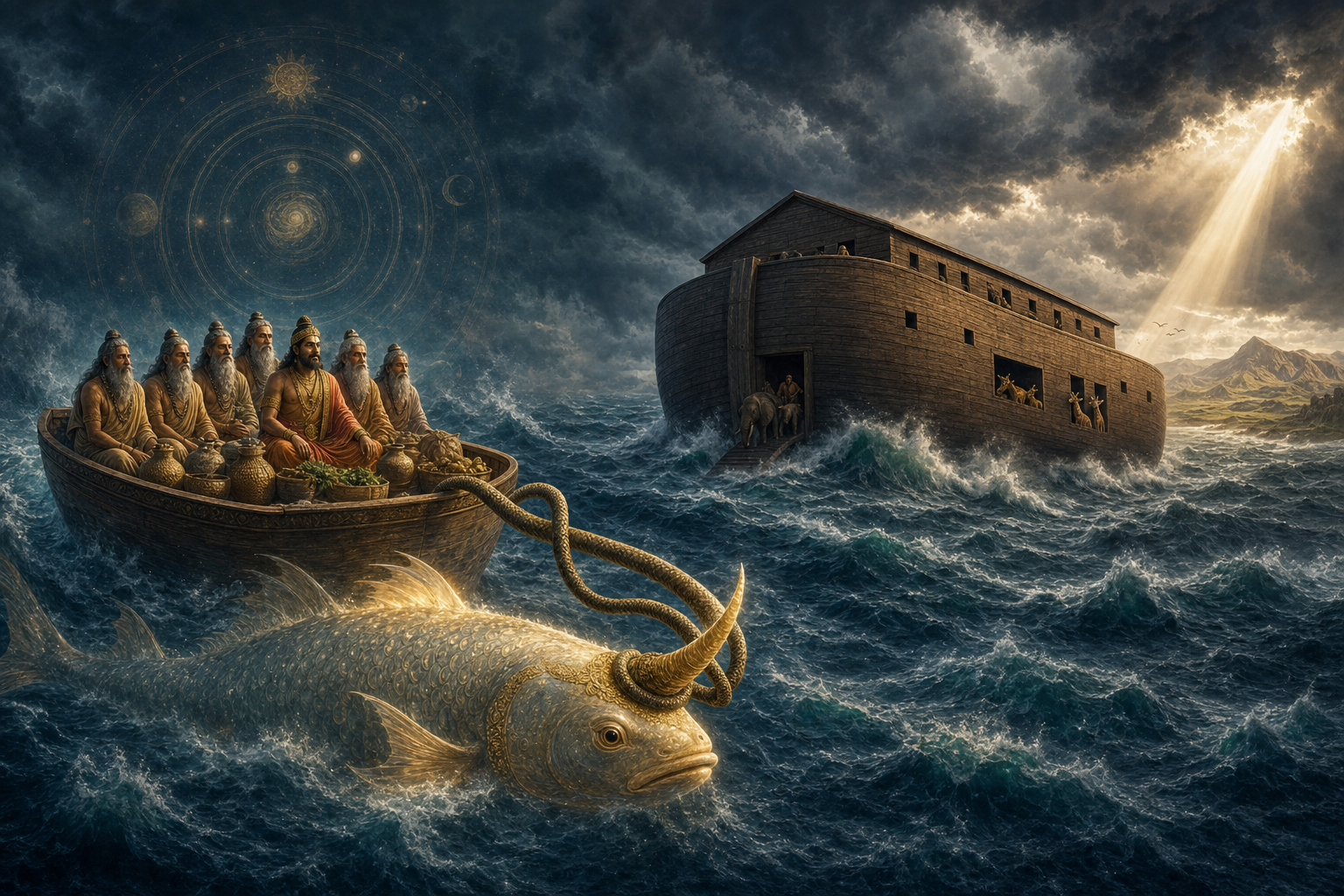
If someone has told you that Matsya-Manu is simply the Hindu version of Noah’s Ark, you are right to feel that something important has been left out. The resemblance is real: a great flood approaches, divine warning is given, a vessel carries life through the waters, and order resumes afterward. But that resemblance identifies a shared narrative pattern. It does not tell you what either tradition means by the pattern.
You can make a clearer comparison by asking four questions: What kind of time does the flood interrupt? Why does it happen? How does the divine act? What must be preserved? Those questions reveal two markedly different cosmologies without requiring you to deny their visible parallels or diminish either tradition.
The common flood pattern is only the starting point
The Hindu narrative develops through several layers of sacred literature. An early form appears in the Shatapatha Brahmana, while the Mahabharata, Bhagavata Purana, and Matsya Purana carry developed retellings. Details vary, but the recurring structure is recognizable: Manu receives a warning from a mysterious fish; the fish is revealed in later tellings as Vishnu’s Matsya avatar; and a boat preserves the means by which life, knowledge, and dharma can continue.
Genesis 6-9 also presents warning, construction of a vessel, the preservation of living beings, a catastrophic flood, and a renewed world. Noah brings his household and animals into the ark, including additional pairs of clean species. After the waters recede, the narrative culminates in a covenant represented by the rainbow.
| Question | Matsya-Manu | Noah |
|---|---|---|
| What frames the flood? | A transition within recurring creation, preservation, and dissolution | Divine judgment within a linear sacred history |
| Who receives the warning? | Manu, the progenitor associated with an epoch | Noah, a righteous man and the head of a household |
| How does the divine act? | Vishnu manifests as Matsya and guides the vessel | God warns, commands, judges, preserves, and establishes a covenant |
| What is preserved? | Seeds, sages, sacred knowledge, and the capacity to restore dharma | Noah’s family and animal life within a covenantal renewal |
| What follows? | Reconstitution of order within the cosmic cycle | Continuation of human history under a new covenant |
This table should prevent the most common mistake. If a comparison stops after noting a flood, a boat, and a survivor, it has catalogued motifs but has not interpreted them. To understand a sacred narrative, you have to follow its internal grammar: the account’s view of time, divine action, moral disorder, knowledge, and renewal.
Matsya belongs to cyclical time, while Noah redirects a line
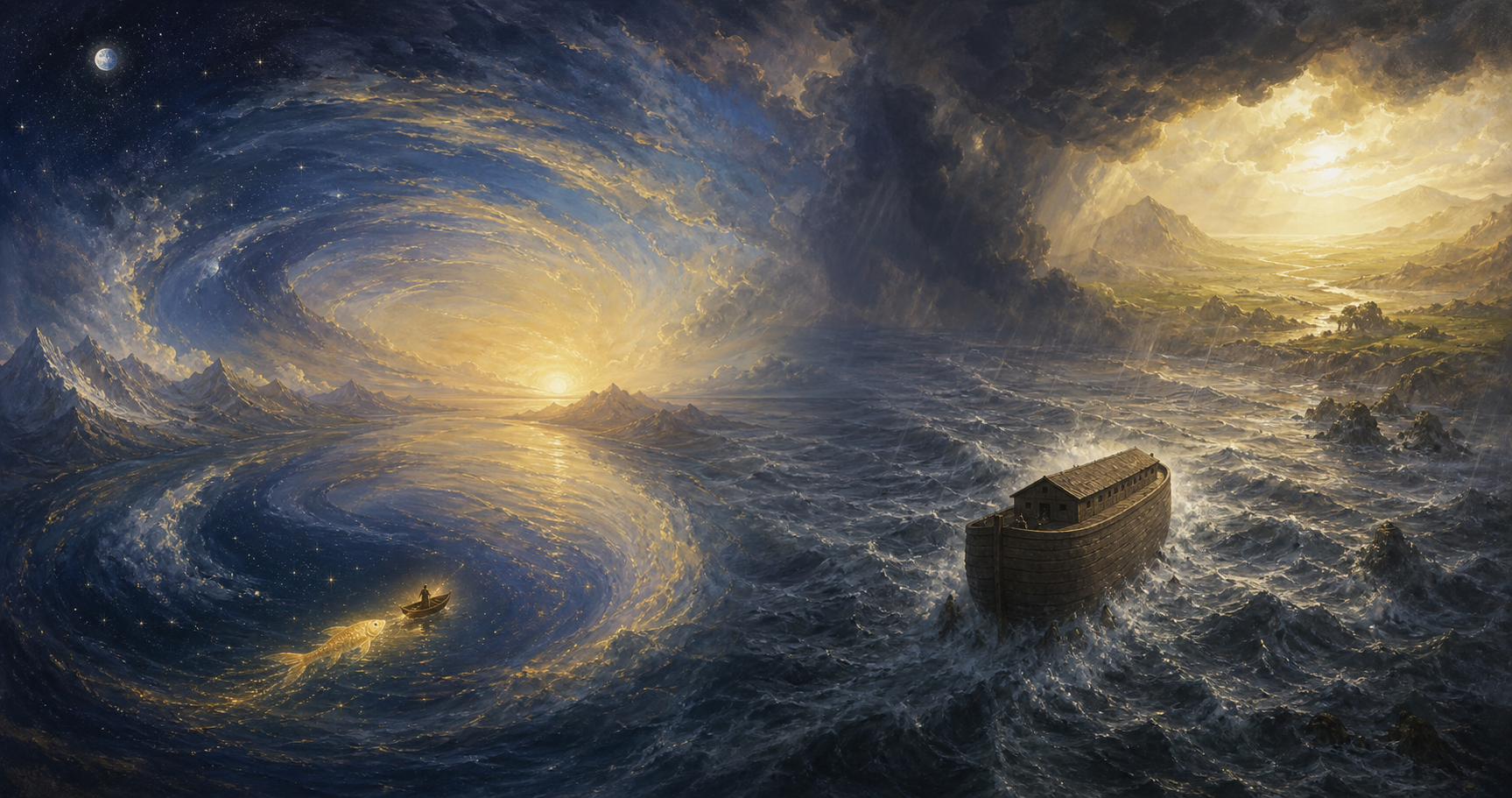
The decisive difference is temporal. Puranic cosmology does not imagine the universe as a single journey from one beginning toward one final historical destination. It works through recurring processes of srishti, or manifestation; sthiti, or sustenance; and laya or pralaya, dissolution. A flood can therefore mark a transition through which an ordered world is withdrawn and restored. It is not necessarily the absolute end of existence.
The scale matters. A day of Brahma, or kalpa, spans 4.32 billion years in the Puranic system and contains 14 manvantaras. Each manvantara contains 71 mahayugas, and each mahayuga passes through four yugas. These are units within a sacred cosmological architecture; when you discuss them, identify them as Puranic measures rather than presenting them as modern scientific dating.
Manu also requires careful handling. The name does not refer only to one ancestor occupying one unrepeatable moment. Different epochs have different Manus, and Vaivasvata Manu is the seventh Manu of the present kalpa. Some tellings associate Satyavrata’s passage through the deluge with his elevation to the role of Vaivasvata Manu. Others present Vaivasvata Manu directly as the lawgiver of the current manvantara. Variation at that level is characteristic of layered Puranic narration, not proof that the tradition lacks a coherent cosmology.
Genesis places its flood differently. Widespread human wickedness brings judgment; Noah’s righteousness and obedience distinguish him; and the covenant after the flood moves sacred history forward. The event is not one recurring transition among many manvantaras. It occupies a particular place in a continuous moral and genealogical history.
When you hear the two accounts treated as interchangeable, ask whether the speaker has distinguished an event inside a cycle from an event that changes the course of a line. That one question often exposes the category error. Similar events do not carry identical meanings when their traditions give time itself a different shape.
The divine roles disclose two different theologies
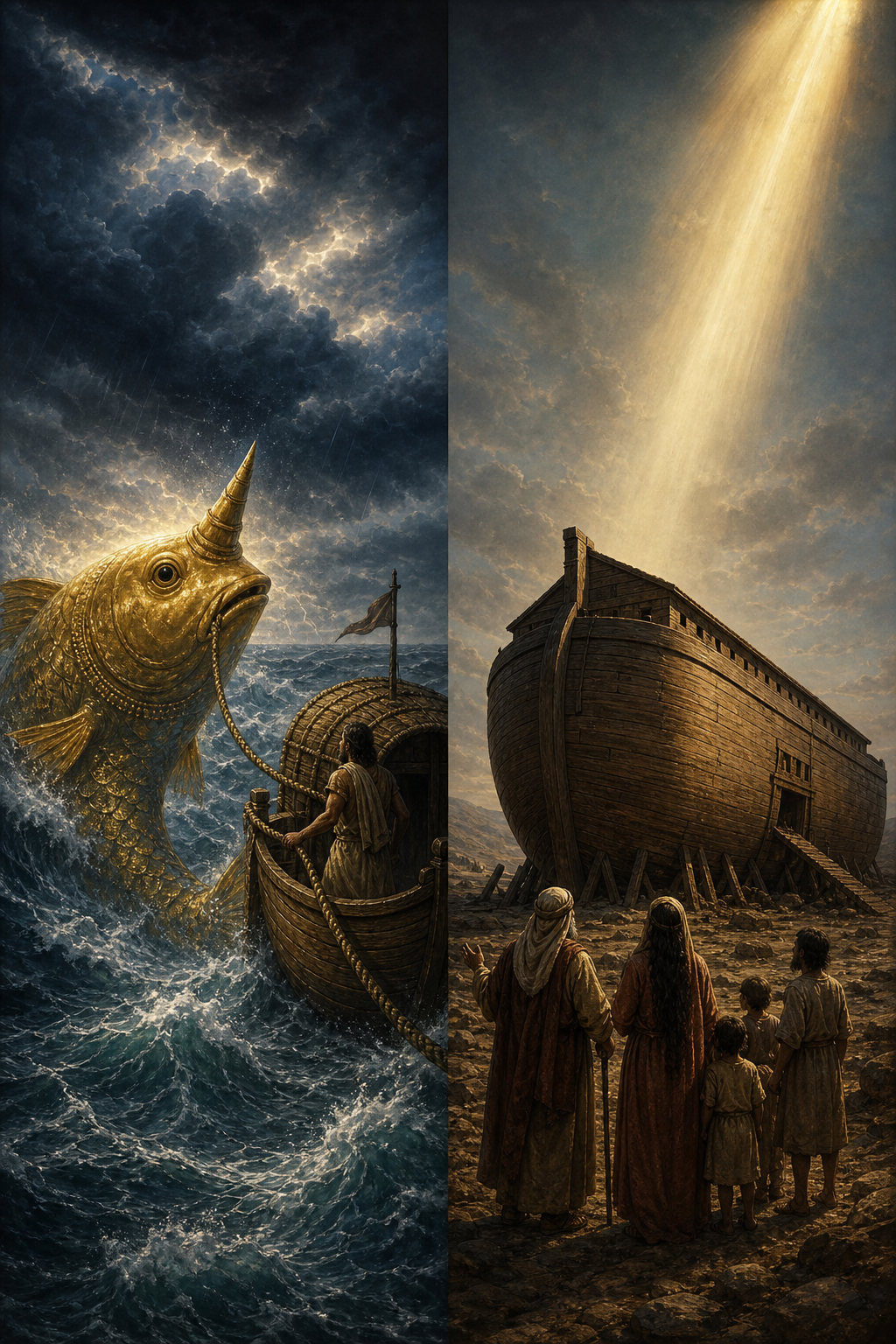
Matsya is not merely a messenger who delivers instructions before withdrawing from the action. Vishnu manifests within the threatened world, guides Manu, and leads the vessel through dissolution. The avatar is therefore protective, cosmological, and epistemic: divine presence safeguards not only living bodies but also the knowledge required to restore right order.
The boat is fastened to Matsya’s horn, and some tellings place Vasuki between the divine guide and the human vessel as the tether. These details should not be dismissed as decorative additions. The horn gives the fragile boat a stable point of orientation amid formless waters. Vasuki links terrestrial vulnerability to the power directing the passage. A responsible symbolic reading begins with those narrative functions instead of assigning an arbitrary meaning to every object.
In the Noah narrative, divine-human relations are structured through warning, command, obedience, judgment, and covenant. God gives Noah instructions for the ark and its living cargo. Noah follows them. The deity does not become the animal that physically guides the ark through the water. Divine transcendence and human faithfulness remain central to the episode.
This distinction should not be exaggerated into a crude claim that one account has divine presence and the other does not. Both depict divine involvement. The difference lies in its narrative form. Matsya enters the crisis as avatar and guide; Genesis emphasizes the sovereign command to which Noah responds. If you want to identify the theology at work, pay attention to the verbs attached to the divine rather than stopping at the generic phrase “God saves.”
The same test clarifies revelation. Several Puranic tellings connect Matsya with the recovery or preservation of the Vedas. Knowledge is not incidental cargo. It is one of the conditions under which an intelligible and dharmic world can re-emerge. In Genesis, the covenant gives the renewed world its moral frame. Both accounts carry meaning across the waters, but they do so through different theological instruments.
The cargo reveals what each tradition means by continuity
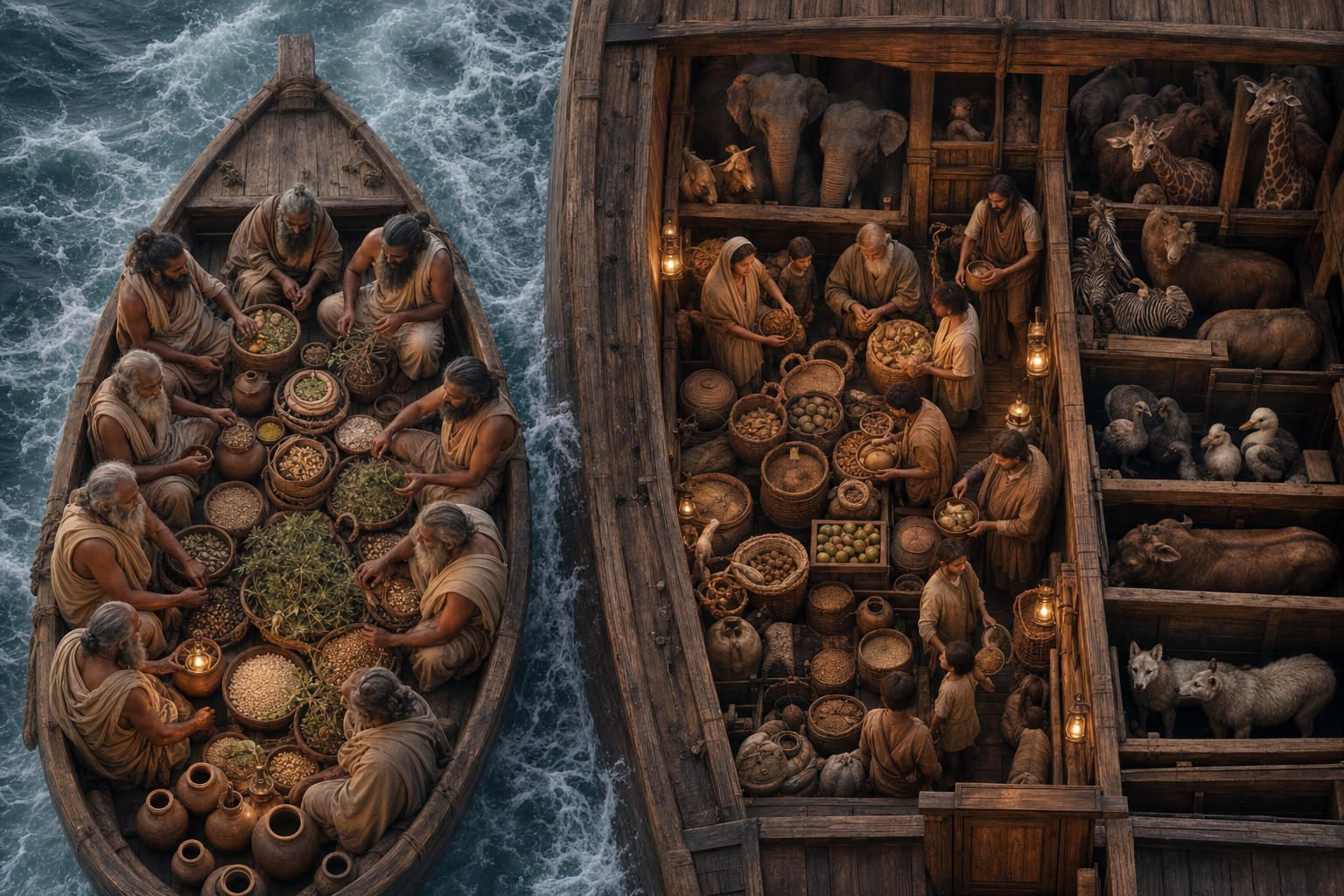
Ask what the boat carries, and the Hindu account becomes much harder to reduce to an ark of animal rescue. Manu preserves bija, or seeds; the Saptarishi, the seven sages; and sacred knowledge. Biological continuity, cultivation, teaching, memory, and moral order travel together. Survival without the means to cultivate the earth or transmit dharma would be incomplete.
The Saptarishi embody more than the survival of seven individuals. Their presence signals the passage of disciplined memory across a rupture. Ritual knowledge, ethical teaching, and civilizational orientation require living bearers. The Vedas similarly represent knowledge that must be heard, remembered, practiced, and taught. Matsya-Manu therefore preserves a seed-stock of ordered life, not merely a population.
This gives the narrative a concrete lesson for how you think about resilience. Preserving a community through crisis requires at least three kinds of continuity: regenerative material such as seed and food systems; knowledgeable people who can teach; and living practices that turn inherited information into conduct. An archive without teachers can become inert. Teachers without the material basis of life cannot rebuild. Biological survival without a moral orientation can reproduce the disorder from which people hoped to emerge.
Noah’s cargo serves another emphasis. His household carries human genealogy forward, while the animals preserve the living world entrusted to the ark. The covenant after the flood supplies the moral structure of renewal. The narrative’s logic is therefore not bare survival either, but it arrives at continuity through family, creatures, obedience, judgment, and covenant rather than through the Puranic complex of seeds, sages, Vedic knowledge, and recurring cosmic order.
That difference also guards against a shallow environmental reading. The seeds in Manu’s boat can illuminate present concerns about biodiversity, agriculture, and intergenerational responsibility, but the story is not simply a modern conservation campaign written in mythic language. Bija belongs with the sages and the Vedas. Ecology, education, and dharma are joined because a habitable world must be materially renewed and rightly ordered.
The wider Dharmic world makes cyclical scale familiar without making every tradition identical. Buddhism speaks of the contraction and expansion of world-systems through saṃvaṭṭa and vivaṭṭa. Jain cosmology maps vast ascending and descending movements through utsarpini and avasarpini. Sikh Gurbani does not reproduce that technical architecture, yet it repeatedly directs attention to the One, the moral order pervading life, and the smallness of ego before divine order. You can recognize a broad Dharmic comfort with immense, law-like time while still respecting the doctrinal boundaries among Hindu, Buddhist, Jain, and Sikh traditions.
Use the comparison without turning resemblance into equivalence
Flood memories are not rare, and their recurrence should make you cautious rather than overconfident. River floods, monsoon inundations, coastal surges, and changing shorelines give human communities many reasons to remember water as both destroyer and purifier. South Asia’s monsoon-fed rivers, Himalayan waters, and long coastlines offer an especially intelligible environmental setting for stories of inundation. That context can explain why flood imagery has power; it does not by itself prove that a particular sacred narrative records one identifiable event.
Nor does a shared motif prove borrowing. To establish literary dependence, you would need evidence of transmission, chronology, and distinctive correspondences that go beyond the widespread combination of warning, water, a vessel, and survival. Similarity is a reason to investigate, not permission to announce a genealogy. Claims that Matsya is copied from Noah, or that Noah is copied from Matsya, outrun the evidence supplied by resemblance alone.
Key takeaways
- Name the parallel precisely. Both accounts contain warning, a catastrophic flood, a vessel, preserved life, and renewal. Acknowledging that overlap makes the later distinctions more credible.
- Identify the model of time. Matsya-Manu belongs to recurring cosmic cycles and the succession of Manus. Noah belongs to a linear history of judgment, genealogy, and covenant.
- Watch how the divine acts. Vishnu manifests as Matsya and guides the boat. In Genesis, God commands Noah, judges wickedness, preserves life, and establishes a covenant.
- Inspect the cargo. Seeds, sages, and sacred knowledge make the Hindu preservation program civilizational as well as biological. Noah’s family and animals carry genealogy and creaturely life into covenantal renewal.
- Keep interpretation separate from historical proof. Environmental memory can help explain the persistence of flood narratives, but resemblance alone cannot establish a single event or a line of borrowing.
The next time the comparison comes up in a classroom, family discussion, or online debate, write four labels on a page: time, cause, divine action, and cargo. Fill them in for each account before arguing about origins. You will be able to acknowledge the common flood pattern while explaining, in concrete terms, why Matsya-Manu remains a distinctly Hindu vision of how life, knowledge, and dharma cross a cosmic rupture.
References
