
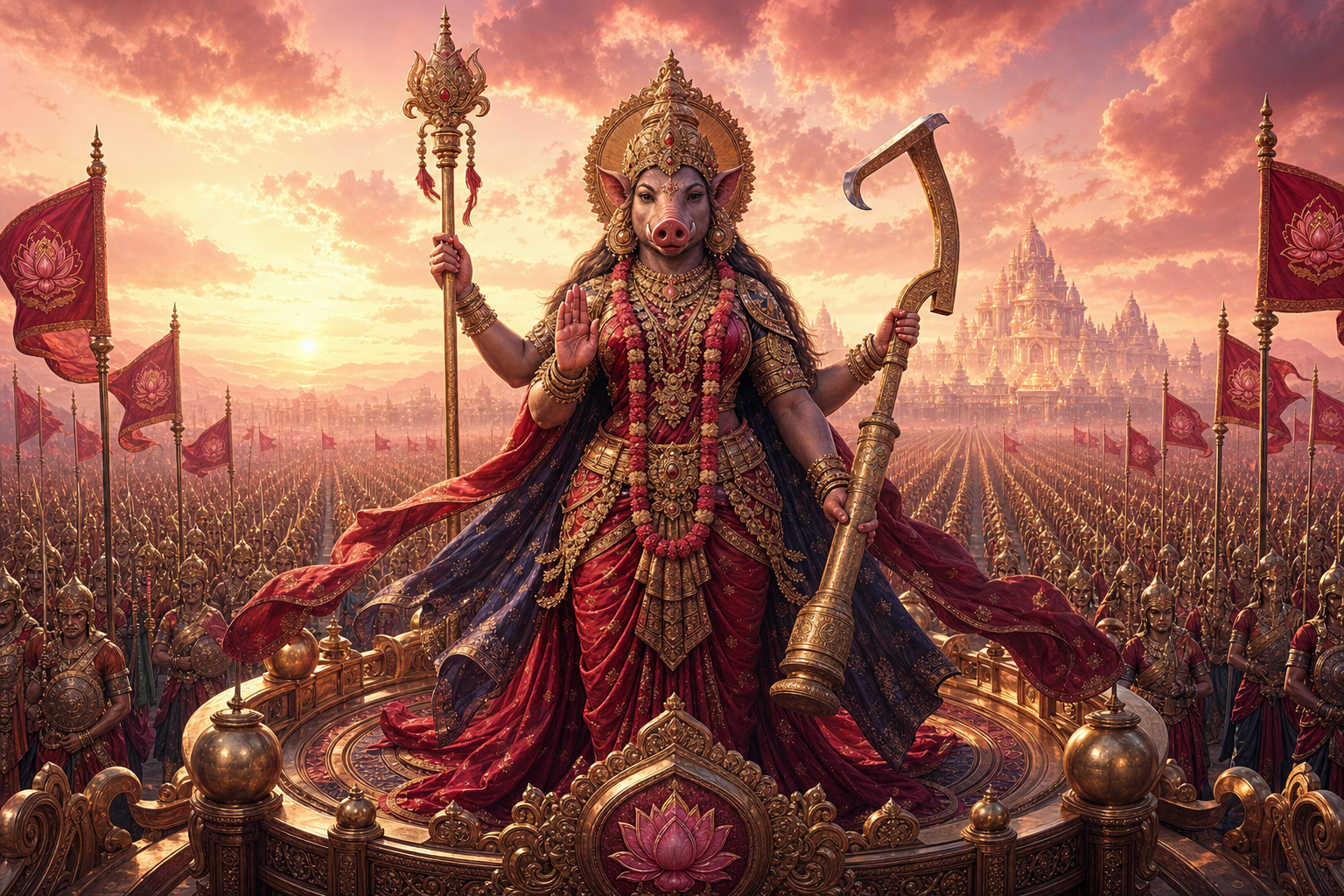
You may have come to Varahi with a simple question: who is she in the Lalitopakhyana? Is she the boar-faced protector, a Matrika, Lalita’s commander, or the slayer of an asura? The clearest answer begins with her office. Varahi is Dandanatha, the commander through whom divine sovereignty becomes disciplined action.
That distinction changes how you read her fierceness. Varahi does not sanctify anger, domination, or impulsive retaliation. She represents power placed under Dharma: power that protects sacred order, maintains necessary boundaries, and acts decisively only in service of a rightful end.
Begin with Dandanatha, not merely the boar face
Within the Brahmanda Purana’s Lalitopakhyana, Lalita Mahatripurasundari arises from the Chidagni Kunda when Bhandasura’s rule suppresses Dharma and obstructs sacred rites. Varahi enters this conflict not as an isolated fierce goddess but as Dandanatha, the commander of Lalita’s forces. Her identity is therefore relational: her authority comes from serving Lalita’s sovereign and harmonizing will.
Danda is often translated as the rod, punishment, or coercive authority. Here it is better understood as the capacity to correct disorder lawfully. A danda that serves personal resentment is not Varahi’s principle. Neither is indefinite passivity while adharma damages people, institutions, or worship. Dandanatha stands between those failures: uncontrolled aggression on one side and refusal to uphold a necessary boundary on the other.
Her boar face recalls the earth-restoring force associated with Varaha. The resonance does not require you to flatten the two forms into a single theological identity. It shows how Dharmic traditions can restate a shared sacred intuition through different devotional languages: what has been submerged, violated, or displaced must be raised and returned to order.
When you encounter Varahi’s fierce iconography, ask three questions. What is she protecting? Under whose rightful authority does she act? What limit governs her force? Those questions keep the image within its dharmic setting. Without them, fierceness becomes spectacle. With them, it becomes an ethic of responsible strength.
Read Varahi beside Lalita and Mantrini
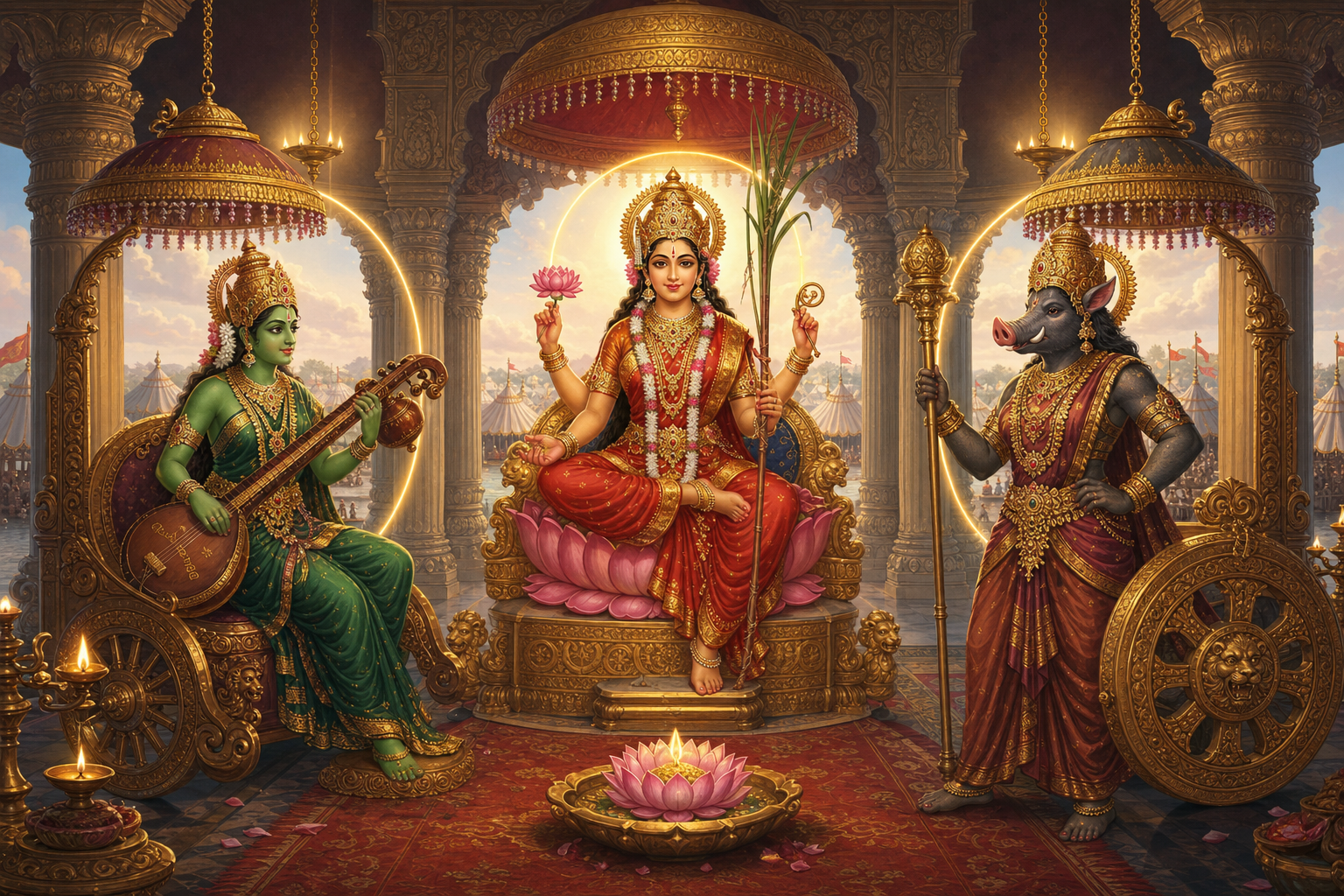
Varahi’s function becomes clearest in the arrangement of Lalita’s campaign. Lalita advances on the Chakra Raja Ratha, Mantrini or Raja Shyamala on the Geya Chakra Ratha, and Varahi on the Kiri Chakra Ratha. These are not three unrelated displays of divine grandeur. They present three coordinated requirements of dharmic order: legitimate sovereignty, intelligent counsel, and disciplined enforcement.
| Divine power | Vehicle | Function in the campaign | Question for your own action |
|---|---|---|---|
| Lalita Mahatripurasundari | Chakra Raja Ratha | Sovereignty, integrating vision, and the rightful end | What dharmic good must this action serve? |
| Mantrini or Raja Shyamala | Geya Chakra Ratha | Counsel, mantra, communication, strategy, and refined intelligence | Have discernment and truthful speech been fully used? |
| Varahi or Dandanatha | Kiri Chakra Ratha | Discipline, protection, boundaries, command, and corrective force | What proportionate action will actually secure the good? |
The order matters. Force does not define the goal for itself. Lalita supplies the sovereign purpose; Mantrini gives that purpose articulate and strategic form; Varahi makes it effective in conditions where counsel alone cannot contain adharma. Varahi is powerful precisely because her power is integrated with wisdom and legitimate authority.
You can use this triad whenever a difficult situation tempts you toward either paralysis or overreaction. First identify the principle that must be protected. Then clarify the facts, words, and strategy. Only then decide what boundary or corrective action is warranted. Reversing that order produces force in search of a justification. Omitting the final step produces insight that never protects anything.
Do not reduce Varahi to a disputed final blow
The names Vishanga, also rendered Vishangan, and Vishukra require care. Puranic, ritual, oral, and commentarial transmissions can preserve variations in how particular victories are assigned. Some South Indian ritual and oral tellings explicitly celebrate Varahi as the power who defeats Vishanga. Closely related remembrance surrounding the Sri Lalita Sahasranama celebrates the destruction of both Vishanga and Vishukra while emphasizing that Lalita’s sovereignty works through appointed divine powers as well as directly.
If your edition, commentary, temple tradition, or guru-parampara assigns a final blow differently, do not conceal the difference and do not turn it into a larger theological rupture than it is. Name the transmission you are using. A confident statement about one recension should not be presented as the only form in which the entire tradition has remembered the battle.
A careful reading check has four parts:
- Confirm whether the name is Vishanga or Vishukra; their similarity makes casual retellings especially easy to confuse.
- Identify the acting power in that specific telling: Lalita, Mantrini, Varahi, or another member of the divine host.
- Distinguish a Puranic narrative passage from a Sahasranama name, a later commentary, and a temple or oral account.
- After recording the variation, return to the stable theological structure: Lalita’s purpose is carried through counsel, command, and proportionate divine action.
This approach protects two things at once. It preserves textual honesty, and it prevents a debate over demon names from obscuring Varahi’s larger significance. Her defining role is not exhausted by one moment of killing. She is the disciplined capacity by which the Goddess’s order is defended and restored.
The battlefield becomes a test of inner governance
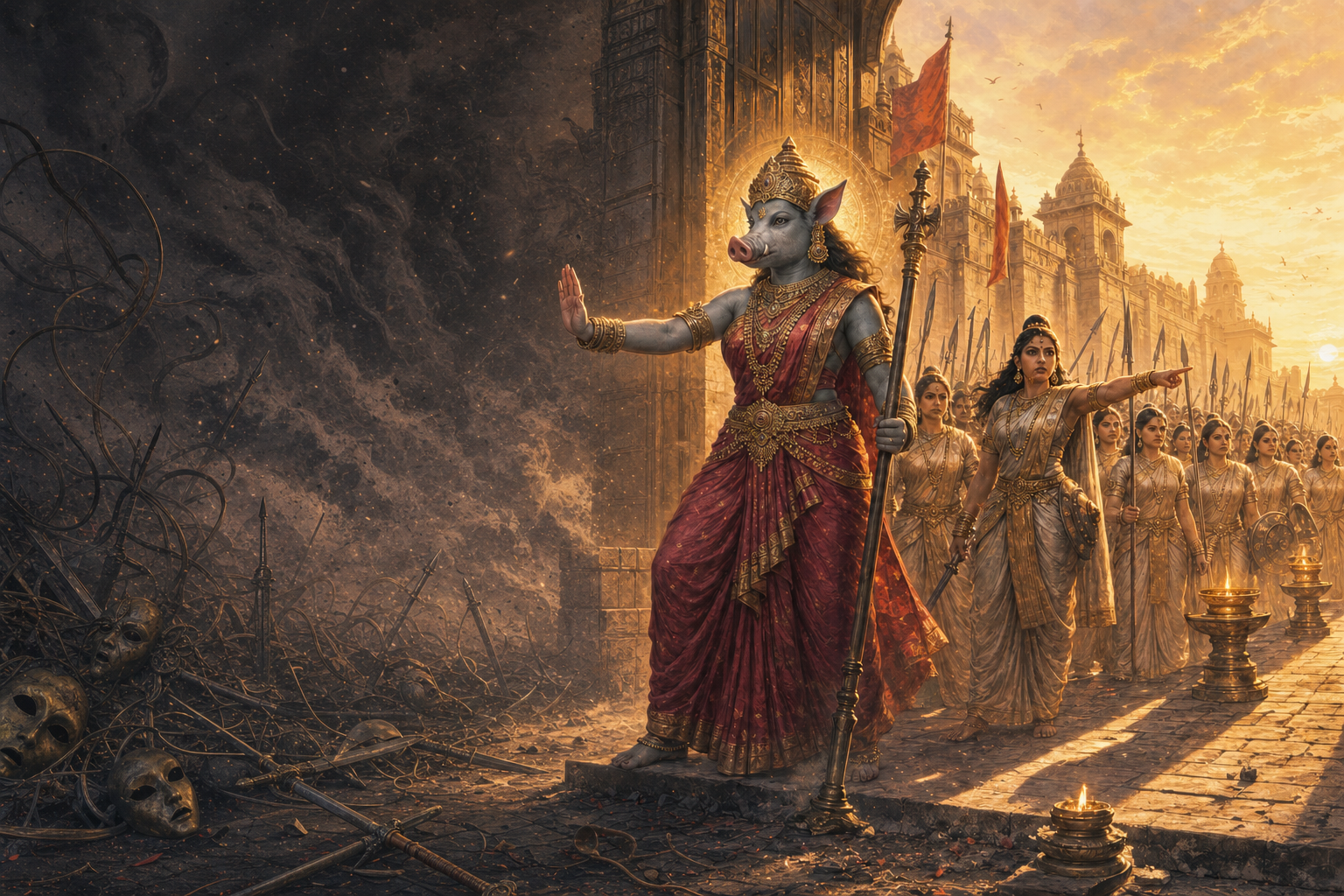
Vishanga can be read as more than a military opponent. He represents intrusion, disordered attachment, misdirection, and the kind of disturbance that enters through an unguarded opening. Varahi’s victory then becomes a lesson in governing attention, habits, speech, and boundaries. This symbolic reading need not cancel the devotional or cosmic meaning of the battle. It asks what the same structure reveals within your own conduct.
The crucial point is timing. An intrusion is easiest to govern when it first crosses a boundary. Once it has become a routine, an identity, or an institutional habit, correction costs more and provokes greater resistance. Varahi therefore represents more than dramatic intervention. She also represents the unglamorous discipline that prevents disorder from acquiring a permanent seat.
You can apply that insight without turning it into an improvised ritual. Choose one existing vrata, niyama, duty, or ethical boundary that you have allowed to become vague. Define the boundary in a sentence. Name the recurring intrusion that breaks it. Select the smallest action strong enough to protect it. Then review whether the action restored order or merely discharged emotion.
Suppose the boundary concerns speech. Mantrini’s function asks whether your words are truthful, timely, and capable of resolving the matter. Varahi’s function asks what you will do if repeated manipulation continues after the truth has been spoken. The answer may be ending an exchange, refusing cooperation with wrongdoing, documenting a decision, or consistently enforcing a rule. The point is not severity. It is the conversion of discernment into a dependable boundary.
Related Dharmic vocabularies illuminate this inner field without becoming interchangeable. Yogic and Buddhist traditions speak of kleshas that destabilize clear awareness. Jain philosophy describes kashayas that obstruct right vision and conduct. Sikh discipline joins the overcoming of vice with niyam and seva. Varahi’s idiom is distinctly Shakta, yet the civilizational kinship is recognizable: insight must shape conduct, and strength must remain answerable to an ethical end.
Approach Varahi worship with sobriety and guidance

Understanding Varahi and undertaking technical Varahi upasana are not the same decision. You can study her place in the Lalitopakhyana, contemplate Dandanatha as an ethical principle, and receive darshana in a public temple setting without pretending that you have entered a specialized ritual discipline.
In Shakta practice, Varahi is invoked for protection, stability, the removal of obstruction, and the preservation of sacred order. She is also remembered within the Sapta Matrika constellation, including in some Navaratri settings. These public and theological forms can introduce you to her place in the larger divine family. Technical mantra, nyasa, yantra, or paddhati-based worship is another matter and should be learned through a competent lineage rather than assembled from disconnected instructions.
That caution is not fear of the Goddess. It is fidelity to her meaning. Dandanatha embodies order, so a disorderly approach to her worship contradicts the very power being invoked. If you seek formal upasana, ask a qualified teacher what preparation is required, which form of Varahi belongs to the lineage, what daily obligations accompany the practice, and what should remain within initiated transmission. Do not treat an isolated mantra or ritual fragment as a complete method.
You can also test your understanding by its fruit. A Varahi-centered interpretation that feeds impulsive anger, contempt, fantasies of domination, or hostility toward ordinary disagreement has lost the dharmic measure of danda. Discipline should make you steadier, more truthful, more capable of protecting what is sacred, and less governed by personal rage.
Key takeaways
- Varahi’s central identity in the Lalitopakhyana is Dandanatha: disciplined command acting under Lalita’s sovereignty.
- Her boar form signifies restorative and protective strength, not uncontrolled ferocity.
- Lalita, Mantrini, and Varahi express a complete order of action: establish the rightful end, apply counsel and strategy, then enforce a proportionate boundary.
- Accounts involving Vishanga and Vishukra can vary across narrative, commentarial, ritual, and oral transmissions; cite the specific transmission rather than claiming a universal assignment.
- An inner reading of Varahi asks whether your insight becomes consistent conduct without hardening into aggression.
- Study and public devotion are distinct from technical upasana, which should be undertaken with appropriate guidance.
The next time you read Varahi’s part in Lalita’s campaign, mark three things in the passage: the good being protected, the intelligence directing the response, and the boundary that finally makes protection effective. Then carry the same sequence into one unresolved duty of your own. That is where Dandanatha stops being a distant image and becomes a disciplined measure for action.
References
