
You may have encountered the word “Madhyandina” in a family record, heard it during a ritual, or found it while choosing an edition of the Yajurveda. The immediate question is practical: what does that name identify, and which text, chant, or ritual manual belongs with it?
Madhyandina identifies more than a version of a book. It identifies a transmitted system joining mantras, ritual interpretation, household practice, pronunciation, and philosophical inquiry. Once you see that system as a whole, you can choose reliable materials without mixing related but distinct Vedic recensions.
First place Madhyandina on the Vedic lineage map
Begin with three nested names: Yajurveda, Shukla Yajurveda, and Madhyandina Shakha. The Yajurveda preserves sacrificial formulas, called yajus, together with the ritual logic governing their use. Its two broad streams are traditionally described as Krishna, or “Black,” and Shukla, or “White.” The Krishna stream intersperses mantras and explanatory material, whereas the Shukla stream presents its mantra Samhita separately from its Brahmana exposition.
Within the Shukla Yajurveda, Madhyandina and Kanva are the two authoritative recensions. A recension is not a rival religion or a new philosophical school. It is a recognized form of transmission with its own textual arrangement, readings, phonetic details, and pedagogical continuity.
The traditional lineage account connects the Shukla Yajurveda with Yajnavalkya. After a rupture with his teacher Vaishampayana, Yajnavalkya is said to have relinquished his earlier learning and received a purified, reordered body of mantras from Surya. This sacred account explains how the tradition understands its own distinct identity. It should be presented as lineage memory rather than converted into an unsupported claim about a precisely datable historical event.
Key takeaways
- Madhyandina is a shakha, or transmitted recension, within the Shukla Yajurveda.
- Its central mantra collection is the Vajasaneyi Madhyandina Samhita, arranged in forty adhyayas.
- Its principal Brahmana is the Madhyandina recension of the Shatapatha Brahmana, arranged in fourteen kandas.
- The Isha Upanishad closes the Samhita, while the Brihadaranyaka Upanishad belongs within the Shatapatha Brahmana tradition.
- You should verify the recension before combining a printed text, an audio recording, a translation, or a ritual manual.
This hierarchy gives you a quick test whenever a catalogue or teacher uses only the word “Yajurveda.” Ask which broad stream and which shakha. “Shukla Yajurveda, Madhyandina Shakha” is a usable identification; “Yajurveda” alone usually is not precise enough for recitation or ritual work.
Build a map of the Madhyandina textual system

The Madhyandina corpus becomes easier to navigate when you separate five functions: mantra, ritual explanation, large-scale procedure, household procedure, and phonetic control. Each has a corresponding textual anchor.
| Function | Madhyandina textual anchor | What it helps you understand |
|---|---|---|
| Mantra collection | Vajasaneyi Madhyandina Samhita | Formulas used in sacrificial and related observances; forty adhyayas, with the Isha Upanishad as the fortieth |
| Ritual exposition | Shatapatha Brahmana, Madhyandina recension | Offering sequences, altar construction, cosmological correspondences, and the meanings assigned to sacrificial actions; fourteen kandas and the setting of the Brihadaranyaka Upanishad |
| Shrauta procedure | Katyayana Shrauta Sutra | The ordered performance of major public and fire rituals |
| Household procedure | Paraskara Grihya Sutra | Domestic samskaras, including initiation, marriage, and ancestral observances |
| Pronunciation and recitation | Vajasaneyi Pratishakhya | Accent, sandhi, sound values, and standards of oral delivery |
The distinction between Samhita and Brahmana is essential. The Samhita supplies the verbal material used in the rite. The Brahmana explains sequences, correspondences, purposes, and symbolic relationships at far greater length. If you expect the Samhita alone to provide a complete ritual explanation, it will appear frustratingly compressed. If you approach the Shatapatha as though it were merely a collection of mantras, its expansive reasoning will seem disordered. Each work is doing a different job.
This map also prevents a common mistake in reading the Upanishads. The Isha Upanishad is the fortieth adhyaya of the Madhyandina Samhita, not an unrelated philosophical appendix. Its treatment of action, renunciation, and the all-pervading Self stands at the end of a liturgical collection. The Brihadaranyaka Upanishad likewise emerges from the world of the Shatapatha Brahmana. Its inquiries into atman, knowledge, imperishability, and liberation do not require you to abandon the ritual corpus; they disclose a deeper level of questioning within it.
That relationship changes how you read. Instead of placing “ritual” and “philosophy” in opposing boxes, notice how disciplined speech, precisely ordered action, relinquishment, and knowledge develop along one continuum. Refrains such as svaha, vashat, and idam na mama coordinate offering and intention. The Upanishadic movement inward does not make that discipline meaningless; it asks what the sacrificer, the offering, and the knowing Self ultimately are.
Verify Madhyandina before using a text or recording
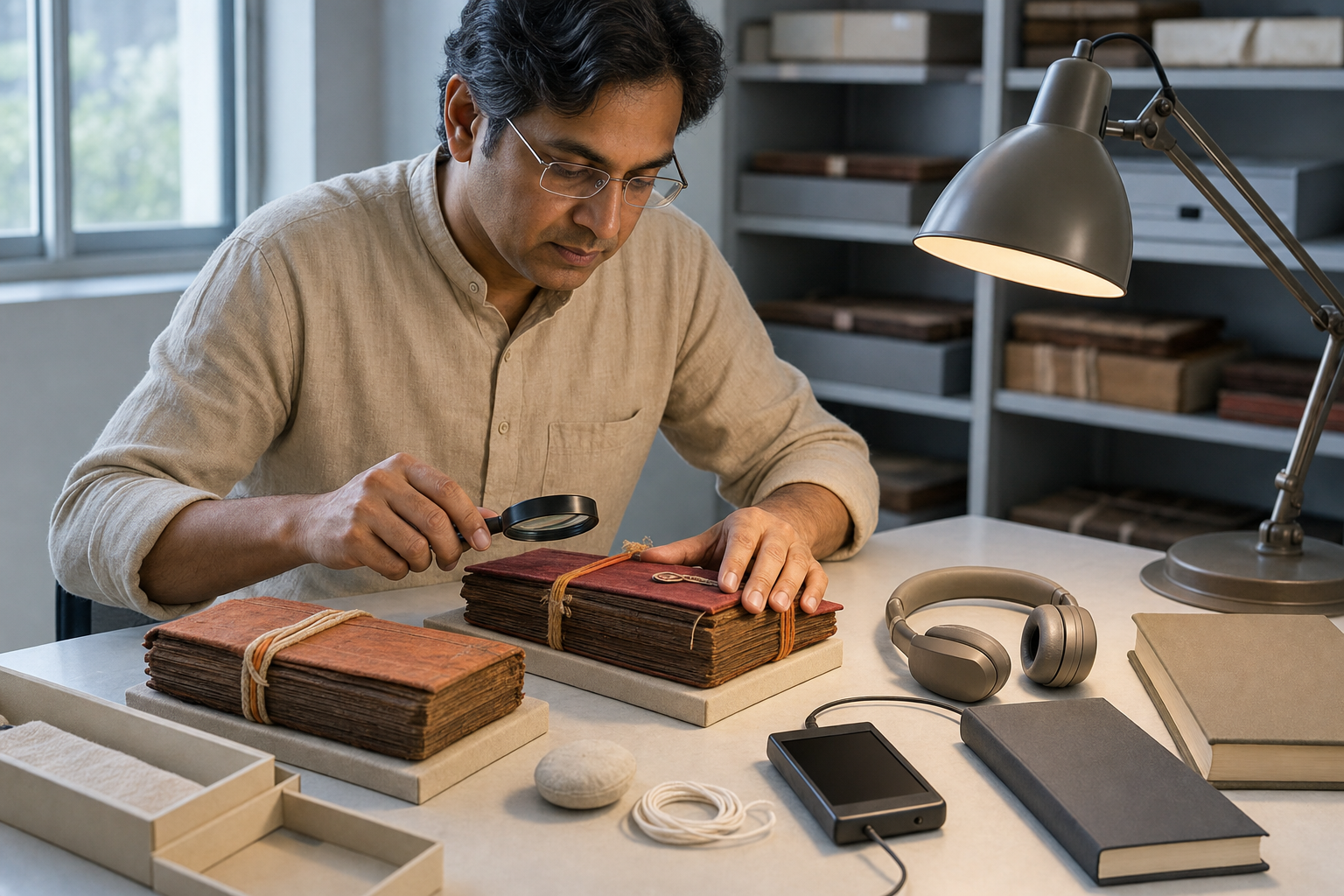
Madhyandina and Kanva share the theological and ritual architecture of the Shukla Yajurveda, but they are not interchangeable line by line. Their differences include mantra order, lexical and phonetic readings, and the placement of corresponding passages. The Shatapatha Brahmana has fourteen kandas in its Madhyandina recension and seventeen in its Kanva recension.
Use the following checks before you study, cite, chant, or commission a ritual:
- Read the full title. Look for “Vajasaneyi Madhyandina Samhita,” “Madhyandina recension,” or an equivalent identification in the title page, introductory matter, catalogue record, or colophon. The word “Vajasaneyi” alone may still leave the recension unstated.
- Check what is being counted. Forty adhyayas identifies the arrangement of the Madhyandina Samhita described here. Fourteen versus seventeen kandas is a distinction between the Madhyandina and Kanva forms of the Shatapatha Brahmana; do not apply that count to the Samhita.
- Inspect the Sanskrit, not only the translation. A translation may smooth out changes of wording and arrangement. It may not show the accents at all. Matching English sentences therefore do not prove that two Sanskrit editions follow the same recension.
- Match audio to print. Do not assume that a recording labelled only “Shukla Yajurveda” follows your printed Madhyandina text. Compare the recension, passage order, wording, and accent notation before learning from it.
- Confirm the teaching lineage. For actual recitation, ask the instructor which shakha, patha, and accent conventions are being taught. A living teacher can detect a mismatch that a beginner will not hear.
Geography can provide a clue, but it cannot replace these checks. Madhyandina transmission has been especially prominent in North India and Nepal, including Mithila, Kashi, Prayaga, parts of Rajasthan and Gujarat, the Nepali Tarai, and the Kathmandu Valley. A manuscript or family tradition from one of these regions may well be Madhyandina, but regional origin alone does not establish its recension.
Variant readings should not be treated automatically as damage or error. Parallel shakhas embody the Vedic method of preserving continuity through more than one authorized line. Your task is to identify the line accurately, keep its internal relationships intact, and describe a variant as a variant rather than silently replacing it with a familiar reading.
Treat sound and ritual as parts of the meaning
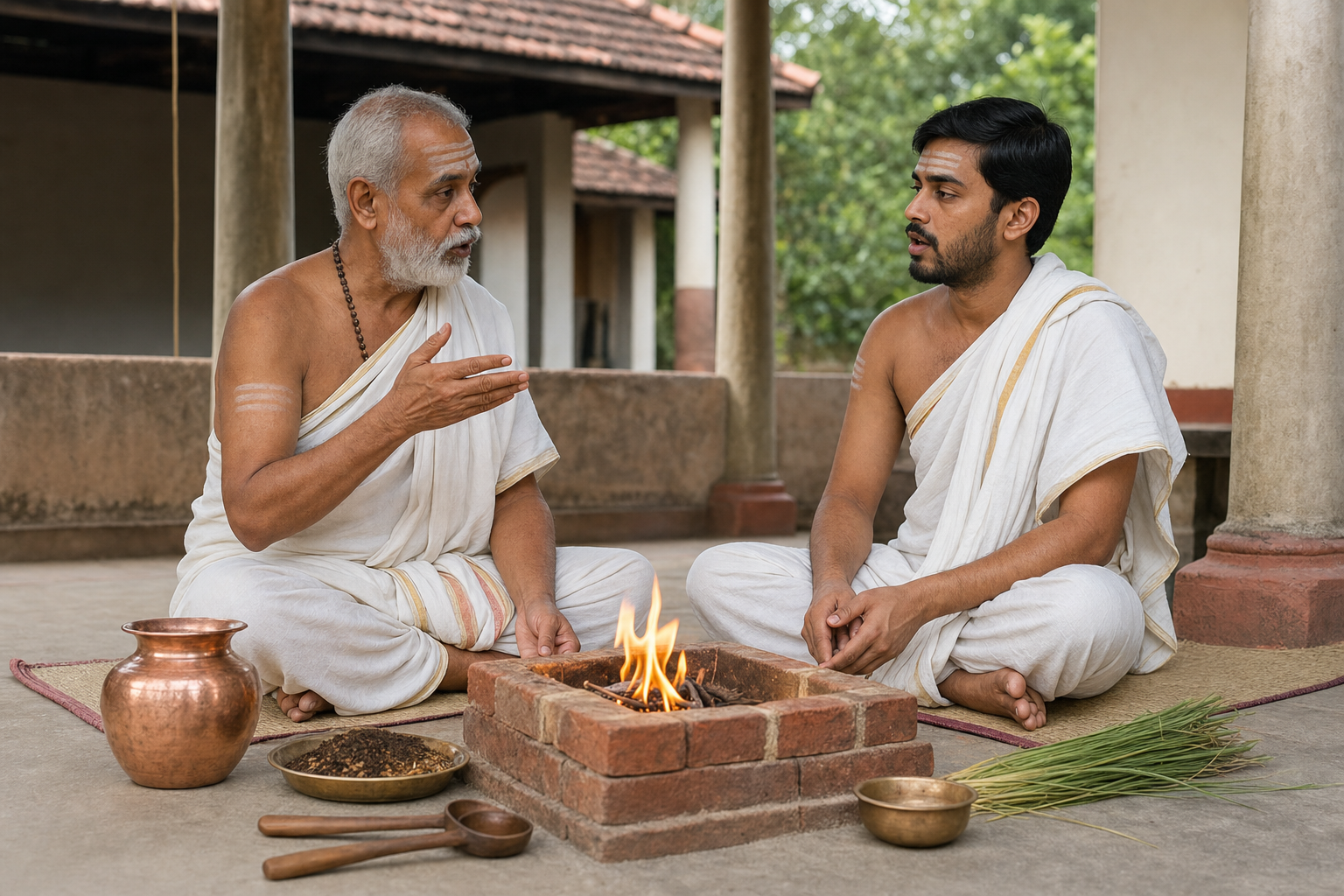
A romanized mantra can tell you which letters an editor has printed. It cannot by itself transmit a Vedic recitation. Madhyandina oral discipline depends on the three accents udātta, anudātta, and svarita, together with rules governing combination, duration, articulation, and continuity. In this setting, sound is not decorative performance placed on top of semantic meaning. It is part of what the lineage preserves.
The traditional learning sequence employs increasingly analytical and mnemonic modes. Samhita-patha gives the connected recitation. Pada-patha separates the words. Krama-patha recites them in ordered pairs. Jata and ghana use more elaborate patterns that strengthen memory and provide internal checks against alteration. These modes are not different translations of a passage; they are disciplined ways of securing the same verbal transmission.
If you want to begin chanting, use a restrained process:
- Identify the exact Madhyandina passage and the edition your teacher uses.
- Learn a short unit by listening and repeating rather than guessing the melody from unaccented print.
- Follow an accent-marked text and ask what each printed sign means in that edition.
- Record your own recitation, then compare it with the teacher’s model for accent, vowel length, junctions, and pauses.
- Stabilize samhita-patha and word division before treating jata or ghana as a shortcut to accomplishment.
Digital recordings and archives are valuable for review, preservation, and access. They are weakest precisely where a beginner most needs correction: a recording cannot always tell you that your own vowel, accent, or sandhi is wrong. Use digital access to support instruction, not to erase the difference between hearing a chant and being trained in it.
Ritual practice requires the same respect for coordination. Madhyandina materials support rites such as Agnihotra, Darsha-Purnamasa, Chaturmasya, soma sacrifices, Vajapeya, Rajasuya, and Ashvamedha. The Shatapatha’s treatment of agnicayana includes the celebrated hawk-shaped altar, where geometry, number, construction, offering, and cosmology meet. The Paraskara Grihya Sutra brings the tradition into household samskaras such as upanayana, vivaha, and ancestral offerings.
These names should orient your study, not encourage a do-it-yourself reconstruction of a major rite from a translation. A ritual manual assumes knowledge of roles, fires, implements, gestures, sequence, pronunciation, and local lineage practice. If your purpose is performance rather than textual study, consult a trained Madhyandina practitioner and establish which rite, textual authority, and family custom apply before selecting mantras.
Choose an entry point that matches your purpose
If you are tracing a family tradition
Ask for the most specific identification your family retains: Veda, Krishna or Shukla stream, shakha, associated grihya procedure, teacher, and place of transmission. Photograph title pages and colophons where permitted. Record the wording elders actually use, even when its spelling is uncertain. You can normalize the transliteration later; you cannot easily recover an unrecorded lineage name.
Do not decide that a familiar North Indian wedding mantra proves Madhyandina affiliation. Madhyandina formulas have strongly influenced wedding practice across North India and Nepal, but liturgical circulation is broader than family identity. Confirm the shakha through the family’s priestly or educational lineage whenever that remains possible.
If you are approaching the philosophy
Start by locating the Isha Upanishad within adhyaya forty of the Samhita. Read its handling of action and renunciation with that location in mind. Then approach the Brihadaranyaka through the larger world of the Shatapatha Brahmana. Yajnavalkya’s exchanges with Gargi and Maitreyi address the imperishable, the limits of conceptual speech, the Self, and the discipline expressed by neti neti. Their questions become clearer when you know that this inquiry belongs to a corpus already concerned with action, order, offering, and correspondence.
Resist the urge to extract one phrase as a complete account of the tradition. “Neti neti” is not a licence for vague negation, just as renunciation in the Isha Upanishad is not a pretext for indifference to action. Track how a teaching relates knowledge, conduct, disciplined action, non-attachment, and liberation. That gives you a more useful philosophical reading than collecting isolated declarations.
If you are doing textual or historical study
Keep the recension visible in every citation. Record whether a passage comes from the Vajasaneyi Madhyandina Samhita, the Madhyandina Shatapatha Brahmana, or a later sutra. Include adhyaya or kanda information appropriate to the work instead of citing “Yajurveda” as though it were a single undifferentiated book.
Traditional exegesis is represented especially by Uvata, from roughly the eleventh century, and Mahidhara, from roughly the sixteenth. Their attention to mantra use, accent, and ritual setting helps prevent a purely lexical reading. For English-language orientation, researchers have also used Julius Eggeling’s multi-volume rendering of the Shatapatha Brahmana and Arthur Berriedale Keith’s rendering of the Vajasaneyi Samhita. A translation can clarify argument and structure, but it cannot serve as an accentual base for chanting.
Your best next step is small and verifiable. Write down the exact label “Shukla Yajurveda, Madhyandina Shakha,” then identify whether your immediate need concerns Samhita, Brahmana, shrauta procedure, household practice, or recitation. Choose one matching text and one qualified line of guidance. That simple discipline keeps the Madhyandina inheritance connected in the way it was built to be: word with sound, sound with action, and action with knowledge.
References
