
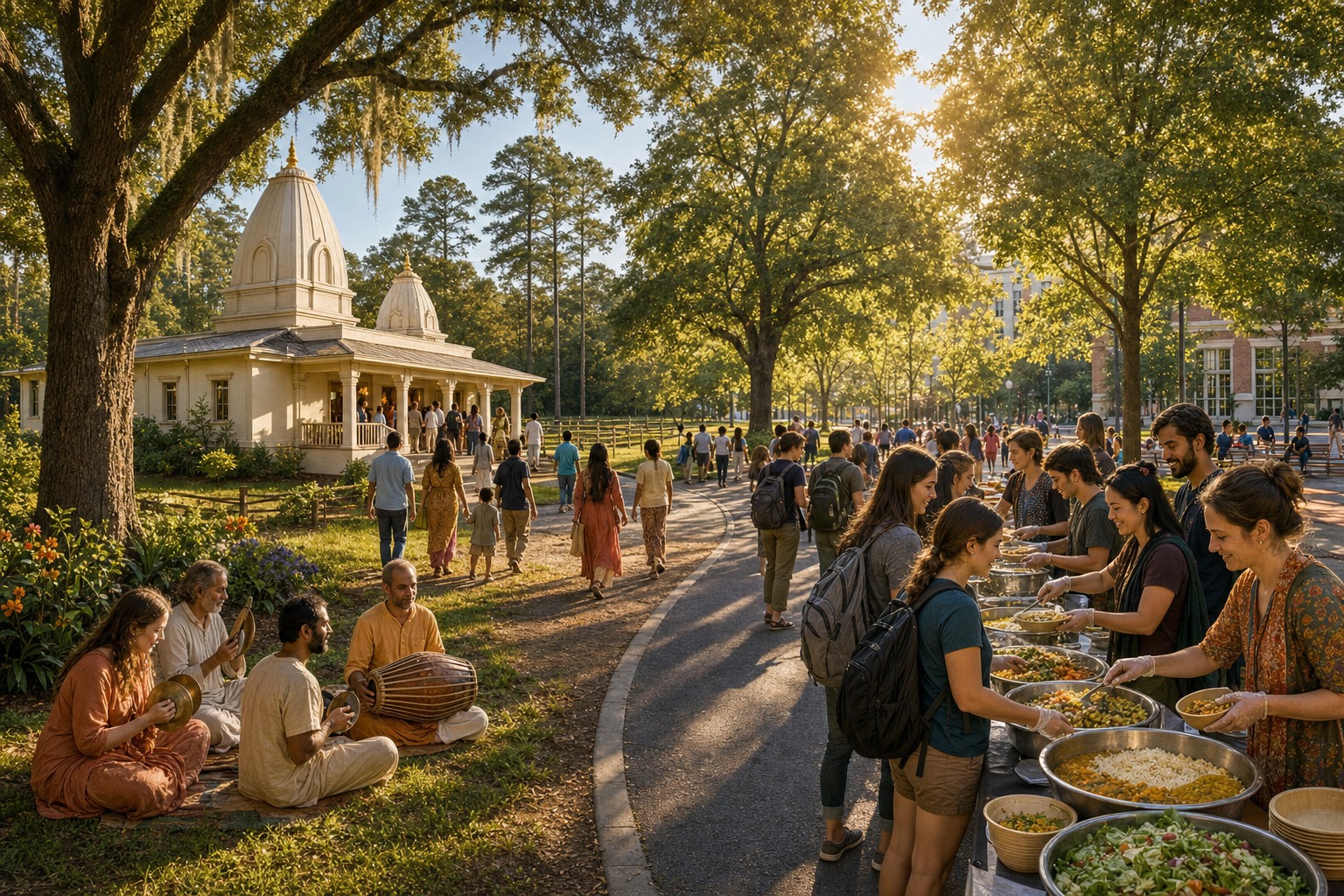
If you want to understand what ISKCON contributes to Alachua and Gainesville, don’t begin with buildings or membership. Begin with what people can reliably do because the community is there: worship in a settled rural environment, raise children within a devotional culture, share kirtan, serve neighbors, and find an affordable plant-based meal in the middle of a demanding campus day.
These activities may look separate, but they form an institutional ecosystem. Alachua provides continuity, sacred space, and intergenerational community. Gainesville brings that tradition into public life through food, hospitality, and daily contact. If you want to support either place, you need to know what makes each institution durable, what threatens its work, and which practical response fits the problem.
Two places, one institutional ecosystem
An institution is more than an organization with a name. It is a repeated practice, a community that depends on it, a place or process that makes it possible, and a set of responsibilities that keeps it trustworthy.
In Alachua, daily worship, kirtan, family life, programs for children and elders, and a peaceful rural setting reinforce one another. The fields, tree lines, broad skies, roads, and approaches to sacred spaces are not incidental scenery. They shape whether prayer, festivals, processions, and ordinary community life can proceed without constant conflict with traffic, glare, noise, or incompatible neighboring uses.
In Gainesville, Krishna Lunch has served plant-based meals to students, faculty, staff, alumni, and visitors. Its institutional value comes from repetition. A meal offered once is an event. A meal people can expect during the academic term becomes part of the social and nutritional infrastructure of campus life.
You can test the importance of any community program by asking four practical questions:
- What recurring need does it meet? Look for worship, food, education, companionship, cultural continuity, or service rather than a vague claim of community value.
- Who reorganizes life around it? Children, elders, students, families, volunteers, and visitors may depend on the same institution in different ways.
- What conditions make it possible? A rural temple community may need quiet edges and safe access. A campus meal needs permits, kitchen discipline, a workable serving location, and predictable operating rules.
- What would disappear if it stopped? Count more than the immediate activity. A canceled lunch also removes a meeting place; a damaged sacred setting can disrupt worship, festivals, family routines, and hospitality.
This test prevents two common mistakes. The Alachua community should not be treated as a private congregation unaffected by surrounding land use. Krishna Lunch should not be treated as an interchangeable food vendor simply because meals are involved. Each performs a distinct public and spiritual function.
Protect Alachua by translating sacred routines into land-use conditions
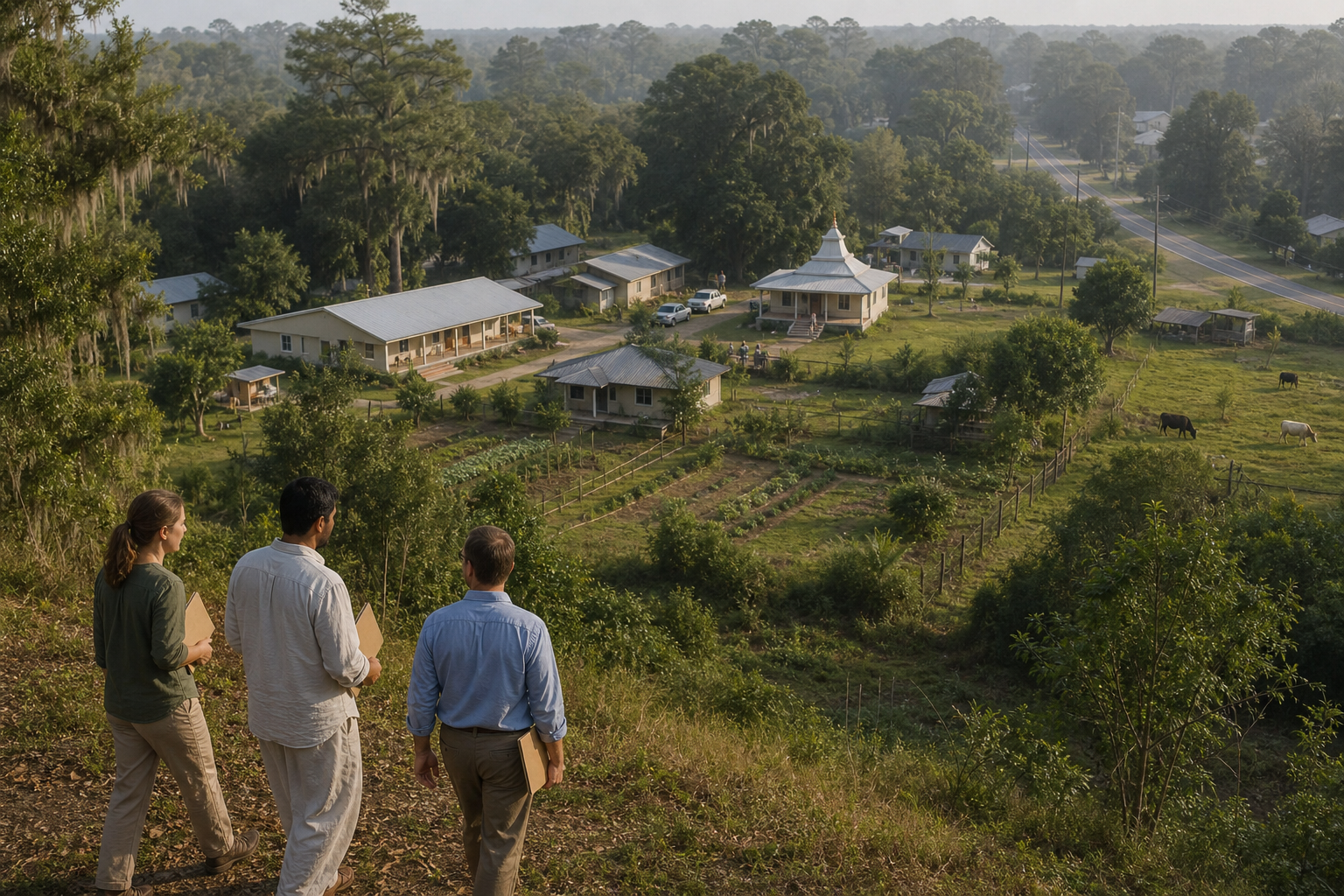
A proposal involving approximately 60 acres along US Highway 441 near the Alachua ISKCON community illustrates how quickly a religious environment can become a planning question. The relevant choice is not simply growth versus no growth. It is whether a particular intensity, layout, and operating pattern can coexist with the community already present.
Florida land-use review commonly separates broad policy from detailed site design. A comprehensive plan amendment can change the Future Land Use Map and the range of uses contemplated for a property. Rezoning, including a Planned Unit Development, can then determine matters such as layout, intensity, buffers, access, building placement, and operating conditions. If you are commenting, identify the stage first. A good request made at the wrong stage may receive no enforceable answer.
- At the comprehensive-plan stage, focus on whether the proposed land-use category is compatible with the agricultural and religious edge, whether transportation and utilities can support it, and whether environmental constraints have been addressed.
- At rezoning or site-plan review, ask for exact setbacks, buffers, building heights, driveway locations, lighting specifications, delivery hours, stormwater features, construction controls, and rules for uses that could produce late-night activity.
- Before a final vote, check whether important promises appear in the ordinance, development agreement, approved plan, or another enforceable instrument. A reassuring presentation is not the same thing as a binding condition.
Religious impact becomes easier to evaluate when you translate it into a simple matrix: community routine, possible impact, measurement, and requested condition. That does not diminish the sacred meaning. It gives public officials something they can place in the record and administer later.
- Early-morning and evening worship: identify the concern as light trespass or tonal noise; request a photometric or acoustic analysis; then seek full-cutoff fixtures, parcel-boundary light limits, loading orientation away from sacred spaces, and delivery-hour restrictions.
- Festival access and processions: identify conflicts with turning traffic and crossings; request a traffic impact analysis covering peak-hour movements, driveway spacing, turn lanes, signal warrants, pedestrian refuges, and temple access.
- The rural edge: identify loss of canopy, habitat continuity, aquifer recharge, or stormwater capacity; request tree, habitat, and drainage documentation along with native buffers, on-site retention, and low-impact development measures.
- Construction near community events: provide an accurate festival calendar and request a construction-management plan that addresses heavy deliveries, temporary lighting, dust, noise, and road closures during sensitive periods.
Several design measures already provide a useful negotiating vocabulary: native buffers in the 150- to 300-foot range, step-down building heights, full-cutoff lighting at no more than 3000K, vegetated berms, staggered masonry barriers, and limits on delivery hours. These figures should not be copied mechanically. The record should explain why a particular width, height, fixture, or schedule will work at the actual interface.
Do not frame every potential benefit as a threat. Appropriately scaled development may support local businesses, housing, services, and the tax base. A credible community position acknowledges those possibilities and then asks the decisive question: what design and operating conditions allow those benefits without imposing avoidable harm on established religious life?
Where conventional development would create a hard urban edge, alternatives may preserve more of the site’s character. Conservation easements, clustered development, transferable development rights, orchards, a working community farm, pollinator areas, educational gardens, or a vegetarian marketplace can place activity away from the most sensitive boundary. A development agreement or good-neighbor agreement can record responsibilities that would otherwise remain informal.
If you intend to challenge a decision rather than participate as a commenter, do not rely on general advocacy advice. Appeal deadlines, standing, and preservation of issues can have legal consequences. Consult qualified Florida land-use counsel while the relevant deadline is still open.
Protect Krishna Lunch by treating regularity as part of the service
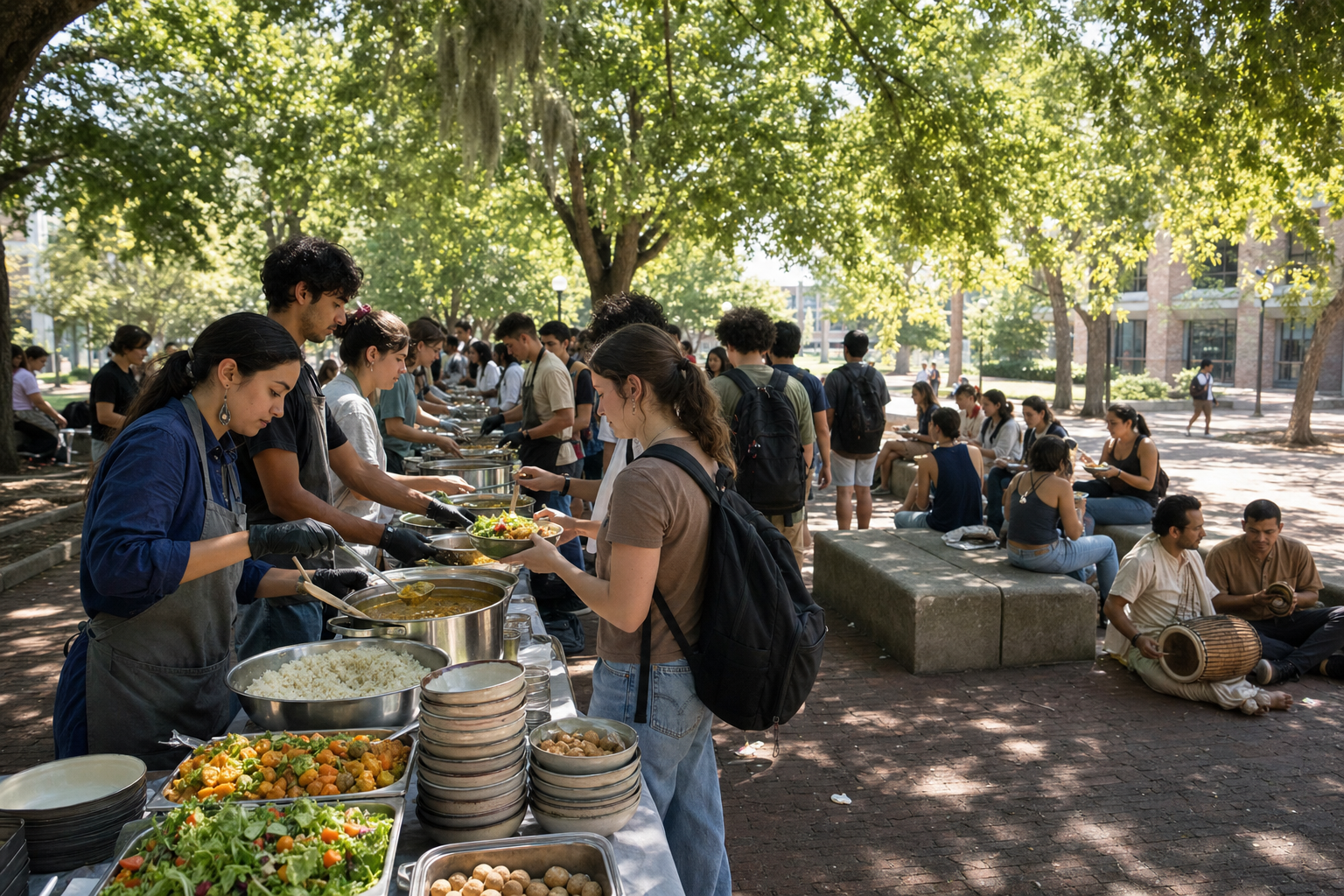
Krishna Lunch matters partly because of what is served and partly because people know it will be there. Its familiar format has included a grain, a legume-based preparation, vegetables, salad, and a small sweet. The combination is filling, plant-based, relatively simple to produce in volume, and compatible with an ethic of ahimsa.
Yet calling it an inexpensive vegetarian lunch misses its religious center. Prasadam is food prepared and shared within a devotional relationship. That identity should remain visible even when organizers explain the program in the administrative language of food safety, accessibility, sustainability, and campus welfare. Open participation does not require the service to erase where it comes from.
If campus access is being negotiated, protect the qualities that make the program an institution:
- Predictability: students should be able to identify the approved location, service period, and operating calendar.
- Open participation: a person should not need to profess a belief or join an organization to receive a meal.
- Affordability: administrative arrangements should preserve the program’s practical usefulness to students under financial pressure.
- Food-safety discipline: religious goodwill does not replace temperature control, sanitation, allergen communication, trained staff, or documented procedures.
- Hospitality: queue design and speed matter, but the program should remain a shared meal rather than becoming an anonymous transaction.
- Environmental restraint: batch cooking, limited packaging, composting, recycling, and food-waste controls can support the same ethic of simplicity expressed by the menu.
A workable campus arrangement needs more than permission in principle. A time-bound memorandum of understanding can specify the serving area and schedule, permits, insurance, responsibility for cleanup, weather contingencies, waste handling, emergency access, and the process for correcting a problem before suspension becomes necessary.
The operating plan should also address HACCP-aligned food handling, appropriately trained personnel, hot and cold holding, handwashing, sanitization, cross-contact risks, and visible ingredient or allergen notices. Stanchions or other queue controls can keep accessible routes and exits open. Cashless payment or donation options may reduce delays where they are feasible, but they should not create a new barrier for the people the lunch is intended to serve.
Measurement can turn broad support into an accountable proposal. Organizers and administrators can track daily participation, average waiting time, incidents, participant satisfaction, and waste diversion. The purpose is not to bury seva under paperwork. It is to show whether the arrangement works and to correct small operational problems before they become reasons to remove the program.
Public universities must manage food service, shared space, safety, vendor access, and expressive activity under neutral rules. If a problem arises, begin with the written policy and the specific compliance finding. Ask which requirement is unmet, whether comparable programs face the same rule, what evidence would establish compliance, and what cure is available. A documented solution is usually more useful than an immediate accusation that cannot yet be proved.
Use the right evidence in the right decision-making venue
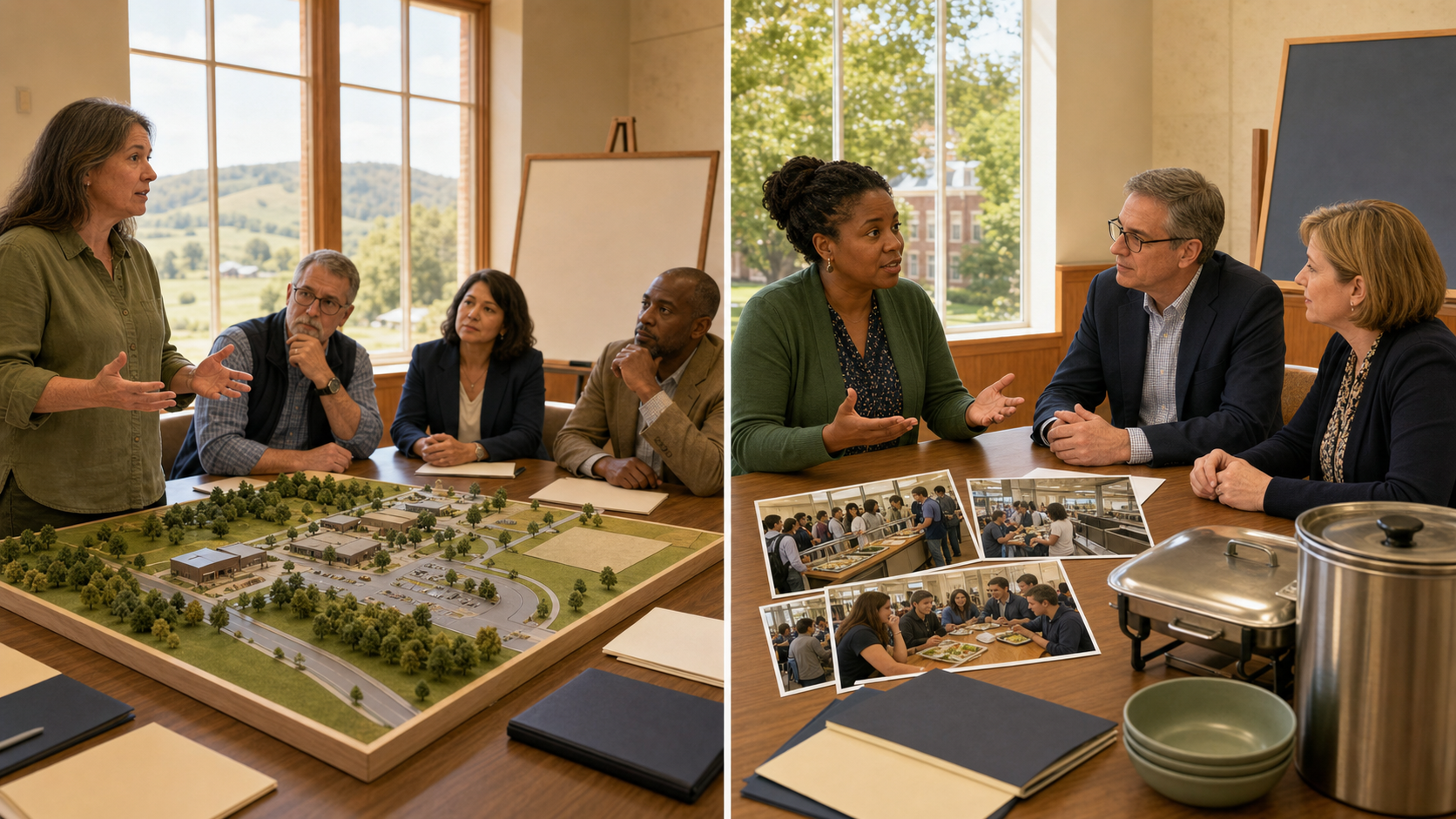
Alachua’s rural community and Gainesville’s campus meal express related values, but they cannot be protected with the same advocacy packet. One depends heavily on land-use compatibility. The other depends on a stable operating agreement. Before you send a petition, testimony, or email, match the request to the body that can actually grant it.
| Question | Alachua community setting | Gainesville Krishna Lunch |
|---|---|---|
| What must remain possible? | Worship, kirtan, festivals, safe access, family life, and a peaceful rural religious environment | Regular preparation and service of affordable prasadam in an accessible campus setting |
| What is the immediate pressure? | Changes in land-use intensity, traffic, lighting, noise, drainage, habitat, and edge conditions | Administrative access, food-safety compliance, vendor equity, crowd flow, liability, and shared-space management |
| What evidence carries weight? | Traffic, photometric, acoustic, stormwater, ecological, and site-design evidence placed in the land-use record | Permits, training records, operating procedures, allergen information, queue plans, incident data, and participation metrics |
| What is a durable result? | Conditions in an approved plan, zoning ordinance, development agreement, easement, or other enforceable instrument | A written memorandum of understanding with defined responsibilities, review points, and a process for correcting deficiencies |
| What argument is too weak by itself? | The area is sacred, so all change must stop | The lunch is beloved, so ordinary operating rules should not apply |
Before entering either process, answer these questions in writing:
- What exact decision is open, and who has authority to make it?
- Which current rule, staff finding, site plan, or proposed agreement controls that decision?
- What fact is missing from the record?
- What precise sentence, condition, drawing change, or operating procedure would solve the problem?
- Who will verify compliance after approval?
Devotional testimony explains why an institution matters. Technical evidence identifies the mechanism of harm or failure. Enforceable text tells everyone what must happen next. Effective advocacy needs all three.
Keep the dharmic character visible and open
ISKCON’s service does not have to become religiously generic to welcome a broad public. Alachua community events have drawn participation from Hindu, Buddhist, Jain, and Sikh neighbors. Krishna Lunch also presents recognizable points of contact: ahimsa in its plant-based meal, seva in its service, dana in its offering-and-sharing ethic, and aparigraha in its simplicity.
Shared values should build cooperation without pretending that distinct traditions are identical. A useful public explanation follows a clear sequence:
<!– wp:list {