
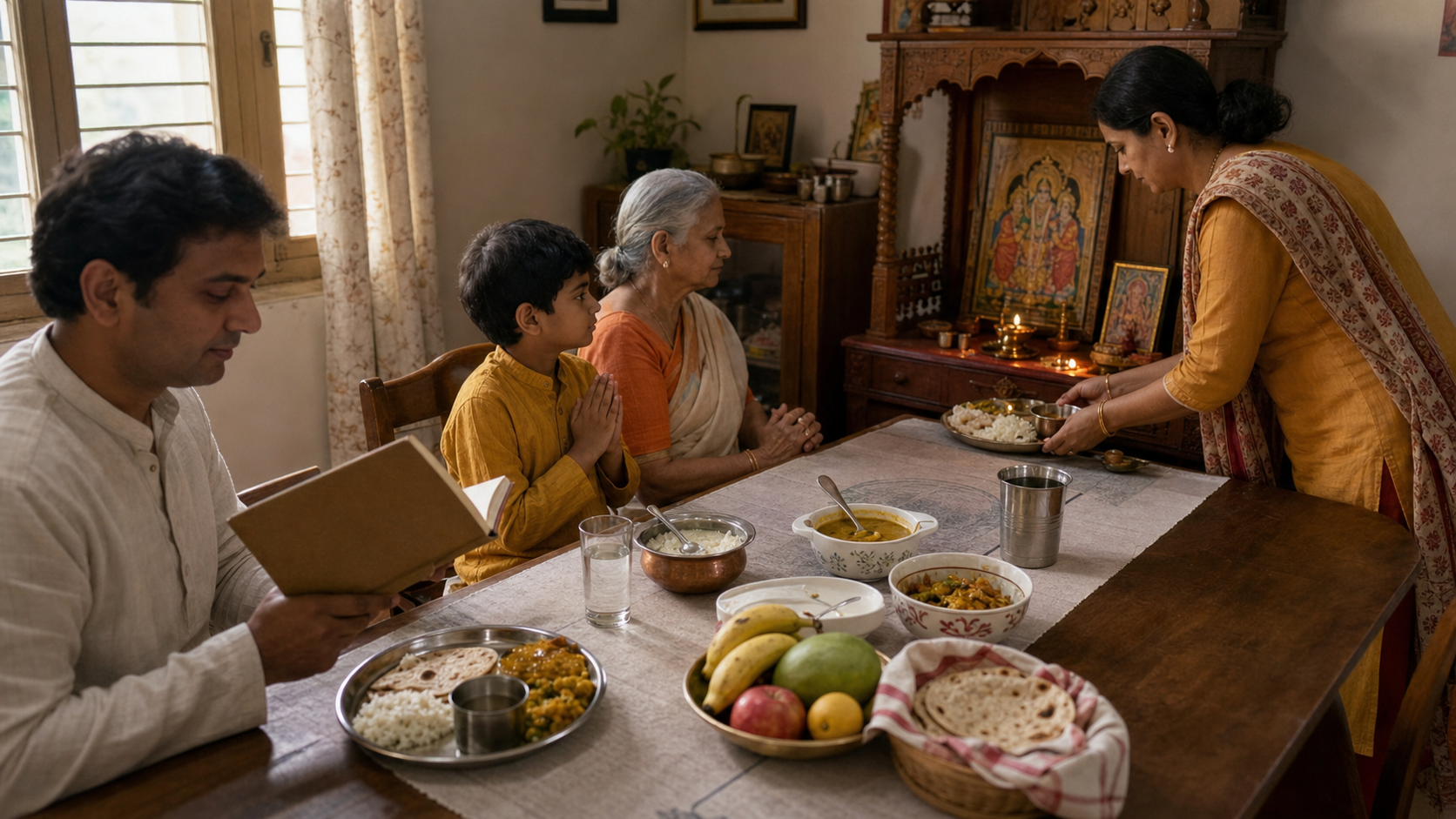
You may hear the Bhagavata, accept prasadam at a temple, and still wonder how the two belong together in ordinary household life. Do you need an elaborate altar, a large feast, or perfect knowledge of ritual before you can begin?
No. Begin by preserving the devotional movement at the heart of the tradition: hear, offer, receive, and share. A simple meal approached in that order can carry Bhagavata teaching into daily conduct more faithfully than an impressive arrangement that cannot be sustained.
The sequence matters: hear, offer, receive, share
Placing SB 4.20.14 beside prasadam-katha points toward a practical unity. Bhagavata hearing is not meant to remain an idea in your head, while prasadam is not merely the meal served after a discourse. Hearing prepares your consciousness; offering redirects ownership; receiving disciplines entitlement; sharing turns devotion outward.
In everyday Vaishnava usage, prasadam is food that has first been offered to Bhagavan and is then received as grace. This makes it different from food prepared entirely for personal enjoyment and given a religious label afterward. The decisive change is relational: you stop treating the meal as something that begins and ends with your appetite.
That distinction gives you a useful test. Before cooking, ask, “Am I preparing something for Bhagavan that I will later receive, or am I preparing my food and adding an offering as an afterthought?” You do not need to manufacture a special emotion. You need to place the offering before personal consumption and let that order educate your habits.
Hearing also gives the offering direction. Without remembrance, kitchen rules can become mechanical. Without the offering, spiritual listening can remain detached from how you consume, speak, and share. Bring the two together by retaining one clear teaching from the Bhagavata and carrying it to the table. It may be gratitude, freedom from possessiveness, careful speech, service, or remembrance of Bhagavan.
A household method you can sustain
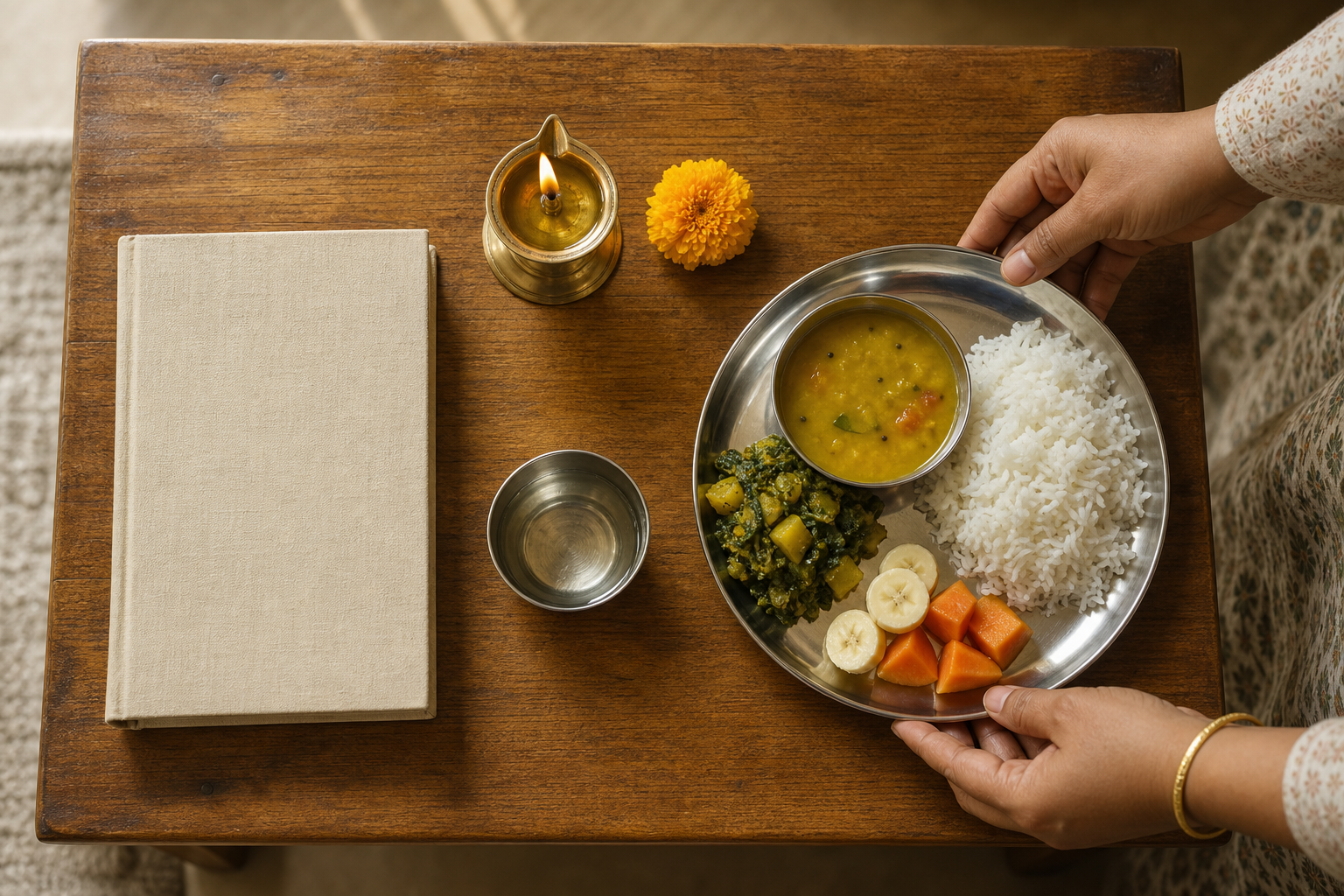
This is a Bhagavata-centered Vaishnava practice, not a claim that every Hindu lineage follows identical kitchen rules. Ingredients, mantras, altar procedures, and standards of preparation can differ by sampradaya and household tradition. Follow the instructions you have genuinely received. If you are uncertain about a formal requirement, ask a trusted teacher or an experienced practitioner in your community instead of building a rule from fragments found elsewhere.
- Choose food that your tradition considers suitable for offering. Do this before cooking. If an ingredient is uncertain, check it rather than assuming that any vegetarian dish automatically meets your lineage’s standard.
- Set the intention before preparation begins. A brief inward reminder is enough: this is being prepared for Bhagavan, not merely for your immediate appetite. That intention affects how carefully you cook and how you respond when the meal is delayed or imperfect.
- Keep the offering distinct from personal eating. In many Vaishnava households, the food is not tasted before it is offered. If that is your discipline, plan recipes and seasoning so that you can follow it safely and consistently rather than treating the rule casually on busy days.
- Present a modest portion respectfully. Use a clean dish and the altar, image, or sacred space recognized in your household practice. Recite the mantra or prayer you have been taught. If you have not received a formal procedure, speak a simple, sincere prayer and seek proper instruction when you can; do not pretend that an invented formula carries an authority you have not received.
- Complete the offering according to your tradition. Allow the prayerful pause and any customary procedure to finish before serving the food for personal consumption. The pause is not empty waiting. It interrupts the assumption that availability creates immediate entitlement.
- Receive and distribute the food as prasadam. Begin with a manageable portion, eat attentively, offer more to others, and store usable food safely. Reverence is visible in what happens after the prayer as much as in the prayer itself.
Do not make elaborateness the condition for regularity. If a complicated feast is possible only occasionally, keep it for suitable occasions. On an ordinary day, offer the simple meal you can prepare with steadiness. The household habit is formed by repetition, not by the scale of one display.
You can also establish a clear minimum practice for rushed days: choose one suitable preparation, keep it aside before personal consumption, offer it with the prayer recognized in your tradition, and receive it respectfully. A small practice that remains connected to its meaning is more useful than an ambitious routine repeatedly abandoned.
Respect prasadam without turning it into a purity contest
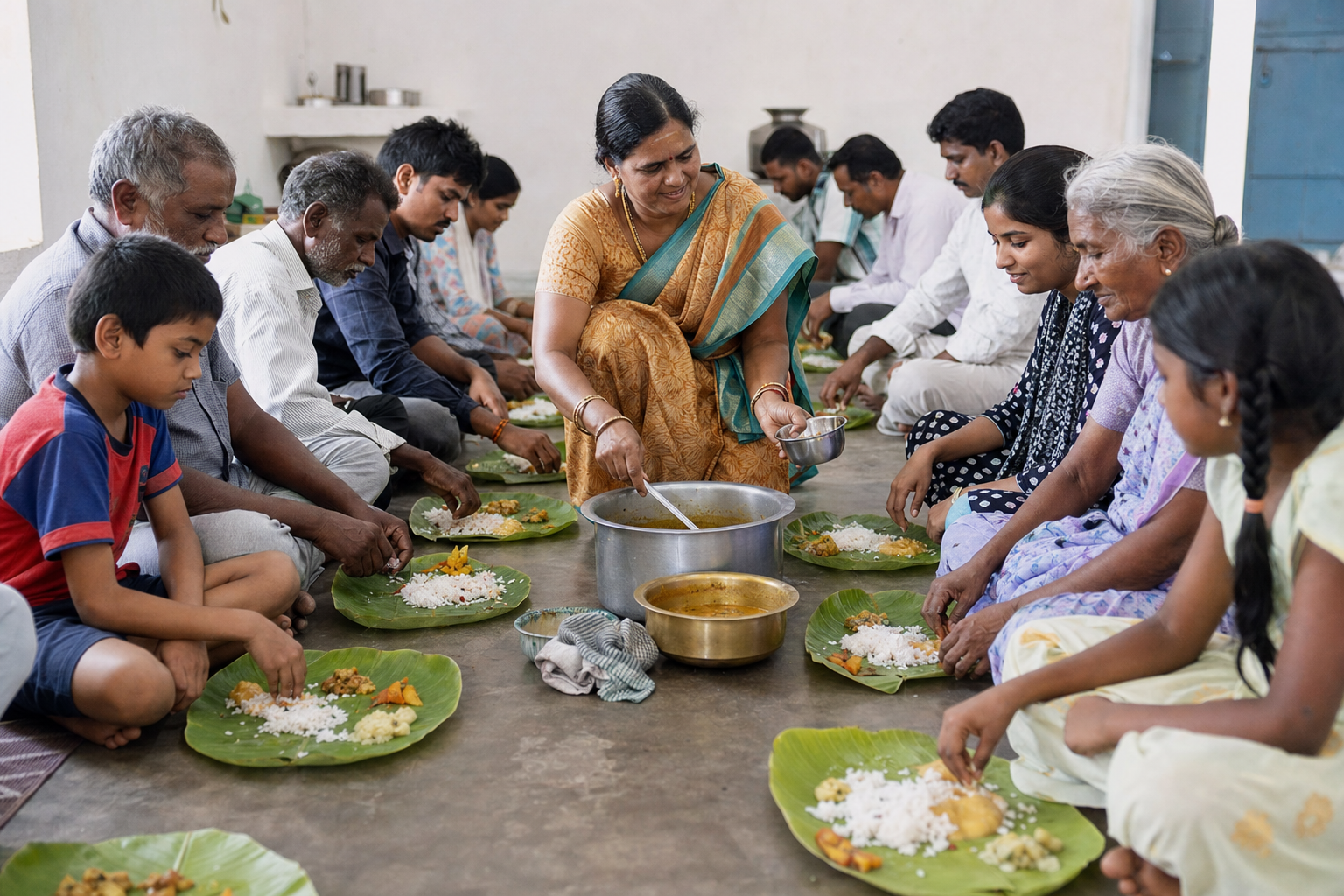
Clean preparation matters. So do food safety, attentiveness, and fidelity to the discipline you follow. Trouble begins when these supports for devotion become tools for measuring other people’s spiritual worth.
When you serve guests, explain plainly that the food was offered and is being served as prasadam. Do not demand that everyone display devotion in the same way. A newcomer may not know when to sit, how much to take, or what words to use. Show the practice without staging a test. Offer a small first portion and make additional servings available; this protects both hospitality and the wish to avoid waste.
State ingredients clearly when allergies, intolerances, fasting rules, or medical diets may be involved. Sacred status does not make an allergen harmless or cancel a health restriction. If you are receiving prasadam and cannot confirm what it contains, ask before eating. If it is unsuitable, decline respectfully rather than gambling with your health or treating refusal as an insult to Bhagavan.
Children also learn respect better through proportion than through fear. Give a small serving first, allow them to request more, and explain why offered food should not be wasted. Guilt after an oversized portion teaches less than care before serving it.
Watch for another distortion: displaying the cost, richness, or quantity of a preparation as evidence of superior devotion. A feast can be a beautiful act of worship and community, but expense is not a reliable measure of inward offering. If the meal leaves the cook resentful, strains the household, or exists mainly to impress visitors, reduce the scale and recover the purpose.
Let the meal reveal whether the teaching reached you
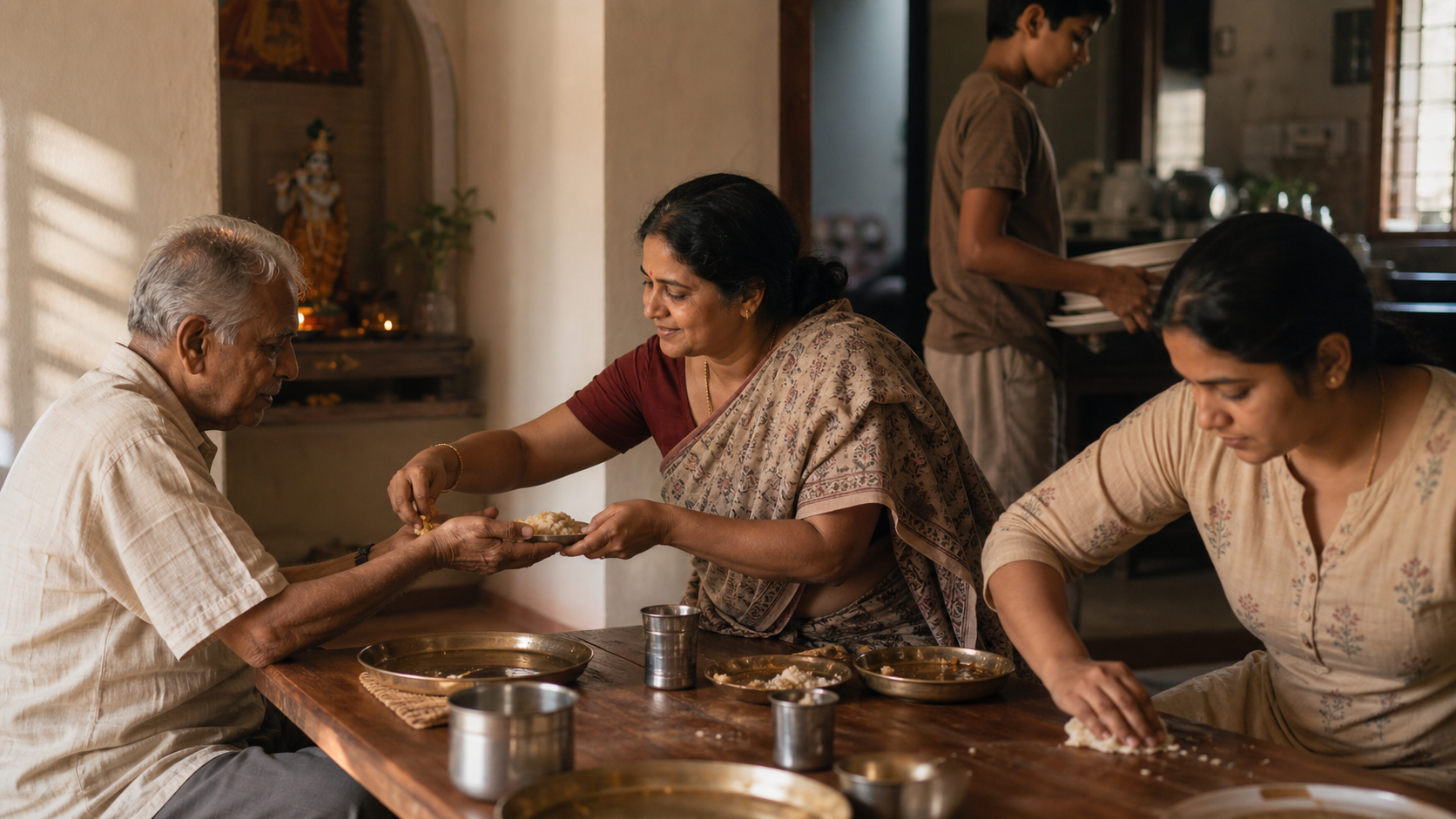
The table is where abstraction becomes observable. You can say that everything belongs to Bhagavan, yet become angry when another person takes the portion you wanted. You can speak about compassion during katha, then disregard the person who cooked, served, or cleaned. Prasadam practice exposes that distance without requiring a philosophical debate.
Use three concrete checks after Bhagavata hearing:
- Check your speech. If the meal immediately becomes a setting for complaint, ridicule, or quarrelling, pause before continuing the conversation. Receiving grace and using the same moment to injure another person do not belong comfortably together.
- Check your claim of ownership. Notice irritation when the menu changes, a preferred portion runs out, or service is slower than expected. Treat that reaction as material for practice, not as proof that someone else has failed you.
- Check what you share. Distribution need not be grand. Offer hospitality within your means, make sure people serving the meal are also cared for, and avoid keeping the best portion automatically for yourself.
A household can connect katha and prasadam with one question at the meal: “What did we hear that should change how we act before the next meal?” Keep the answer brief and specific. “Be more spiritual” is too vague. “We will serve before choosing our own portions” or “we will not complain about the preparation” can actually be practiced and noticed.
Do not turn this question into a compulsory sermon, especially for guests or tired family members. Its purpose is recollection, not control. One sentence sincerely practiced does more than a long discussion used to correct everyone else.
Key takeaways
- Connect Bhagavata hearing and prasadam through one repeatable sequence: hear, offer, receive, and share.
- Prepare the meal for Bhagavan before treating it as personal food; the offering is not a label added after consumption has begun.
- Follow your sampradaya or household tradition on ingredients, mantras, and procedure rather than presenting one local custom as universal.
- Choose a modest routine you can maintain on ordinary days. Elaborate preparation is not the measure of sincerity.
- Make ingredients clear and respect allergies, medical diets, and a guest’s freedom to decline.
- Judge the practice by its fruit in conduct: less entitlement, more careful speech, less waste, and a genuine readiness to share.
At your next meal, do not begin by redesigning the kitchen. Choose one suitable dish, prepare it with clear intention, offer it according to the tradition you follow, receive it without entitlement, and share what you can. Then repeat the practice until the teaching heard in katha becomes visible at the table.
References
