

If you help manage, serve, donate to or worship at a temple in Maharashtra, the danger is not always visible at the sanctum door. Historic fabric can be altered under a project labelled development, while valuable land can be affected through an administrative order that few devotees see until much later.
Your first task is not to begin a campaign or accuse someone of wrongdoing. It is to make the temple’s physical condition, ownership records and decision-making chain clear enough that trustees, specialists and public authorities can act before the damage becomes difficult to reverse.
Protect the temple as both a sacred place and a legal estate
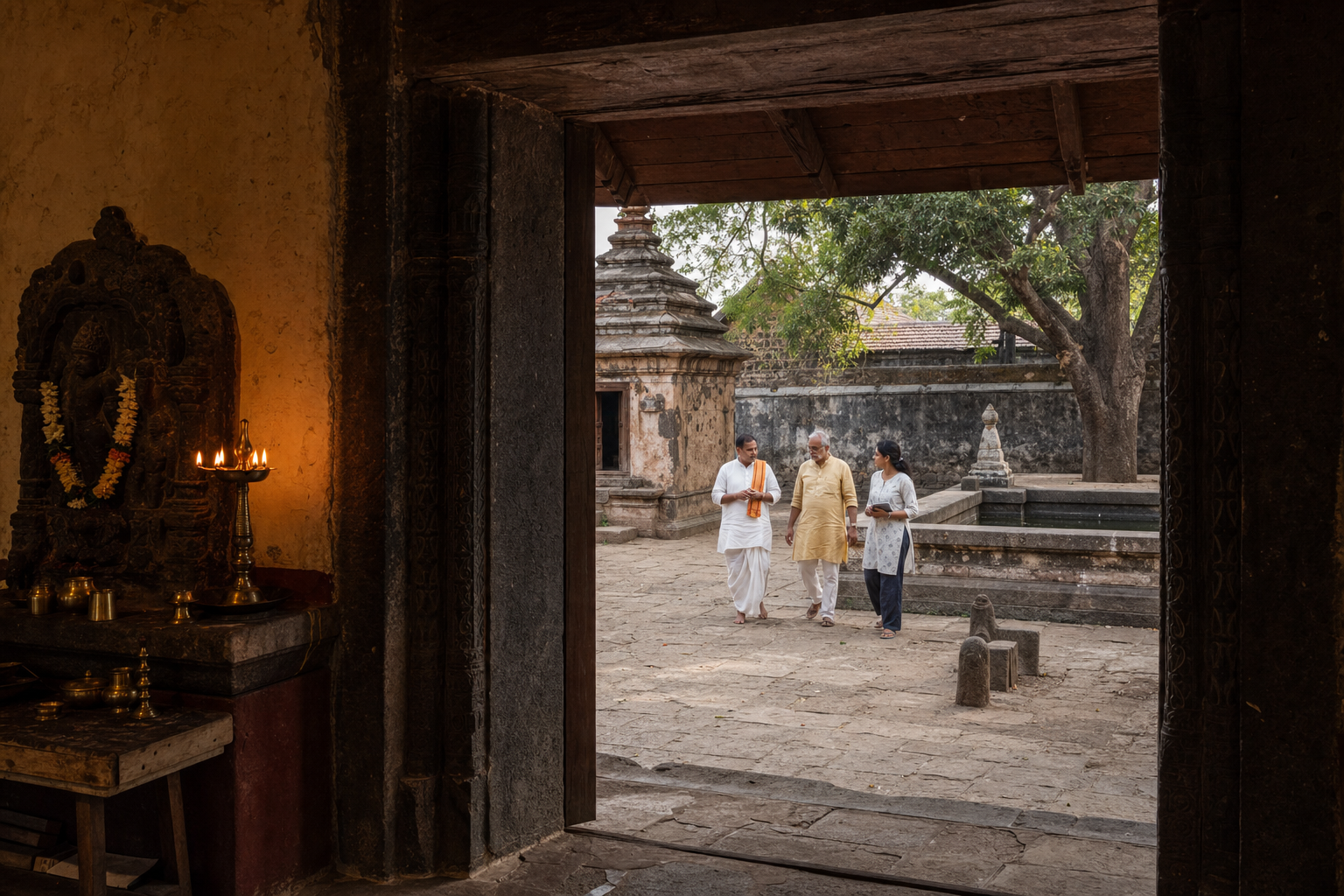
Temple protection has two connected parts. The first is conservation: the structure, sculpture, inscriptions, ritual spaces, movable objects and historic character. The second is property stewardship: land, boundaries, access rights, leases, licences, revenue entries and the authority under which decisions are made.
A temple can be secure in one sense and exposed in the other. Perfect title papers will not restore carvings lost during careless work. Careful restoration of the shrine will not recover land quietly placed in another name. Trustees and devotees therefore need two living records: a conservation file and a property file, joined by a clear governance record.
- The conservation file should show what exists, why it matters, its condition, what work has been approved and who may approve a change.
- The property file should show what the temple owns or lawfully uses, how the right arose, where the boundaries lie and whether any claim, transfer or encumbrance is pending.
- The governance record should show who is authorised to instruct workers, sign applications, receive notices, engage lawyers and speak publicly for the institution.
This division also prevents a common confusion. Development may improve queues, sanitation, drainage or visitor access, but development and conservation are not interchangeable. Each needs its own scope, competence and approval path.
Build an evidence file before you need to defend the temple
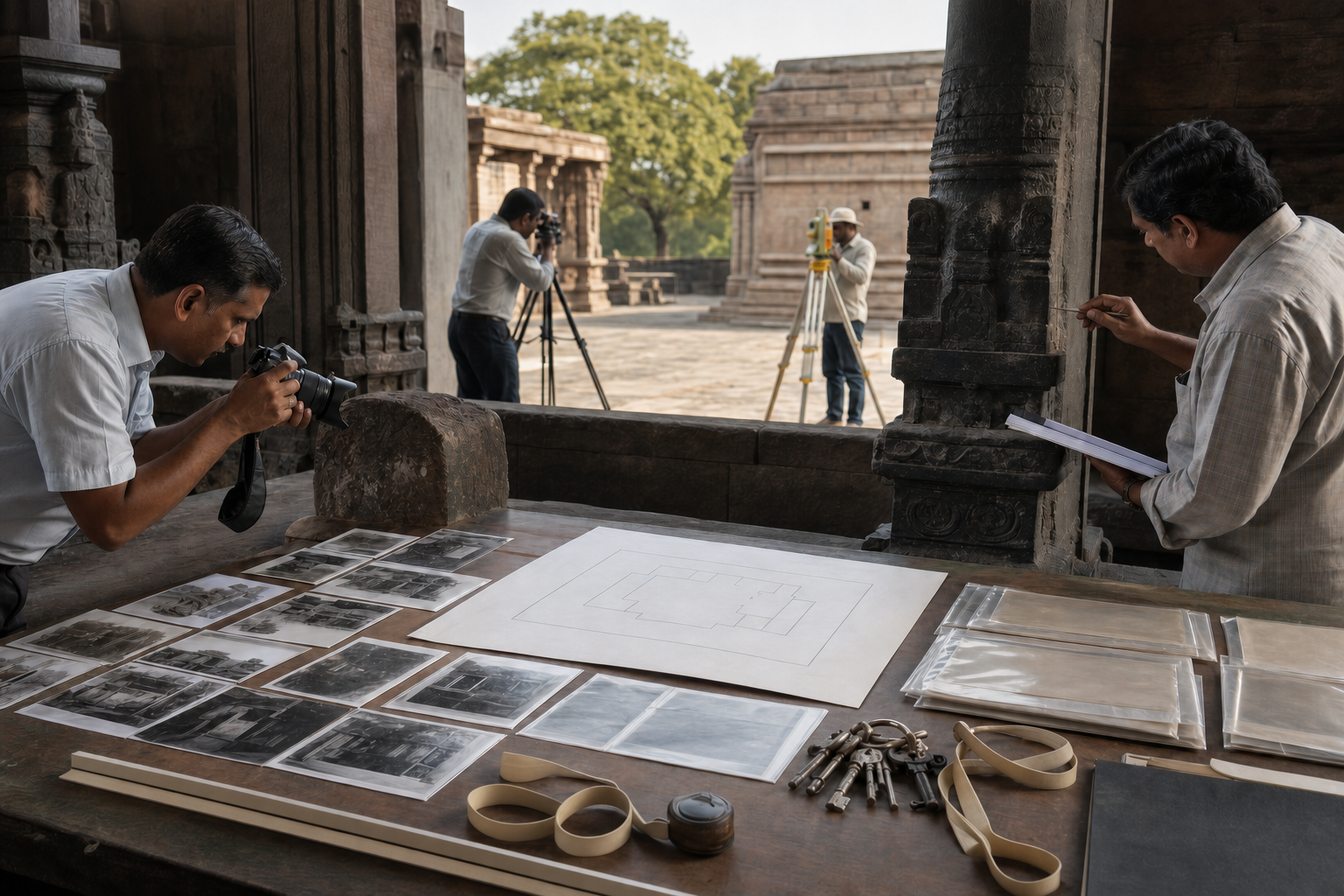
Do not wait for excavation equipment, a mutation notice or a disputed signature. A defensive file assembled during a crisis is usually slower to verify and easier for an opponent to challenge. Build the following record while there is no immediate dispute.
- Identify the lawful custodian. Keep the trust or institutional registration documents, governing instrument, current trustee or committee details, authorised signatories and resolutions assigning responsibility for property and conservation.
- Assemble the chain of property records. Include available deeds, grants, revenue extracts, property cards, mutation history, survey plans, boundary records, court or administrative orders, leases, licences and records of any known encumbrance or dispute.
- Map possession and actual use. Mark the temple, subsidiary shrines, paths, water bodies, shops, agricultural parcels, residential areas and land used by tenants or licensees. Note where the documentary boundary and the visible boundary appear not to agree.
- Create a dated condition baseline. Photograph every elevation, roof, floor, mandapa, entrance, sculpture, inscription and vulnerable detail. Give each image a location and date so that a later change can be demonstrated rather than merely alleged.
- Collect every active approval and contract. The file should contain the exact work scope, drawings, permissions, contractor appointment, specialist advice, bills, inspection records and approved changes. A project title such as beautification or development is not an adequate scope.
- Record decisions as they occur. Minutes should state the question considered, documents reviewed, conflicts disclosed, decision taken and person authorised to implement it. Avoid retrospective resolutions written after a dispute has begun.
Ask for certified copies when the issuing office provides them, and record the office, application date and receipt number. Keep a working scan, a read-only backup and a controlled physical set. A simple filename such as year-month-day, issuing office, document type and parcel or structure name makes later retrieval far easier.
Do not assume that one revenue entry, mutation, deed, trust entry or period of possession answers every ownership question. These records can have different legal functions. A lawyer experienced in Maharashtra property and public-trust matters should read the chain as a whole, especially before anyone signs, relinquishes a claim or accepts a proposed settlement.
Put enforceable controls around every conservation project
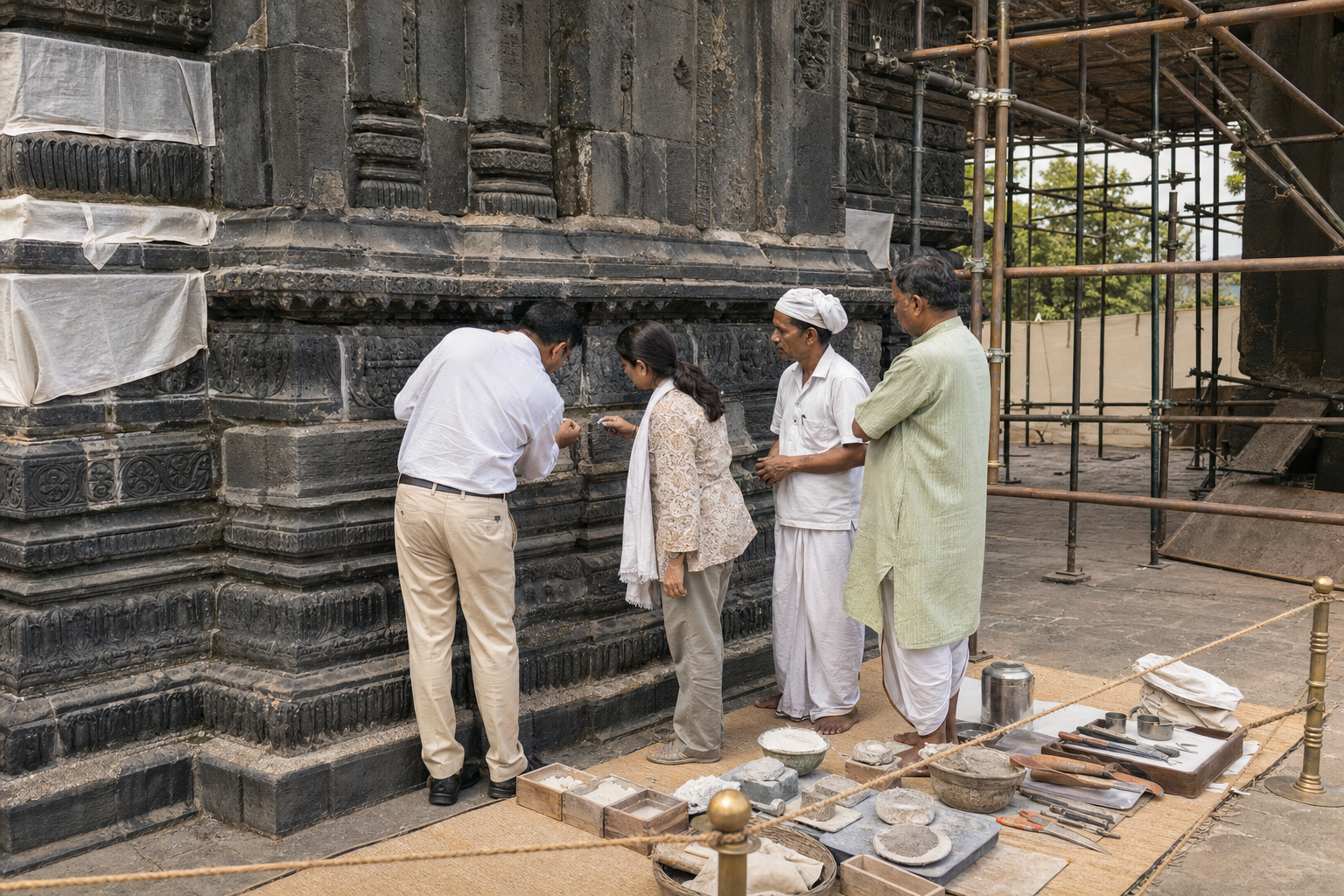
At Shri Mahalakshmi (Ambabai) Temple, Hindu organisations alleged multiple conservation lapses and serious negligence, and demanded criminal proceedings against responsible Archaeology Department officers. Allegations require examination through the proper process, but they point to a practical vulnerability: institutional prestige does not substitute for documented control of work on the ground.
Before workers touch historic fabric, insist on a project pack that answers the following questions in writing:
- What is significant? Identify the fabric, spatial relationship, image, inscription or ritual use that must be retained.
- What is its starting condition? Use dated photographs, annotated drawings and a condition description prepared or reviewed by a qualified conservation professional.
- What exactly will be done? Describe work by location and element. Replace vague verbs such as repair, renew or beautify with an identifiable intervention.
- Who decides technical questions? Name the conservation professional, site supervisor, temple representative and authority responsible for statutory approval. A contractor should not become the final judge of heritage significance.
- How are changes approved? Require a written change note that records the discovery, proposed response, technical reason, photographs, cost effect and signatures required before work resumes in that location.
- When is work inspected? Set inspection points before an element is concealed, removed or permanently altered. Link payment certification to the documented scope and verified work.
- What happens to removed material? Number, photograph and log architectural fragments, fittings and other objects before moving them. Record their temporary location and authorised final disposition.
- How will worship continue safely? Coordinate work zones, ritual requirements, devotee movement and emergency access without allowing operational pressure to justify undocumented alteration.
The change-control rule matters most when workers uncover something unexpected. Discovery is not permission to improvise. Secure the area, record what appeared and obtain the designated technical and institutional decision. Volunteers should not remove material, direct workers or physically confront a crew. If unapproved work appears likely to cause irreversible damage, the authorised custodian should promptly seek advice from the conservation professional, competent authority and legal counsel on whether that part of the work must be paused.
After completion, preserve the final drawings, photographs, approvals, test or inspection records, invoices and change log. The next repair team should not have to guess what lies behind a finished surface.
Catch a property threat while it is still paperwork
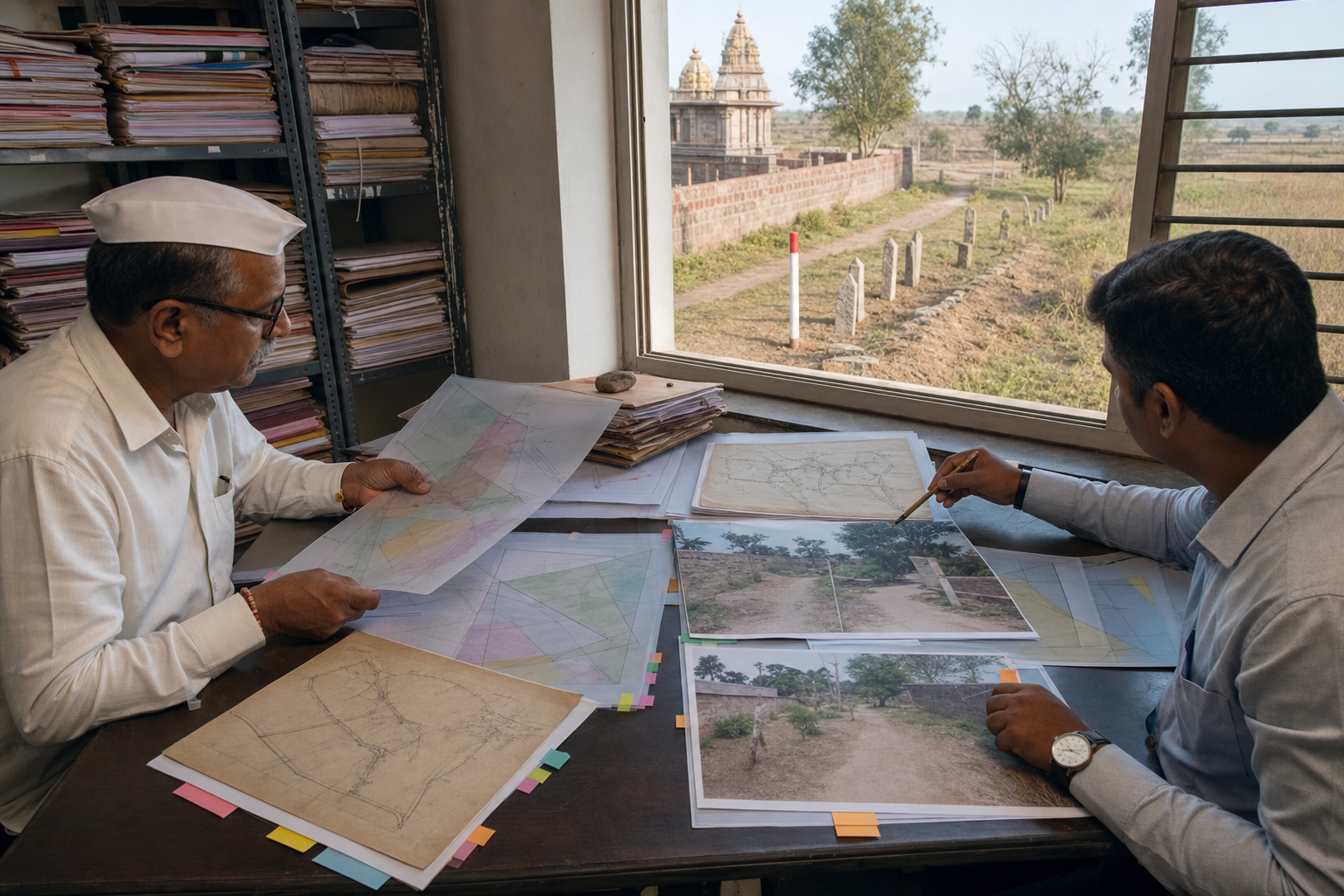
Temple land can be endangered without a fence being moved. At Shri Someshwar Mahadev Sansthan in Amravati, the Sub-Divisional Officer set aside a Tehsildar’s order transferring 12 acres, described as worth Rs 50 crore, for Rs 960 after legal intervention by the Maharashtra Mandir Mahasangh. Whatever the disputed parties’ motives, an order with consequences that extreme must be obtained, examined and challenged through the competent forum before it becomes part of a later chain of transactions.
Assign one named person to receive official correspondence and one alternate for absence. Periodically compare the temple’s master property schedule with current records available from the relevant office. Review immediately when the temple receives a notice, proposes a lease or licence, discovers a boundary change, learns of an unexpected claim or sees a new name connected with its parcel.
Treat the following as verification triggers, not automatic proof of fraud:
- An unfamiliar owner, transferee, tenant, lessee, occupier or claimant appears in a notice or entry.
- The area, survey reference, boundary description or recorded use differs from the temple’s master file.
- A proposed transfer carries consideration that appears nominal or cannot be reconciled with a documented valuation.
- An application or order relies on a trustee resolution, consent, signature or authority paper that the temple cannot locate in its own records.
- A notice was sent to an obsolete address or received after an important procedural event.
- Someone asks a trustee or employee to sign a blank, incomplete, backdated or poorly understood document.
When a trigger appears, preserve the envelope, notice, screenshot or entry exactly as received. Obtain the complete order and supporting file rather than reacting to a summary. Record the discovery date, verify the parcel and parties, and have the governing body authorise a defined response. Separate the legal track from the conservation track: a property or public-trust lawyer examines title and procedure, while a conservation architect assesses physical heritage risk.
The appropriate objection, appeal, complaint and deadline depend on the authority involved and the temple’s legal status. This is where temple-specific legal advice is necessary. Do not rely on a generic checklist, miss a deadline while organising a public meeting, enter disputed land by force, alter a public record or sign away rights merely to gain time.
Public advocacy can support accountability, but it does not replace a filed legal response. Keep public statements disciplined: identify the document, state what appears inconsistent, name the remedy requested and distinguish an allegation from an established finding. That protects credibility and keeps attention on the temple’s rights instead of an avoidable defamation dispute.
Key takeaways for trustees and devotees
- Maintain two coordinated ledgers: one for historic fabric and one for land and legal rights.
- Do not allow physical work to begin without a dated baseline, location-specific scope, named decision-makers and written change control.
- Obtain complete and preferably certified records when a property entry or administrative order looks wrong; a photograph or verbal account may omit the decisive page.
- Respond through an authorised resolution and the right specialist. Conservation, title, public-trust procedure and criminal allegations are not the same question.
- Use careful public language. A serious discrepancy justifies urgent verification, but it does not by itself prove motive or guilt.
At the next trustee or management meeting, approve three concrete things: the person responsible for the master records, a list of missing documents and a written control process for conservation work and property notices. If you can complete only one task first, request the missing official records. Temple protection becomes possible when sacred responsibility is backed by evidence that can withstand administrative and judicial scrutiny.
References
- Hindu Jagruti Samiti – Serious negligence and multiple lapses by the Archaeology Department in the Shri Mahalakshmi (Ambabai) Temple Development Plan
- Hindu Jagruti Samiti – Maharashtra Mandir Mahasangh’s efforts save Rs 50 crore temple land in Amravati
