
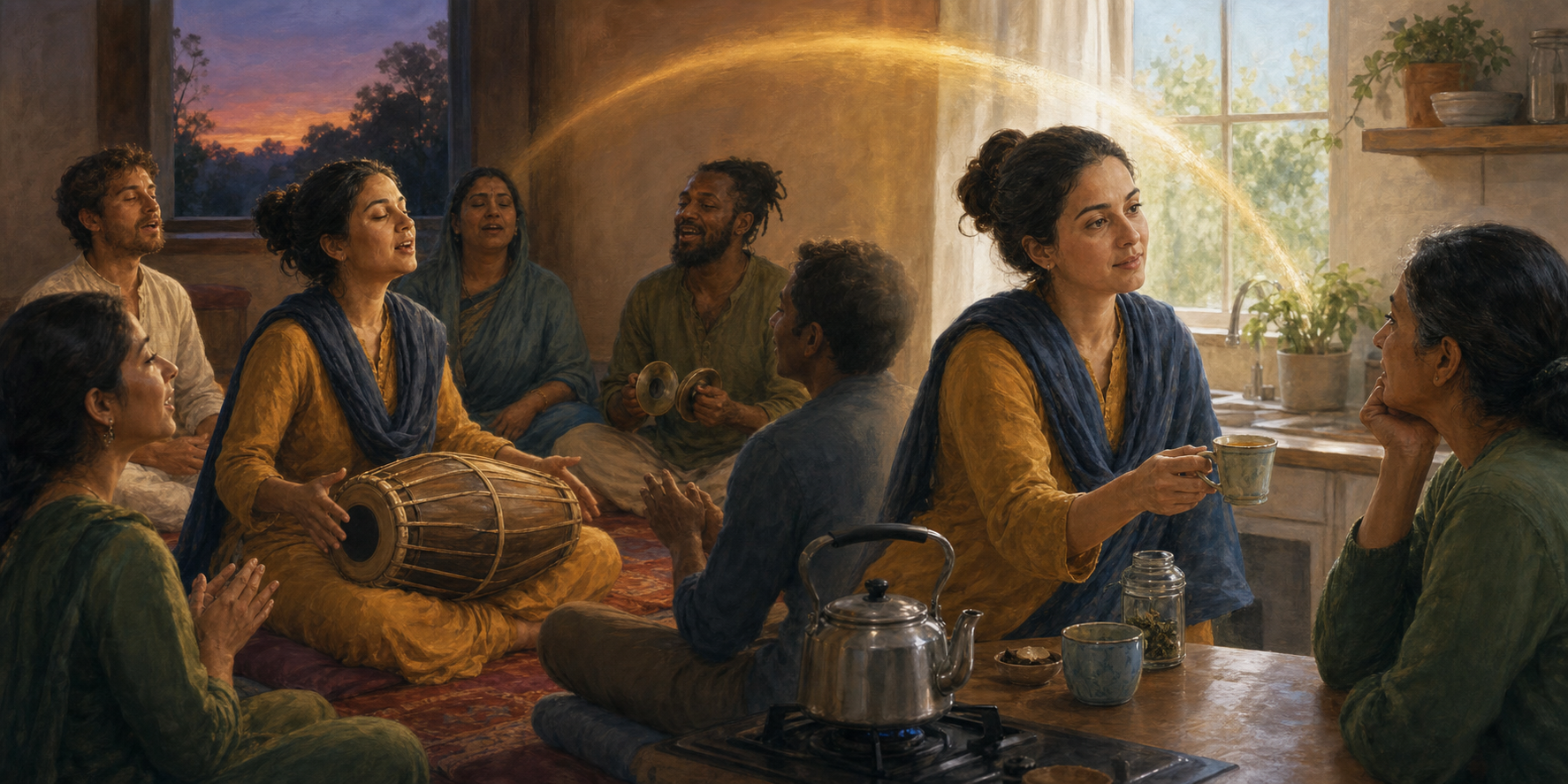
You can leave a kirtan feeling open, peaceful, and deeply moved, then find that the same irritation, craving for approval, or scattered attention returns the next morning. That does not make the evening false. It means the experience has not yet become a practice.
Kirtan becomes personally transformative when sacred sound, remembrance, daily discipline, ethical conduct, and seva begin to reinforce one another. The real test is not how intensely you felt while singing. It is what you remember, choose, and offer when the music is no longer playing.
The decisive shift is from stimulation to relationship
Kirtan gathers the mind through melody, repetition, rhythm, and breath. Its call-and-response form gives you one clear task: hear the sacred name and answer. Because the group carries the refrain, you do not need musical training or an elaborate meditation technique before participating. You can enter through attentive listening and a willing voice.
There is a plausible physiological dimension to this. Synchronized singing and breath may support autonomic regulation, steadier attention, and social connection. The evidence should be handled modestly because methods vary. Calm is a possible effect of kirtan, not its complete meaning, and certainly not proof that every emotional or medical difficulty has been resolved. When professional mental-health care is needed, chanting can accompany that care; it should not be used to replace it.
Bhakti does not need to borrow its legitimacy from neuroscience. Within Gaudiya Vaishnavism, nama-sankirtana is sadhana because the divine name and the Divine addressed through that name are understood to be non-different. You are not merely repeating a soothing sound. You are calling, listening, remembering, and placing yourself in a relationship of devotion.
The Hare Krishna maha-mantra gives that relationship a simple verbal form: Hare Krishna, Hare Krishna, Krishna Krishna, Hare Hare; Hare Rama, Hare Rama, Rama Rama, Hare Hare. Hare addresses divine energy, Krishna means the all-attractive, and Rama points toward the reservoir of joy. The words therefore matter. The melody may change, but the act remains an address rather than a display.
You can make that distinction practical through a four-part loop:
- Hear the names distinctly instead of letting them dissolve into the music.
- Answer the leader without competing with the leader.
- Remember that you are addressing the Divine, not manufacturing a mood.
- Carry one devotional intention out of the room, such as patience, gratitude, restraint, or service.
This changes the center of gravity. The Bhagavad Gita distinguishes atman from the changing roles through which we seek security: professional, performer, achiever, consumer, or admired person. Kirtan gives you a repeated opportunity to loosen identification with those roles. John Richardson’s movement from chart success to Krishna bhakti illustrates the point without demanding rejection of talent. His musicianship remained, but its purpose shifted from acquiring validation to supporting remembrance and seva.
Before your next kirtan, choose one quality that should survive the final note. If you cannot name what the chanting is meant to nourish, musical excitement will easily become the goal by default.
Build a practice that can survive an ordinary week

An occasional powerful gathering can introduce you to bhakti, but repetition gives it roots. The useful pattern is not constant intensity. It is a modest rhythm you can maintain when work is demanding, the mind is dull, and no one is watching.
Use daily japa to train the return
Japa and kirtan are complementary. Kirtan places your voice inside a congregation; japa asks you to remain with the name when the congregation is absent. A fixed daily count makes the commitment visible. If you have received a prescribed mantra or count from a guru or lineage, follow that instruction. Otherwise, choose a modest count you can keep consistently rather than making a dramatic promise that collapses after enthusiasm fades.
- Attach japa to a repeatable point in your day rather than waiting to feel inspired.
- Pronounce each repetition clearly enough that you can hear it.
- When attention wanders, return with the next name instead of turning distraction into self-criticism.
- Complete the count you chose; do not keep changing it in response to a good or bad mood.
- Notice the recurring distraction. It often reveals where attention is being claimed during the rest of your day.
The small act of returning is the training. A session is not wasted because the mind wandered. It becomes wasted when you stop listening and merely move through the count mechanically.
Let weekly kirtan renew the communal dimension
A weekly kirtan adds what solitary repetition cannot: shared breath, reciprocal listening, intergenerational company, and the discipline of allowing other voices to lead. A sound practice can follow a clear arc:
- Begin with two minutes of coherent, unforced breathing.
- Introduce the mantra and its devotional meaning.
- Chant slowly until the group finds the tonal and rhythmic center.
- Increase to a moderate tempo without sacrificing pronunciation or congregational participation.
- Return to a soft unison refrain.
- Keep one minute of silence before speaking or moving on.
This slow-expansive-still arc gives the session a beginning, development, and release. The final silence is not empty space to hurry through. It lets emotion settle and reveals whether attention has become quieter or merely more stimulated.
Then connect sound to action. A sustainable bhakti rhythm can include a fixed japa count, one weekly kirtan, regular study of the Bhagavad Gita, sattvic habits, and a specific seva commitment. These disciplines work together by giving attention, conduct, and talent the same devotional direction. If you sing about surrender but reserve all your time and ability for yourself, the practice remains divided.
A good kirtan makes participation easier than spectatorship
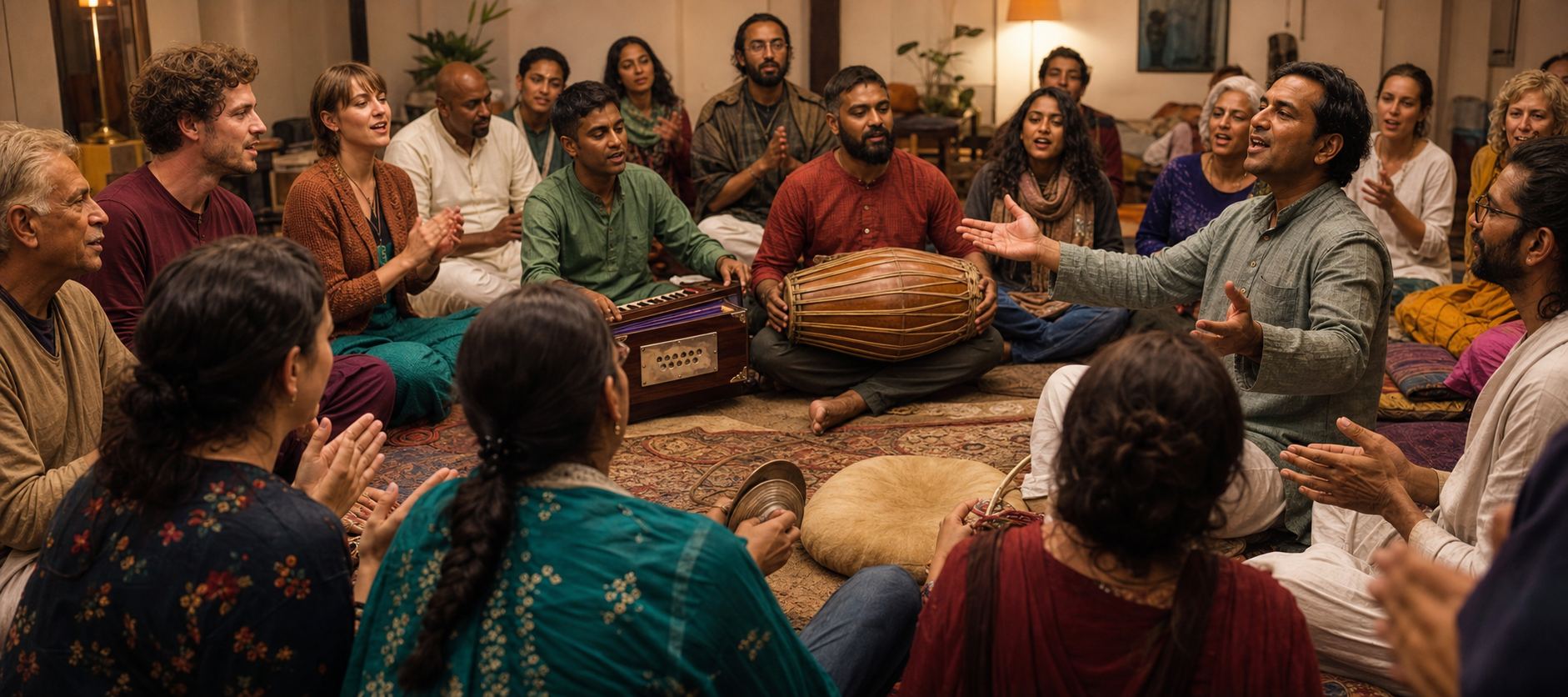
The leader’s task is not to create an audience. It is to make the congregation audible. Technical skill matters precisely because it can remove obstacles between the participants and the name.
- As a participant: join the response in a comfortable register. Do not force your voice upward to imitate the leader.
- As a vocalist: keep the jaw relaxed, the vowels open, and the projection unforced. Clarity serves remembrance better than strained volume.
- As a leader: select a melody the room can answer after hearing it once or twice. Brief improvisation can enliven the chant, but prolonged virtuosity turns the congregation into observers.
- With instruments: let harmonium establish tonality, mridanga or khol support groove and phrasing, and kartals clarify the pulse. If an instrument obscures the words or the gathered voices, reduce it.
- With tempo: increase speed only while the syllables remain intelligible and the group remains together. Faster is not automatically deeper.
- With amplification: set the lead voice clearly enough to guide without burying the response. Intention does not require punishing volume.
- With newcomers: provide transliteration and a brief explanation before chanting. People participate more freely when they know what they are saying.
Pronunciation deserves care, but anxiety about forensic perfection can become another form of self-absorption. Seek correction respectfully, make the syllables clear, and continue. Sincerity of address should guide diction; diction should not become a gate that excludes the sincere beginner.
Responsible facilitation also includes fixed start and finish times, leadership shared across qualified singers, attention to accessibility, and sensitivity toward participants for whom strong emotion may arise. Neighbourly volume and respect for venue rules are expressions of ahimsa, not administrative distractions. If kirtan is seva, the comfort and dignity of other people belong inside the practice.
Respect shared dharmic ground without erasing distinctions
Sacred sound appears across Dharmic traditions, but the practices should not be flattened into an interchangeable playlist. Sikh shabad kirtan places Gurbani in a musical and congregational setting. Buddhist communities use mantra and paritta chanting for recollection, protection, steadiness, and compassion. Jain practice includes the Navkar Mantra and devotional stavan, joining repeated sacred speech to restraint and ethical resolve. Rhythm, attentive repetition, humility, and community form genuine shared ground, while each tradition retains its own theology, texts, discipline, and aim.
When you enter a practice outside your own lineage, learn the words, their meaning, the purpose of the chant, and the community’s etiquette. Mutual respect grows from taking difference seriously, not from declaring every name or doctrine identical.
Judge the practice in the hour when chanting is absent

Bhakti does not require emotional flatness. Rasa, the distilled flavour of relationship and devotion, gives kirtan much of its beauty. Yet bhakti aesthetics also distinguishes transient emotional waves from a devotional disposition that becomes stable. Tears, energy, stillness, or joy may be meaningful, but none is a reliable scoreboard by itself.
Look instead for changes that appear in ordinary friction:
- Attention: Do you notice distraction sooner and return without feeding it?
- Reactivity: Is there more space between provocation and your reply?
- Identity: Does praise still determine your worth, or can you act well without being seen?
- Speech: Is your language becoming less needlessly harsh, deceptive, or self-promoting?
- Service: Has some part of your time, money, or ability become a concrete offering?
- Discipline: Can you chant on an unremarkable day, without needing a musical peak?
- Humility: Are you becoming easier to correct, or merely more confident in a spiritual identity?
These questions prevent a common mistake: confusing a changed state with a changed character. A state passes. Character appears through repeated choices. If your chanting is intense but your conduct becomes more contemptuous, careless, or self-important, do not defend the contradiction as devotion. Reconnect the practice to hearing, service, gratitude, and responsibility.
Correct the pattern when the form starts replacing the purpose
- If you keep chasing the fastest or loudest part of kirtan, lengthen the slow opening and protect the closing silence.
- If japa has become mechanical, reduce competing activity and listen closely to the next repetition rather than trying to manufacture emotion.
- If pronunciation anxiety prevents participation, request guidance outside the chant and return to sincere, audible repetition.
- If one singer dominates every gathering, rotate qualified leaders and restore the congregational response.
- If spiritual pride is growing, choose seva that is useful but not visible.
- If the peaceful state disappears as soon as conflict begins, bring one name and one breath into the pause before speaking.
Transformation rarely means abandoning your craft, family, or worldly responsibilities. It means changing their orientation. Artistic skill can support kirtan. Professional discipline can strengthen seva. Family life can become a field for patience and gratitude. The movement is from extraction toward offering and from public validation toward durable purpose.
Key takeaways
- Kirtan becomes bhakti when sacred sound is received as an address to the Divine, not merely as music that changes your mood.
- Daily japa trains individual attention; weekly kirtan restores the communal dimension of devotion.
- A useful kirtan arc begins slowly, expands without losing clarity, returns to softness, and ends in silence.
- Leaders serve the congregation by making the mantra easy to hear, answer, and remember.
- Shared Dharmic use of sacred sound invites mutual learning, but Sikh, Buddhist, Jain, and Hindu practices should retain their distinct meanings.
- The strongest evidence of personal transformation appears in attention, restraint, humility, ethical conduct, and seva after the chanting ends.
Before your next kirtan, write down three commitments: the daily japa count you will actually keep, the weekly gathering you will attend, and one form of seva your present abilities can support. After the chanting, sit through the final minute of silence. Then watch what happens during your next difficult conversation or next hunger for recognition. That is where sacred sound begins to become character.
References
- Dandavats — From Pop Fame to Bhakti: John Richardson’s Powerful Journey to Krishna, Purpose, and Inner Peace
- Dandavats — Navina-nirada Sankirtan Seminar: Bhakti Music, Neuroscience, and Dharmic Unity
