
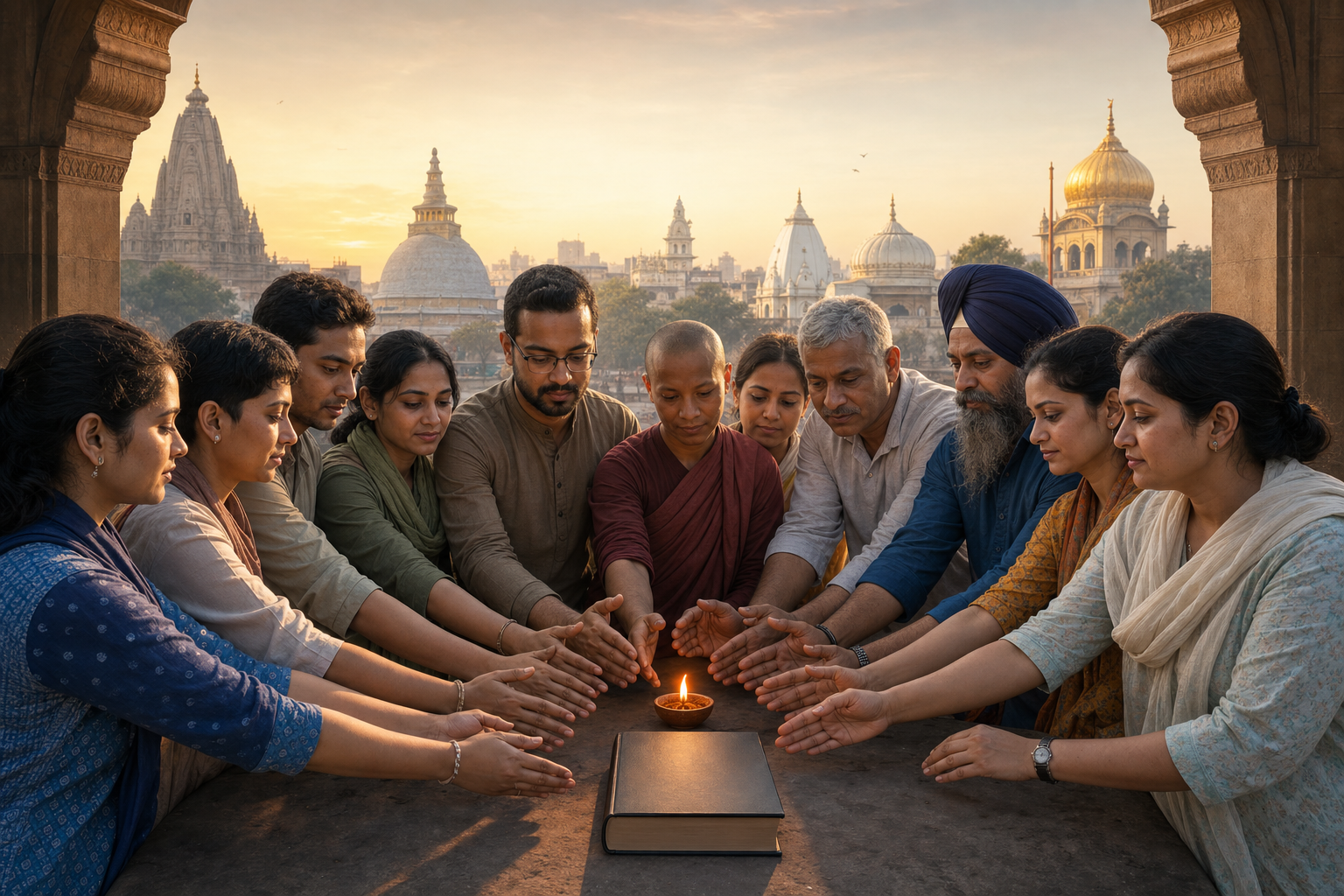
A hostile message is circulating. A place of worship has been threatened, vandalised, or drawn into an administrative dispute. Volunteers want to respond, but they disagree about whether to publish names, organise a protest, contact the police, or wait for legal advice. This is where Dharmic unity either becomes useful or collapses into slogans.
You need a response that protects the community without spreading an unverified allegation, compromising evidence, or treating an entire population as responsible for one act. The practical answer is to combine inter-dharmic solidarity with constitutional literacy, disciplined documentation, institutional readiness, and visible seva.
Key takeaways
- Dharmic unity should coordinate action without pretending that Hindu, Buddhist, Jain, and Sikh doctrines are interchangeable.
- Use Articles 25 to 28 precisely. First determine whether the issue concerns individual conscience, denominational management, taxation for religious promotion, or religious instruction in a state institution.
- When an incident occurs, preserve original files, metadata, witness accounts, complaint acknowledgements, and a clear record of who handled each item.
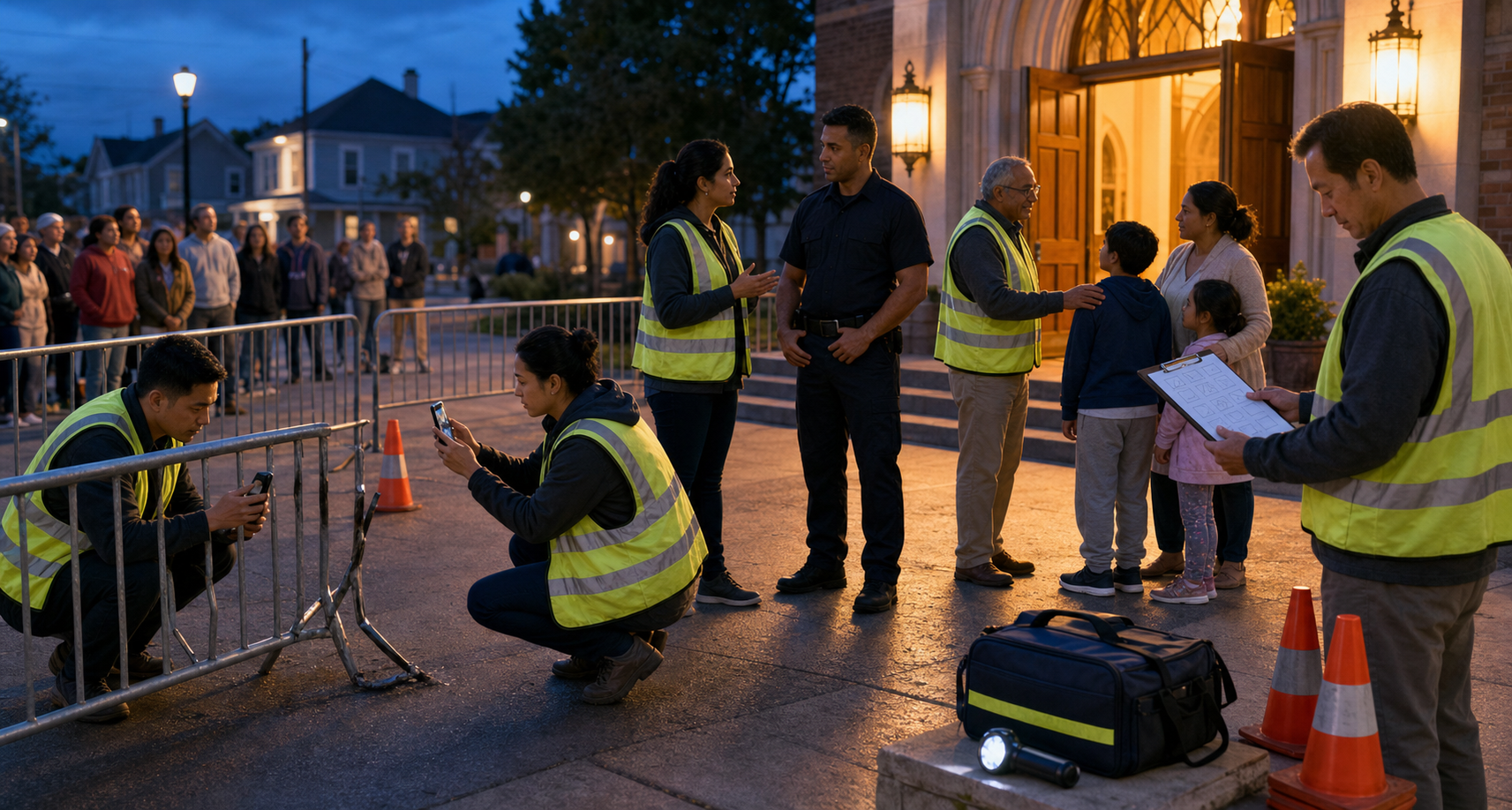
- Protect gatherings through trained marshals, crowd-flow plans, first-aid readiness, visible exits, official liaison, and safe arrangements for women and vulnerable attendees.
- Measure unity by resolved grievances, safer events, constitutional education, reliable incident records, and sustained service to neighbours.
Unity is a civic compact, not a merged theology
Hinduism, Buddhism, Jainism, and Sikhism arose from Bharat’s civilisational environment, but they don’t make identical claims about the self, liberation, scripture, worship, authority, or metaphysics. Effective unity begins by respecting those differences. A Jain community shouldn’t have to soften ahimsa, a Buddhist institution shouldn’t have to borrow Hindu theology, and a Sikh organisation shouldn’t have to recast seva in someone else’s vocabulary before cooperation becomes possible.
The common ground is ethical and civic. Satya disciplines public speech. Ahimsa rules out retaliation against uninvolved people. Karuna keeps the human consequences of conflict visible. Seva turns solidarity into material help. Dharma places responsibility alongside rights. These principles are sufficiently substantial for cooperation and sufficiently open to preserve each tradition’s integrity.
The useful synthesis is spiritual conviction joined to civic competence: confidence in worship, evidence in public claims, lawful process in disputes, and care for neighbours. It rejects two failures at once. One is passivity disguised as tolerance. The other is aggression disguised as courage.
When several Dharmic organisations consider a joint initiative, use this sequence:
- Name the concrete problem. It might be festival safety, vandalism, legal literacy, heritage conservation, youth radicalisation, or assistance after a disaster.
- Write the minimum shared commitment. For example: protect lawful worship, reject violence, verify claims before publication, and cooperate with legitimate authorities.
- Record doctrinal and institutional boundaries. Each organisation keeps control of its worship, teaching, internal decisions, symbols, funds, and public identity.
- Assign a named coordinator from every participating tradition. No organisation should discover after publication that another group has spoken in its name.
- Choose work that produces a visible public benefit. Shared labour builds more durable trust than a photograph of leaders standing together.
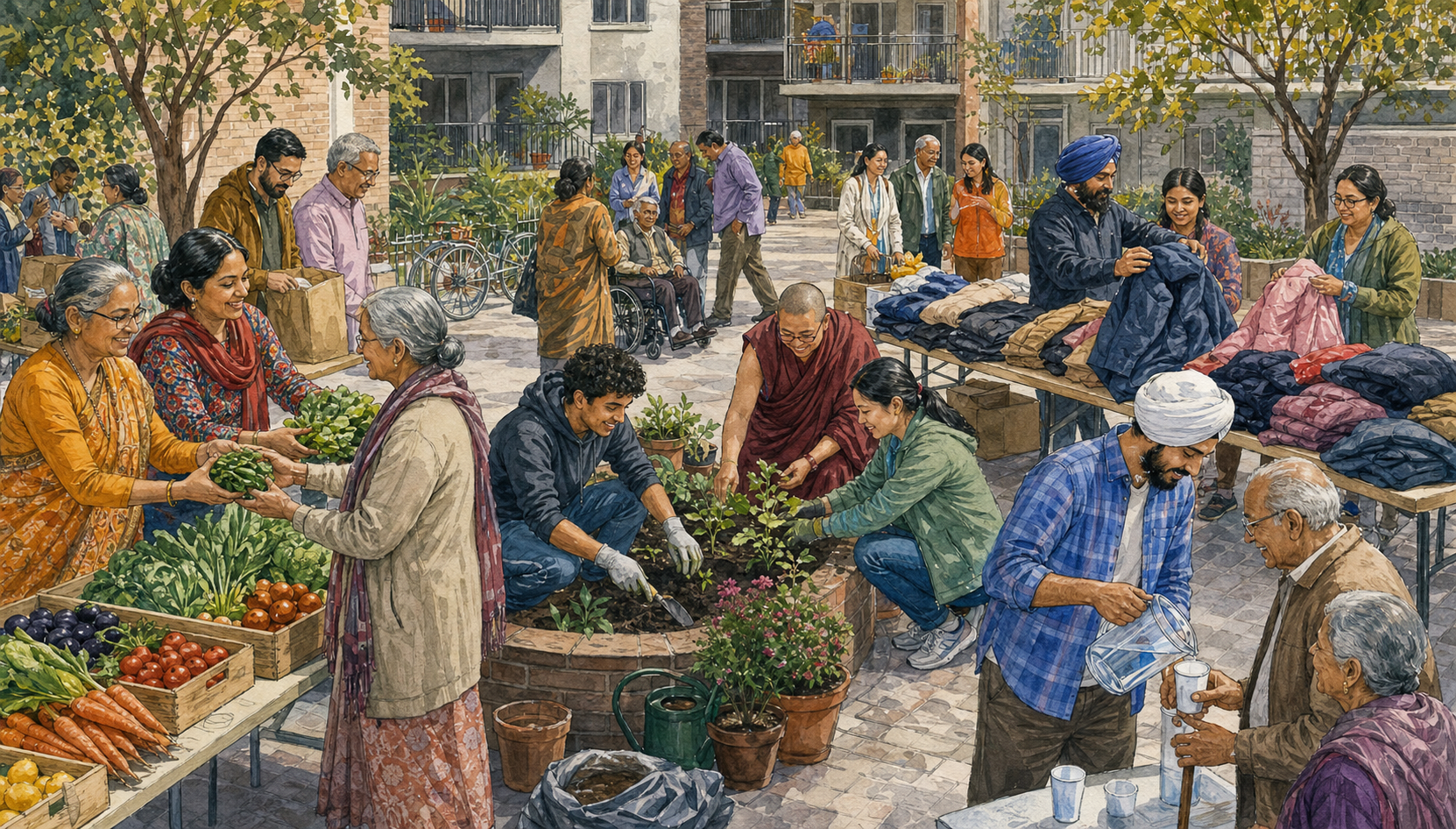
Joint langar or annadanam, blood-donation drives, health camps, relief kitchens, environmental work, scholarships, skills training, and women’s safety initiatives give unity a practical form. They also change the public question. Instead of asking only what a community fears, neighbours can see what it contributes.
Apply a simple language test before issuing a joint statement: could every participating organisation repeat it without denying its own teaching or degrading another community? Remove collective accusations, speculative motives, inflammatory adjectives, and claims that have not been verified. Firm language is sometimes necessary. Careless language never is.
Women and young people must have authority within this compact, not ceremonial seats around it. Women trustees and organisers should help decide transport, safeguarding, grievance, finance, and event policies. Youth can combine heritage work, oral-history recording, cyber-safety training, constitutional study, and service placements. That gives the next generation something more demanding than pride alone: responsibility for what it inherits.
Use constitutional rights as tools, not incantations
Invoking the Constitution is not the same as making a constitutional argument. A useful argument identifies the affected person or institution, the precise government or private action being challenged, the relevant right, the available evidence, and the lawful remedy being requested.
| Provision | What it protects or regulates | Question to ask first |
|---|---|---|
| Article 25 | Freedom of conscience and the right to profess, practise, and propagate religion. | Whose freedom of conscience or religious practice is being restricted, and by what specific action? |
| Article 26 | The autonomy of religious denominations to manage their religious affairs. | Is the dispute about a denomination’s institutional affairs rather than only an individual’s practice? |
| Article 27 | Protection against taxation specifically directed to promoting or maintaining a particular religion. | What tax or appropriation is being challenged, and is the objection actually about its expressly religious purpose? |
| Article 28 | Religious instruction and worship in certain state-linked educational institutions. | What is the institution’s legal status, and is the activity instruction, worship, voluntary participation, or something else? |
The distinctions matter. Article 25 commonly directs attention to conscience and individual religious exercise, while Article 26 raises questions about denominational management. Article 27 is not a general objection to every public expenditure that touches religion. Article 28 cannot be applied intelligently without identifying the kind of educational institution involved. A slogan that ignores these distinctions can weaken an otherwise legitimate grievance.
Use a five-part rights triage before speaking publicly or filing a complaint:
- Identify the actor. Record whether the disputed action came from a government office, police authority, educational institution, religious governing body, platform, private organisation, or individual.
- Describe the action. Replace conclusions such as persecution or discrimination with observable facts: permission denied, access obstructed, property damaged, instruction required, account suspended, funds withheld, or a threat delivered.
- Identify the affected party. State whether the immediate claimant is an individual worshipper, a denomination, a trust, an educational institution, or another legal body.
- Match the provision. Explain why Article 25, 26, 27, or 28 is relevant rather than listing every constitutional provision available.
- State the requested outcome. Ask for a defined action such as acknowledgement of a complaint, protection for a gathering, reconsideration by the competent authority, preservation of evidence, or an opportunity to make a formal representation.
This triage organises the facts; it does not decide an individual legal case. If you have received an official notice, face a filing deadline, anticipate arrest or serious liability, or are dealing with property, trust management, or institutional control, take the complete documents to a qualified lawyer. Public speculation can prejudice a case, expose individuals to defamation claims, or create contradictions that later undermine reliable evidence.
Constitutional consistency also tests the quality of Dharmic advocacy. If you defend freedom of conscience only for people you agree with, you are arguing for privilege rather than a right. Defending a principled framework for everyone does not require agreement with every belief. It protects the legal space in which disagreement can remain peaceful.
Respond to threats with evidence, not amplification
The urge to repost a threat immediately is understandable, but uncontrolled forwarding can strip away context, expose private information, alert a wrongdoer, or leave investigators with multiple altered copies. Preserve first. Verify second. Escalate through the appropriate channel. Publish only what a responsible spokesperson can support.
Create an incident file containing:
- The date, time, and exact location of the incident or message.
- The original photograph, video, audio file, email, or message export rather than only a screenshot or forwarded copy.
- Available metadata, account identifiers, telephone numbers, profile links, URLs, and platform details, preserved without editing.
- Separate witness accounts stating what each person directly saw or heard. Do not ask witnesses to harmonise their wording.
- Photographs of damage taken from a safe and lawful position, with the wider scene as well as relevant details.
- Copies of complaints, emails, notices, delivery receipts, acknowledgement numbers, and the names or designations of officials contacted.
- A handling log showing who received, copied, transferred, or submitted each important item.
That handling log is the practical core of a chain of custody. It helps distinguish the original material from edited or circulated versions. Keep a protected working copy and restrict editing access. Never trespass, impersonate another person, break into an account, publish a home address, or place a volunteer in danger to obtain better evidence. Open-source investigation still has to respect privacy, platform rules, and law.
For viral allegations, designate a verification lead and a backup. Give each claim one of three working labels: unverified, confirmed, or false. Record what would be needed to change the label. A screenshot without an original link, date, location, or identifiable context should remain unverified, however emotionally persuasive it appears.
Your public statement can follow a disciplined three-part form: what is known, what is not yet known, and what action has been requested from the competent authority. Update it when the evidence changes. Quietly correct an error on the same channel where it spread; deleting it without explanation can leave the false claim circulating through copies.
When there is an immediate danger to life or an ongoing attack, move people away from the hazard and contact local emergency services. Documentation must not delay safety. Once the immediate risk is controlled, use formal channels, retain the acknowledgement, and connect affected people with appropriate legal assistance. Volunteers can organise records and support; they should not present themselves as investigators or lawyers unless they hold those roles.
Build institutions that can protect freedom calmly
A community should not have to invent its safety, communications, and legal procedures in the middle of a crisis. Temples, viharas, derasars, gurdwaras, trusts, and festival committees can prepare without turning sacred spaces into intimidating security zones.
For every large gathering
- Name one safety coordinator whose authority and contact details are known to organisers.
- Brief volunteer marshals on crowd flow, lost children, medical incidents, blocked passages, confrontation avoidance, and when to call professionals.
- Inspect entrances, exits, evacuation routes, signage, lighting, barriers, emergency-vehicle access, and first-aid supplies before attendees arrive.
- Agree on a liaison process with local authorities where the scale or sensitivity of the event warrants it.
- Provide a clear method for reporting harassment, suspicious objects, missing persons, or unsafe crowding without creating panic.
- Include women organisers in decisions about transport, lighting, sanitation, reporting, and late-evening arrangements.
- Record incidents and near misses after the event, then revise the operating procedure before the next high-footfall gathering.
Volunteer marshals are not a private police force. Their job is to guide, observe, communicate, de-escalate, and summon qualified help. They should not interrogate people, use force except where lawfully necessary for immediate protection, or make public accusations based on appearance or group identity.
For year-round governance
Run periodic reviews of legal compliance, finance, safeguarding, insurance, data handling, volunteer roles, and emergency procedures. Use proportionate background checks for sensitive positions. Define who may speak for the institution, sign a complaint, release footage, access financial records, or communicate with legal counsel. Ambiguity over authority creates delay precisely when decisions have consequences.
Heritage protection deserves its own operating plan. Living worship and conservation are not competing purposes when responsibilities are clear. Manuscripts need secure storage and suitable environmental controls. Iconography and inscriptions need trained documentation. Ritual access, handling rules, repair decisions, and conservation work should be recorded so that devotion does not accidentally damage what the community hopes to transmit.
Publish a quarterly community dashboard that is modest enough to maintain and specific enough to expose weak performance. Useful measures include:
- Participation in constitutional and civic-education sessions.
- Incident reports received, completed, and submitted with usable evidence.
- Grievances resolved, pending, or referred for professional help.
- Safety incidents and near misses at major gatherings.
- Rumours corrected before they triggered mobilisation or confrontation.
- Women and young people holding defined decision-making roles.
- Joint seva projects completed and the communities or local needs they served.
Numbers should improve judgement, not manufacture good publicity. A low incident count might indicate a safe environment, but it might also reveal that people don’t trust the reporting process. Pair each measure with a short explanation of what changed, what remains unresolved, and who is responsible for the next action.
At your next committee meeting, leave with four concrete decisions: who owns the incident protocol, who coordinates event safety, who can obtain qualified legal help, and which neighbouring Dharmic institution will be invited into a shared seva effort. That is how unity becomes durable: each tradition remains itself, every claim is answerable to truth, and constitutional freedom is defended through competent action.


References
