
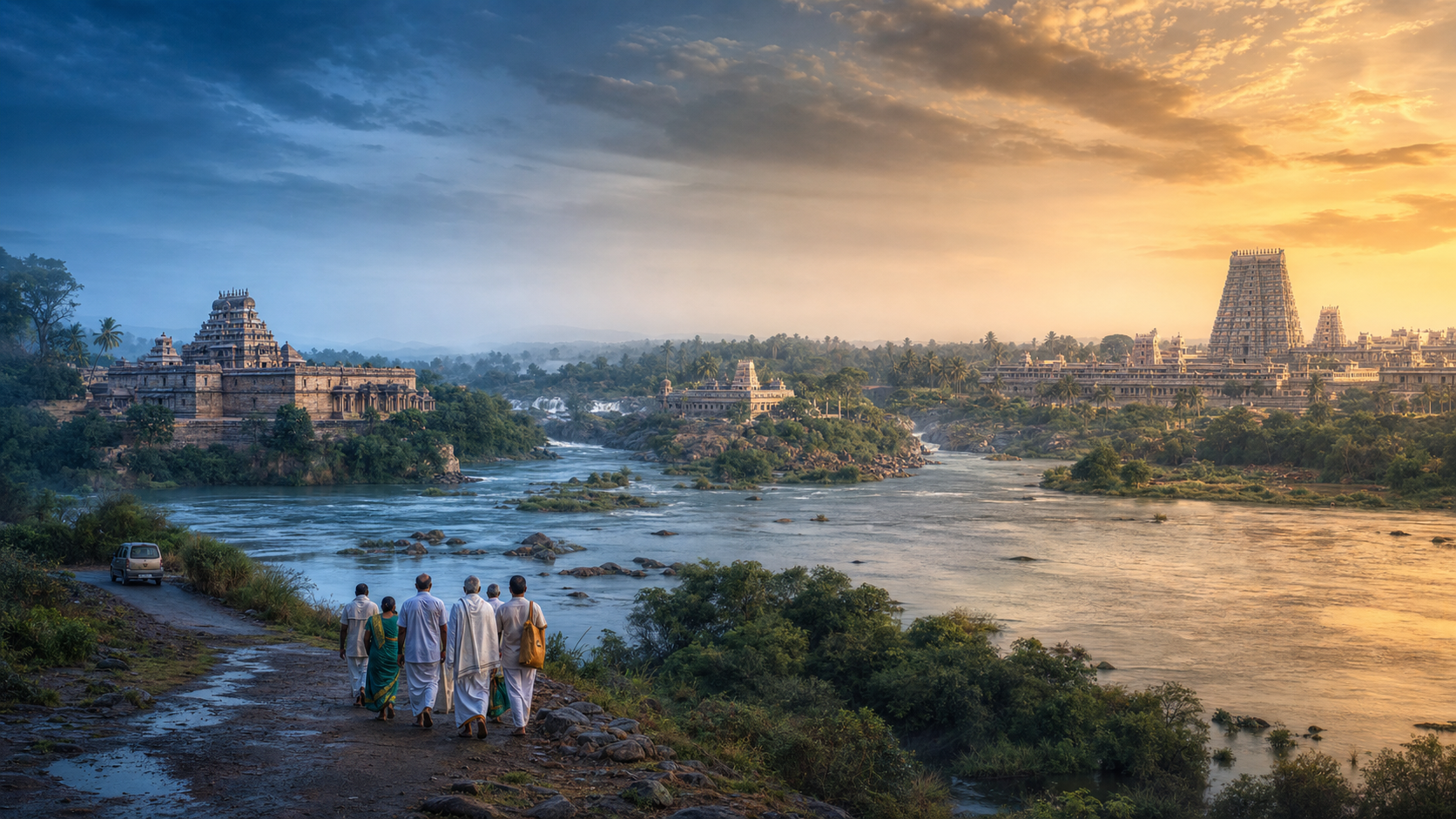
You want to receive darshan at Adi Ranga, Madhya Ranga, and Antya Ranga in one day without reducing the pilgrimage to a race between temple doors. It can be attempted, but the day only works when you plan around worship timings, rural-road uncertainty, the long final drive to Srirangam, and your own capacity to remain attentive.
The essential choice comes before departure: is your sankalpa to force three visits into a date, or to carry one devotional intention through three sacred places? The traditional one-day form values discipline and single-pointedness, but it is not a rule that makes a two-day pilgrimage spiritually inferior. That distinction will help you respond wisely if a puja closure, festival crowd, or swollen river changes the plan.
Make the sankalpa precise before you arrange the journey
The traditional movement is unambiguous: Adi Ranga at Srirangapatna, Madhya Ranga at Shivanasamudra, and Antya Ranga at Srirangam follow the Kaveri from west to east. The route is geographical, but it also gives the day its devotional coherence. You follow the river while approaching the same Lord in three consecrated abodes.
At each temple, Sri Ranganatha reclines upon Adishesha. Repetition is part of the practice rather than a reason to hurry. The form remains recognisable while the temple scale, landscape, ritual atmosphere, and historical setting change around it. Your task is to sustain the same bhava through those changes.
Set three terms for the sankalpa before you leave:
- Keep the sacred order. Begin with Adi Ranga, continue to Madhya Ranga, and conclude at Antya Ranga.
- Define completion as darshan, not sightseeing. Long diversions, leisurely meals, and optional stops work against an already demanding one-day schedule.
- Choose your fallback in advance. If a closure or unsafe river condition prevents the middle darshan, you will continue the yatra over a second day rather than drive recklessly or quarrel with temple staff.
This is practical spiritual preparation. A vow made without room for circumstances can turn a pilgrim’s attention toward the clock. A clear fallback protects both safety and devotion.
Build the day around three critical arrival windows
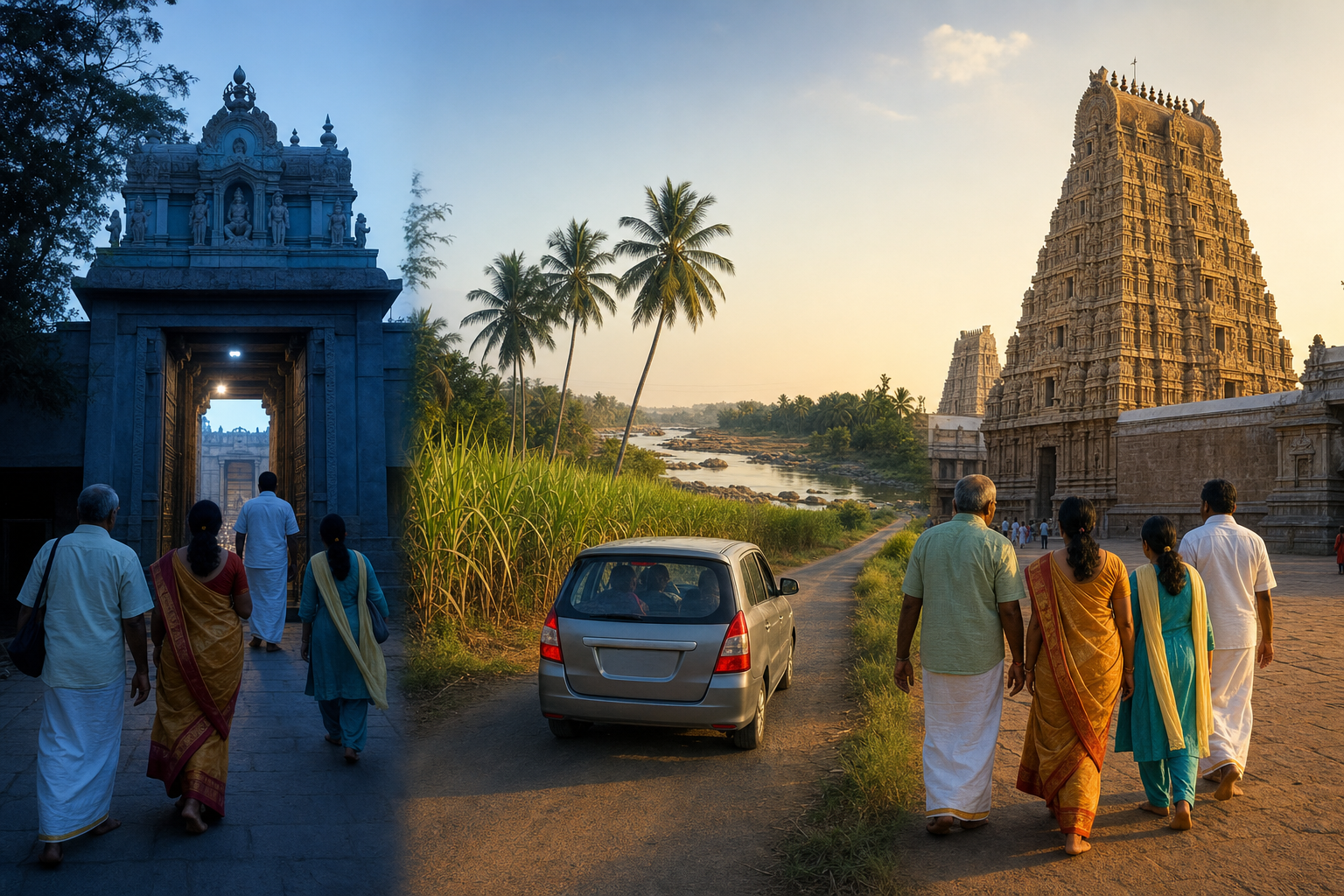
A commonly attempted schedule begins at dawn in Srirangapatna, reaches Shivanasamudra during its morning opening, and reserves the late afternoon or evening for Srirangam. Treat the following times as working targets, not promises from the temples.
| Stage | Working target | What the target protects |
|---|---|---|
| Adi Ranga, Srirangapatna | Arrive by 6:00-6:30 a.m.; try to complete darshan by about 8:00 a.m. | An early departure for the more variable approach to Madhya Ranga |
| Madhya Ranga, Shivanasamudra | Arrive around 9:30-10:00 a.m.; aim to depart before noon | The smaller shrine’s potentially shorter morning window and the long onward journey |
| Antya Ranga, Srirangam | Reach the temple town in the late afternoon or evening | Time for navigation, queues, and the published evening darshan window |
Larger temples often follow a broad pattern such as 6:00-10:00 a.m. and 4:00-8:30 p.m., with a closure around midday for worship and offerings. Madhya Ranga can have shorter or less predictable hours. Seasons, weekdays, festivals, abhishekam, alankara, and naivedya can all alter access. Confirm the actual schedule one day before departure, giving special attention to Shivanasamudra. If possible, confirm again locally on the morning of travel.
If one-day completion matters to you, spend the previous night close enough to Srirangapatna to reach the temple rested at dawn. Bengaluru and Mysuru are useful gateways, but a long early-morning approach from a distant starting point consumes the buffer needed later. The schedule becomes fragile if the first darshan begins late.
Srirangapatna lies near the Bengaluru-Mysuru corridor. The usual approach to Shivanasamudra runs through the Malavalli or Kollegala side, where roads narrow as you approach the river island and parking may be limited. The final leg crosses into Tamil Nadu toward Tiruchirappalli and Srirangam. Because this is a long interstate day, a reliable vehicle and a driver comfortable with temple towns and rural stretches are more important than an ambitious minute-by-minute timetable.
Carry water and light satvik food so that a delayed meal does not become a crisis. Keep any meal stop brief after Madhya Ranga, but do not sacrifice hydration or driver rest merely to preserve an estimated arrival time. Avoid attaching a tight flight or train connection to the end of the pilgrimage; Srirangam’s queue and evening worship should determine the close of the day.
Approach the three Rangas as distinct darshans
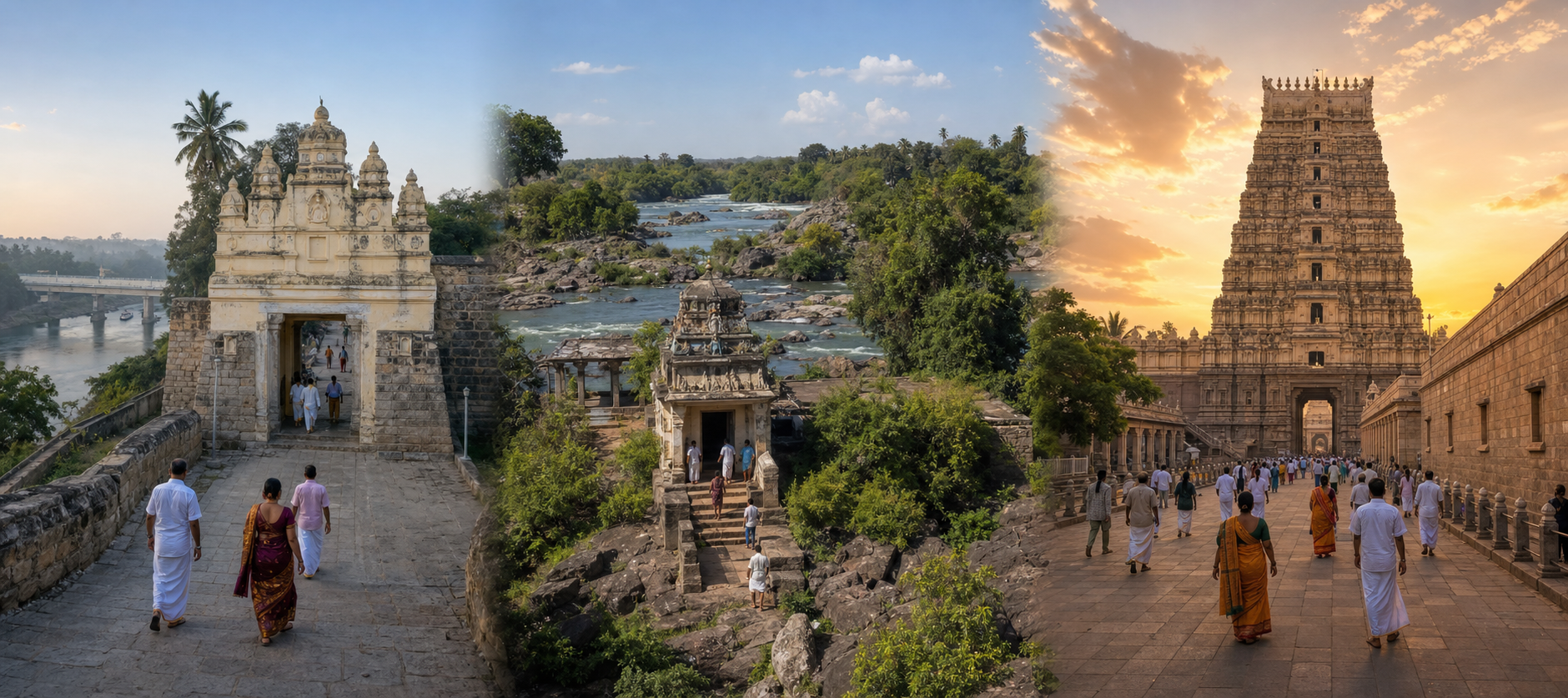
Adi Ranga: establish the day’s attention
Sri Ranganathaswamy Temple at Srirangapatna carries an early medieval inheritance shaped over time by the Western Ganga, Hoysala, Vijayanagara, and Wodeyar traditions. Dravidian architectural elements frame a reclining Ranganatha associated with familiar Vaishnava emblems and the presence of Bhudevi and Neeladevi. The Thayar shrine reinforces the Sri Vaishnava rhythm in which the Divine Mother and Lord are approached within one devotional world.
Do not spend the first darshan mentally rehearsing the drive. Use it to establish the ekagrata that the rest of the yatra will test. Offer the day’s intention, receive darshan without lingering beyond what the queue permits, and leave the precinct calmly. An efficient departure need not be an abrupt one.
Madhya Ranga: let the middle become a pause
Shivanasamudra places the smaller Madhya Ranga shrine within the Kaveri’s riverine landscape, between the Gaganachukki and Bharachukki waterfalls. Its scale and atmosphere differ sharply from the monumental experience awaiting you at Srirangam. That is precisely why it should not be treated as a box to tick between two larger temples.
The quieter sanctum can become the contemplative centre of the pilgrimage. After the logistical pressure of the morning, notice whether your mind is still with Ranganatha or already bargaining with the arrival time at Srirangam. Gather your attention before continuing.
Practical caution matters most here. The final approach can be narrow, parking may be constrained, temple hours may vary, and monsoon-swollen waters can affect accessibility. From November through February, clearer post-monsoon conditions and cooler weather generally make travel and queues easier. During heavy rain or uncertain river conditions, confirm local access and accept a change of plan rather than forcing the approach.
Antya Ranga: allow enough time for a living temple city
Srirangam is not simply a larger version of the first two stops. It is an immense functioning temple complex organised through seven concentric prakaras, with successive gopurams and the Rajagopuram shaping the approach. Passing through a gateway does not necessarily mean you are close to the sanctum, so preserve time for orientation as well as the queue.
The reclining moola-vigraha faces south, while Namperumal, the utsava murti, carries much of Srirangam’s public festival life. The temple is deeply embedded in the Divya Prabandham tradition and in the memory of Sri Vaishnava acharyas, especially Ramanujacharya. Chant, prasada, movement through the prakaras, and multiple strands of worship make the precinct a living sacred settlement rather than a monument that can be consumed quickly.
Vaikunta Ekadashi, Panguni Uttiram, and other major observances can transform both access and crowd conditions. If your chosen day falls within a festival cycle, discard ordinary queue assumptions and verify the special arrangements. At the final darshan, resist the urge to measure whether the day matched your spreadsheet. Let Antya Ranga complete the devotional movement that began at dawn.
Protect the pilgrimage through conduct, not haste
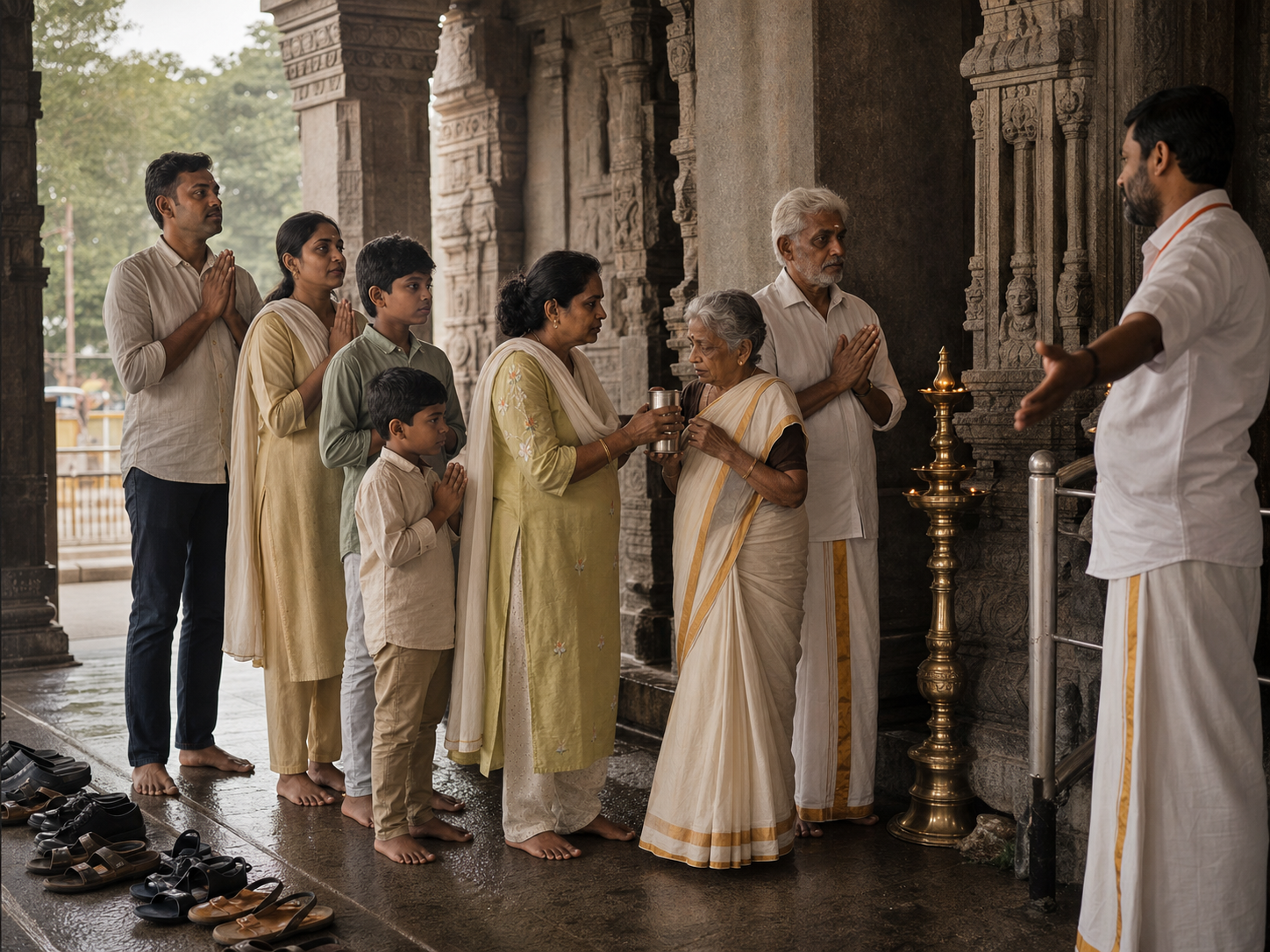
The same discipline that keeps the route on time should make you easier, not harder, to share a temple with. Basic conduct also protects the sanctity of spaces that remain active places of worship.
- Wear modest clothing that covers shoulders and knees. Do not assume that travel wear acceptable outside the temple will be suitable near the sanctum.
- Leave footwear only at the designated place. Build a few minutes for depositing and retrieving it into each stop.
- Silence your phone before entering. Avoid photography in sanctum areas and follow every locally displayed restriction.
- Maintain queue discipline and defer to archakas and volunteers. A temporary pause for puja, alankara, or naivedya is part of temple life, not an obstruction to your private schedule.
- Respect any posted convention governing entry into particular inner areas. Visitors from different traditions may enter the broader precincts, but a living temple has local customs that should not be argued away.
- Prepare for the shift from Kannada-speaking Karnataka to Tamil-speaking Srirangam. Keep destination names clear and ask for help simply and respectfully when needed.
- Carry your waste out. At the Kaveri, a pranam from a safe place is sufficient; devotion does not require leaving offerings, packaging, or food in the water.
- When practical, receive prasada and support local temple-linked vendors or artisans. The pilgrimage survives through communities as well as stone and ritual.
This ethic extends beyond sectarian identity. Ahimsa in what you consume and discard, satya in how honestly you assess your limits, seva toward elderly or struggling pilgrims, and compassion in a crowded queue are not decorative ideals. They are visible measures of whether the yatra is changing your conduct.
Key takeaways: your one-day go/no-go test

- Go in one day only if you can sleep near the starting point, reach Adi Ranga by about 6:00-6:30 a.m., and begin the day rested.
- Confirm all three opening windows the day before travel. Do not rely on generic internet timings, especially for Madhya Ranga.
- Keep a hard morning checkpoint: if you cannot leave Srirangapatna near the planned time, reassess the entire day rather than trying to recover every lost minute on the road.
- Use an experienced driver and reliable vehicle. The decisive challenge comes after Madhya Ranga, when a long final leg follows an already early start.
- Carry water and light satvik food while allowing necessary rest. Fatigue is a reason to change the plan, not proof that the vow is working.
- Choose two days if temple hours are uncertain, monsoon access is questionable, a major festival is affecting Srirangam, or anyone in your party cannot safely sustain the schedule.
If the one-day test fails, divide the pilgrimage at its natural middle: receive Adi Ranga and Madhya Ranga without haste, then approach Antya Ranga on the following day. You preserve the west-to-east movement and gain the attention needed to understand Srirangam rather than merely reach it.
Before making the sankalpa, confirm the three temple schedules, arrange the vehicle, and decide the delay that will trigger your two-day fallback. Then put the timetable away when you stand before Ranganatha. The itinerary should carry you to darshan; it should not accompany you into it.
References
