

You may be certain that a wrong occurred and still sense that the response is becoming wrong in its turn. That is one of the hardest Dharma conflicts: stopping cruelty without abandoning justice, and showing compassion without making the vulnerable pay for everyone else’s peace.
The Mahabharata gives us two demanding tests. King Shibi must protect a frightened being without dismissing another being’s legitimate need. King Janamejaya must answer his father’s death without converting punishment into extermination. In both conflicts, compassion is neither passivity nor acquittal. It is the discipline that protects the exposed, limits the reach of vengeance, and places the cost of mercy on those who possess power.
First ask who is being made to pay

A dove seeks refuge in King Shibi’s lap while an eagle demands its prey. The king cannot dismiss the dove’s fear, but neither does he pretend that the eagle’s hunger is meaningless. Bound by sharanagati, the duty created by granting refuge, Shibi offers his own flesh rather than surrender the being under his protection. In several tellings, pieces of flesh fail to balance the scale, and he finally offers his whole being.
The scene is not an instruction for managing predators. Nature describes predation; Dharma asks what a responsible person ought to do when power, vulnerability, promise, and necessity meet. Shibi does not criminalize the eagle or declare hunger illegitimate. He refuses to solve the conflict by betraying the one who trusted him.
That distinction matters whenever you invoke compassion. There are usually at least three possible bearers of its cost: the threatened person, the person pressing a competing claim, and the authority deciding between them. Cheap mercy transfers the burden to someone who had no meaningful choice. Shibi’s mercy is morally serious because the guarantor absorbs the cost himself.
Before you call a decision compassionate, ask four concrete questions:
- What protection was promised? A vague hope to help is different from refuge already granted. Once another person has reasonably relied on your word, your duty has changed.
- Who faces the immediate danger? Begin with the party who cannot safely wait for a perfect settlement.
- What competing claim is legitimate? Acknowledging it does not require surrendering the vulnerable person to it.
- Who will bear the cost of the solution? If the answer is the refugee, complainant, junior member, or uninvolved public, the mercy may be only performative.
Suppose a person reports intimidation within a family, temple committee, workplace, or community organization. Asking that person to withdraw so harmony can return resembles handing the dove back. The institution should bear the inconvenience of separating roles, examining conduct, documenting a decision, and enforcing boundaries. Peace purchased by silencing the exposed party is not compassion. It is displaced harm.
Compassion gives punishment an endpoint
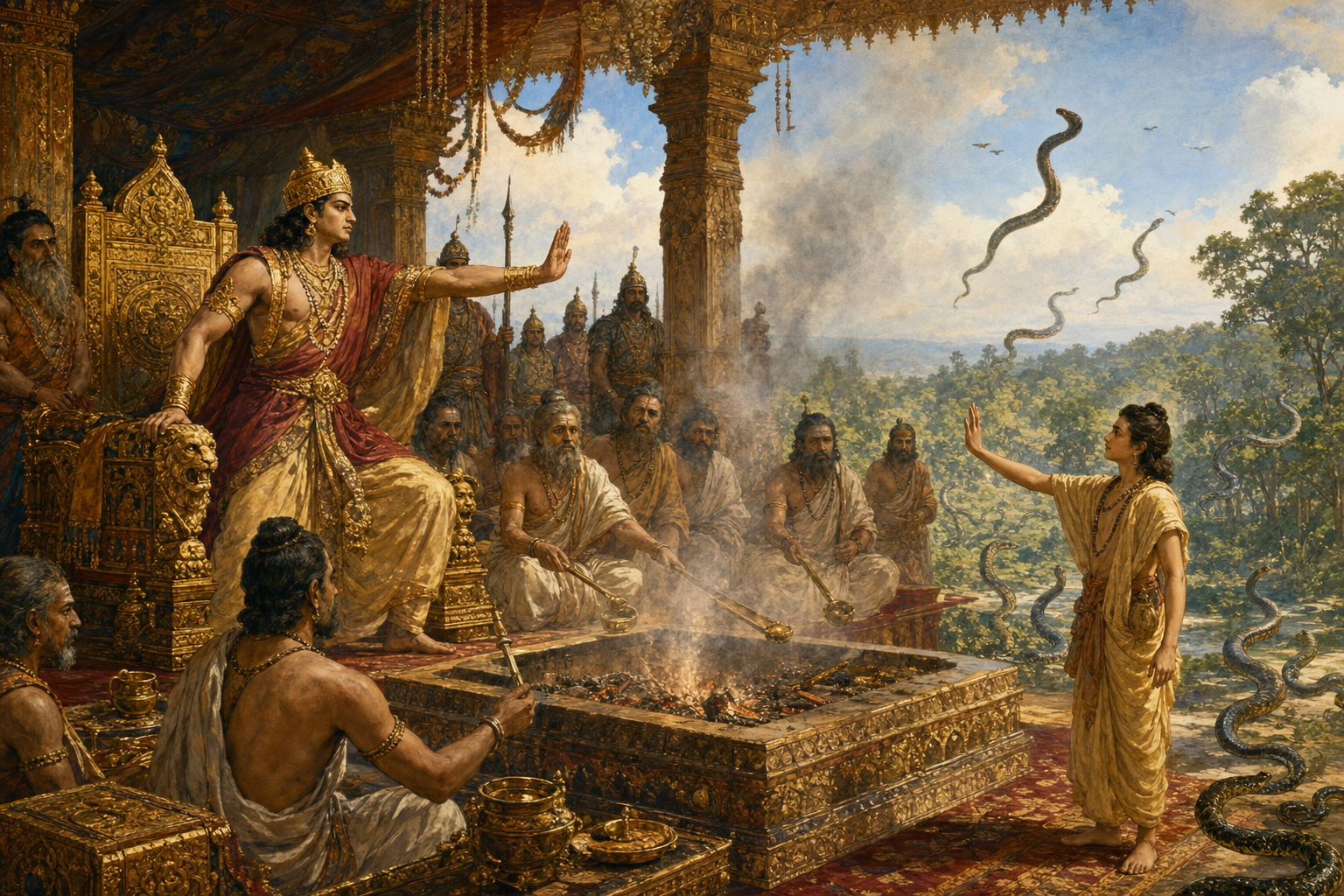
Janamejaya’s grievance is not imaginary. His father, Parikshit, dies from Takshaka’s bite, and the son turns to a powerful sacrificial mechanism for redress. Yet the target expands from Takshaka to every Naga. Priests use the Sarpasattra to draw serpents into the fire, and a rite that can be performed with technical precision becomes an engine of collective destruction.
Astika enters after many serpents have already perished. Born across Brahmana and Naga lines, he has standing in more than one world. He does not deny Parikshit’s death or demand that Janamejaya feel no anger. He asks for a definite act: stop the sacrifice. Janamejaya grants the request and halts the rite before an entire living order is destroyed.
The warning is sharp. A real injury can generate an adharmic response. Competent procedure can magnify rather than correct that response. Royal authority, ritual expertise, and public anger do not become righteous merely because they move in the same direction.
You can often detect the turn from justice to vengeance by listening for a change in nouns. One person becomes a family, faction, caste, species, faith, or population. A named deed becomes an alleged nature shared by all members of the category. A bounded consequence becomes cleansing, eradication, or permanent exclusion. The original wrong remains real, but the proposed target is no longer the original wrongdoer.
- Accountability identifies conduct, responsibility, evidence, and an appropriate consequence.
- Collective punishment assigns guilt through association and reaches people whose individual conduct has not been established.
- Compassionate restraint stops that expansion without pretending that the first injury never happened.
- Impunity refuses proportionate accountability altogether. It should not be confused with compassion.
When anger is broadening the target, rewrite the demand using proper names and specific verbs: Who did what? Who can reasonably be held responsible? What action would protect others from a recurrence? Who has been included only because of identity or association? If the case cannot be stated without words such as all, always, or inherently, pause before authorizing punishment.
Mercy and compassion also need not mean the same thing. Mercy commonly reduces a consequence imposed on a responsible party. Compassion looks more widely at suffering created by the injury, the punishment, and the process itself. Astika’s intervention is compassionate chiefly because it protects beings who have been swept into an unlimited response. It does not require declaring Takshaka innocent.
The Dharmic answer often changes the structure of the choice

Both conflicts initially appear binary. Either the eagle goes hungry or the dove is surrendered. Either Janamejaya avenges Parikshit or the killing goes unanswered. Dharma opens a third path by changing the allocation, target, or endpoint of power. Shibi accepts the burden created by his promise. Astika separates legitimate grief from limitless extermination.
A third option is not necessarily a compromise halfway between two demands. Sometimes the middle is itself unjust. Nor is it a clever escape from responsibility. A Dharmic alternative must preserve the duty that matters most while refusing unnecessary harm. You can search for it with this sequence:
- Describe the original wrong in one sentence. Name conduct before attaching identities or theories about an entire group.
- Map the legitimate claims. Shibi must see both terror and hunger. Seeing more than one claim is not the same as assigning them equal moral weight.
- Identify the non-negotiable duty. It may arise from refuge, office, kinship, a vow, stewardship, or responsibility for public safety.
- Choose the narrowest action that can discharge that duty. Direct protection and individualized accountability usually answer the problem more accurately than generalized retaliation.
- Place unavoidable costs as close to power as possible. The ruler, institution, or decision-maker should not export the price of its moral position to an unseen victim.
- Set the stopping condition before acting. Decide what completion looks like, who can call a halt, and what evidence would show that the action has exceeded its purpose.
The sixth step is easy to neglect. Once Janamejaya’s rite begins, ritual machinery, priestly expertise, grief, and royal prestige all favor continuation. Modern institutions develop similar momentum. A campaign acquires slogans, committees acquire sunk costs, and leaders fear that restraint will look like weakness. An endpoint chosen in advance gives conscience somewhere to stand when momentum begins masquerading as duty.
Astika also shows how to intervene without erasing the injured party. He approaches a grieving king with respect, gains a hearing, and makes a concrete request. If you must interrupt an escalating conflict, use the same architecture: acknowledge the established injury, identify the exact line being crossed, request a specific restraint, and preserve a path by which the decision-maker can choose Dharma without being asked to deny everything that came before.
Beware of counterfeit third options. Delay can be disguised as balance while danger continues. Forced reconciliation can make a victim finance communal comfort. Equal blame can conceal a severe imbalance of power. Symbolic mercy can move a real cost onto workers, dependants, or the public. Test the proposed alternative by tracing its consequences to the person who will actually live with them.
Four Dharmic lenses keep compassion from becoming sentiment

Hindu, Buddhist, Jain, and Sikh ethical vocabularies do not erase their doctrinal differences. They do, however, illuminate complementary disciplines within a conflict. Used together as questions, they prevent compassion from collapsing into vague goodwill.
Hindu raja-dharma asks what your role obliges you to protect. Shibi’s compassion is inseparable from kingship and sharanagati. A ruler’s promise of refuge is part of the moral covenant that makes authority credible. The practical question is not merely whether you feel pity. It is whether your office, word, or prior act has created a duty that personal convenience cannot cancel.
Buddhist karuna asks whether fear is actually being removed. The Shibi motif becomes an expression of abhaya-dana, the gift of fearlessness, within bodhisattva ethics. That pushes you beyond benevolent intention. If a frightened person remains exposed while the authority celebrates its own kindness, fear has not been removed at its root.
Jain ahimsa asks you to examine intention, method, and total harm. The distinction between harm in disposition and harm in material action prevents easy moral accounting. A decision advertised as peaceful may be driven by hostility, while an act of restraint may require courage and personal sacrifice. Anekantavada, the discipline of many-sided understanding, also warns against flattening a conflict into one convenient description. Recognizing the eagle’s need does not erase the dove’s claim. Recognizing Parikshit’s death does not justify the destruction of every Naga.
Sikh saint-soldier ethics asks whether strength is serving the vulnerable. Sarbat da bhala, the welfare of all, is not achieved by refusing to confront oppression. Compassion must possess the courage to protect. Restraint is righteous when it limits excess; it becomes cowardice when it merely protects the comfort or reputation of those able to intervene.
Put these lenses to work in order. Ask what duty your role creates, whose fear must be removed, what harms exist in motive and consequence, and whether your use or refusal of strength protects the exposed. A proposed act of mercy that fails all four tests is probably sentiment, avoidance, or reputation management rather than Dharma.
Key takeaways for the conflict in front of you
- Do not ask the vulnerable party to purchase peace by surrendering protection already promised.
- Acknowledge every legitimate claim, but do not confuse acknowledging claims with giving them equal weight.
- Keep accountability attached to identifiable conduct; pause when anger expands guilt to an entire category.
- Make compassion concrete by naming who will bear its cost. Those with authority should absorb that cost before transferring it downward.
- Define an endpoint before punishment begins. Power without a stopping condition can turn a just grievance into an unlimited campaign.
- Intervene in a way that recognizes the original injury while drawing a clear boundary against further excess.
For your next difficult decision, write five short lines before you speak publicly or authorize action: the wrong that occurred; the person now exposed; the competing legitimate claim; the red line the response must not cross; and the cost you or your institution will bear. If the fifth line is blank, your compassion is probably being financed by somebody with less power.
Then choose one concrete act: preserve refuge, narrow the target, appoint someone able to halt escalation, or accept the burden your promise created. Epic Dharma does not ask you to feel merciful while events run their course. It asks you to place disciplined compassion inside the exercise of power, before vengeance becomes its own unquestioned law.
References
- DharmaRenaissance Blog — Decoding King Shibi’s Paradox: When Compassion Transcends Nature and Defines Dharma
- DharmaRenaissance Blog — Kadru’s Curse and Janamejaya’s Sarpasattra: Dharma, Deceit, and Astika’s Compassionate Intervention
