
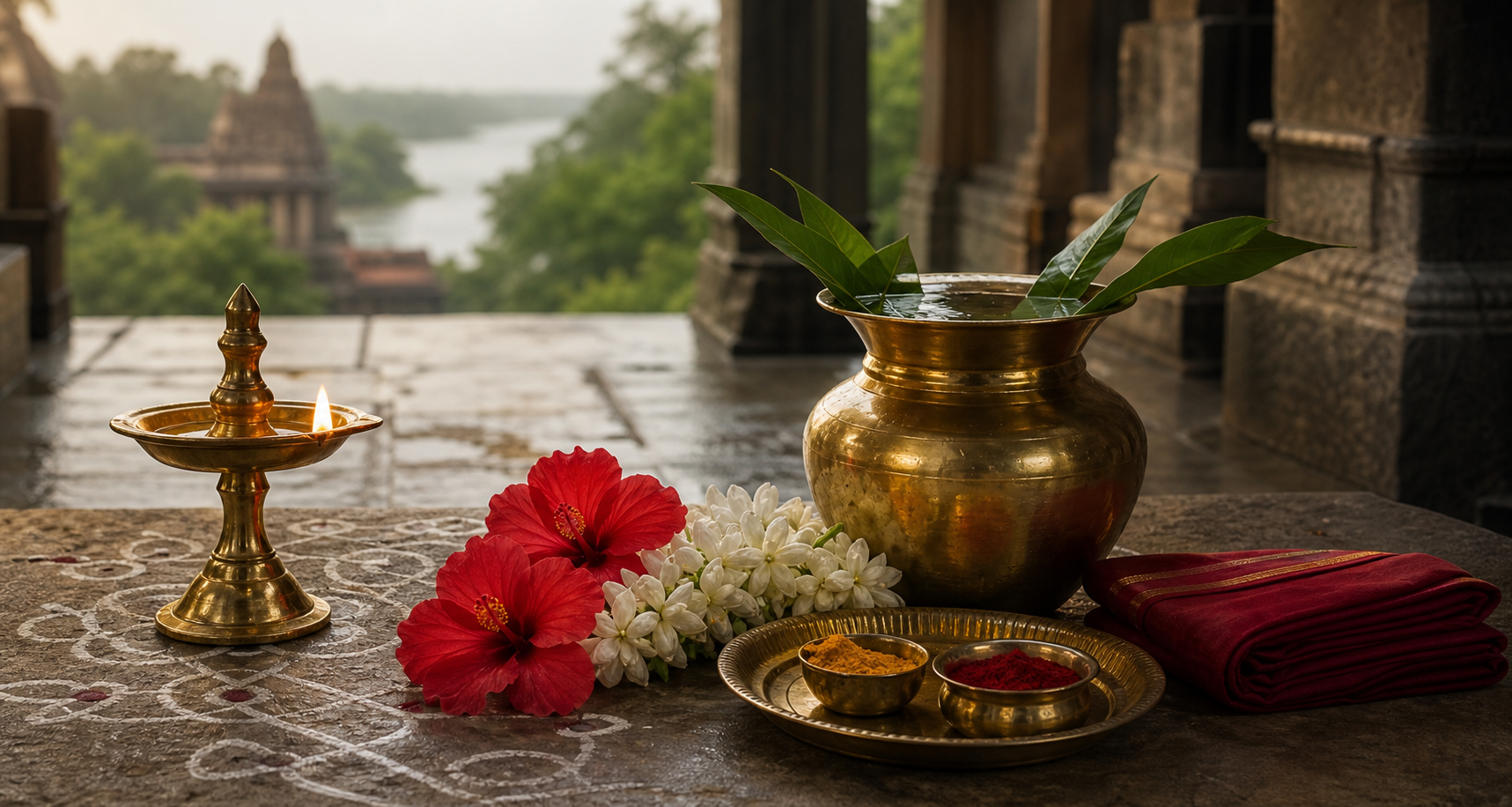
If you are arranging temple visits, family rites, work leave, or travel for Aadi in 2026, separate the fixed dates from the observances that depend on your location. In Tamil Nadu, Aadi runs from Friday, 17 July, through Monday, 17 August 2026, a span of 32 days in IST. The opening day is itself a Friday, so Aadi Pirappu and the first Aadi Velli coincide.
The simplest way to observe the month well is to give each part its proper place: a manageable weekly Devi practice, gratitude to water on Aadi Perukku, remembrance of ancestors on Aadi Amavasai, and local confirmation for nakshatra-based temple festivals. You do not need to make every day elaborate. You do need to know which dates should not be guessed.
Put these Aadi 2026 dates on your calendar first
Aadi is a Tamil solar month rather than a lunar month. Its astronomical beginning is Karkadaka Sankranti, when the Sun moves from Mithuna Rashi into Karkataka Rashi in the nirayana, or sidereal, system used by Tamil panchangams. Community observance is generally aligned with the first sunrise of the new month, which places Aadi Pirappu on 17 July in Tamil Nadu. The precise ingress, tithi, and nakshatra boundaries can vary with location and panchang method, however.
If you live outside India, do not simply treat midnight IST as the start of every local observance. The fixed civil dates below are a sound planning framework, but your nearest Tamil temple or trusted regional panchang should settle local ritual timing, especially for Aadi Amavasai, Aadi Pooram, and Aadi Krithigai.
| Observance | 2026 date | Devotional focus | What you need to plan |
|---|---|---|---|
| Aadi Pirappu | Friday, 17 July | Opening of Aadi and Devi worship | It is also the first Aadi Velli |
| Aadi Velli | 17, 24, and 31 July; 7 and 14 August | Durga, Mariamman, Andal, and the Divine Feminine | Choose one sustainable Friday practice for all five weeks |
| Aadi Chevvai | 21 and 28 July; 4 and 11 August | Mariamman worship for health and protection | Check the schedule of the Amman temple you intend to visit |
| Aadi Perukku | Monday, 3 August | Gratitude for rivers, rainfall, food, and livelihood | Choose a safe and lawful place near water, or plan a modest home observance |
| Aadi Amavasai | Wednesday, 12 August | Remembrance of ancestors and pitru rites | Confirm local tithi and eclipse-related instructions before fixing the ritual time |
| Aadi Pooram | Confirm locally | Andal Jayanti and Vaishnava bhakti | Use the published schedule of your temple or regional panchang |
| Aadi Krithigai | Confirm locally | Murugan worship | Use the local Krithika nakshatra and temple schedule |
| Final day of Aadi | Monday, 17 August | Completion of the month | Conclude any month-long discipline according to your family custom |
Key takeaways
- Save the five Aadi Vellis, four Aadi Chevvais, Aadi Perukku, and Aadi Amavasai now; those dates can anchor your household plan.
- Ask your local temple to confirm Aadi Pooram and Aadi Krithigai. Both depend on nakshatra timing, so a date copied from another city may be wrong for your observance.
- Choose a Friday vrata or puja that you can repeat five times. Consistency will serve you better than an elaborate first Friday followed by four neglected ones.
- For Aadi Amavasai, confirm both the local tithi window and any eclipse instructions. Do not infer ritual rules from the Gregorian date alone.
- Marriages, griha-pravesha, and lavish celebrations are generally deferred during Aadi, while puja, charity, temple participation, and remembrance of ancestors are encouraged.
Use the five Fridays to build a practice you can sustain
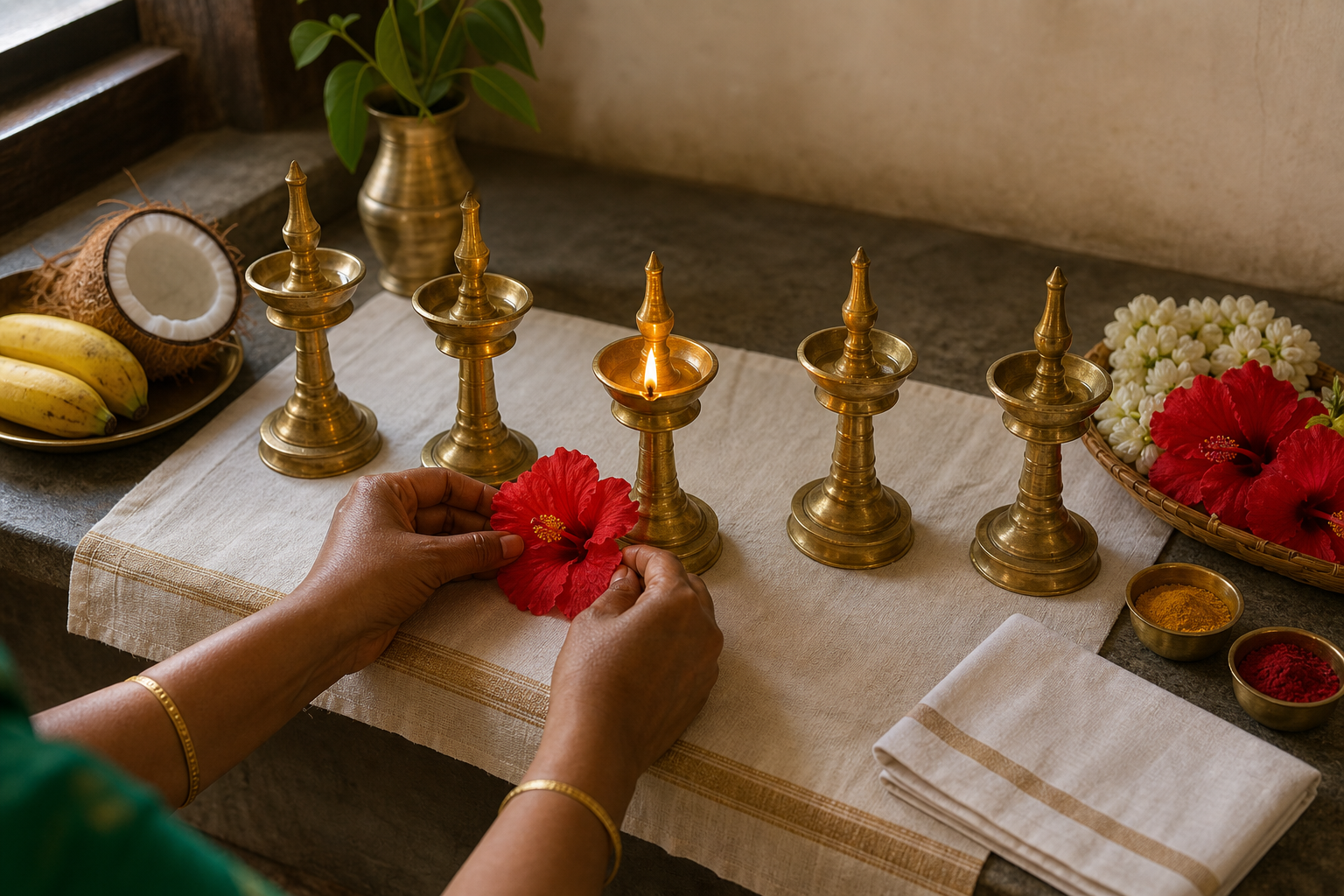
There are five Aadi Vellis in 2026: 17, 24, and 31 July, followed by 7 and 14 August. Because the first Friday is also Aadi Pirappu, it is the natural day to make your intention for the month. Keep that intention narrow enough to honor every week.
A manageable home observance
Your household may already have an inherited sequence of worship. Follow it. If it does not, a restrained observance is more appropriate than assembling an unfamiliar ceremony from fragments. A practical weekly rhythm can look like this:
- On Thursday evening, set aside what you will actually use: a clean lamp, new rice or ingredients for sweet pongal, flowers if available, and turmeric and kumkum where these belong to your custom.
- On Friday, clean the worship space and light the lamp in a stable, attended place. Offer your prayer, japa, or familiar Devi stotra to the form of the Goddess worshipped in your home.
- Prepare sweet pongal or another simple offering consistent with your family practice. Avoid turning the day into a display that creates waste or burdens the household.
- Choose one repeatable vrata: a sattvic meal, a visit to an Amman temple, a simple Devi puja, or another discipline already understood in your sampradaya.
- If your family observes sumangali puja or exchanges turmeric and kumkum, arrange it according to local and family custom rather than assuming it is compulsory for every devotee.
- On 14 August, the fifth Aadi Velli, consciously complete the sequence with gratitude. If you made a specific vow, conclude it in the manner taught by your family elder, priest, or temple.
The five Fridays form a devotional arc. The first establishes the vrata; the middle weeks test whether it has become part of your life; the final Friday provides a clear point of completion. If your work or caregiving responsibilities make a long puja unrealistic, shorten the external form without abandoning the weekly appointment.
Give Aadi Chevvai its own place
The Tuesdays of Aadi fall on 21 and 28 July, and 4 and 11 August. Many communities direct these days toward Mariamman, with prayers for health and protection. A lamp, familiar prayer, or temple visit is enough when that is the scale of your household practice.
Some Amman temples conduct larger Aadi festivals, including Theemithi. Fire-walking is a specialized communal vow with serious burn risk, not a home activity to reproduce independently. If you are participating through a temple, follow its eligibility, preparation, crowd-control, and safety instructions exactly. You can attend in devotion without undertaking the fire-walking vow yourself.
Let Aadi Perukku change how you relate to water
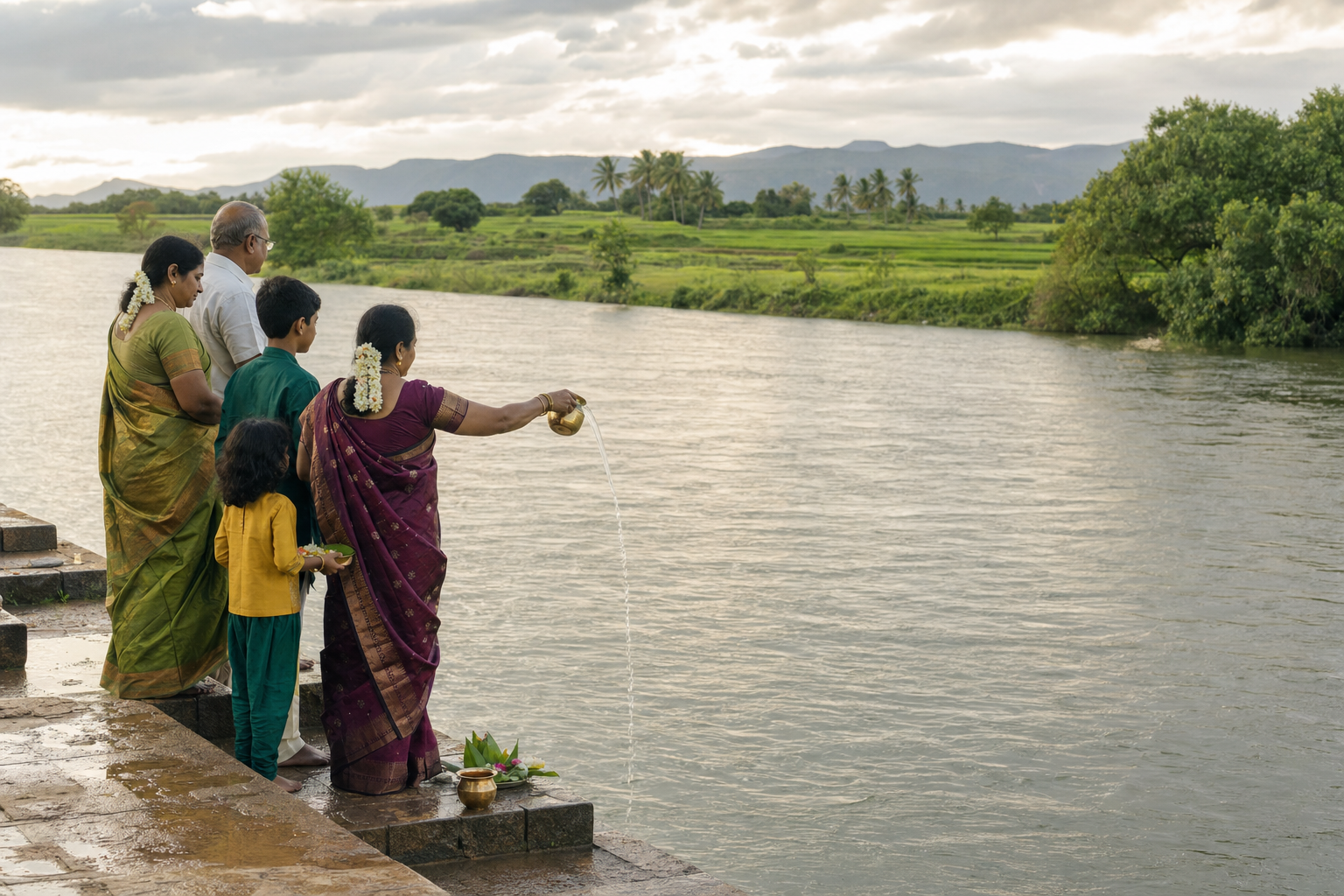
Aadi Perukku, or Padinettam Perukku, is the eighteenth day of Aadi. In 2026 it falls on Monday, 3 August. Its setting is the monsoon world of swelling rivers, cultivation, and communities whose food and livelihoods depend on reliable water. The heart of the day is gratitude, not spectacle.
If you are going to the Kaveri or another river, plan for conditions as they are, not as a photograph makes them look. Monsoon-fed water and unstable banks can be dangerous. Stay out of floodwater, obey closures and barriers, keep children within reach, and do not place a lamp where flame, wind, or dry vegetation creates a hazard.
- Choose the water body in advance and check whether access, offerings, or lamps are restricted there.
- Take only what you can carry away again. Flowers, prasadam, and a lamp may be customary, but packaging, foil, plastic, oil containers, and spent wicks should not be left on the bank or released into the water.
- Offer gratitude for rainfall, drinking water, crops, food, and the labor that carries them into your household. Include a prayer for stable livelihoods and ecological balance.
- Pair reverence with one concrete act of seva: help clean the site, reduce avoidable water waste at home, or support a responsible local effort that protects a water body.
- Share prasadam without leaving disposable material behind. Before you leave, look back at the place and make sure your worship has not become someone else’s cleanup.
If you live far from a river, you do not need to manufacture a false riverbank ritual. You can place clean water in the worship space, offer flowers nearby rather than putting objects into the water, give thanks for the watershed that sustains your city, and make a practical water-conservation commitment. This is not a claim that a home gesture replaces every formal river custom. It is a way to preserve the day’s ethical center when geography prevents the customary setting.
Aadi Perukku asks you to notice a relationship that modern plumbing can hide: water reaches the home through rivers, rainfall, soil, infrastructure, ecosystems, and human work. A clean riverbank after worship is part of the offering.
Handle Aadi Amavasai and the star days with local care

Aadi Amavasai in 2026 falls on Wednesday, 12 August. It is a day for pitru tarpanam, charity, and quiet remembrance of ancestors. In Kerala, the same day is observed as Karkidaka Vavu, which can matter when a family follows customs from both sides of the Tamil Nadu-Kerala cultural region.
The new moon also coincides with a solar eclipse on 12 August. Local visibility and the ritual instructions followed in Tamil Nadu may vary. That makes this a year in which you should not rely on a generic date graphic or assume that every temple will use the same schedule.
- Check a panchang calculated for your location, then compare it with the schedule of the temple or priest whose tradition you follow.
- Ask specifically for the applicable Amavasya tithi window and whether local eclipse visibility changes temple hours, food practices, or the timing of tarpanam in your sampradaya.
- If tilodaka tarpanam is part of your inherited practice, follow the method taught by your family or officiating priest. The rite has lineage-specific details that should not be reconstructed from a short checklist.
- Prepare the practical information your family practice requires, including the names of ancestors to be remembered, before the ritual begins.
- If you do not perform formal tarpanam, you can still keep the day through respectful remembrance, charity, and quiet prayer without pretending to conduct a rite you have not been taught.
The essential distinction is between the date and the ritual window. The Gregorian date helps you reserve the day; the local tithi, eclipse circumstances, and sampradaya determine what you actually do and when.
Why Aadi Pooram and Aadi Krithigai need confirmation
Aadi Pooram is tied to the Pooram, or Purva Phalguni, nakshatra within Aadi. It honors Andal and is celebrated prominently at Srivilliputtur, Srirangam, and other Vaishnava kshetras through abhishekam, alankara, and devotional recitation, including Tiruppavai. Aadi Krithigai is tied to Krithika nakshatra and centers on Subrahmanya or Murugan, with temple abhishekams, deepa alankaram, processions, japa, vrata, and visits to hill shrines.
Neither star day should be assigned merely by counting forward from 17 July. Nakshatras can begin or end across civil midnights, and temples may apply local sunrise-based reckoning. For Aadi Pooram and Aadi Krithigai in 2026, use the date published by the temple you will actually attend. This is especially important before booking travel to a major kshetra.
Decide now what to defer and what to begin
Calling Aadi simply an inauspicious month misses its character. Tamil households generally defer weddings, griha-pravesha, and lavish life-cycle celebrations, yet the calendar becomes fuller with Devi worship, river reverence, temple festivals, charity, and remembrance of ancestors. Aadi redirects attention; it does not ask you to withdraw from dharmic life.
If a wedding or housewarming is under discussion, raise the Aadi dates before deposits, invitations, or travel commitments make the decision difficult. The custom is general rather than a substitute for your family’s own rules, so settle the matter with the elders, priest, or temple authority whose calendar you follow. If an event is already fixed, seek that guidance instead of assuming either that the date is acceptable or that cancellation is automatically required.
For the observances you want to keep, make the month concrete:
- Before 17 July, enter all five Fridays, all four Tuesdays, 3 August, and 12 August in your calendar.
- Choose one weekly Aadi Velli discipline and obtain only the supplies needed to repeat it.
- Contact your local temple for its Aadi Pooram, Aadi Krithigai, and Aadi Amavasai schedule. If you will travel, confirm before purchasing tickets.
- Decide whether Aadi Perukku will be observed at a river, another permitted water body, or at home, and plan for safety and cleanup.
- Ask about eclipse-related guidance well before 12 August, particularly if formal tarpanam or a temple visit is part of your Amavasai observance.
- Tell the rest of the household what you have committed to. A shared calendar prevents one person’s vrata from becoming an unexpected burden for everyone else.
Start with the two decisions that unlock the rest: put the fixed dates in your calendar, then contact the temple or family authority who can settle the location-sensitive ones. By the time Aadi Pirappu arrives on Friday, 17 July, you will be ready to worship with steadiness rather than trying to solve the entire month on its first morning.
References
