
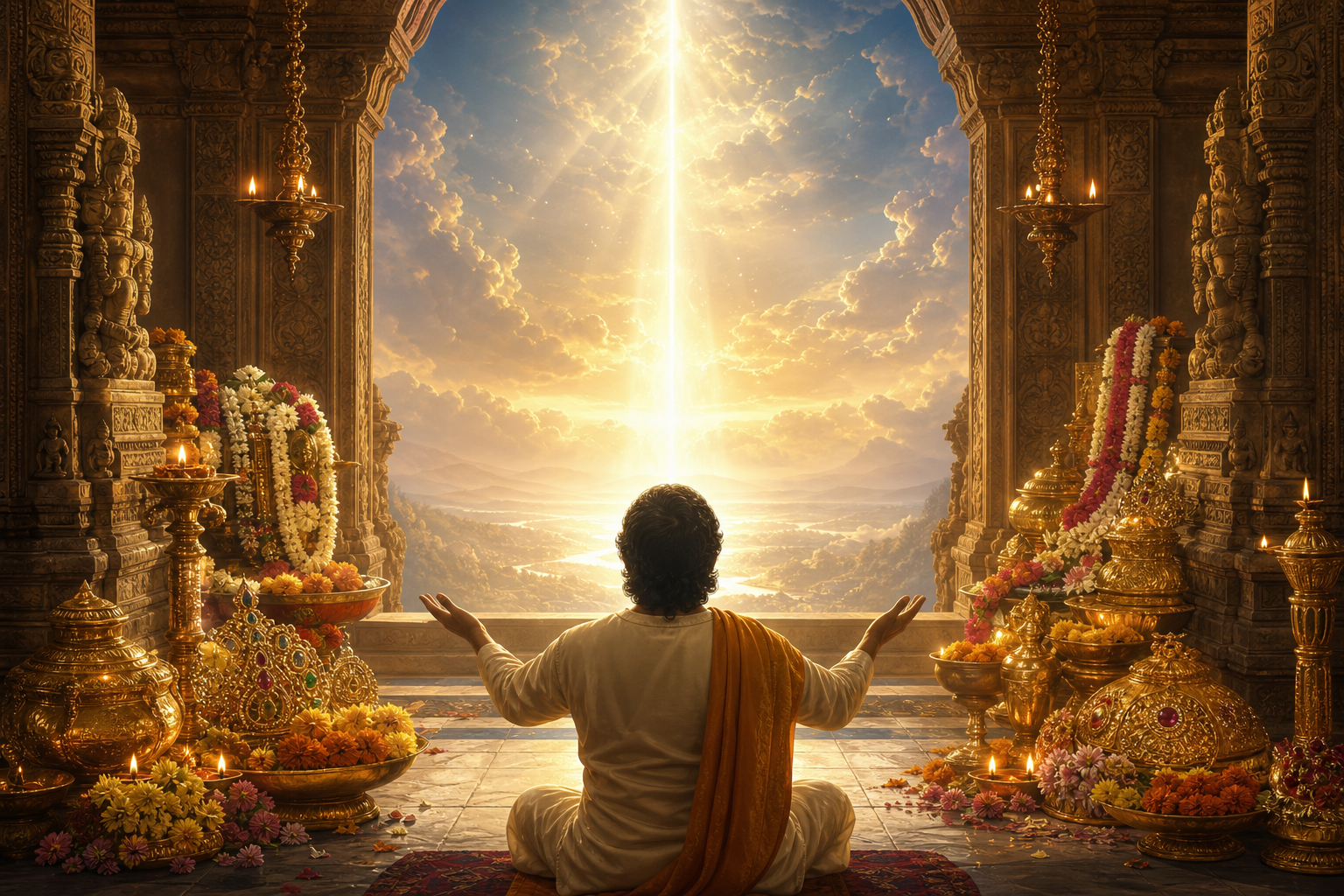
You may admire a gold-lit sanctum and still wonder whether its splendour contradicts the call to non-attachment. If moksha frees you from grasping, why are Bhagavan’s abodes, ornaments and festivals so often imagined through gold, jewels and inexhaustible abundance?
You don’t have to choose between condemning wealth and worshipping it. The tension clears when you separate the object, your relationship to it and the spiritual destination it serves. Gold can be an offering without becoming an obsession. Beauty can steady attention without becoming the goal. A celestial reward can be magnificent and still fall short of moksha.
Divine splendour expresses fullness, not unmet need
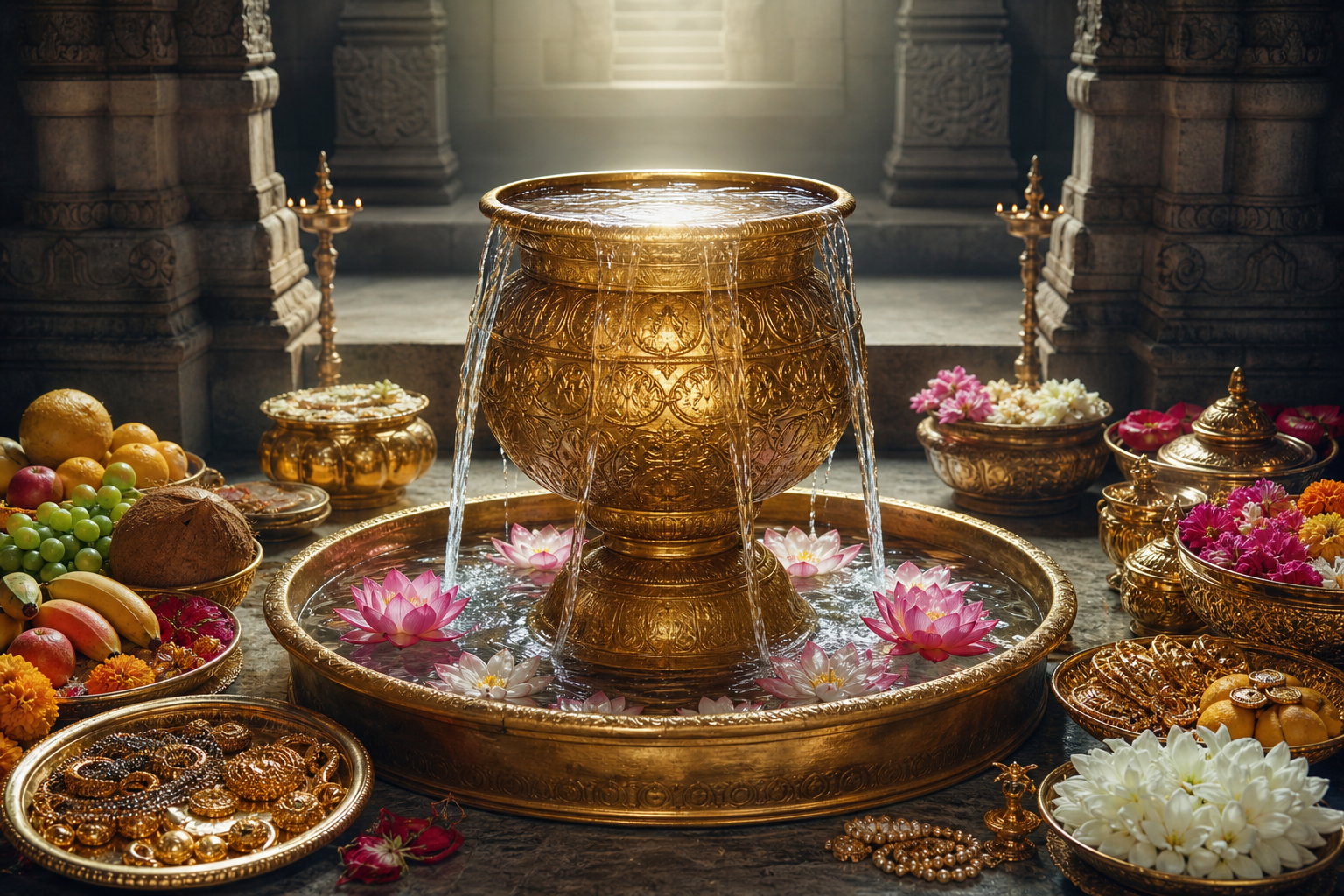
The first mistake is to imagine a deity’s ornaments as compensation for some deficiency. Human beings often accumulate because we feel incomplete, insecure or eager to establish rank. Divine opulence works in the opposite direction. It presents a reality already complete. The Sanskrit vocabulary of aiśvarya and śrī points toward sovereignty, auspiciousness, beauty and radiant order, not a divine appetite for luxury.
This reverses the ordinary relation between wealth and its possessor. A person may hope that an expensive object will confer importance. Bhagavan’s adornment does not confer divinity upon Bhagavan. The divine presence gives the ornament its sacred orientation. Lakṣmī is therefore not a theological licence for acquisitiveness. She embodies auspicious flourishing when material life remains aligned with dharma.
Attachment is not a chemical property of gold. It is a relationship marked by clinging, identification and dependence: I need this possession, status or experience in order to be whole. A plain begging bowl can be guarded possessively, while a costly ornament can be offered without a claim of personal ownership. The material alone does not settle the spiritual question.
When you encounter sacred wealth, use three tests:
- What is being revealed? Look for the qualities communicated by the image: luminosity, sovereignty, purity, permanence, generosity or cosmic order.
- What is being offered? Ask whether material resources are being placed in the service of worship, community, preservation and remembrance, or merely displayed for private status.
- What is being produced in you? Notice whether the encounter leads toward reverence, gratitude and generosity, or toward envy, price-consciousness and the desire to possess.
The third test is especially important for practice. A symbol can have a sound theological meaning while you react to it unskillfully. That is not a reason to discard the symbol. It is a reason to examine the reaction. Darśana gives you an opportunity to see both the divine form and the movement of your own mind.
Svarga is splendid, but splendour is not moksha

The English word heaven can conceal several distinct Dharmic ideas. Svarga is a paradisal condition obtained through merit. Its enjoyments may be extraordinary, but they remain within time, karma and eventual return. The Bhagavad Gītā therefore treats merit-born celestial enjoyment as finite rather than liberating. Pleasant karma is still karma when its result must be consumed.
Vaikuṇṭha in Vaiṣṇava traditions and Kailāsa in Śaiva traditions should not simply be collapsed into Svarga. Their splendour is associated with divine presence and eternal glory, not merely with an upgraded version of consumer pleasure. Interpretations differ across sampradāyas, but the imagery is meant to disclose a sacred order centred on the Lord, not a luxury resort centred on the devotee’s appetites.
| Image or goal | Dharmic function | Mistake to avoid | Your practical response |
|---|---|---|---|
| Sacred ornament in a temple or home shrine | Offers beauty and material means to the divine | Assuming expense proves holiness, or that ornament automatically proves greed | Judge its intention, stewardship and effect on conduct |
| Svarga | Represents the pleasurable fruit of merit | Confusing a desirable karmic result with freedom from karma | Perform good action without making celestial enjoyment your final aim |
| Vaikuṇṭha or Kailāsa | Expresses divine presence, sovereignty and inexhaustible glory within particular traditions | Reducing the divine domain to material consumption on a larger scale | Read the splendour through the theology of the relevant sampradāya |
| Moksha | Freedom from cyclical bondage | Thinking any finite possession or pleasurable state can manufacture liberation | Orient worship, knowledge, conduct and surrender toward freedom from grasping |
This distinction also prevents a common spiritual bargain: I will be virtuous now so that I can consume without limit later. Such a bargain may restrain harmful conduct, but it has not yet transformed desire. Moksha is not infinite shopping with a divine address. It is freedom from the bondage that makes possession, loss and reward the measure of the self.
The major Vedānta traditions explain opulent imagery differently, and those differences should be respected. Advaita Vedānta places forms, ornaments and celestial environments within vyavahāra, the empirical order in which instruction and worship operate. The fullness of the Self is pāramārthika, or absolute. Sacred form can therefore guide the mind toward a realization in which no object supplies what the Self supposedly lacks.
Viśiṣṭādvaita and Dvaita do not require you to dismiss the Lord’s beauty as a disposable illusion. Divine palaces, jewels and ornaments can express īśvara’s real majesty and auspicious perfection. The devotee does not have to see through divine beauty as though it were a mistake. Beauty can be an enduring mode of communion with Bhagavan.
The shared practical conclusion is narrower but firm: finite acquisition does not produce moksha. Advaita may emphasize the transcendence of form, while devotional schools may affirm eternally meaningful divine form. Neither position makes personal accumulation the measure of liberation. Before interpreting a sacred image, identify the tradition speaking. Do not use an Advaitic phrase such as mere appearance to dismiss Vaiṣṇava or Śaiva theology, and do not turn devotional descriptions into promises of limitless material gratification.
Gold, gems and beauty train attention when you read them well

Gold speaks first as light
Modern economic life trains you to see gold first as a price, asset or status marker. Sacred language often asks you to see light before market value. Hiraṇyagarbha, the golden origin of the cosmos, evokes radiant generativity. The Upaniṣadic image of a golden covering before the face of truth uses the same material with a different force: brilliance can reveal, but it can also fascinate the eye and veil what lies beyond it.
That double meaning is useful. A sacred symbol is neither worthless nor self-sufficient. It catches your attention and then asks you to look through its surface. If you stop at the metal, you have received the appearance but missed the instruction.
Viṣṇu’s Kaustubha jewel, arising in the Samudra Manthana narrative, can be contemplated as a sign of pure consciousness and the polished qualities of discernment and compassion. Lakṣmī’s radiance directs prosperity toward auspicious order. These associations are contemplative openings, not a rigid code in which every gem always has one dictionary meaning. Context, deity, ritual and sampradāya still matter.
Make the symbolism concrete. When you see a jewel in sacred art, ask which inner facet you are polishing. A clear gem may call your attention to discernment. A durable metal may remind you of steadiness. Radiance may become an instruction to make awareness less clouded by resentment or distraction. The question changes from What is this worth? to Which quality must become visible in my conduct?
Beauty can gather a scattered mind
Dharmic worship does not assume that the senses are enemies that must always be starved. It can discipline them by giving them a worthy object. Reflected light, fragrance, music, colour, proportion and ornament gather attention around the deity. Indian aesthetic thought describes refined experience through rasa: beauty can quiet ordinary preoccupation, enlarge the heart and prepare it for reverence.
This is why alankāra is more than decoration added after the serious religious work is complete. Agamic and Śilpa-śāstra traditions treat adornment, sacred orientation and the consecration of gems as parts of an ordered field of worship. Ratna-nyāsa and navaratna associations with the grahas place precious materials within ritual correspondences larger than personal taste. The sanctum becomes a tangible theology.
Mīmāṃsā supplies another interpretive tool through arthavāda, or purposive praise. Magnificent descriptions can awaken aspiration, gratitude and willingness to act. That does not require every tradition to treat every celestial palace as exaggeration. It means you should ask what the praise is doing as well as what it depicts. Is it motivating ethical action, intensifying devotion, conveying sovereignty or lifting the imagination beyond a cramped picture of reality?
You can test the aesthetic effect without pretending that every emotional response is spiritual. Compare your mind before and after darśana. If beauty leaves you quieter, more grateful and less self-occupied, it has helped gather the senses toward dharma. If you leave calculating prices, comparing donors or desiring social prestige, the same setting has exposed an attachment that needs work. Both observations are useful, provided you name them honestly.
A shared Dharmic grammar does not erase doctrinal differences
Jewelled imagery appears beyond Hindu traditions because opulence can communicate more than possession. The traditions do not thereby teach one identical metaphysics. They use a related visual grammar for distinct soteriological purposes:
- Mahāyāna Buddhism: Indra’s net presents jewels reflecting every other jewel, turning preciousness into an image of interdependence rather than isolated ownership. Pure Land descriptions of jewel trees and radiant lakes can function as upāya, or skillful means, drawing attention toward virtue, mindfulness and the vow for awakening.
- Jain dharma: Magnificent deva-lokas belong to particular karmic states, but even celestial enjoyment remains below the liberation embodied by the Tīrthaṅkaras. Right knowledge, faith and conduct culminate in non-attachment, not residence in a splendid palace.
- Sikh dharma: The priceless jewel of Naam exceeds material treasure. The gilded sanctity of the Harmandir Sahib can honour the Divine while remembrance, humility and seva prevent outward splendour from becoming the final measure of devotion.
The useful comparative question is not whether all Dharmic religions secretly say the same thing. Ask three more precise questions: What pedagogical work does the beauty perform? What does this tradition identify as the highest goal? Which form of attachment must be relinquished? That approach reveals a family resemblance without flattening genuine differences.
Turn sacred splendour into a discipline of giving and restraint
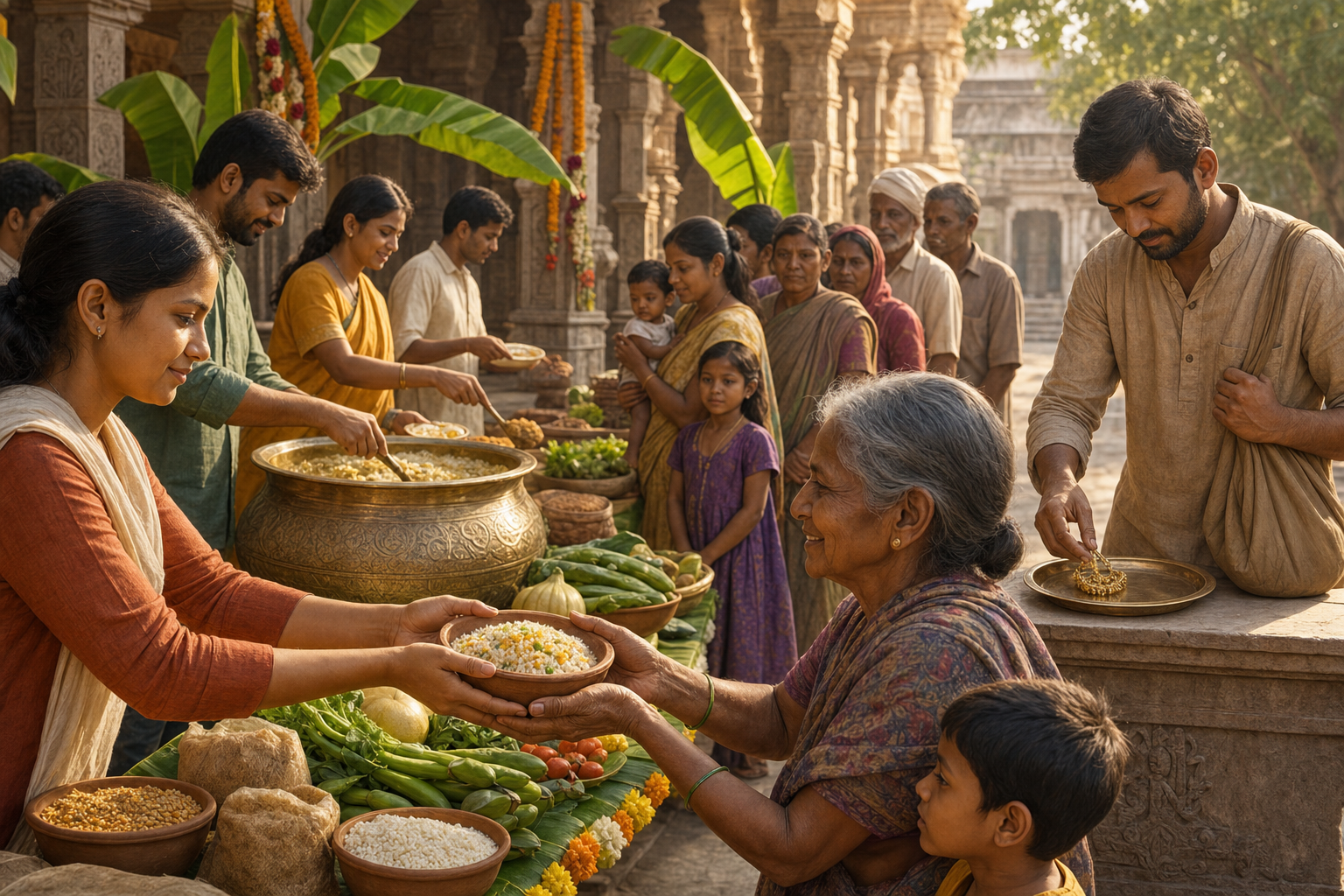
An interpretation that never changes conduct is only an ornament of the intellect. The decisive move is to carry sacred abundance out of the temple as a different relationship with attention, possessions and other people.
Use this practice at your next darśana
- Set your intention before looking closely. Use one plain sentence: May this beauty turn my mind toward its source rather than toward possession. This gives the senses a direction before visual comparison begins.
- Receive the whole arrangement. Pause for three unhurried breaths. Notice the deity, light, flowers, textiles, metalwork and the order joining them. Do not begin by estimating expense or isolating the most valuable object.
- Translate one visual quality into one virtue. Let radiance mean clarity, durability mean steadiness, symmetry mean balance or a jewel’s facets mean wisdom, compassion and courage. Choose only one quality so the contemplation remains usable.
- Name your actual reaction. It may be awe, gratitude, tenderness, distraction, envy, resentment or acquisitiveness. Do not condemn the reaction, but do not baptize craving as devotion merely because it arose in a temple.
- Make an appropriate offering. Offer attention, prayer, skill, time or money according to your circumstances. If money is involved, decide what you can give without neglecting dependants, essential needs or existing obligations. Religious emotion does not turn financial imprudence into renunciation.
- Carry out one vow before the day ends. Feed someone, complete a neglected duty, refrain from an unnecessary purchase, spend time in japa, help preserve a sacred space or give useful service. The symbol has reached its purpose when it changes the way you live.
This sequence prevents two opposite errors. You need not reduce the sanctum to its construction budget, and you need not pretend that admiration is automatically transformative. You receive the beauty fully, examine what it awakens and give the experience an ethical consequence.
Apply the same test to your own wealth
Artha is a legitimate material means within a dharmic life, but it cannot safely govern itself. Dāna, annadāna, education, service and the preservation of cultural memory are ways in which resources move from private control toward shared flourishing. Use this five-part audit on a significant purchase, treasured possession or giving decision:
- Acquisition: Was the wealth obtained through conduct you can defend as dharmic, or did deceit, exploitation or vanity shape the choice?
- Function: Does the object meet a real responsibility, support beauty and worship, serve another person or mainly advertise rank?
- Grip: If circumstances required you to surrender it, would you experience ordinary disappointment or the collapse of your identity? The second response reveals that the possession has begun to possess you.
- Flow: Does some part of your material capacity move outward through generosity and service, or does everything terminate in personal accumulation?
- Aftereffect: Does the way you use wealth make you more dependable, grateful and free, or more anxious, comparative and demanding?
The aim is not to impoverish your household or cultivate deliberate ugliness. Some paths emphasize severe austerity; others honour Bhagavan through elaborate beauty. Neither a bare room nor a jewelled altar proves non-attachment by itself. The better evidence is whether you meet your duties, give without theatricality and remain inwardly capable of letting go.
The same moral standard applies to institutions. Temple opulence is not self-justifying simply because it is sacredly labelled. Consecrated objects, donations and cultural treasures should be treated as a trust. Ritual purpose, preservation, honest stewardship, feeding, education and service can coexist with alankāra. Misuse should be corrected directly, but misuse does not prove that sacred beauty is inherently corrupt.
Watch for four recurring misreadings:
- High price equals high sanctity. Correction: price can purchase material, not devotion, realization or ethical integrity.
- Renunciation requires contempt for beauty. Correction: beauty can become a disciplined means of recollection when you do not demand ownership.
- A spiritual setting makes every desire spiritual. Correction: craving remains craving until it is understood and redirected.
- Divine abundance promises personal abundance. Correction: sacred splendour reveals divine fullness; it does not guarantee that your preferred possessions will arrive.
A useful final test is simple: follow the movement of attention. If beauty moves your attention from the object to Bhagavan, from Bhagavan to dharma and from dharma into compassionate action, it is functioning as a ladder. If attention circles back to status and acquisition, you are still standing on the first rung.
Key takeaways
- Divine ornaments signify fullness, sovereignty and auspicious beauty; they do not imply that Bhagavan needs material completion.
- Svarga is a finite result of merit and should not be confused with moksha, which lies beyond cyclical reward and return.
- Vaikuṇṭha and Kailāsa belong to particular Vaiṣṇava and Śaiva theologies and cannot be reduced to luxurious versions of ordinary consumption.
- Advaita, Viśiṣṭādvaita and Dvaita interpret divine form differently, but none makes personal accumulation the cause or proof of liberation.
- Gold and gems can train attention through luminosity, order, rasa and offering, but their spiritual value is tested by the reaction and conduct they produce.
- Your wealth serves dharma when it supports responsibility, worship, generosity, community and freedom from possessiveness.
At your next darśana, don’t stop at asking how much gold you can see. Ask what the splendour is teaching your eyes to value. Then give the encounter a visible consequence before the day ends: fulfil a duty, restrain a needless desire, offer food, preserve something sacred or spend time in remembrance.
When splendour ends in steadiness, generosity and less grasping, it has pointed beyond itself. That movement from beauty to offering, and from offering to freedom, is where divine opulence meets moksha.
References
