
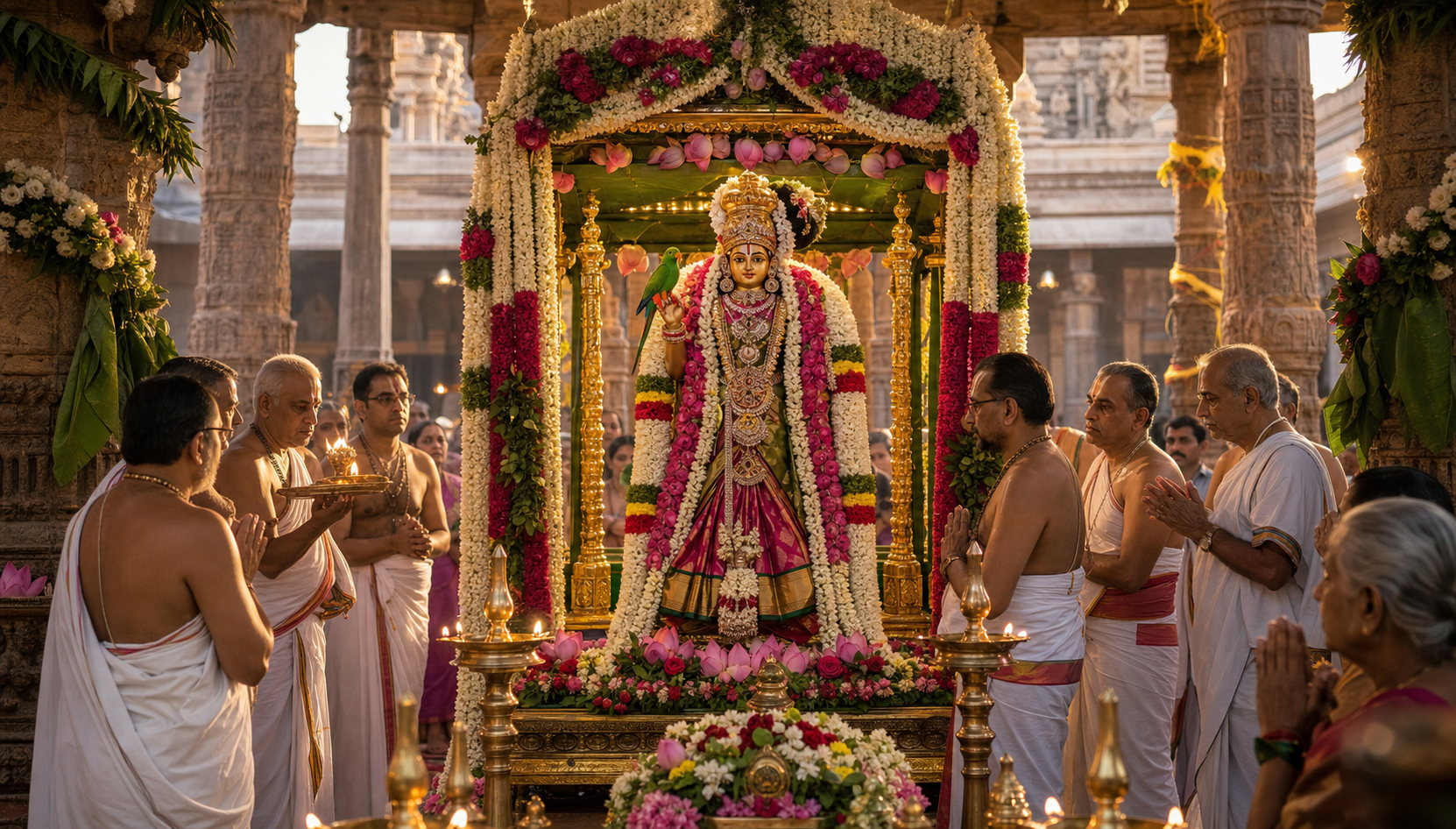
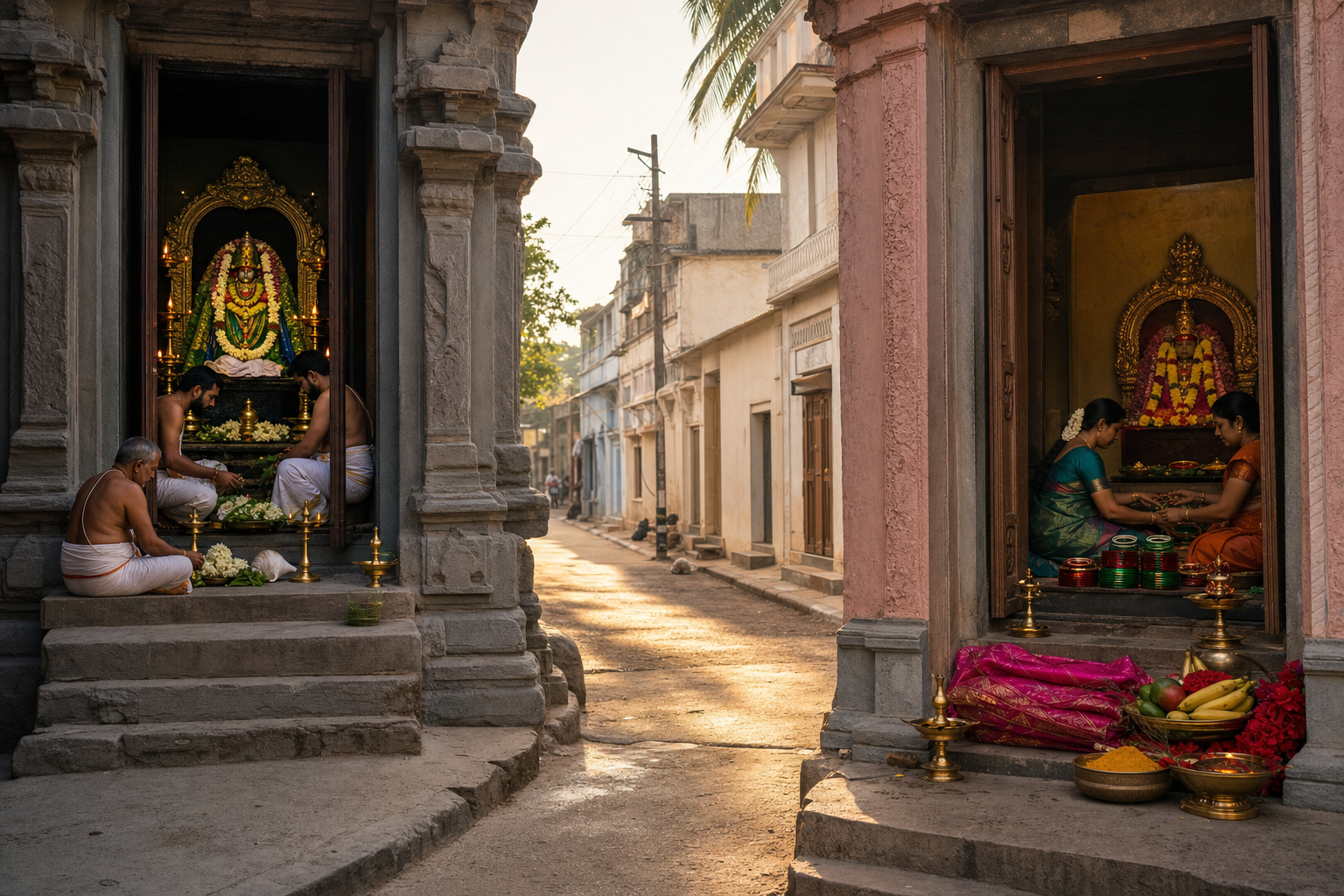
Your calendar says Aadi Pooram, a Vaishnava temple announces Andal Thirunakshatram, and an Amman shrine nearby is preparing Valaikappu. You may reasonably wonder whether these are different festivals, or whether several traditions are observing the same sacred day in their own ways.
Here is the practical answer. For Sri Vaishnavas, Aadi Pooram is Andal Jayanti: the celebration of Andal’s birth star in the Tamil month of Aadi. Many Shaiva-Shakta communities observe the same calendar occasion in honour of Ambal. You do not have to blend the two liturgies. Confirm the local Pooram timing, follow your family or temple sampradaya, and build the day around recitation, offering, darshan, and seva.
First identify the observance on your temple calendar
Aadi Pooram is determined by the Pooram, or Purva Phalguni, nakshatra occurring during Aadi Masam. Aadi is a Tamil solar month associated with the Sun’s entry into sidereal Karka, or Cancer, while the festival itself is fixed by the Moon’s passage through Pooram. It is therefore a nakshatra-based observance rather than a tithi-based one.
That distinction matters when you choose a date. A general calendar may display one civil date, but a temple may use the nakshatra prevailing at sunrise or follow another locally established panchang convention. The Pooram interval also changes with longitude and time zone. If your family lives outside India, do not automatically copy the Tamil Nadu date: use the announcement from a nearby temple or a panchang calculated for your location.
In Tamil Nadu, Aadi Pooram in 2026 falls on Friday, 14 August. Overseas observances may differ by a day because the Pooram window is local. The Friday occurrence also places the 2026 festival within the devotional atmosphere of Aadi Velli, but the Pooram nakshatra remains the calendrical reason for Andal Jayanti.
| Context | Sacred focus | Practices you are likely to encounter |
|---|---|---|
| Sri Vaishnava temple | Andal, also revered as Goda Devi | Thirumanjanam, Andal alankaram, Divya Prabandham recitation, procession, and sometimes Andal-Ranganathar Thirukalyanam |
| Amman temple | Ambal or Parvati as the auspicious Divine Mother | Valaikappu, bangle and kumkum distribution, lamp worship, homa, and prayers for household and community well-being |
| Home or diaspora gathering | The family’s inherited Vaishnava or Shakta practice | A lamp, flowers, recitation, sattvic naivedya, arati, prasada, dana, or community service |
These expressions share a sacred date without becoming interchangeable. A Vaishnava household can centre Andal and Sriman Narayana without adding Valaikappu. An Amman temple can honour Ambal without treating its observance as Andal Thirukalyanam. Sanatana Dharma holds unity through relationship, not through the erasure of distinct forms, texts, and temple disciplines.
Two common calendar confusions are easy to avoid. Aadi Pooram is not Aadi Perukku, the Aadi 18 observance associated with rivers and agrarian abundance. Andal Jayanti is also not the Margazhi season, although Tiruppavai is central to both. Margazhi foregrounds the collective discipline voiced in Tiruppavai; Aadi Pooram commemorates Andal’s own Thirunakshatram.
Build a home observance around Andal’s own voice
If you understand who Andal is, the elements of her puja stop looking like a collection of auspicious objects. Andal is honoured as the only woman among the twelve Alvars and as the composer of Tiruppavai and Nachiyar Tirumozhi. Her poetry gives disciplined devotion and intimate longing equal theological seriousness. It does not present bhakti as decorative emotion; it makes love, surrender, remembrance, and service ways of knowing the Divine.
Andal is also remembered as Soodik-kodutta Nachiyar, the goddess who first wore the garland later offered to Perumal. That sacred memory explains why flowers carry unusual weight in her worship. You need not reproduce every temple custom at home. A fresh, respectfully prepared garland offered with attention is more fitting than an elaborate arrangement assembled only for display.
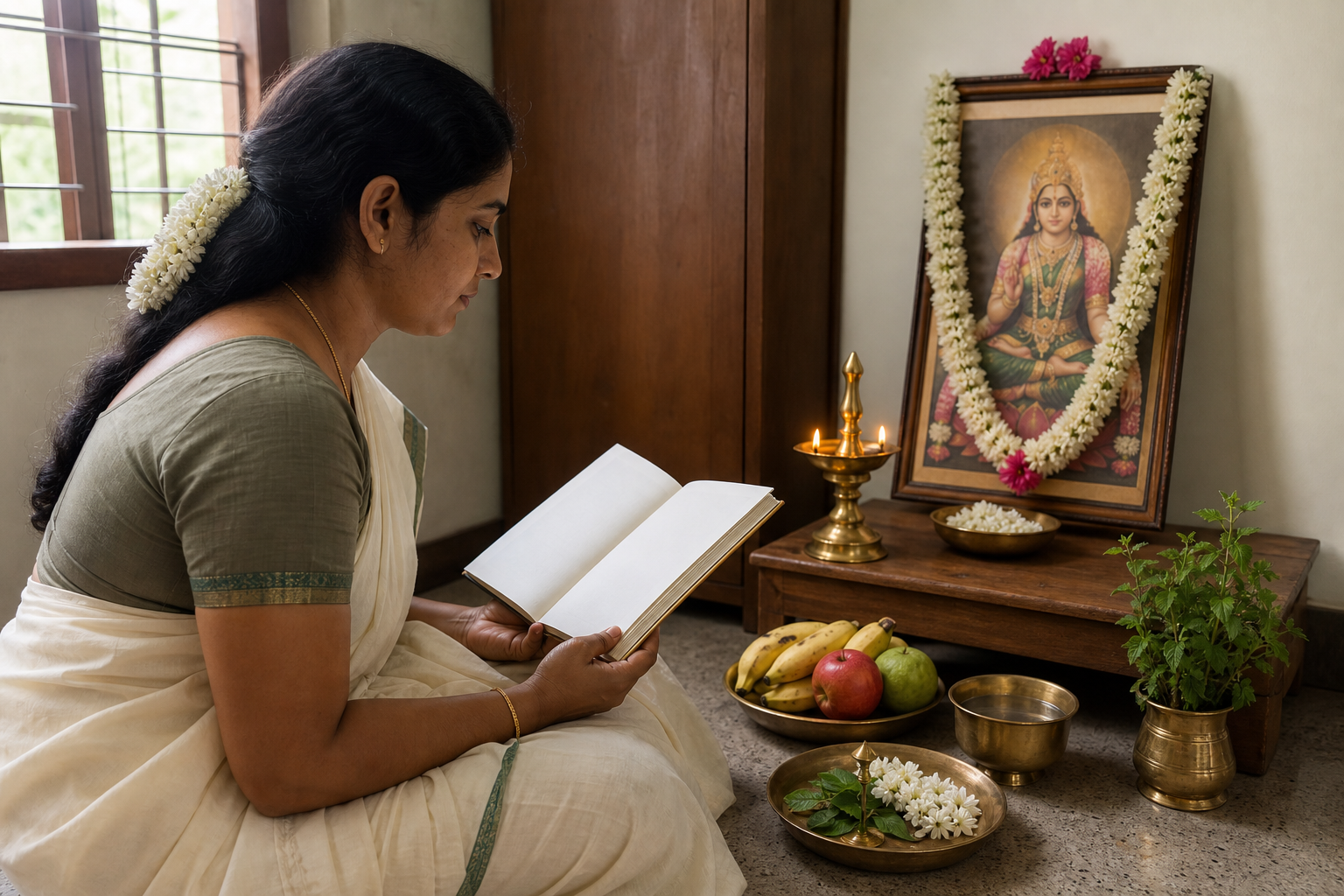
A complete household observance can follow this sequence:
- Confirm the local date. Check your temple’s notice or a regional panchang for the Pooram window. If they differ, follow the authority that governs the worship you will actually attend or perform.
- Prepare a clean worship space. Place an image or murti of Andal with Sri Vishnu, light a deepam, and keep the flowers and naivedya ready before beginning. Simplicity makes it easier to remain attentive.
- Take a clear sankalpa. State that the worship is for Andal Thirunakshatram and direct the intention toward devotion, right conduct, and the welfare of all beings. A sankalpa gives the observance a spiritual direction beyond a list of personal requests.
- Recite Andal’s words. Chant Tiruppavai and selected passages from Nachiyar Tirumozhi according to your capacity. If you are still learning Tamil pronunciation, read a meaning you understand rather than rushing through unfamiliar syllables without attention.
- Offer flowers with discernment. Jasmine and roses are customary choices for Andal. Offer tulasi respectfully to Sri Vishnu, while the flower garland adorns Andal. Follow your household achara when it gives more specific instructions.
- Prepare one sattvic naivedya well. Akkaravadisal, made with rice, milk, ghee, and jaggery, has a cherished association with Andal. Sakkarai Pongal, payasam, seasonal fruit, or another established family offering is also appropriate. You do not need several dishes to make the puja complete.
- Conclude outwardly as well as inwardly. Perform arati, sit briefly in silent prayer, distribute prasada, and connect the worship to dana, annadanam, or another concrete act of care.
A light vrata is kept in some families, but fasting is not a contest and should not displace the purpose of the day. Follow your sampradaya and your genuine capacity. Andal’s bhakti calls for steadiness and surrender, not a performance designed to impress other people.
If you cannot perform the full puja
Do not abandon the observance because you cannot reproduce a temple festival at home. Light a lamp, offer a fresh flower or fruit, recite a passage from Tiruppavai or Nachiyar Tirumozhi with its meaning, and close with a prayer for others. If even that must happen later in the day, keep the date consciously and attend a temple or community recitation when possible. The smaller practice should be coherent, not apologetic.
For a family with children, give each child one visible responsibility: arranging flowers, drawing a kolam, carrying the recitation book, or helping distribute prasada. Aadi Pooram survives across generations when children participate in its work, language, and hospitality rather than merely watching adults complete a ritual.
Plan temple darshan around the ritual rhythm
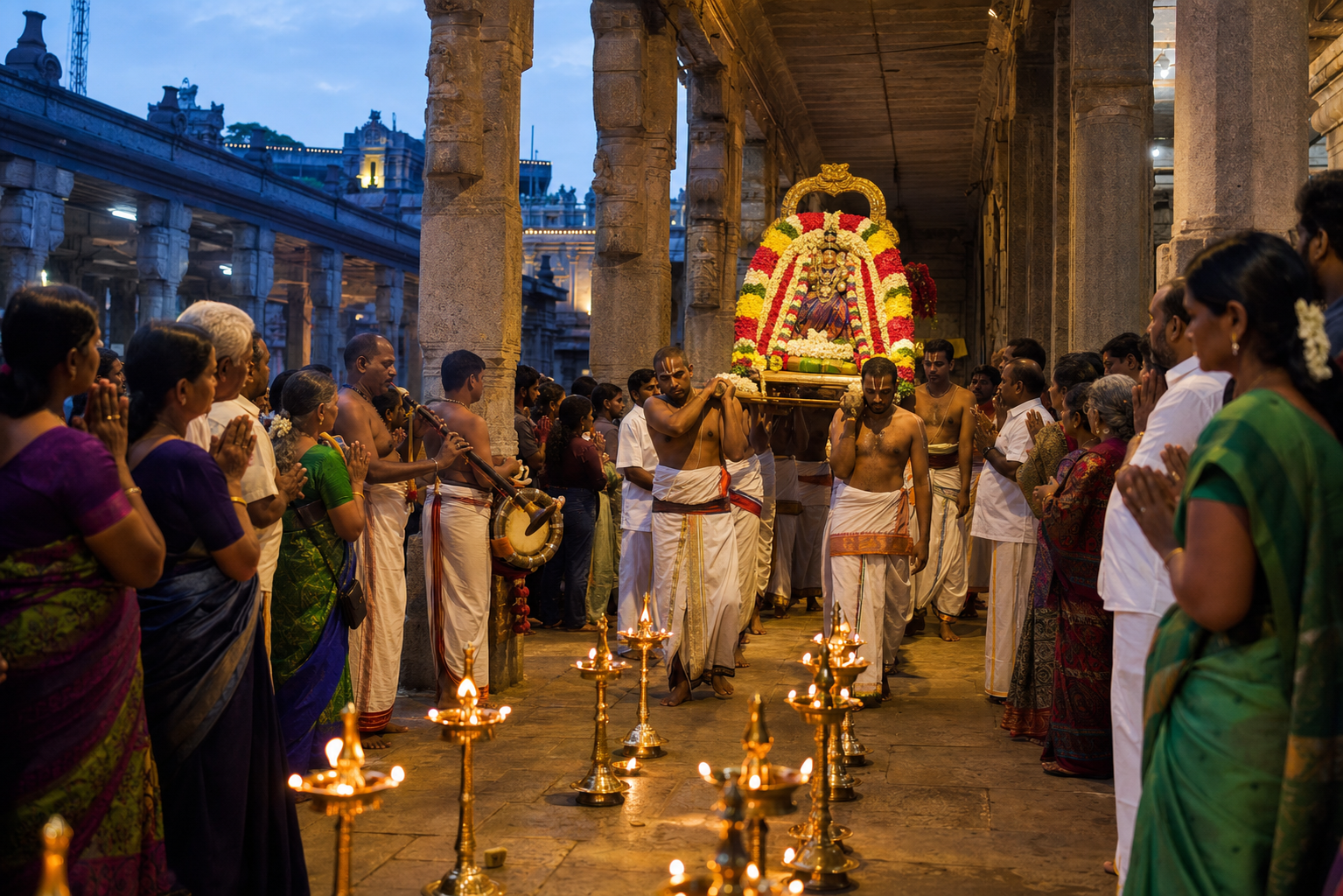
A festival visit becomes much easier when you plan around events rather than treating the entire day as one continuous darshan window. Temples commonly place Thirumanjanam and major alankaram in the morning, intersperse Divya Prabandham recitation through the programme, and schedule processions later. Andal Thirukalyanam is important in many temples, but its precise day and hour can vary. Check the local schedule before arranging transport around it.
For Srivilliputhur, divide the day into two visits
Srivilliputhur Nachiyar Temple is Andal’s birthplace shrine and a Divya Desam. Its Aadi Pooram celebration is a multi-day temple festival culminating around the Pooram observance. If this is your principal pilgrimage, arrive before dawn when feasible, prioritise the morning vishesha darshan, stay for a block of Prabandham recitation, and return for the evening procession after the heaviest daytime movement has eased.
This two-visit plan is especially useful because the festival unfolds in several spaces. The sanctum offers concentrated darshan; the mandapas carry recitation and music; the mada veedhis hold processions, kolams, flower work, and the participation of the wider town. Leaving after the morning rites and returning later is not missing the festival. It lets you encounter two different phases without exhausting elders or young children in one long queue.
- Before travelling: Verify the temple programme, procession route, and any festival traffic diversions. Srivilliputhur has a railway station with regional connections; Madurai airport is approximately 80-90 kilometres away, with road time dependent on traffic.
- At the entrance: Wear modest clothing, leave footwear in the designated place, and obey restrictions on photography. Do not assume that a crowded festival relaxes sanctum rules.
- During processions: Keep a respectful distance from the utsava murtis, remain outside the working path of archakas and bearers, and respond promptly to volunteer instructions at narrow turns.
- With elders or children: Identify shaded waiting areas before joining a long queue. Families seeking a less demanding darshan may find mid-morning or late evening more manageable, though ritual visibility depends on the published schedule.
- For water and waste: Carry water in a reusable container where permitted, avoid single-use plastic, and use designated bins. Festival cleanliness is part of protecting sacred space, not an optional civic gesture.
If you visit another Vaishnava temple, use the same planning logic without assuming that Srivilliputhur’s sequence will be copied exactly. Srirangam, Kanchipuram Varadaraja Perumal Temple, and Thiruvallikeni Parthasarathy Temple hold special observances, but local agamic practice governs the order and scale of each utsavam. The stable centre is Andal; the schedule is local.
The festival also sustains flower artisans, traditional musicians, kolam makers, food producers, and textile workers. When you buy a garland, local textile, or Srivilliputhur paalkova, choose thoughtfully and keep the transaction respectful. Supporting inherited skills is a practical form of cultural stewardship, provided consumption does not become the purpose of the pilgrimage.
Learn to read Andal’s iconography and poetry
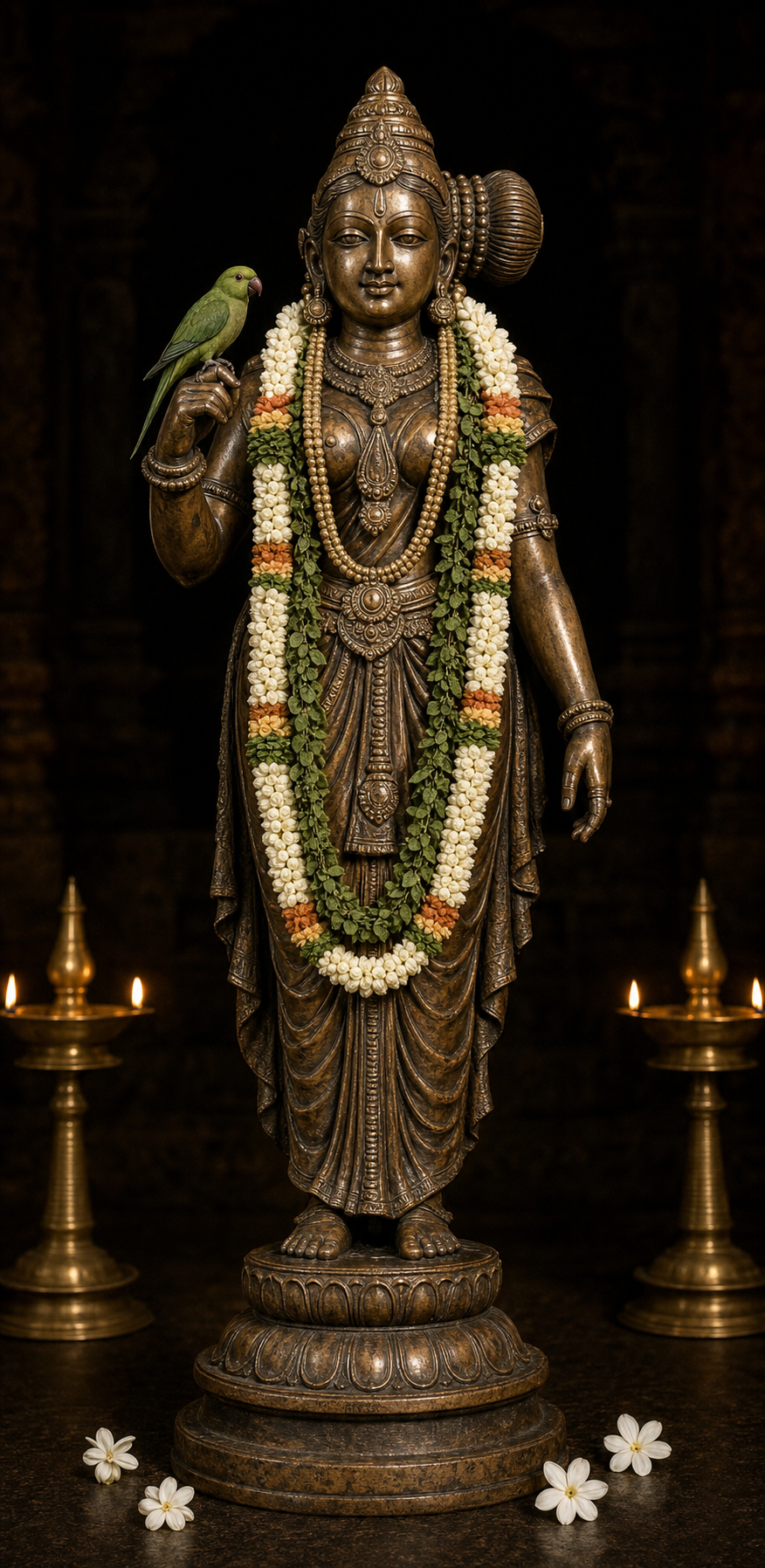
Andal darshan becomes more intelligible when you know what you are seeing. Her alankaram is not merely ornate decoration. It presents a theological identity through hair, flowers, ornaments, and bridal signs. Look for four recurring elements:
- The Andal Kondai: The distinctive side-bun immediately identifies Andal and conveys the grace and resolve of the poet-saint. During Aadi Pooram, flowers and jewels often emphasise this defining form.
- The parrot: The parrot can function as a messenger of love and wisdom. It belongs to an iconographic language in which longing communicates knowledge rather than mere sentiment.
- The garland: The garland recalls Soodik-kodutta Nachiyar and the movement from intimate devotion to accepted offering. It also links Srivilliputhur to a wider sacred network: Andal-associated garlands are ceremonially sent to Srirangam for Panguni Uttiram and to Tirumala-Tirupati for Garuda Seva during Brahmotsavam.
- Bridal ornaments and Thirukalyanam: Andal’s divine wedding with Sri Ranganatha represents the soul’s longing for union with the Divine. The bridal language is therefore neither a secular romance nor an ornamental tale added to the ritual; it carries the theology of surrender, or prapatti.
Listen as carefully as you look. Tiruppavai gives communities an accessible language of shared vow, awakening, praise, and approach to Narayana. Nachiyar Tirumozhi voices Andal’s vows, pleas, urgency, and bridal resolve more intensely. During recitation, do not let the Tamil hymns become background sound while you wait for the next alankaram. Follow the text if you can, attend to a translation if you are learning, and notice how the ritual moves in the language of the poetry.
This is also why the music and flowers matter. Nadasvaram and tavil, collective Prabandham chanting, jasmine and tulasi, kolam-lined thresholds, and the movement of the utsava murti create a form of embodied memory. The senses are disciplined toward darshan. Beauty serves remembrance; it is not separate from the spiritual work.
Andal and Ambal show unity without sameness
Aadi already carries a strong current of Divine Feminine worship, especially through Aadi Velli. In Amman temples, Valaikappu may include offering bangles to Ambal and sharing bangles and kumkum with women. Lamp pujas, homas, annadanam, and prayers for family and community welfare may accompany it.
Andal’s observance remains distinctly Sri Vaishnava, grounded in the Alvar canon and devotion to Sriman Narayana. Ambal worship remains rooted in its own Shaiva-Shakta forms. You honour dharmic plurality more faithfully by recognising both relationships than by claiming that every form is ritually identical. Shared values such as compassion, self-discipline, dana, reverence, and service can unite communities while each tradition keeps its own theological grammar.
Key takeaways for your Aadi Pooram observance
- Aadi Pooram and Andal Jayanti name the same Pooram-nakshatra celebration in the Sri Vaishnava tradition; Andal Thirunakshatram is another name you may see.
- The same calendar occasion can be dedicated to Ambal in an Amman temple. Respect the shared sacred season without combining distinct liturgies casually.
- In Tamil Nadu, the 2026 observance falls on Friday, 14 August. Check local Pooram timing if you live elsewhere or if your temple follows a particular panchang convention.
- A sound home practice needs only a clean altar, lamp, sankalpa, Andal recitation, flowers, one sattvic offering, arati, and an outward act of care.
- At a temple, verify the hours of Thirumanjanam, alankaram, Thirukalyanam, Prabandham recitation, and procession separately. They may not occur in one continuous block.
- Read the Kondai, parrot, garland, and bridal ornaments as theological signs. They point to bhakti as surrender and knowledge, not simply to pageantry.
- Do not confuse Aadi Pooram with Aadi Perukku or with Margazhi. They can share devotional themes while marking different calendrical and ritual occasions.
Your next step is simple: check the Pooram date and programme published for your location. Once that is fixed, choose one coherent path—a home Andal puja, a temple darshan plan, or service through prasada and annadanam—and prepare it before the festival day arrives.
References
- DharmaRenaissance Blog — Definitive Guide: Aadi Pooram 2026 at Srivilliputhur Andal Temple: History, Rituals, Travel
- DharmaRenaissance Blog — Aadi Pooram 2026 on August 14: Definitive Guide to Andal Jayanti, Rituals, and Temple Traditions
